Thank you for visiting SNEWPapers!
Sign up free
Editorial
June 27, 1955
Trainman News
Indianapolis, Marion County, Indiana
What is this article about?
Rep. Chet Holifield criticizes the Hoover Commission for exceeding its congressional mandate on government organization by delving into national policies like water resources and foreign affairs. He highlights its Republican bias, lack of open hearings, and limited member control, urging better-defined future commissions.
Clipping
OCR Quality
98%
Excellent
Full Text
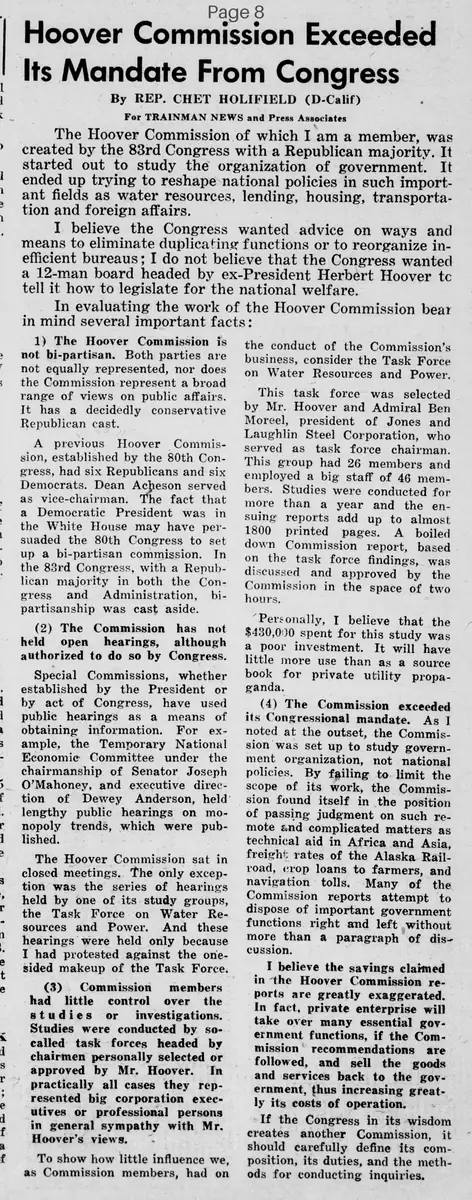
Hoover Commission Exceeded Its Mandate From Congress
By REP. CHET HOLIFIELD (D-Calif)
For TRAINMAN NEWS and Press Associates
The Hoover Commission of which I am a member, was created by the 83rd Congress with a Republican majority. It started out to study the organization of government. It ended up trying to reshape national policies in such important fields as water resources, lending, housing, transportation and foreign affairs.
I believe the Congress wanted advice on ways and means to eliminate duplicating functions or to reorganize inefficient bureaus; I do not believe that the Congress wanted a 12-man board headed by ex-President Herbert Hoover to tell it how to legislate for the national welfare.
In evaluating the work of the Hoover Commission bear in mind several important facts:
1 The Hoover Commission is not bi-partisan. Both parties are not equally represented, nor does the Commission represent a broad range of views on public affairs. It has a decidedly conservative Republican cast.
A previous Hoover Commission, established by the 80th Congress, had six Republicans and six Democrats. Dean Acheson served as vice-chairman. The fact that a Democratic President was in the White House may have persuaded the 80th Congress to set up a bi-partisan commission. In the 83rd Congress, with a Republican majority in both the Congress and Administration, bi-partisanship was cast aside.
(2) The Commission has not held open hearings, although authorized to do so by Congress.
Special Commissions, whether established by the President or by act of Congress, have used public hearings as a means of obtaining information. For example, the Temporary National Economic Committee under the chairmanship of Senator Joseph O'Mahoney. and executive direction of Dewey Anderson, held lengthy public hearings on monopoly trends, which were published.
The Hoover Commission sat in closed meetings. The only exception was the series of hearings held by one of its study groups, the Task Force on Water Resources and Power. And these hearings were held only because I had protested against the one-sided makeup of the Task Force.
(3) Commission members had little control over the studies or investigations.
Studies were conducted by so-called task forces headed by chairmen personally selected or approved by Mr. Hoover. In practically all cases they represented big corporation executives or professional persons in general sympathy with Mr. Hoover's views.
To show how little influence we, as Commission members, had on the conduct of the Commission's business, consider the Task Force on Water Resources and Power.
This task force was selected by Mr. Hoover and Admiral Ben Moreel, president of Jones and Laughlin Steel Corporation, who served as task force chairman.
This group had 26 members and employed a big staff of 46 members. . Studies were conducted for more than a year and the ensuing reports add up to almost 1800 printed pages. A boiled down n Commission report, based on the task force findings, was discussed and approved by the Commission in the space of two hours.
Personally, I believe that the $430,000 spent for this study was a poor investment. It will have little more use than as a source book for private utility propaganda.
(4) The Commission exceeded its Congressional mandate. As I noted at the outset. the Commission'was set up to study government organization, not national policies. By failing to limit the scope of its work, the Commission found itself in the position of passing judgment on such remote and complicated matters as technical aid in Africa and Asia, freight rates of the Alaska Railroad, crop loans to farmers, and navigation tolls. Many of the Commission reports attempt to dispose of important government functions right and left without more than a paragraph of discussion.
I believe the savings claimed in the Hoover Commission reports are greatly exaggerated.
In fact, private enterprise will take over many essential government functions, if the Commissionrecommendations are followed, and sell the goods and services back to the government, thus increasing greatly its costs of operation.
If the Congress in its wisdom creates another Commission, it should carefully define its composition, its duties, and the methods for conducting inquiries.
By REP. CHET HOLIFIELD (D-Calif)
For TRAINMAN NEWS and Press Associates
The Hoover Commission of which I am a member, was created by the 83rd Congress with a Republican majority. It started out to study the organization of government. It ended up trying to reshape national policies in such important fields as water resources, lending, housing, transportation and foreign affairs.
I believe the Congress wanted advice on ways and means to eliminate duplicating functions or to reorganize inefficient bureaus; I do not believe that the Congress wanted a 12-man board headed by ex-President Herbert Hoover to tell it how to legislate for the national welfare.
In evaluating the work of the Hoover Commission bear in mind several important facts:
1 The Hoover Commission is not bi-partisan. Both parties are not equally represented, nor does the Commission represent a broad range of views on public affairs. It has a decidedly conservative Republican cast.
A previous Hoover Commission, established by the 80th Congress, had six Republicans and six Democrats. Dean Acheson served as vice-chairman. The fact that a Democratic President was in the White House may have persuaded the 80th Congress to set up a bi-partisan commission. In the 83rd Congress, with a Republican majority in both the Congress and Administration, bi-partisanship was cast aside.
(2) The Commission has not held open hearings, although authorized to do so by Congress.
Special Commissions, whether established by the President or by act of Congress, have used public hearings as a means of obtaining information. For example, the Temporary National Economic Committee under the chairmanship of Senator Joseph O'Mahoney. and executive direction of Dewey Anderson, held lengthy public hearings on monopoly trends, which were published.
The Hoover Commission sat in closed meetings. The only exception was the series of hearings held by one of its study groups, the Task Force on Water Resources and Power. And these hearings were held only because I had protested against the one-sided makeup of the Task Force.
(3) Commission members had little control over the studies or investigations.
Studies were conducted by so-called task forces headed by chairmen personally selected or approved by Mr. Hoover. In practically all cases they represented big corporation executives or professional persons in general sympathy with Mr. Hoover's views.
To show how little influence we, as Commission members, had on the conduct of the Commission's business, consider the Task Force on Water Resources and Power.
This task force was selected by Mr. Hoover and Admiral Ben Moreel, president of Jones and Laughlin Steel Corporation, who served as task force chairman.
This group had 26 members and employed a big staff of 46 members. . Studies were conducted for more than a year and the ensuing reports add up to almost 1800 printed pages. A boiled down n Commission report, based on the task force findings, was discussed and approved by the Commission in the space of two hours.
Personally, I believe that the $430,000 spent for this study was a poor investment. It will have little more use than as a source book for private utility propaganda.
(4) The Commission exceeded its Congressional mandate. As I noted at the outset. the Commission'was set up to study government organization, not national policies. By failing to limit the scope of its work, the Commission found itself in the position of passing judgment on such remote and complicated matters as technical aid in Africa and Asia, freight rates of the Alaska Railroad, crop loans to farmers, and navigation tolls. Many of the Commission reports attempt to dispose of important government functions right and left without more than a paragraph of discussion.
I believe the savings claimed in the Hoover Commission reports are greatly exaggerated.
In fact, private enterprise will take over many essential government functions, if the Commissionrecommendations are followed, and sell the goods and services back to the government, thus increasing greatly its costs of operation.
If the Congress in its wisdom creates another Commission, it should carefully define its composition, its duties, and the methods for conducting inquiries.
What sub-type of article is it?
Partisan Politics
Economic Policy
Foreign Affairs
What keywords are associated?
Hoover Commission
Government Reorganization
Bipartisanship
Policy Overreach
Task Forces
Water Resources
Foreign Affairs
What entities or persons were involved?
Hoover Commission
Herbert Hoover
Chet Holifield
83rd Congress
Republican Party
Dean Acheson
Joseph O'mahoney
Dewey Anderson
Ben Moreel
Jones And Laughlin Steel Corporation
Editorial Details
Primary Topic
Criticism Of Hoover Commission's Overreach And Partisan Bias
Stance / Tone
Strongly Critical Of The Commission's Process, Bias, And Policy Intrusions
Key Figures
Hoover Commission
Herbert Hoover
Chet Holifield
83rd Congress
Republican Party
Dean Acheson
Joseph O'mahoney
Dewey Anderson
Ben Moreel
Jones And Laughlin Steel Corporation
Key Arguments
Commission Exceeded Mandate By Reshaping National Policies Beyond Organization
Not Bipartisan With Conservative Republican Dominance
Failed To Hold Open Hearings Despite Authorization
Members Had Little Control Over Task Force Studies
Task Force On Water Resources Wasted Resources On Biased Reports
Claimed Savings Are Exaggerated And Would Increase Costs Via Privatization
Future Commissions Need Defined Composition, Duties, And Methods