Thank you for visiting SNEWPapers!
Sign up free
Story
February 9, 1833
New Hampshire Statesman And State Journal
Concord, Merrimack County, New Hampshire
What is this article about?
In 1833 Boston court case, trader Richard Edwards sued shoe dealer John F. Pray for seducing his 30-year-old daughter Abigail, leading to her pregnancy and birth of a child. Evidence showed Pray's frequent visits and false marriage intentions. Jury awarded Edwards $2,200 damages.
Clipping
OCR Quality
95%
Excellent
Full Text
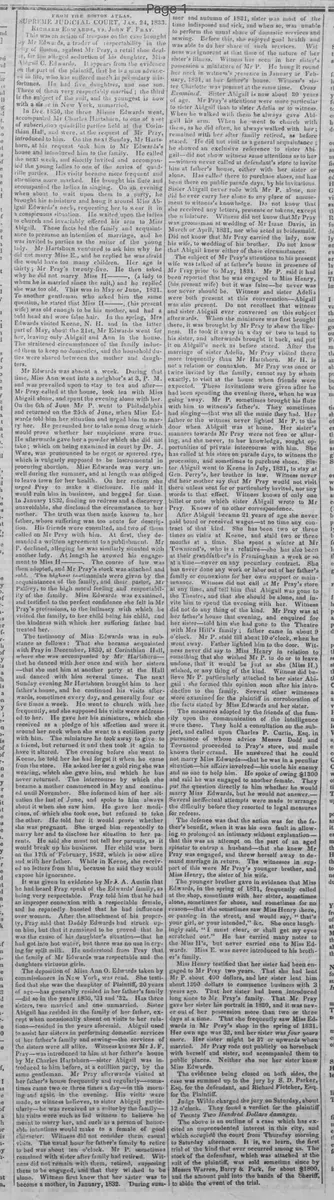
FROM BOSTON ATLAS.
SUPREME JUDICIAL COURT. JAN. 24, 1833
Richard Edwards, vs. John F. Pray.
This was an action of trespass on the case brought by Mr Edwards, a trader of respectability in the city of Boston, against Mr Pray, a retail shoe dealer, for the alleged seduction of his daughter, Miss Abigail C. Edwards. It appears from the evidence on the part of the plaintiff, that he is a man advanced in life, who has suffered much in pecuniary misfortunes. He had five daughters, and one son. Three of them very respectably married; the third is the subject of the suit, and the youngest is now with a sister in New York, unmarried.
In Dec. 1830, the three Misses Edwards went, accompanied by Mr Charles Hartshorn, to one of a set of subscription quadrille parties held at the Corinthian Hall, and were, at the request of Mr Pray, introduced to him. On the next Sunday, Mr Hartshorn, at his request took him to Mr Edwards's house and introduced him to the family. He called the next week, and shortly invited and accompanied the young ladies to one of the series of quadrille parties. His visits became more frequent and attentions more marked. He brought his flute and accompanied the ladies in singing. On an evening when about to wait upon them to a party, he brought his miniature and hung it around Miss Abigail Edwards's neck, requesting her to wear it in a conspicuous situation. He waited upon the ladies to church and invariably offered his arm to Miss Abigail. These facts led the family and acquaintance to presume an intention of marriage, and he was invited to parties as the suitor of the young lady. Mr Hartshorn ventured to ask him why he did not marry Miss E., and he replied he was afraid she would have too many children. Her age is thirty; Mr Pray's twenty-five. He then asked why he did not marry Miss H—, (a lady to whom he is married since the suit.) and he replied she was too old. This was in May or June, 1831.
To another gentleman who asked him the same question, he stated that Miss H—, (his present wife) was old enough to be his mother, and had a bald head and wore false hair. In the spring, Mrs Edwards visited Keene, N. H. and in the latter part of May, about the 21st, Mr Edwards went for her, leaving only Abigail and Ann in the house.
The straitened circumstances of the family induced them to keep no domestics, and the household duties were shared between the mother and daughters.
Mr Edwards was absent a week. During that time, Miss Ann went into a neighbor's at 3, P. M. and was prevailed upon to stay to tea and after— Mr Pray called at the house, took tea with Miss Abigail alone, and spent the evening alone with her.
On the 6th of June Mr P. went to Philadelphia and returned on the 25th of June, when Miss Edwards told him her situation and urged him to marry her. He persuaded her to take some drug which would prove whether her suspicions were true. He afterwards gave her a powder which she did not take; which on being examined in court by Dr. J. Ware, was pronounced to be ergot or spurred rye, which is vulgarly supposed to be instrumental in procuring abortion. Miss Edwards was very unwell during the summer, and at length was obliged to leave town for her health. On her return she urged Pray to make a disclosure. He said it would ruin him in business, and begged for time.
In January 1832, finding no redress and a discovery unavoidable, she disclosed the circumstance to her mother. The truth was then made known to her father, whose suffering was too acute for description. His friends were consulted, and two of them called on Mr Pray with him. At first, they demanded a written agreement to a publishment. Mr P. declined, alleging he was similarly situated with another lady. At length he avowed his engagement to Miss H
The course of law was then adopted, and Mr Pray's stock was attached and sold. The highest testimonials were given by the acquaintances of the family, and their pastor, Mr Palfrey, to the high moral feeling and respectability of the family. Miss Edwards was examined, and testified to the perfect confidence she felt in Mr Pray's professions, to the intimacy with which he visited the family, to her child being his child, and the kindness with which her suffering father had treated her.
The testimony of Miss Edwards was in substance as follows: That she became acquainted with Pray in December, 1830, at Corinthian Hall, where she was accompanied by Mr Hartshorn—that he danced with her once and with her sisters—that she met him at another party at the Hall and danced with him several times. The next Sunday evening Mr Hartshorn brought him to her father's house, and he continued his visits afterwards, sometimes every day, and generally four or five times a week. He went to church with her frequently, and she supposed his visits were addressed to her. He gave her his miniature, which she received as a pledge of his affection and wore it around her neck when she went to a cotillion party with him. The miniature he took away to give to a friend, but returned it and then took it again to have it altered. The evening before she went to Keene, he told her he had forgot it when he came from the store. He asked her for a gold ring she was wearing, which she gave him, and which he has never returned. The intercourse by which she became a mother commenced in May and continued until November. She informed him of her situation the last of June, and spoke to him always about it when she saw him. He gave her medicines, of which she took one, but refused to take the other. He told her it would prove whether she was pregnant. She urged him repeatedly to marry her and to disclose her situation to her parents. He said she must not tell her parents, as it would break up his business. Her child was born on the 17th of February, 1832, which is now alive and with her father. While in Keene, she received no letters from him, because he said they would expose his ignorance.
It was given in evidence by Mr J. A. Austin that he had heard Pray speak of the Edwards' family, as being very respectable. Pray told him that he had an improper connexion with a respectable female, and he repeatedly boasted that he had influence over women. After the attachment of his property, Pray said that Daddy Edwards had struck upon him, but that it remained to be proved that he was the cause of his daughter's situation—that he had got into hot water, but there was no use in crying for spilt milk. He understood from Pray that the family of Mr Edwards was respectable and the daughters virtuous girls.
The deposition of Miss Ann C. Edwards taken by commissioners in New York, was read. She testified that she was the daughter of Plaintiff, 20 years of age—has generally resided in her father's family—did so in the years 1830, '31 and '32. Has three sisters, two married and one unmarried. Sister Abigail has resided in the family of her father, except when occasionally absent on visits to her relations—resided in the years aforesaid. Abigail used to assist her sisters in performing domestic services of her father's family and sewing—the services of the sisters were all alike. Witness knows Mr J. F. Pray—was introduced to him at her father's house by Mr Charles Hartshorn—sister Abigail was introduced to him before, at a cotillion party, by the same gentleman. Mr Pray afterwards visited at her father's house frequently and regularly—sometimes came two or three times a day—in the morning and again in the evening. His visits were made, as witness believes, to sister Abigail particularly—he was received as a suitor by the family—his visits were such as led witness to believe he meant to marry her, and such as a person of honorable intentions would make to a female of good character. Witness did not consider them casual visits. The usual hour for father's family to retire to bed was about ten o'clock. Mr P. sometimes remained with sister after family had retired. Witness did not remain with them, retired, supposing them to be engaged, and that they wished to be alone. Witness first knew that her sister was to become a mother, in January, 1832. During summer and autumn of 1831, sister was most of the time indisposed and sick, and when so, was unable to perform the usual share of domestic services and sewing. Before this, she enjoyed good health and was able to do her share of such services. Witness was ignorant at that time of the nature of her sister's illness. Witness has seen in her sister's possession a miniature of Mr P. He hung it round her neck in witness's presence in January or February, 1831, at her father's house. Witness's sister Charlotte was present at the same time. Cross Examined. Sister Abigail is now about 30 years of age. Mr Pray's attentions were more particular to sister Abigail than to sister Adelia or to witness. When he walked with them he always gave Abigail his arm. When he went to church with them, as he did often, he always walked with her; remained with her after family retired, as before stated. He did not visit as a general acquaintance; he showed an exclusive reference to sister Abigail—did not show witness same attentions as to her—witness never called at defendant's store to invite him at father's house, either with her sister or alone. Has called there to purchase shoes, and has been there on public parade days, by his invitations. Sister Abigail never rode with Mr P. alone, nor did he ever carry her alone to any place of amusement to witness's knowledge. Do not know that she received any letters, presents or tokens, except the miniature. Witness did not know that Mr Pray was groomsman at wedding of Mr Isaac Davis, in March or April, 1831, nor who acted as bridesmaid. Did not know that Mr Pray carried the lady, now his wife, to wedding of his brother. Do not know that Abigail knew either of these circumstances.
The subject of Mr Pray's attentions to his present wife was talked of at father's house in presence of Mr Pray prior to May, 1831. Mr P. said it had been reported that he was engaged to Miss Henry, (his present wife) but it was false—he never was nor never should be. Witness and sister Adelia were both present at this conversation—Abigail was also present. Do not recollect that witness and sister Abigail ever conversed on this subject afterwards. When the miniature was first brought there, it was brought by Mr Pray to shew the likeness. He took it away in a day or two to lend to his sister, and afterwards brought it back, and put it on Abigail's neck as before stated. After the marriage of sister Adelia, Mr Pray visited there more frequently than Mr Hartshorn. Mr H. is not a relation or connexion. Mr Pray was once or twice invited by the family, cannot say by whom exactly, to visit at the house when friends were expected. These invitations were given after he had been spending the evening there, when he was going away. Mr P. sometimes brought his flute with him to witness's father's. They sometimes had singing—that was all the music they had. Her father or the witness never lighted Mr P. to the door when Abigail was at home. Her sister's manners towards Mr Pray were not free or alluring, and she never, to her knowledge, sought opportunities of private intercourse with him. She has called at his store on parade days, to witness the procession, and sometimes to purchase shoes. Sister Abigail went to Keene in July, 1831, to stay at Gen. Perry's, her brother in law. Witness never did hear mother say that Mr Pray would not visit there unless sent for or particularly invited, nor any words to that effect. Witness knows of only one billet or note which sister Abigail wrote to Mr Pray. Knows of no other correspondence.
After Abigail became 21 years of age she never paid board or received wages—at no time any contract of that kind. She has been two or three times on visits at Keene, and staid two or three months at a time. She spent a winter at Mr Townsend's, who is a relative—she has also been at their grandfather's in Framingham a week or so at a time—never on any pecuniary contract. She has never done any work or labor out of her father's family or connexions for her own support or maintenance. Witness did not call at Mr Pray's store at any time, and tell him that Abigail was gone to the Theatre, and that she should be alone, and invite him to spend the evening with her. Witness did not do any thing of the kind. Mr Pray was at her father's house that evening, and enquired for her sister—told him she had gone to the Theatre with Mrs Hill's family; father came in about 9 o'clock. Mr P. staid till about 10 o'clock, when he went away. Father lighted him to the door. Witness never did say to Miss Henry in relation to something that she wished Mr P. to do or to leave undone, that it would be just as she (Miss H.) wished, or any thing of the kind. Witness did believe Mr P. particularly attached to her sister Abigail: she formed this opinion soon after his introduction to the family. Several other witnesses were examined for the plaintiff in corroboration of the facts stated by Miss Edwards and her sister.
The measures adopted by the friends of the family upon the communication of the intelligence were these. They held a consultation on the subject, and called upon Charles P. Curtis, Esq. in pursuance of whose advice Messrs Dodd and Townsend proceeded to Pray's store, and made known their errand. He answered that he could not marry Miss Edwards—that he was in a peculiar situation—his affairs involved—his uncle his enemy and no one to help him. He spoke of owing $1300 and said he was engaged to another female. They put the question directly to him whether he would marry Miss Edwards, but he would not answer.—Several ineffectual attempts were made to arrange the difficulty before they resorted to legal measures for redress.
The defence was that the action was for the father's benefit, when it was his own fault in allowing so prolonged an intimacy without explanation—that this was an attempt on the part of an aged spinster to entrap a husband—that she knew Mr Pray was engaged, and threw herself away to demand marriage in return. The witnesses in support of this were Mr Pray's younger brother, and Miss Henry, the sister of his wife.
The younger brother gave in evidence that Miss Edwards, in the spring of 1831, frequently called at the shop, sometimes with her sister, sometimes alone, sometimes for shoes, and sometimes for no reason—that she sometimes saw Miss Henry there, or passing in the street, and would say, "that's your girl, or your intended," &c. She once laughingly said, "I must clear, or shall get my eyes scratched out." He has carried many notes to the Miss H's. but never carried one to Miss Edwards. Miss E. was never introduced to his brother's family.
Miss Henry testified that her sister had been engaged to Mr Pray two years. That she had lent Mr P. about $400, and her sister lent him about $1300 to commence business with 3 years ago. That her sister had been introduced long since to Mr Pray's family. That Mr Pray gave her sister his portrait in 1830, and it was never out of her possession more than two or three days at a time. That she frequently saw Miss Edwards in Mr Pray's shop in the spring of 1831. Her own age was 32, and her sister was four years more. Her sister might be 37 or upwards when married. Mr Pray rode out publicly on horseback with herself and sister, and accompanied them to public places. Neither she nor her sister knew Miss Edwards.
The evidence being closed on both sides, the case was summed up to the jury by S. D. Parker, Esq. for the defendant, and Richard Fletcher, Esq. for the Plaintiff.
Judge Wilde charged the jury on Saturday, about 12 o'clock. They found a verdict for the plaintiff of Twenty Two Hundred Dollars damages.
The above is an outline of a case which has excited an unprecedented interest in this city, and which occupied the court from Thursday morning to Saturday afternoon. It is, we learn, the first trial of the kind that ever occurred among us. The stock of the defendant, which was attached at the suit of the plaintiff, was sold sometime since by Messrs Warren, Barry & Park, for about $1800, and the amount paid into the hands of the Sheriff, to abide the event of the trial.
SUPREME JUDICIAL COURT. JAN. 24, 1833
Richard Edwards, vs. John F. Pray.
This was an action of trespass on the case brought by Mr Edwards, a trader of respectability in the city of Boston, against Mr Pray, a retail shoe dealer, for the alleged seduction of his daughter, Miss Abigail C. Edwards. It appears from the evidence on the part of the plaintiff, that he is a man advanced in life, who has suffered much in pecuniary misfortunes. He had five daughters, and one son. Three of them very respectably married; the third is the subject of the suit, and the youngest is now with a sister in New York, unmarried.
In Dec. 1830, the three Misses Edwards went, accompanied by Mr Charles Hartshorn, to one of a set of subscription quadrille parties held at the Corinthian Hall, and were, at the request of Mr Pray, introduced to him. On the next Sunday, Mr Hartshorn, at his request took him to Mr Edwards's house and introduced him to the family. He called the next week, and shortly invited and accompanied the young ladies to one of the series of quadrille parties. His visits became more frequent and attentions more marked. He brought his flute and accompanied the ladies in singing. On an evening when about to wait upon them to a party, he brought his miniature and hung it around Miss Abigail Edwards's neck, requesting her to wear it in a conspicuous situation. He waited upon the ladies to church and invariably offered his arm to Miss Abigail. These facts led the family and acquaintance to presume an intention of marriage, and he was invited to parties as the suitor of the young lady. Mr Hartshorn ventured to ask him why he did not marry Miss E., and he replied he was afraid she would have too many children. Her age is thirty; Mr Pray's twenty-five. He then asked why he did not marry Miss H—, (a lady to whom he is married since the suit.) and he replied she was too old. This was in May or June, 1831.
To another gentleman who asked him the same question, he stated that Miss H—, (his present wife) was old enough to be his mother, and had a bald head and wore false hair. In the spring, Mrs Edwards visited Keene, N. H. and in the latter part of May, about the 21st, Mr Edwards went for her, leaving only Abigail and Ann in the house.
The straitened circumstances of the family induced them to keep no domestics, and the household duties were shared between the mother and daughters.
Mr Edwards was absent a week. During that time, Miss Ann went into a neighbor's at 3, P. M. and was prevailed upon to stay to tea and after— Mr Pray called at the house, took tea with Miss Abigail alone, and spent the evening alone with her.
On the 6th of June Mr P. went to Philadelphia and returned on the 25th of June, when Miss Edwards told him her situation and urged him to marry her. He persuaded her to take some drug which would prove whether her suspicions were true. He afterwards gave her a powder which she did not take; which on being examined in court by Dr. J. Ware, was pronounced to be ergot or spurred rye, which is vulgarly supposed to be instrumental in procuring abortion. Miss Edwards was very unwell during the summer, and at length was obliged to leave town for her health. On her return she urged Pray to make a disclosure. He said it would ruin him in business, and begged for time.
In January 1832, finding no redress and a discovery unavoidable, she disclosed the circumstance to her mother. The truth was then made known to her father, whose suffering was too acute for description. His friends were consulted, and two of them called on Mr Pray with him. At first, they demanded a written agreement to a publishment. Mr P. declined, alleging he was similarly situated with another lady. At length he avowed his engagement to Miss H
The course of law was then adopted, and Mr Pray's stock was attached and sold. The highest testimonials were given by the acquaintances of the family, and their pastor, Mr Palfrey, to the high moral feeling and respectability of the family. Miss Edwards was examined, and testified to the perfect confidence she felt in Mr Pray's professions, to the intimacy with which he visited the family, to her child being his child, and the kindness with which her suffering father had treated her.
The testimony of Miss Edwards was in substance as follows: That she became acquainted with Pray in December, 1830, at Corinthian Hall, where she was accompanied by Mr Hartshorn—that he danced with her once and with her sisters—that she met him at another party at the Hall and danced with him several times. The next Sunday evening Mr Hartshorn brought him to her father's house, and he continued his visits afterwards, sometimes every day, and generally four or five times a week. He went to church with her frequently, and she supposed his visits were addressed to her. He gave her his miniature, which she received as a pledge of his affection and wore it around her neck when she went to a cotillion party with him. The miniature he took away to give to a friend, but returned it and then took it again to have it altered. The evening before she went to Keene, he told her he had forgot it when he came from the store. He asked her for a gold ring she was wearing, which she gave him, and which he has never returned. The intercourse by which she became a mother commenced in May and continued until November. She informed him of her situation the last of June, and spoke to him always about it when she saw him. He gave her medicines, of which she took one, but refused to take the other. He told her it would prove whether she was pregnant. She urged him repeatedly to marry her and to disclose her situation to her parents. He said she must not tell her parents, as it would break up his business. Her child was born on the 17th of February, 1832, which is now alive and with her father. While in Keene, she received no letters from him, because he said they would expose his ignorance.
It was given in evidence by Mr J. A. Austin that he had heard Pray speak of the Edwards' family, as being very respectable. Pray told him that he had an improper connexion with a respectable female, and he repeatedly boasted that he had influence over women. After the attachment of his property, Pray said that Daddy Edwards had struck upon him, but that it remained to be proved that he was the cause of his daughter's situation—that he had got into hot water, but there was no use in crying for spilt milk. He understood from Pray that the family of Mr Edwards was respectable and the daughters virtuous girls.
The deposition of Miss Ann C. Edwards taken by commissioners in New York, was read. She testified that she was the daughter of Plaintiff, 20 years of age—has generally resided in her father's family—did so in the years 1830, '31 and '32. Has three sisters, two married and one unmarried. Sister Abigail has resided in the family of her father, except when occasionally absent on visits to her relations—resided in the years aforesaid. Abigail used to assist her sisters in performing domestic services of her father's family and sewing—the services of the sisters were all alike. Witness knows Mr J. F. Pray—was introduced to him at her father's house by Mr Charles Hartshorn—sister Abigail was introduced to him before, at a cotillion party, by the same gentleman. Mr Pray afterwards visited at her father's house frequently and regularly—sometimes came two or three times a day—in the morning and again in the evening. His visits were made, as witness believes, to sister Abigail particularly—he was received as a suitor by the family—his visits were such as led witness to believe he meant to marry her, and such as a person of honorable intentions would make to a female of good character. Witness did not consider them casual visits. The usual hour for father's family to retire to bed was about ten o'clock. Mr P. sometimes remained with sister after family had retired. Witness did not remain with them, retired, supposing them to be engaged, and that they wished to be alone. Witness first knew that her sister was to become a mother, in January, 1832. During summer and autumn of 1831, sister was most of the time indisposed and sick, and when so, was unable to perform the usual share of domestic services and sewing. Before this, she enjoyed good health and was able to do her share of such services. Witness was ignorant at that time of the nature of her sister's illness. Witness has seen in her sister's possession a miniature of Mr P. He hung it round her neck in witness's presence in January or February, 1831, at her father's house. Witness's sister Charlotte was present at the same time. Cross Examined. Sister Abigail is now about 30 years of age. Mr Pray's attentions were more particular to sister Abigail than to sister Adelia or to witness. When he walked with them he always gave Abigail his arm. When he went to church with them, as he did often, he always walked with her; remained with her after family retired, as before stated. He did not visit as a general acquaintance; he showed an exclusive reference to sister Abigail—did not show witness same attentions as to her—witness never called at defendant's store to invite him at father's house, either with her sister or alone. Has called there to purchase shoes, and has been there on public parade days, by his invitations. Sister Abigail never rode with Mr P. alone, nor did he ever carry her alone to any place of amusement to witness's knowledge. Do not know that she received any letters, presents or tokens, except the miniature. Witness did not know that Mr Pray was groomsman at wedding of Mr Isaac Davis, in March or April, 1831, nor who acted as bridesmaid. Did not know that Mr Pray carried the lady, now his wife, to wedding of his brother. Do not know that Abigail knew either of these circumstances.
The subject of Mr Pray's attentions to his present wife was talked of at father's house in presence of Mr Pray prior to May, 1831. Mr P. said it had been reported that he was engaged to Miss Henry, (his present wife) but it was false—he never was nor never should be. Witness and sister Adelia were both present at this conversation—Abigail was also present. Do not recollect that witness and sister Abigail ever conversed on this subject afterwards. When the miniature was first brought there, it was brought by Mr Pray to shew the likeness. He took it away in a day or two to lend to his sister, and afterwards brought it back, and put it on Abigail's neck as before stated. After the marriage of sister Adelia, Mr Pray visited there more frequently than Mr Hartshorn. Mr H. is not a relation or connexion. Mr Pray was once or twice invited by the family, cannot say by whom exactly, to visit at the house when friends were expected. These invitations were given after he had been spending the evening there, when he was going away. Mr P. sometimes brought his flute with him to witness's father's. They sometimes had singing—that was all the music they had. Her father or the witness never lighted Mr P. to the door when Abigail was at home. Her sister's manners towards Mr Pray were not free or alluring, and she never, to her knowledge, sought opportunities of private intercourse with him. She has called at his store on parade days, to witness the procession, and sometimes to purchase shoes. Sister Abigail went to Keene in July, 1831, to stay at Gen. Perry's, her brother in law. Witness never did hear mother say that Mr Pray would not visit there unless sent for or particularly invited, nor any words to that effect. Witness knows of only one billet or note which sister Abigail wrote to Mr Pray. Knows of no other correspondence.
After Abigail became 21 years of age she never paid board or received wages—at no time any contract of that kind. She has been two or three times on visits at Keene, and staid two or three months at a time. She spent a winter at Mr Townsend's, who is a relative—she has also been at their grandfather's in Framingham a week or so at a time—never on any pecuniary contract. She has never done any work or labor out of her father's family or connexions for her own support or maintenance. Witness did not call at Mr Pray's store at any time, and tell him that Abigail was gone to the Theatre, and that she should be alone, and invite him to spend the evening with her. Witness did not do any thing of the kind. Mr Pray was at her father's house that evening, and enquired for her sister—told him she had gone to the Theatre with Mrs Hill's family; father came in about 9 o'clock. Mr P. staid till about 10 o'clock, when he went away. Father lighted him to the door. Witness never did say to Miss Henry in relation to something that she wished Mr P. to do or to leave undone, that it would be just as she (Miss H.) wished, or any thing of the kind. Witness did believe Mr P. particularly attached to her sister Abigail: she formed this opinion soon after his introduction to the family. Several other witnesses were examined for the plaintiff in corroboration of the facts stated by Miss Edwards and her sister.
The measures adopted by the friends of the family upon the communication of the intelligence were these. They held a consultation on the subject, and called upon Charles P. Curtis, Esq. in pursuance of whose advice Messrs Dodd and Townsend proceeded to Pray's store, and made known their errand. He answered that he could not marry Miss Edwards—that he was in a peculiar situation—his affairs involved—his uncle his enemy and no one to help him. He spoke of owing $1300 and said he was engaged to another female. They put the question directly to him whether he would marry Miss Edwards, but he would not answer.—Several ineffectual attempts were made to arrange the difficulty before they resorted to legal measures for redress.
The defence was that the action was for the father's benefit, when it was his own fault in allowing so prolonged an intimacy without explanation—that this was an attempt on the part of an aged spinster to entrap a husband—that she knew Mr Pray was engaged, and threw herself away to demand marriage in return. The witnesses in support of this were Mr Pray's younger brother, and Miss Henry, the sister of his wife.
The younger brother gave in evidence that Miss Edwards, in the spring of 1831, frequently called at the shop, sometimes with her sister, sometimes alone, sometimes for shoes, and sometimes for no reason—that she sometimes saw Miss Henry there, or passing in the street, and would say, "that's your girl, or your intended," &c. She once laughingly said, "I must clear, or shall get my eyes scratched out." He has carried many notes to the Miss H's. but never carried one to Miss Edwards. Miss E. was never introduced to his brother's family.
Miss Henry testified that her sister had been engaged to Mr Pray two years. That she had lent Mr P. about $400, and her sister lent him about $1300 to commence business with 3 years ago. That her sister had been introduced long since to Mr Pray's family. That Mr Pray gave her sister his portrait in 1830, and it was never out of her possession more than two or three days at a time. That she frequently saw Miss Edwards in Mr Pray's shop in the spring of 1831. Her own age was 32, and her sister was four years more. Her sister might be 37 or upwards when married. Mr Pray rode out publicly on horseback with herself and sister, and accompanied them to public places. Neither she nor her sister knew Miss Edwards.
The evidence being closed on both sides, the case was summed up to the jury by S. D. Parker, Esq. for the defendant, and Richard Fletcher, Esq. for the Plaintiff.
Judge Wilde charged the jury on Saturday, about 12 o'clock. They found a verdict for the plaintiff of Twenty Two Hundred Dollars damages.
The above is an outline of a case which has excited an unprecedented interest in this city, and which occupied the court from Thursday morning to Saturday afternoon. It is, we learn, the first trial of the kind that ever occurred among us. The stock of the defendant, which was attached at the suit of the plaintiff, was sold sometime since by Messrs Warren, Barry & Park, for about $1800, and the amount paid into the hands of the Sheriff, to abide the event of the trial.
What sub-type of article is it?
Crime Story
Family Drama
Historical Event
What themes does it cover?
Deception
Justice
Family
What keywords are associated?
Seduction Trial
Court Case
Deceptive Courtship
Pregnancy
Damages Award
Boston Judiciary
What entities or persons were involved?
Richard Edwards
John F. Pray
Abigail C. Edwards
Ann C. Edwards
Charles Hartshorn
Where did it happen?
Boston
Story Details
Key Persons
Richard Edwards
John F. Pray
Abigail C. Edwards
Ann C. Edwards
Charles Hartshorn
Location
Boston
Event Date
1833 01 24
Story Details
Richard Edwards sued John F. Pray for seducing his daughter Abigail, who became pregnant after Pray's deceptive courtship. Pray denied marriage intentions, was already engaged to another, and attempted to induce abortion. Jury awarded $2200 damages in first such trial in Boston.