Thank you for visiting SNEWPapers!
Sign up free
Story
January 9, 1833
The Arkansas Advocate
Little Rock, Pulaski County, Arkansas
What is this article about?
Trial of an iron steam vessel in London for towing on the Ganges. It demonstrated low draught, responsive helm, quick machinery response, and speeds of 8:21 against tide and 5:47 with tide per mile. Collision showed durability; proposed for Atlantic voyage to India intact.
Clipping
OCR Quality
98%
Excellent
Full Text
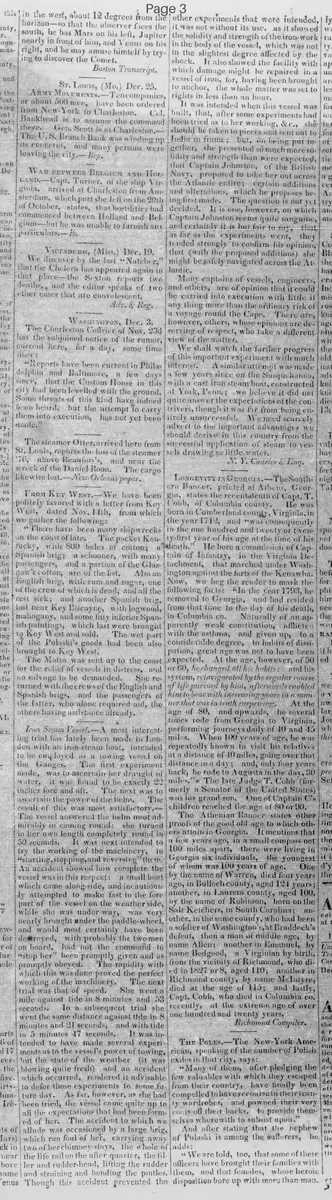
Iron Steam Vessel.—A most interesting trial has lately been made in London with an iron steam boat, intended to be employed as a towing vessel on the Ganges. The first experiment made, was to ascertain her draught of water, it was found to be exactly 22 inches fore and aft. The next was to ascertain the power of the helm. The result of this was most satisfactory.—The vessel answered the helm most admirably in coming round: she turned in her own length completely round in 50 seconds. It was next intended to try the working of the machinery, in "starting, stopping, and reversing" them. An accident showed how complete the vessel was in this respect: a small boat which came along-side, and incautiously attempted to make fast to the fore part of the vessel on the weather side, while she was under way, was very nearly brought under the paddle-wheel, and would most certainly have been destroyed, with probably the two men on board, had not the command to "stop her" been promptly given and as promptly obeyed. The rapidity with which this was done proved the perfect working of the machinery. The next trial was that of speed. She went a mile against tide in 8 minutes and 53 seconds. In a subsequent trial she went the same distance against tide in 8 minutes and 21 seconds, and with tide in 5 minutes 47 seconds. It was intended to have made several experiments as to the vessel's power of towing, but the state of the weather (it was blowing quite fresh) and an accident which occurred, rendered it advisable to defer those experiments to some future day. As far, however, as she had been tried, the vessel came quite up to all the expectations that had been formed of her. The accident to which we allude was occasioned by a large brig, which run foul of her, carrying away two of her chimney-stays, the whole of the life rail on the after quarter, the tiller and rudder-head, lifting the rudder and straining and bending the pintles. Though this accident prevented the other experiments that were intended, it was not without its use, as it showed the solidity and strength of the iron-work in the body of the vessel, which was not in the slightest degree affected by the shock. It also showed the facility with which damage might be repaired in a vessel of iron, for, having been brought to anchor, the whole matter was set to rights in less than an hour.
It was intended when this vessel was built, that, after some experiments had been tried as to her working, &c., she should be taken to pieces and sent out to India in frame; but, on being put together, she presented so much more solidity and strength than were expected, that Captain Johnston, of the British Navy, proposed to take her out across the Atlantic entire; certain additions and alterations, which he proposes being first made. The question is not yet decided. It is one, however, on which Captain Johnston seems quite sanguine, and certainly it is but fair to say,—that as far as the experiments went, they tended strongly to confirm his opinion, that (with the proposed additions) she might be safely navigated across the Atlantic.
Many captains of vessels, engineers, and others, are of opinion that it could be carried into execution with little if any thing more than the ordinary risk of a voyage round the Cape. There are, however, others, whose opinions are deserving of respect, who take a different view of the matter.
We shall watch the further progress of this important experiment with much interest. A similar attempt was made a few years since on the Susquehanna, with a cast iron steam boat, constructed at York, Penn.; we believe it did not quite answer the expectations of the contrivers, though it was far from being entirely unsuccessful. We need scarcely advert to the important advantages we should derive in this country from the successful application of steam to vessels drawing so little water.
It was intended when this vessel was built, that, after some experiments had been tried as to her working, &c., she should be taken to pieces and sent out to India in frame; but, on being put together, she presented so much more solidity and strength than were expected, that Captain Johnston, of the British Navy, proposed to take her out across the Atlantic entire; certain additions and alterations, which he proposes being first made. The question is not yet decided. It is one, however, on which Captain Johnston seems quite sanguine, and certainly it is but fair to say,—that as far as the experiments went, they tended strongly to confirm his opinion, that (with the proposed additions) she might be safely navigated across the Atlantic.
Many captains of vessels, engineers, and others, are of opinion that it could be carried into execution with little if any thing more than the ordinary risk of a voyage round the Cape. There are, however, others, whose opinions are deserving of respect, who take a different view of the matter.
We shall watch the further progress of this important experiment with much interest. A similar attempt was made a few years since on the Susquehanna, with a cast iron steam boat, constructed at York, Penn.; we believe it did not quite answer the expectations of the contrivers, though it was far from being entirely unsuccessful. We need scarcely advert to the important advantages we should derive in this country from the successful application of steam to vessels drawing so little water.
What sub-type of article is it?
Curiosity
Historical Event
What themes does it cover?
Triumph
Exploration
What keywords are associated?
Iron Steam Vessel
Trial
London
Ganges Towing
Atlantic Crossing
Captain Johnston
Machinery Test
Collision Damage
What entities or persons were involved?
Captain Johnston
Where did it happen?
London
Story Details
Key Persons
Captain Johnston
Location
London
Event Date
Lately
Story Details
Trial of iron steam vessel in London showed low draught of 22 inches, quick turning in 50 seconds, rapid machinery response preventing accident, speeds of 8:21 against tide and 5:47 with tide per mile. Collision demonstrated durability and easy repairs. Proposed for intact Atlantic voyage to India by Captain Johnston.