Thank you for visiting SNEWPapers!
Sign up free
Story
July 20, 1881
The Florida Agriculturist
Jacksonville, De Land, Duval County, Volusia County, Florida
What is this article about?
Fanny Fields offers practical advice from Prairie Farmer on raising Guinea chicks, emphasizing frequent feeding to prevent sudden death, suitable housing, ranging, taming for market, and on-site rearing for success.
Clipping
OCR Quality
98%
Excellent
Full Text
JULY 20.
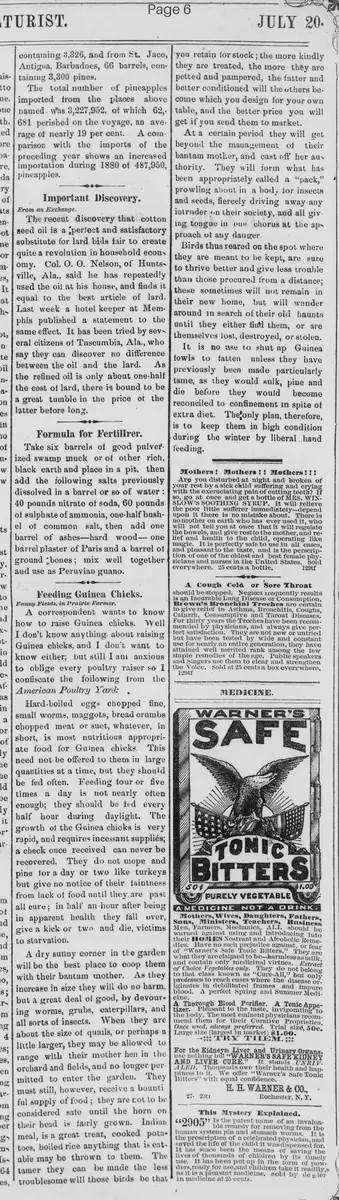
Feeding Guinea Chicks.
Fanny Fields, in Prairie Farmer.
A correspondent wants to know how to raise Guinea chicks. Well I don't know anything about raising Guinea chicks, and I don't want to know either; but still I am anxious to oblige every poultry raiser so I confiscate the following from the American Poultry Yard:
Hard-boiled eggs chopped fine, small worms, maggots, bread crumbs chopped meat or suet, whatever, in short, is most nutritious appropriate food for Guinea chicks. This need not be offered to them in large quantities at a time, but they should be fed often. Feeding four or five times a day is not nearly often enough; they should be fed every half hour during daylight. The growth of the Guinea chicks is very rapid, and requires incessant supplies; a check once received can never be recovered. They do not mope and pine for a day or two like turkeys but give no notice of their faintness from lack of food until they are past all cure; in half an hour after being in apparent health they fall over, give a kick or two and die, victims to starvation.
A dry sunny corner in the garden will be the best place to coop them with their bantam mother. As they increase in size they will do no harm, but a great deal of good, by devouring worms, grubs, caterpillars, and all sorts of insects. When they are about the size of quails, or perhaps a little larger, they may be allowed to range with their mother hen in the orchard and fields, and no longer permitted to enter the garden. They must still, however, receive a bountiful supply of food; they are not to be considered safe until the horn on their head is fairly grown. Indian meal, is a great treat, cooked potatoes, boiled rice anything that is eatable may be thrown to them. The tamer they can be made the less troublesome will those birds be that you retain for stock; the more kindly they are treated, the more they are petted and pampered, the fatter and better conditioned will the others become which you design for your own table, and the better price you will get if you send them to market.
At a certain period they will get beyond the management of their bantam mother, and cast off her authority. They will form what has been appropriately called a "pack," prowling about in a body, for insects and seeds, fiercely driving away any intruder on their society, and all giving tongue in one chorus at the approach of any danger.
Birds thus reared on the spot where they are meant to be kept, are sure to thrive better and give less trouble than those procured from a distance; these sometimes will not remain in their new home, but will wander around in search of their old haunts until they either find them, or are themselves lost, destroyed, or stolen.
It is no use to shut up Guinea fowls to fatten unless they have previously been made particularly tame, as they would sulk, pine and die before they would become reconciled to confinement in spite of extra diet. The only plan, therefore, is to keep them in high condition during the winter by liberal hand feeding.
Feeding Guinea Chicks.
Fanny Fields, in Prairie Farmer.
A correspondent wants to know how to raise Guinea chicks. Well I don't know anything about raising Guinea chicks, and I don't want to know either; but still I am anxious to oblige every poultry raiser so I confiscate the following from the American Poultry Yard:
Hard-boiled eggs chopped fine, small worms, maggots, bread crumbs chopped meat or suet, whatever, in short, is most nutritious appropriate food for Guinea chicks. This need not be offered to them in large quantities at a time, but they should be fed often. Feeding four or five times a day is not nearly often enough; they should be fed every half hour during daylight. The growth of the Guinea chicks is very rapid, and requires incessant supplies; a check once received can never be recovered. They do not mope and pine for a day or two like turkeys but give no notice of their faintness from lack of food until they are past all cure; in half an hour after being in apparent health they fall over, give a kick or two and die, victims to starvation.
A dry sunny corner in the garden will be the best place to coop them with their bantam mother. As they increase in size they will do no harm, but a great deal of good, by devouring worms, grubs, caterpillars, and all sorts of insects. When they are about the size of quails, or perhaps a little larger, they may be allowed to range with their mother hen in the orchard and fields, and no longer permitted to enter the garden. They must still, however, receive a bountiful supply of food; they are not to be considered safe until the horn on their head is fairly grown. Indian meal, is a great treat, cooked potatoes, boiled rice anything that is eatable may be thrown to them. The tamer they can be made the less troublesome will those birds be that you retain for stock; the more kindly they are treated, the more they are petted and pampered, the fatter and better conditioned will the others become which you design for your own table, and the better price you will get if you send them to market.
At a certain period they will get beyond the management of their bantam mother, and cast off her authority. They will form what has been appropriately called a "pack," prowling about in a body, for insects and seeds, fiercely driving away any intruder on their society, and all giving tongue in one chorus at the approach of any danger.
Birds thus reared on the spot where they are meant to be kept, are sure to thrive better and give less trouble than those procured from a distance; these sometimes will not remain in their new home, but will wander around in search of their old haunts until they either find them, or are themselves lost, destroyed, or stolen.
It is no use to shut up Guinea fowls to fatten unless they have previously been made particularly tame, as they would sulk, pine and die before they would become reconciled to confinement in spite of extra diet. The only plan, therefore, is to keep them in high condition during the winter by liberal hand feeding.
What sub-type of article is it?
Animal Story
Curiosity
What themes does it cover?
Survival
Nature
What keywords are associated?
Guinea Chicks
Poultry Raising
Feeding Schedule
Taming Birds
Animal Husbandry
What entities or persons were involved?
Fanny Fields
Where did it happen?
Garden, Orchard, Fields
Story Details
Key Persons
Fanny Fields
Location
Garden, Orchard, Fields
Event Date
July 20
Story Details
Advice on raising Guinea chicks: feed frequently with nutritious foods like hard-boiled eggs, worms, and bread crumbs every half hour; house in dry sunny garden corner with bantam mother; allow ranging when larger; tame them for better condition; they form packs later; rear on-site for better results; cannot fatten in confinement unless tame.