Thank you for visiting SNEWPapers!
Sign up free
Hot Springs Weekly Star
Hot Springs, Fall River County, South Dakota
What is this article about?
Amid rising tensions with Spain over Cuba and the USS Maine disaster, the US Congress appropriates $50 million for national defense. Administration shifts to war preparations, with President McKinley and officials united in readiness, viewing hostilities as inevitable unless Spain relents.
Merged-components note: Main article on impending war with Spain, including illustrations with spatial overlap.
Clipping
OCR Quality
Full Text
MILLIONS FOR DEFENSE
Congress Makes Appropriation of $50,000,000 for Emergency.
UNITED STATES IS READY.
Spirit of Patriotism Is Universal Among American People.
The Administration and All Officials at the National Capital Realize that the Country Is Facing a Crisis—Conditions Deemed Such that Hostilities Seem Inevitable—Spaniards Have Sought to Cause a Clash and Must Take the Bitter Consequences—No Honorable Recourse Save the Arbitrament of Arms Appears Open.
Washington correspondence:
There is a general feeling at the capital that we are face to face with a crisis. The bill to appropriate $50,000,000 for the national defense is evidence that the administration has recognized this in its preparations for an emergency. Joseph G. Cannon of Illinois, chairman of the House Committee on Appropriations, Monday introduced the bill appropriating $50,000,000 for national defense. This bill is as follows:
"Be it enacted by the Senate and House of Representatives of the United States in Congress assembled: That there is hereby appropriated, out of any money in the treasury not otherwise appropriated, for the national defense and for each and every purpose connected therewith, to be expended at the discretion of the President, and to remain available until June 30, 1899, $50,000,000."
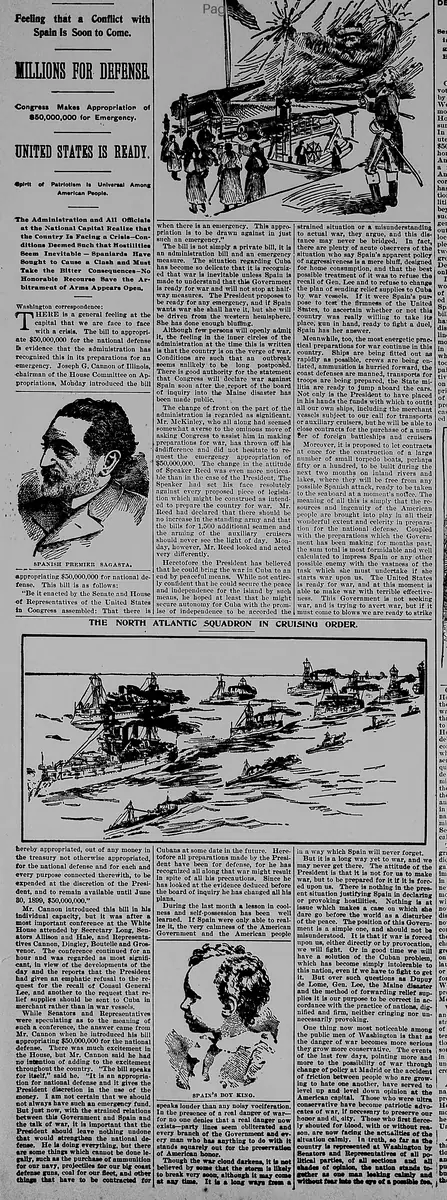
SPANISH PREMIER SAGASTA.
Mr. Cannon introduced this bill in his individual capacity, but it was after a most important conference at the White House attended by Secretary Long, Senators Allison and Hale, and Representatives Cannon, Dingley, Boutelle and Grosvenor. The conference continued for an hour and was regarded as most significant, in view of the developments of the day and the reports that the President had given an emphatic refusal to the request for the recall of Consul General Lee, and another to the request that relief supplies should be sent to Cuba in merchant rather than in war vessels.
While Senators and Representatives were speculating as to the meaning of such a conference, the answer came from Mr. Cannon when he introduced his bill appropriating $50,000,000 for the national defense. There was much excitement in the House, but Mr. Cannon said he had no intention of adding to the excitement throughout the country. "The bill speaks for itself," said he. "It is an appropriation for national defense and it gives the President discretion in the use of the money. I am not certain that we should not always have such an emergency fund. But just now, with the strained relations between this Government and Spain and the talk of war, it is important that the President should leave nothing undone that would strengthen the national defense. He is doing everything, but there are some things which cannot be done legally, such as the purchase of ammunition for our navy, projectiles for our big coast defense guns, coal for our fleet, and other things that have to be contracted for."
The bill is not simply a private bill, it is an administration bill and an emergency measure. The situation regarding Cuba has become so delicate that it is recognized that war is inevitable unless Spain is made to understand that this Government is ready for war and will not stop at half-way measures. The President proposes to be ready for any emergency, and if Spain wants war she shall have it, but she will be driven from the western hemisphere. She has done enough bluffing.
Although few persons will openly admit it, the feeling in the inner circles of the administration at the time this is written is that the country is on the verge of war. Conditions are such that an outbreak seems unlikely to be long postponed. There is good authority for the statement that Congress will declare war against Spain soon after the report of the board of inquiry into the Maine disaster has been made public.
The change of front on the part of the administration is regarded as significant. Mr. McKinley, who all along had seemed somewhat averse to the ominous move of asking Congress to assist him in making preparations for war, has thrown off his indifference and did not hesitate to request the emergency appropriation of $50,000,000. The change in the attitude of Speaker Reed was even more noticeable than in the case of the President. The Speaker had set his face resolutely against every proposed piece of legislation which might be construed as intended to prepare the country for war. Mr. Reed had declared that there should be no increase in the standing army and that the bills for 1,500 additional seamen and the arming of the auxiliary cruisers should never see the light of day. Monday, however, Mr. Reed looked and acted very differently.
Heretofore the President has believed that he could bring the war in Cuba to an end by peaceful means. While not entirely confident that he could secure the peace and independence for the island by such means, he hoped at least that he might secure autonomy for Cuba with the promise of independence to be accorded the Cubans at some date in the future. Heretofore all preparations made by the President have been for defense, for he has recognized all along that war might result in spite of all his precautions. Since he has looked at the evidence deduced before the board of inquiry he has changed all his plans.
During the last month a lesson in coolness and self-possession has been well learned. If Spain were only able to realize it, the very calmness of the American Government and the American people speaks louder than any noisy vociferation. In the presence of a real danger of war—for no one denies that a real danger now exists—party lines seem obliterated and every branch of the Government and every man who has anything to do with it stands squarely out for the preservation of American honor.
Though the war cloud darkens, it is not believed by some that the storm is likely to break very soon, although it may come at any time. It is a long ways from a strained situation or a misunderstanding to actual war, they argue, and this distance may never be bridged. In fact, there are plenty of acute observers of the situation who say Spain's apparent policy of aggressiveness is a mere bluff, designed for home consumption, and that the best possible treatment of it was to refuse the recall of Gen. Lee and to refuse to change the plan of sending relief supplies to Cuba by war vessels. If it were Spain's purpose to test the firmness of the United States, to ascertain whether or not this country was really willing to take its place, gun in hand, ready to fight a duel, Spain has her answer.
Meanwhile, too, the most energetic practical preparations for war continue in this country. Ships are being fitted out as rapidly as possible, crews are being enlisted, ammunition is hurried forward, the coast defenses are manned, transports for troops are being prepared, the State militia are ready to jump aboard the cars. Not only is the President to have placed in his hands the funds with which to outfit all our own ships, including the merchant vessels subject to our call for transports or auxiliary cruisers, but he will be able to close contracts for the purchase of a number of foreign battleships and cruisers. Moreover, it is proposed to let contracts at once for the construction of a large number of small torpedo boats, perhaps fifty or a hundred, to be built during the next two months on inland rivers and lakes, where they will be free from any possible Spanish attack, ready to be taken to the seaboard at a moment's notice. The meaning of all this is simply that the resources and ingenuity of the American people are brought into play in all their wonderful extent and celerity in preparation for the national defense. Coupled with the preparations which the Government has been making for months past, the sum total is most formidable and well calculated to impress Spain or any other possible enemy with the vastness of the task which she must undertake if she starts war upon us. The United States is ready for war, and at this moment is able to make war with terrible effectiveness. This Government is not seeking war, and is trying to avert war, but if it must come to blows we are ready to strike in a way which Spain will never forget.
But it is a long way yet to war, and we may never get there. The attitude of the President is that it is not for us to make war, but to be prepared for it if it is forced upon us. There is nothing in the present situation justifying Spain in declaring or provoking hostilities. Nothing is at issue which makes a case on which she dare go before the world as a disturber of the peace. The position of this Government is a simple one, and should not be misunderstood. It is that if war is forced upon us, either directly or by provocation, we will fight. Or in good time we will have a solution of the Cuban problem, which has become simply intolerable to this nation, even if we have to fight to get it. But over such questions as Dupuy de Lome, Gen. Lee, the Maine disaster and the method of forwarding relief supplies it is our purpose to be correct in accordance with the practice of nations, dignified and firm, neither cringing nor unnecessarily provoking.
One thing now most noticeable among the public men of Washington is that as the danger of war becomes more serious they grow more conservative. The events of the last few days, pointing more and more to the possibility of war through change of policy at Madrid or the accident of friction between people who are growing to hate one another, have served to level up and level down opinion at the American capital. Those who were ultra conservative have become patriotic advocates of war, if necessary to preserve our honor and dignity. Those who first fiercely shouted for blood, with or without reason, are now facing the actualities of the situation calmly. In truth, so far as the country is represented at Washington by Senators and Representatives of all political parties, of all sections and all shades of opinion, the nation stands together as one man looking calmly and without fear into the eye of a possible foe.
THE NORTH ATLANTIC SQUADRON IN CRUISING ORDER.
SPAIN'S BOY KING.
What sub-type of article is it?
What keywords are associated?
What entities or persons were involved?
Where did it happen?
Foreign News Details
Primary Location
Cuba
Key Persons
Outcome
congress appropriates $50,000,000 for national defense; us prepares for potential war with spain over cuba, viewing hostilities as inevitable.
Event Details
Washington officials anticipate war with Spain due to the Cuban crisis and USS Maine disaster. Congress, led by Rep. Cannon, passes a $50M emergency defense bill after White House consultations. President McKinley shifts from peaceful resolution to full preparations, including ship fittings, enlistments, and torpedo boat construction. Patriotic unity prevails across parties amid Spanish provocations.