Thank you for visiting SNEWPapers!
Sign up free
Arizona Tribune
Phoenix, Maricopa County, Arizona
What is this article about?
George Daniels argues that African Americans are vanishing as a distinct group due to integration and historical miscegenation, unlike Native Americans, allowing them to merge into mainstream U.S. society and achieve equality.
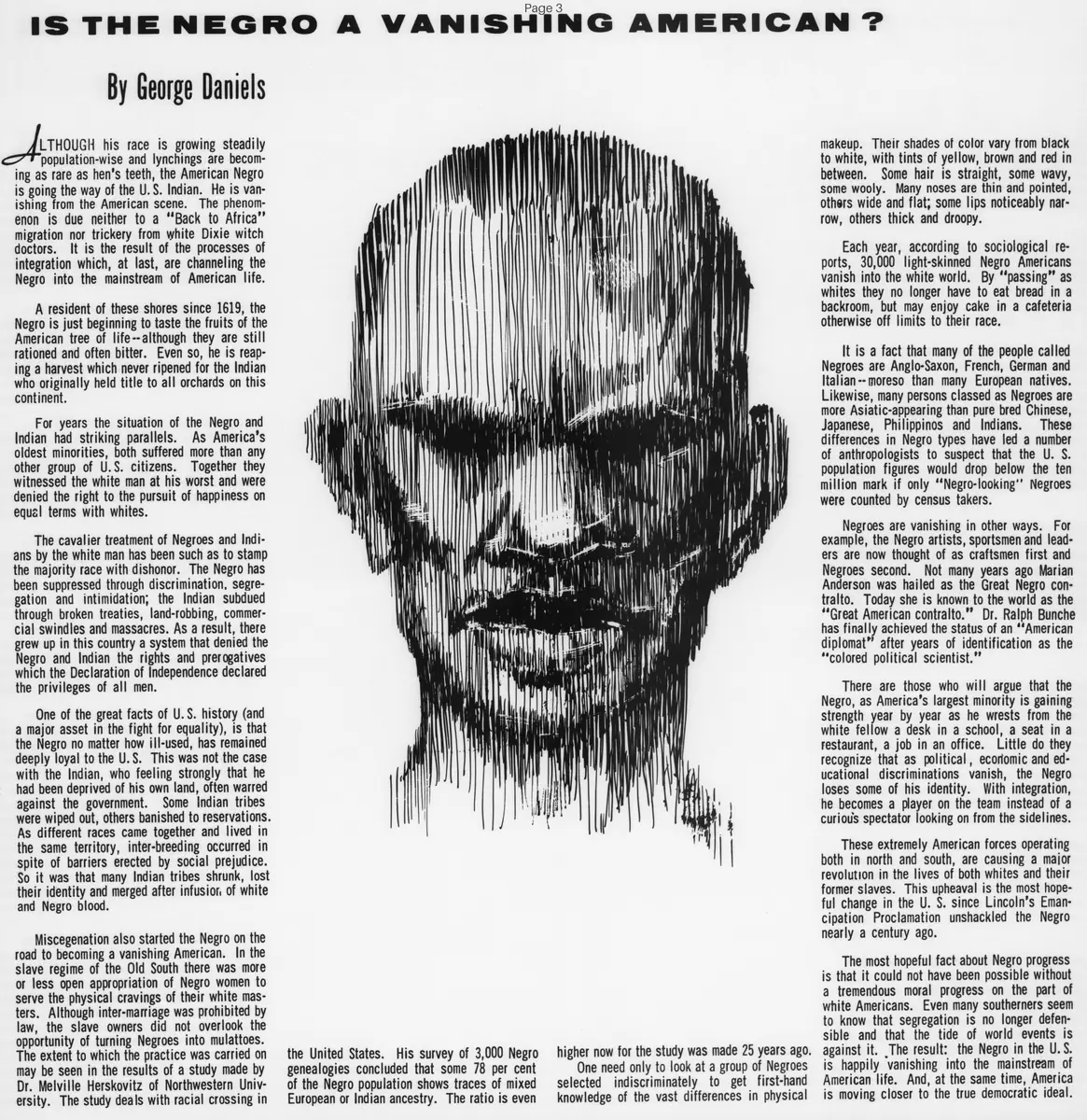
Merged-components note: Image bbox overlaps with the story text blocks, serving as an illustration for the article on the Negro as a vanishing American.
Clipping
OCR Quality
Full Text
By George Daniels
ALTHOUGH his race is growing steadily population-wise and lynchings are becoming as rare as hen's teeth, the American Negro is going the way of the U. S. Indian. He is vanishing from the American scene. The phenomenon is due neither to a "Back to Africa" migration nor trickery from white Dixie witch doctors. It is the result of the processes of integration which, at last, are channeling the Negro into the mainstream of American life.
A resident of these shores since 1619, the Negro is just beginning to taste the fruits of the American tree of life--although they are still rationed and often bitter. Even so, he is reaping a harvest which never ripened for the Indian who originally held title to all orchards on this continent.
For years the situation of the Negro and Indian had striking parallels. As America's oldest minorities, both suffered more than any other group of U.S. citizens. Together they witnessed the white man at his worst and were denied the right to the pursuit of happiness on equal terms with whites.
The cavalier treatment of Negroes and Indians by the white man has been such as to stamp the majority race with dishonor. The Negro has been suppressed through discrimination, segregation and intimidation; the Indian subdued through broken treaties, land-robbing, commercial swindles and massacres. As a result, there grew up in this country a system that denied the Negro and Indian the rights and prerogatives which the Declaration of Independence declared the privileges of all men.
One of the great facts of U. S. history (and a major asset in the fight for equality), is that the Negro no matter how ill-used, has remained deeply loyal to the U. S. This was not the case with the Indian, who feeling strongly that he had been deprived of his own land, often warred against the government. Some Indian tribes were wiped out, others banished to reservations.
As different races came together and lived in the same territory, inter-breeding occurred in spite of barriers erected by social prejudice. So it was that many Indian tribes shrunk, lost their identity and merged after infusion of white and Negro blood.
Miscegenation also started the Negro on the road to becoming a vanishing American. In the slave regime of the Old South there was more or less open appropriation of Negro women to serve the physical cravings of their white masters. Although inter-marriage was prohibited by law, the slave owners did not overlook the opportunity of turning Negroes into mulattoes. The extent to which the practice was carried on may be seen in the results of a study made by Dr. Melville Herskovitz of Northwestern University. The study deals with racial crossing in the United States. His survey of 3,000 Negro genealogies concluded that some 78 per cent of the Negro population shows traces of mixed European or Indian ancestry. The ratio is even higher now for the study was made 25 years ago. makeup. Their shades of color vary from black to white, with tints of yellow, brown and red in between. Some hair is straight, some wavy, some wooly. Many noses are thin and pointed, others wide and flat; some lips noticeably narrow, others thick and droopy.
Each year, according to sociological reports, 30,000 light-skinned Negro Americans vanish into the white world. By "passing" as whites they no longer have to eat bread in a backroom, but may enjoy cake in a cafeteria otherwise off limits to their race.
It is a fact that many of the people called Negroes are Anglo-Saxon, French, German and Italian--moreso than many European natives. Likewise, many persons classed as Negroes are more Asiatic-appearing than pure bred Chinese, Japanese, Philippinos and Indians. These differences in Negro types have led a number of anthropologists to suspect that the U. S. population figures would drop below the ten million mark if only "Negro-looking" Negroes were counted by census takers.
Negroes are vanishing in other ways. For example, the Negro artists, sportsmen and leaders are now thought of as craftsmen first and Negroes second. Not many years ago Marian Anderson was hailed as the Great Negro contralto. Today she is known to the world as the "Great American contralto." Dr. Ralph Bunche has finally achieved the status of an "American diplomat" after years of identification as the "colored political scientist."
There are those who will argue that the Negro, as America's largest minority is gaining strength year by year as he wrests from the white fellow a desk in a school, a seat in a restaurant, a job in an office. Little do they recognize that as political, economic and educational discriminations vanish, the Negro loses some of his identity. With integration, he becomes a player on the team instead of a curious spectator looking on from the sidelines.
These extremely American forces operating both in north and south, are causing a major revolution in the lives of both whites and their former slaves. This upheaval is the most hopeful change in the U. S. since Lincoln's Emancipation Proclamation unshackled the Negro nearly a century ago.
The most hopeful fact about Negro progress is that it could not have been possible without a tremendous moral progress on the part of white Americans. Even many southerners seem to know that segregation is no longer defensible and that the tide of world events is against it. The result: the Negro in the U. S. is happily vanishing into the mainstream of American life. And, at the same time, America is moving closer to the true democratic ideal.
One need only to look at a group of Negroes selected indiscriminately to get first-hand knowledge of the vast differences in physical makeup.
What sub-type of article is it?
What themes does it cover?
What keywords are associated?
What entities or persons were involved?
Where did it happen?
Story Details
Key Persons
Location
United States
Event Date
Since 1619
Story Details
The article discusses how African Americans are losing their distinct identity through integration, miscegenation, and passing as white, contrasting with Native Americans' fate, leading to absorption into mainstream American society.