Thank you for visiting SNEWPapers!
Sign up free
Story
July 15, 1833
Phenix Gazette
Alexandria, Virginia
What is this article about?
Ke-o-kuk, chief of the Sac Indians, offers four innocent young men from his tribe to authorities in Warren County, Illinois, as substitutes for murderers to prevent conflict, but they are discharged after he testifies to their innocence, highlighting their patriotic sacrifice.
Clipping
OCR Quality
95%
Excellent
Full Text
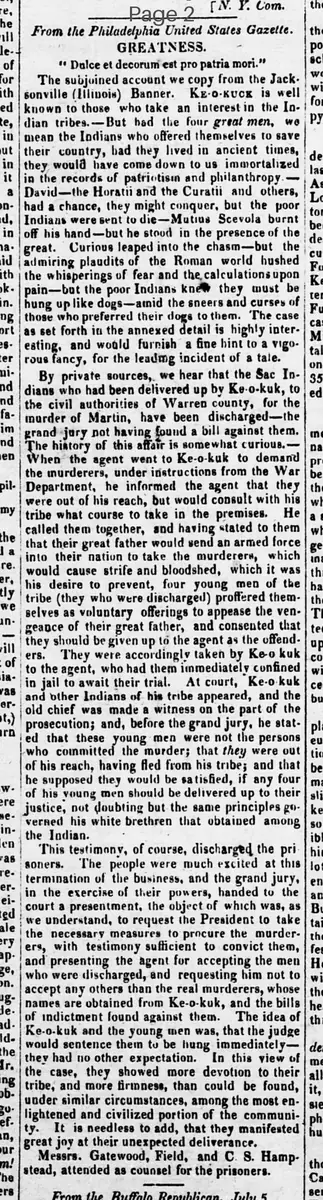
From the Philadelphia United States Gazette.
GREATNESS.
"Dulce et decorum est pro patria mori."
The subjoined account we copy from the Jacksonville (Illinois) Banner. Ke-o-kuk is well known to those who take an interest in the Indian tribes.--But had the four great men, we mean the Indians who offered themselves to save their country, had they lived in ancient times, they would have come down to us immortalized in the records of patriotism and philanthropy.-- David--the Horatii and the Curatii and others, had a chance, they might conquer, but the poor Indians were sent to die--Mutius Scaevola burnt off his hand--but he stood in the presence of the great. Curtius leaped into the chasm--but the admiring plaudits of the Roman world hushed the whisperings of fear and the calculations upon pain--but the poor Indians knew they must be hung up like dogs--amid the sneers and curses of those who preferred their dogs to them. The case as set forth in the annexed detail is highly interesting, and would furnish a fine hint to a vigorous fancy, for the leading incident of a tale.
By private sources, we hear that the Sac Indians who had been delivered up by Ke-o-kuk, to the civil authorities of Warren county, for the murder of Martin, have been discharged--the grand jury not having found a bill against them. The history of this affair is somewhat curious.-- When the agent went to Ke-o-kuk to demand the murderers, under instructions from the War Department, he informed the agent that they were out of his reach, but would consult with his tribe what course to take in the premises. He called them together, and having stated to them that their great father would send an armed force into their nation to take the murderers, which would cause strife and bloodshed, which it was his desire to prevent, four young men of the tribe (they who were discharged) proffered themselves as voluntary offerings to appease the vengeance of their great father, and consented that they should be given up to the agent as the offenders. They were accordingly taken by Ke-o-kuk to the agent, who had them immediately confined in jail to await their trial. At court, Ke-o-kuk and other Indians of his tribe appeared, and the old chief was made a witness on the part of the prosecution; and, before the grand jury, he stated that these young men were not the persons who committed the murder; that they were out of his reach, having fled from his tribe; and that he supposed they would be satisfied, if any four of his young men should be delivered up to their justice, not doubting but the same principles governed his white brethren that obtained among the Indian.
This testimony, of course, discharged the prisoners. The people were much excited at this termination of the business, and the grand jury, in the exercise of their powers, handed to the court a presentment, the object of which was, as we understand, to request the President to take the necessary measures to procure the murderers, with testimony sufficient to convict them, and presenting the agent for accepting the men who were discharged, and requesting him not to accept any others than the real murderers, whose names are obtained from Ke-o-kuk, and the bills of indictment found against them. The idea of Ke-o-kuk and the young men was, that the judge would sentence them to be hung immediately-- they had no other expectation. In this view of the case, they showed more devotion to their tribe, and more firmness, than could be found, under similar circumstances, among the most enlightened and civilized portion of the community. It is needless to add, that they manifested great joy at their unexpected deliverance.
Messrs. Gatewood, Field, and C. S. Hempstead, attended as counsel for the prisoners.
GREATNESS.
"Dulce et decorum est pro patria mori."
The subjoined account we copy from the Jacksonville (Illinois) Banner. Ke-o-kuk is well known to those who take an interest in the Indian tribes.--But had the four great men, we mean the Indians who offered themselves to save their country, had they lived in ancient times, they would have come down to us immortalized in the records of patriotism and philanthropy.-- David--the Horatii and the Curatii and others, had a chance, they might conquer, but the poor Indians were sent to die--Mutius Scaevola burnt off his hand--but he stood in the presence of the great. Curtius leaped into the chasm--but the admiring plaudits of the Roman world hushed the whisperings of fear and the calculations upon pain--but the poor Indians knew they must be hung up like dogs--amid the sneers and curses of those who preferred their dogs to them. The case as set forth in the annexed detail is highly interesting, and would furnish a fine hint to a vigorous fancy, for the leading incident of a tale.
By private sources, we hear that the Sac Indians who had been delivered up by Ke-o-kuk, to the civil authorities of Warren county, for the murder of Martin, have been discharged--the grand jury not having found a bill against them. The history of this affair is somewhat curious.-- When the agent went to Ke-o-kuk to demand the murderers, under instructions from the War Department, he informed the agent that they were out of his reach, but would consult with his tribe what course to take in the premises. He called them together, and having stated to them that their great father would send an armed force into their nation to take the murderers, which would cause strife and bloodshed, which it was his desire to prevent, four young men of the tribe (they who were discharged) proffered themselves as voluntary offerings to appease the vengeance of their great father, and consented that they should be given up to the agent as the offenders. They were accordingly taken by Ke-o-kuk to the agent, who had them immediately confined in jail to await their trial. At court, Ke-o-kuk and other Indians of his tribe appeared, and the old chief was made a witness on the part of the prosecution; and, before the grand jury, he stated that these young men were not the persons who committed the murder; that they were out of his reach, having fled from his tribe; and that he supposed they would be satisfied, if any four of his young men should be delivered up to their justice, not doubting but the same principles governed his white brethren that obtained among the Indian.
This testimony, of course, discharged the prisoners. The people were much excited at this termination of the business, and the grand jury, in the exercise of their powers, handed to the court a presentment, the object of which was, as we understand, to request the President to take the necessary measures to procure the murderers, with testimony sufficient to convict them, and presenting the agent for accepting the men who were discharged, and requesting him not to accept any others than the real murderers, whose names are obtained from Ke-o-kuk, and the bills of indictment found against them. The idea of Ke-o-kuk and the young men was, that the judge would sentence them to be hung immediately-- they had no other expectation. In this view of the case, they showed more devotion to their tribe, and more firmness, than could be found, under similar circumstances, among the most enlightened and civilized portion of the community. It is needless to add, that they manifested great joy at their unexpected deliverance.
Messrs. Gatewood, Field, and C. S. Hempstead, attended as counsel for the prisoners.
What sub-type of article is it?
Heroic Act
Historical Event
Curiosity
What themes does it cover?
Bravery Heroism
Justice
Moral Virtue
What keywords are associated?
Sac Indians
Ke O Kuk
Voluntary Sacrifice
Murder Trial
Indian Justice
Patriotism
What entities or persons were involved?
Ke O Kuk
Four Young Sac Indians
Agent
Where did it happen?
Warren County, Illinois
Story Details
Key Persons
Ke O Kuk
Four Young Sac Indians
Agent
Location
Warren County, Illinois
Story Details
Ke-o-kuk consults his tribe after demands for murderers; four young men volunteer as substitutes to prevent armed conflict; they are jailed but discharged when Ke-o-kuk testifies to their innocence, revealing the real killers fled.