Thank you for visiting SNEWPapers!
Sign up free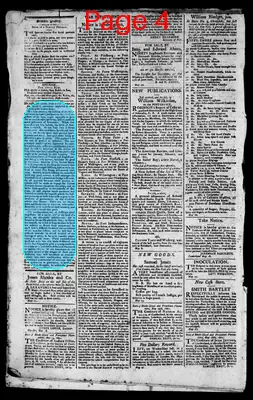
Editorial
June 17, 1801
The Providence Journal, And Town And Country Advertiser
Providence, Providence County, Rhode Island
What is this article about?
A London paper warns U.S. citizens against party-based elections for chief magistrate, highlighting risks of factional division, foreign influence from French and English parties, and threats to impartial governance and constitutional stability.
Clipping
OCR Quality
98%
Excellent
Full Text
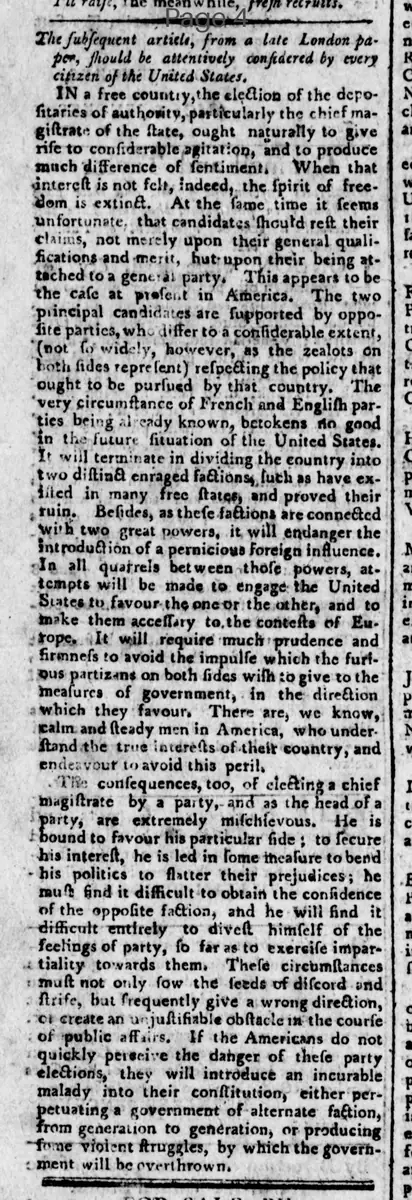
The subsequent article, from a late London paper, should be attentively considered by every citizen of the United States.
IN a free country, the election of the depositories of authority, particularly the chief magistrate of the state, ought naturally to give rise to considerable agitation, and to produce much difference of sentiment. When that interest is not felt, indeed, the spirit of freedom is extinct. At the same time it seems unfortunate, that candidates should rest their claims, not merely upon their general qualifications and merit, but upon their being attached to a general party. This appears to be the case at present in America. The two principal candidates are supported by opposite parties, who differ to a considerable extent, (not so widely, however, as the zealots on both sides represent) respecting the policy that ought to be pursued by that country. The very circumstance of French and English parties being already known, betokens no good in the future situation of the United States.
It will terminate in dividing the country into two distinct enraged factions, such as have existed in many free states, and proved their ruin. Besides, as these factions are connected with two great powers, it will endanger the introduction of a pernicious foreign influence. In all quarrels between those powers, attempts will be made to engage the United States to favour the one or the other, and to make them accessory to the contests of Europe. It will require much prudence and firmness to avoid the impulse which the furious partisans on both sides wish to give to the measures of government, in the direction which they favour. There are, we know, calm and steady men in America, who understand the true interests of their country, and endeavour to avoid this peril.
The consequences, too, of electing a chief magistrate by a party, and as the head of a party, are extremely mischievous. He is bound to favour his particular side; to secure his interest, he is led in some measure to bend his politics to flatter their prejudices; he must find it difficult to obtain the confidence of the opposite faction, and he will find it difficult entirely to divest himself of the feelings of party, so far as to exercise impartiality towards them. These circumstances must not only sow the seeds of discord and strife, but frequently give a wrong direction, or create an unjustifiable obstacle in the course of public affairs. If the Americans do not quickly perceive the danger of these party elections, they will introduce an incurable malady into their constitution, either perpetuating a government of alternate faction, from generation to generation, or producing some violent struggles, by which the government will be overthrown.
IN a free country, the election of the depositories of authority, particularly the chief magistrate of the state, ought naturally to give rise to considerable agitation, and to produce much difference of sentiment. When that interest is not felt, indeed, the spirit of freedom is extinct. At the same time it seems unfortunate, that candidates should rest their claims, not merely upon their general qualifications and merit, but upon their being attached to a general party. This appears to be the case at present in America. The two principal candidates are supported by opposite parties, who differ to a considerable extent, (not so widely, however, as the zealots on both sides represent) respecting the policy that ought to be pursued by that country. The very circumstance of French and English parties being already known, betokens no good in the future situation of the United States.
It will terminate in dividing the country into two distinct enraged factions, such as have existed in many free states, and proved their ruin. Besides, as these factions are connected with two great powers, it will endanger the introduction of a pernicious foreign influence. In all quarrels between those powers, attempts will be made to engage the United States to favour the one or the other, and to make them accessory to the contests of Europe. It will require much prudence and firmness to avoid the impulse which the furious partisans on both sides wish to give to the measures of government, in the direction which they favour. There are, we know, calm and steady men in America, who understand the true interests of their country, and endeavour to avoid this peril.
The consequences, too, of electing a chief magistrate by a party, and as the head of a party, are extremely mischievous. He is bound to favour his particular side; to secure his interest, he is led in some measure to bend his politics to flatter their prejudices; he must find it difficult to obtain the confidence of the opposite faction, and he will find it difficult entirely to divest himself of the feelings of party, so far as to exercise impartiality towards them. These circumstances must not only sow the seeds of discord and strife, but frequently give a wrong direction, or create an unjustifiable obstacle in the course of public affairs. If the Americans do not quickly perceive the danger of these party elections, they will introduce an incurable malady into their constitution, either perpetuating a government of alternate faction, from generation to generation, or producing some violent struggles, by which the government will be overthrown.
What sub-type of article is it?
Partisan Politics
Foreign Affairs
Constitutional
What keywords are associated?
Party Politics
Elections
Foreign Influence
Factions
Chief Magistrate
Constitutional Danger
Impartiality
What entities or persons were involved?
United States
French Parties
English Parties
Chief Magistrate
Two Principal Candidates
Editorial Details
Primary Topic
Dangers Of Party Based Elections For U.S. Chief Magistrate
Stance / Tone
Warning Against Factionalism And Foreign Influence
Key Figures
United States
French Parties
English Parties
Chief Magistrate
Two Principal Candidates
Key Arguments
Elections Based On Party Attachment Rather Than Merit Divide The Nation Into Enraged Factions.
Party Factions Connected To France And England Risk Introducing Foreign Influence Into U.S. Affairs.
Party Elected Magistrates Are Bound To Favor Their Side, Hindering Impartiality And Sowing Discord.
Such Practices Threaten To Introduce An Incurable Malady Into The U.S. Constitution, Leading To Perpetual Factionalism Or Violent Overthrow.