Thank you for visiting SNEWPapers!
Sign up free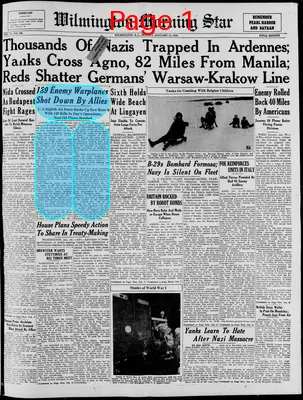
The Wilmington Morning Star
Wilmington, New Hanover County, North Carolina
What is this article about?
On January 14, US Eighth Air Force and RAF aircraft destroyed 189 German planes while bombing oil refineries, depots, steel mills, and Rhine bridges in Germany and Holland, setting a new fighter kill record of 149.
Clipping
OCR Quality
Full Text
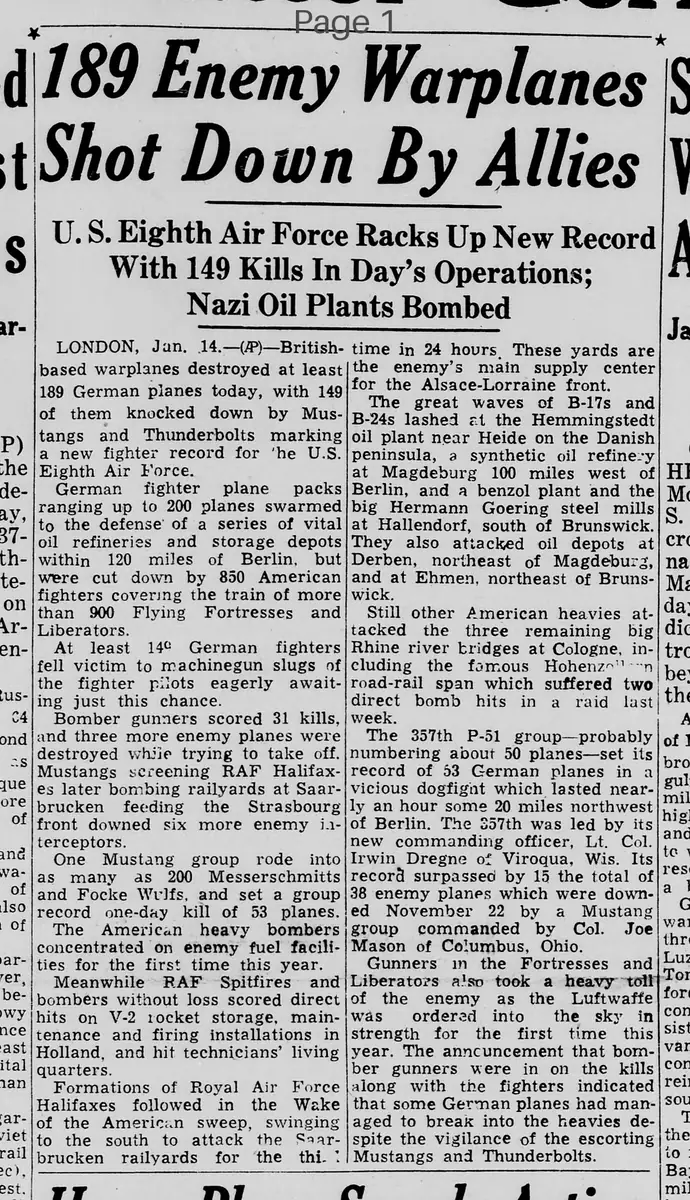
U. S. Eighth Air Force Racks Up New Record With 149 Kills In Day's Operations;
Nazi Oil Plants Bombed
LONDON, Jan. 14.-(P)-British-based warplanes destroyed at least 189 German planes today, with 149 of them knocked down by Mustangs and Thunderbolts marking a new fighter record for the U.S. Eighth Air Force.
German fighter plane packs ranging up to 200 planes swarmed to the defense of a series of vital oil refineries and storage depots within 120 miles of Berlin, but were cut down by 850 American fighters covering the train of more than 900 Flying Fortresses and Liberators.
At least 140 German fighters fell victim to machinegun slugs of the fighter pilots eagerly awaiting just this chance.
Bomber gunners scored 31 kills, and three more enemy planes were destroyed while trying to take off.
Mustangs screening RAF Halifaxes later bombing railyards at Saarbrucken feeding the Strasbourg front downed six more enemy interceptors.
One Mustang group rode into as many as 200 Messerschmitts and Focke Wulfs, and set a group record one-day kill of 53 planes.
The American heavy bombers concentrated on enemy fuel facilities for the first time this year.
Meanwhile RAF Spitfires and bombers without loss scored direct hits on V-2 rocket storage, maintenance and firing installations in Holland, and hit technicians' living quarters.
Formations of Royal Air Force Halifaxes followed in the wake of the American sweep, swinging to the south to attack the Saarbrucken railyards for the third time in 24 hours. These yards are the enemy's main supply center for the Alsace-Lorraine front.
The great waves of B-17s and B-24s lashed at the Hemmingstedt oil plant near Heide on the Danish peninsula, a synthetic oil refinery at Magdeburg 100 miles west of Berlin, and a benzol plant and the big Hermann Goering steel mills at Hallendorf, south of Brunswick.
They also attacked oil depots at Derben, northeast of Magdeburg, and at Ehme, northeast of Brunswick.
Still other American heavies attacked the three remaining big Rhine river bridges at Cologne, including the famous Hohenzollern road-rail span which suffered two direct bomb hits in a raid last week.
The 357th P-51 group-probably numbering about 50 planes-set its record of 53 German planes in a vicious dogfight which lasted nearly an hour some 20 miles northwest of Berlin. The 357th was led by its new commanding officer, Lt. Col. Irwin Dregne of Viroqua, Wis. Its record surpassed by 15 the total of 38 enemy planes which were downed November 22 by a Mustang group commanded by Col. Joe Mason of Columbus, Ohio.
Gunners in the Fortresses and Liberators also took a heavy toll of the enemy as the Luftwaffe was ordered into the sky in strength for the first time this year. The announcement that bomber gunners were in on the kills along with the fighters indicated that some German planes had managed to break into the heavies despite the vigilance of the escorting Mustangs and Thunderbolts.
What sub-type of article is it?
What keywords are associated?
What entities or persons were involved?
Where did it happen?
Foreign News Details
Primary Location
Germany
Event Date
Jan. 14
Key Persons
Outcome
189 german planes destroyed, including 149 by us fighters (new record), 31 by bomber gunners, 3 on takeoff, 6 by mustangs over saarbrucken; direct hits on oil plants, depots, steel mills, bridges, v-2 sites, and railyards.
Event Details
US Eighth Air Force heavy bombers targeted German oil refineries, storage depots, steel mills, and Rhine bridges near Berlin, Magdeburg, Brunswick, Cologne, and other sites, escorted by fighters that engaged up to 200 enemy planes. RAF operations hit V-2 installations in Holland and Saarbrucken railyards. The 357th P-51 group set a record 53 kills in a dogfight northwest of Berlin.