Thank you for visiting SNEWPapers!
Sign up free
Edgefield Advertiser
Edgefield, Edgefield County, South Carolina
What is this article about?
A pseudonymous letter from South Carolina supports Colonel Hammond over Colonel Richardson in the gubernatorial election, emphasizing Hammond's political consistency during the 1832 Nullification crisis and refuting claims that Richardson's election would reconcile Union and Nullification parties.
Clipping
OCR Quality
Full Text
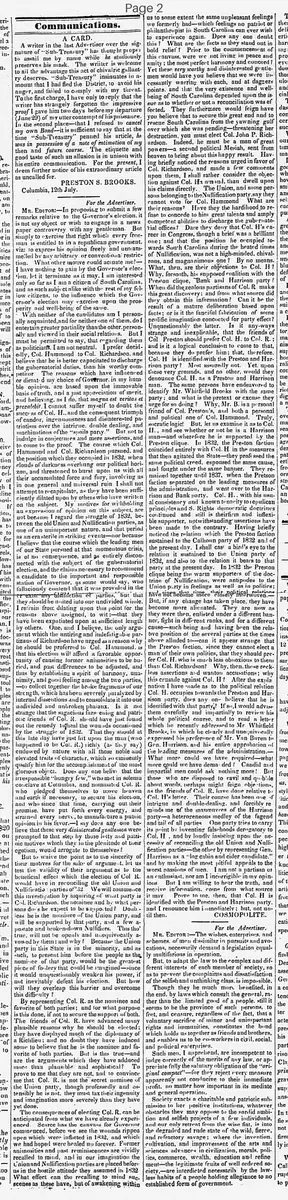
MR. EDITOR:—In proposing to submit a few remarks relative to the Governor's election, it is not my object or wish to engage in a newspaper controversy with any gentleman. But simply to exercise that right which every freeman is entitled to in a republican government viz: to express his opinion freely and untrammelled by any arbitrary or conventional restriction. What other motive could actuate me?— I have nothing to gain by the Governor's election, let it terminate as it may. I am interested only so far as I am a citizen of South Carolina, and as such subject alike with the rest of my fellow citizens, to the influence which the Governor's election may exercise upon the prosperity and well-being of the same. With neither of the candidates am I personally acquainted, and for neither one of them, do I entertain greater partiality than the other, personally and viewed in their social relations. But I must be permitted to say, that regarding them as politicians, I am not neutral. I prefer decidedly, Col. Hammond to Col. Richardson, and believe that he is better capacitated to discharge the gubernatorial duties, than his worthy competitor. The reasons which have influenced or dictated my choice of Governor, in my humble opinion, are based upon the immovable basis of truth, and a just appreciation of merit, and believing, as I do, that magna est veritas et prevalebit, I cannot suffer myself to doubt the success of Col. H., and the consequent triumph of candor, ingenuousness and disinterested patriotism over the intrigue, double dealing, and machinations of the "spoils party." But not to indulge in conjectures and mere assertions, and to come to the proof. The course which Col. Hammond and Col. Richardson pursued, and the position which they occupied in 1832, when clouds of darkness overhung our political horizon, and threatened to burst upon us with all their accumulated force and fury, involving us in one general and universal ruin I shall not attempt to recapitulate, as they have been sufficiently dilated upon by others who have written on the subject. My motives for withholding an expression of opinion on this subject, are not because I regard the struggle of 1832, between the old Union and Nullification parties, as one of an unimportant nature, and that period as an era sterile in striking events—nor because I believe that the course which the leading men of our State pursued at that momentous crisis is of no consequence, and as entirely disconnected with the subject of the gubernatorial election, and the claims necessary to recommend a candidate to the important and responsible station of Governor, as some would say, who fallaciously contend that it was provided in the "crevis" in distinction of parties." but that they should be united into one undivided whole. I refrain from dilating upon this point for the reasons above assigned, to wit: that they have been expatiated upon at sufficient length by others. One, and I believe, the only argument which the untiring and indefatigable partisans of Richardson have urged as a reason why he should be preferred to Col. Hammond, is that his election will afford a favorable opportunity of causing former animosities to be buried, and past differences to be adjusted, and thus by establishing a spirit of harmony, unanimity, and good feeling among the two parties, -to collect together the broke fragments of our strength, which has been severely paralyzed by internal dissentions and to consolidate it into one undivided and unbroken phalanx. Is it not strange that the sagacious far-seeing and patriotic friends of Col. R. should have just found out the remedy to heal the wounds occasioned by the struggle of 1832. That they should at this late day have just hit upon the man (who happened to be Col. R.) richly (as they say) endowed by nature with all those noble and elevated traits of character, which so eminently qualify him for the accomplishment of the most glorious object. Does any one believe that the irresponsible "hungry few," who met in solemn conclave at Columbia, and nominated Col. R., who pledged themselves to move heaven and earth if necessary, to secure his election, and who since that time, carrying out their promise, have put forth every energy, and strained every nerve, to manufacture a public opinion in his favor.—I say does any one believe that these very disinterested gentlemen were prompted to that step by those lofty and patriotic motives which they in the plenitude of their egotism, would arrogate to themselves?
But to waive the point as to the sincerity of their motives for the sake of argument, let us test the validity of their argument as to the beneficial effect which the election of Col R. would have in reconciling the old Union and Nullification parties of 32 we will commence this investigation by inquiring of what party is Col. Richardson, the nominee and by what persons does he expect to be supported? Doubtless he is the nominee of the Union party, and will be supported by that party, and a few apostate and broken-down Nullifiers. This tho true, will not be openly and unequivocally avowed by them; and why? Because the Union party in this State is in the minority, and as such, to present him before the people as the nominee of that party, would be the greatest piece of folly that could be imagined—since it would unquestionably weaken his power, if not inevitably defeat his election. But how will they overleap this barrier and overcome this difficulty?
By representing Col. R. as the nominee and favorite of both parties; and for what purpose is this done, if not to secure the support of both. The friends of Col. R. have advanced many plausible reasons why he should be elected; they have displayed much of the diplomacy of a Richlieu: and no doubt they have induced some to believe that he is the nominee and favorite of both parties. But is this true—and are the arguments which they have adduced more than plausible and sophistical? To prove to me that they are not, and to convince me that Col. R. is not the secret nominee of the Union party, though professedly and ostensibly he is not, they must tax their ingenuity and imagination more severely than they have yet done.
The consequences of electing Col. R. can be anticipated from what we have already experienced. Scarce has the canvas for Governor commenced, before we see the wounds ripped open which were inflicted in 1832, and which we had hoped were healed forever. Former animosities and past reminiscences are vividly recalled to mind, and in our imagination the Union and Nullification parties are placed before us in the hostile attitude they assumed in 1832 What effect can the recalling to mind such scenes as these have, but of awakening within us to some extent the same unpleasant feelings we formerly had—which feelings no patriot or philanthropist in South Carolina can ever wish to experience again. Does any one doubt this? What are the facts as they stand out in bold relief? Prior to the commencement of this canvass, were we not living in peace and amity; the most perfect harmony and concord? Yet these very worthy and disinterested gentlemen would have you believe that we were incessantly warring with each other, and at daggers points, and that the very existence and well being of South Carolina depended upon the issue as to whether or not a reconciliation was effected, They furthermore would feign have you believe that to secure this great end and to rescue South Carolina from the yawning gulf over which she was pending—threatening her destruction, you must elect Col. John P. Richardson. Indeed, he must be a man of great powers—a second political Messiah, sent from heaven to bring about this happy result. Having briefly noticed the reasons urged in favor of Col. Richardson, and made a few comments upon them, I shall rather consider the objection against Col. Hammond, than dwell upon his claims directly. The Union, and some persons belonging to the Nullification party, say they cannot vote for Col. Hammond What are their reasons? Have they the hardihood to refuse to concede to him great talents and amply competent abilities to discharge the gubernatorial offices? Dare they deny that Col. H's career in Congress, though a brief was a brilliant one; and that the position he occupied towards South Carolina during the heated times of Nullification, was not a high-minded, chivalrous, and magnanimous one? By no means. What, then, are their objections to Col. H Why, forsooth, his supposed coalition with the Preston clique, Bank and Harrison party? When did the zealous partisans of Col. R make this great discovery; and from what source did they obtain this information? Can it be the result of a mature deliberation based upon facts; or is it the fanciful fabrication of some prolific imagination concocted for party effect? Unquestionably the latter. Is it any-ways strange and inexplicable, that the friends of Col Preston should prefer Col. H. to Col. R. ; and is it a logical conclusion to come to that, because they do prefer him; that, therefore, Col. H is identified with the Preston and Harrison party? Most assuredly not. Yet, upon these very grounds, and no other, would they denounce Col. H. as a Preston and Harrison man. The same persons have endeavored to identify Mr. Whitfield Brooks with the same party; and what is the pretext or excuse they urge for so doing? Why, Mr. B. is a personal friend of Col. Preston's, and both a personal and political one of Col. Hammond. "Truly, socratic logic! But, let us examine it as to Col. II., and see whether or not he is a Harrison man—and wherefore he is supported by the Preston clique. In 1832, the Preston faction coincided entirely with Col. H in the measures that then agitated the State—they professed the same political creed, espoused the same cause, and fought under the same banner. They remained together until 1837, when the Preston faction separated on the leading measures of the administration, and went over to the Harrison and Bank party. Col. H., with his usual consistency and known tenacity to republican principles and S. Rights democratic doctrines continued and still is their firm and inflexible supporter, notwithstanding assertions have been made to the contrary. Having briefly noticed the relation which the Preston faction sustained to the Calhoun party of 1832 and of the present day, I shall cast a bird's eye to the relation it sustained to the Union party of 1832, and also to the relation it bears to that party at the present day. In 1832 the Preston clique being the warm supporters of the doctrine of Nullification, were antipodes to the Union party in feelings as well as in politics; But, if any change has taken place, they have become more alienated. They are now as they were then, enlisted under a different banner, fight in different ranks, and for a different cause—such being and having been the relative position of the several parties at the times above alluded to—can it appear strange that the Preston faction, since they cannot elect a man of their own politics, that they should prefer Col. H. who is much less obnoxious to them than Col. Richardson? Why, then, these reckless assertions and wanton accusations; why this crusade against Col. H? After the explanation I have made as to the political relation Col. H. occupies towards the Preston and Harrison party, does any one believe that he is identified with that party? If so, I would advise them carefully and impartially to review his whole political course, and to read a letter which he recently addressed to Mr Whitfield Brooks, in which he clearly and unequivocally expressed his preference of Mr. Van Buren to Gen. Harrison, and his entire approbation of the leading measures of the administration.— What more could we have required—what more could we have demanded? "Candid and impartial men could ask nothing more! But those who are disposed to cavil and quibble about words, perhaps might feign objections, as the friends of Col. R. have done relative to Col. H's letter. Their course has been one of intrigue and double-dealing, and forcibly reminds us of the manoeuvres of the Harrison party—a heterogeneous medley of the fag end and tail of all parties One party tries to carry its point by inventing falsehoods derogatory to Col. H., and by loudly insisting upon the necessity of reconciling the old Union and Nullification parties—the other by representing Gen. Harrison as a "log cabin and cider candidate," and by making the most pitiful appeals to the worst passions of men. I am not a partisan or an enthusiast, nor am I incorrigible in my opinions But I am willing to hear the truth, and receive information, come from what source it may. Prove to me, then, that Col. H is identified with the Preston and Harrison party, and I renounce him immediately; but, not until then.
COSMOPOLITE.
What sub-type of article is it?
What themes does it cover?
What keywords are associated?
What entities or persons were involved?
Letter to Editor Details
Author
Cosmopolite
Recipient
Mr. Editor
Main Argument
the writer prefers colonel hammond over colonel richardson for governor of south carolina, citing hammond's superior political qualifications and consistency, particularly during the 1832 nullification crisis, and dismisses arguments that richardson's election would reconcile divided parties as insincere and partisan.
Notable Details