Thank you for visiting SNEWPapers!
Sign up free
Letter to Editor
May 2, 1851
Pawtucket Gazette And Chronicle
Pawtucket, Providence County, Rhode Island
What is this article about?
Newspaper reprint of Benjamin Franklin's 1753 letter to Rev. George Whitefield, correcting a claim of prior non-publication; Franklin discusses performing good works as true expression of faith and gratitude to God, rather than relying on rituals or professions.
Clipping
OCR Quality
95%
Excellent
Full Text
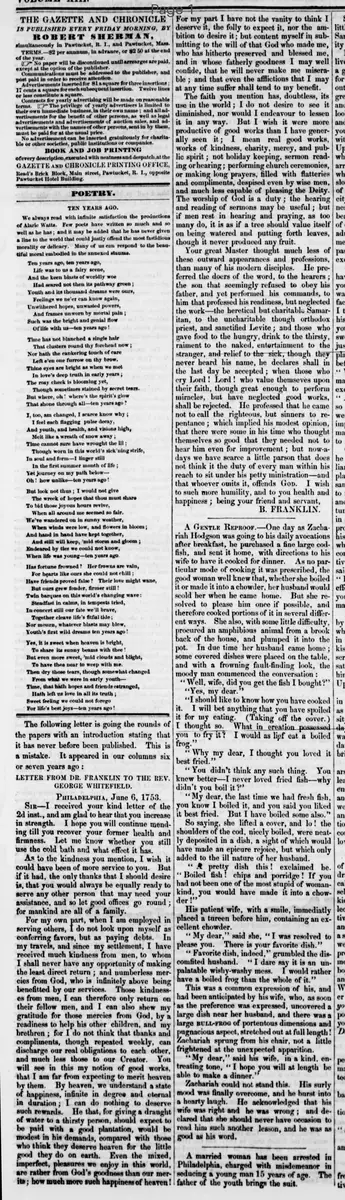
The following letter is going the rounds of
the papers with an introduction stating that
it has never before been published. This is
a mistake. It appeared in our columns six
or seven years ago:
LETTER FROM DR. FRANKLIN TO THE REV.
GEORGE WHITEFIELD.
PHILADELPHIA, June 6, 1753.
SIR: I received your kind letter of the
2d inst., and am glad to hear that you increase
in strength. I hope you will continue mend-
ing till you recover your former health and
firmness. Let me know whether you still
use the cold bath and what effect it has.
As to the kindness you mention, I wish it
could have been of more service to you. But
if it had, the only thanks that I should desire
is, that you would always be equally ready to
serve any other person that may need your
assistance, and so let good offices go round;
for mankind are all of a family.
For my own part, when I am employed in
serving others, I do not look upon myself as
conferring favors, but as paying debts. In
my travels, and since my settlement, I have
received much kindness from men, to whom
I shall never have any opportunity of making
the least direct return; and numberless mer-
cies from God, who is infinitely above being
benefitted by our services. Those kindness-
es from men, I can therefore only return on
their fellow men, and I can also shew my
gratitude for those mercies from God, by a
readiness to help his other children, and my
brethren: for I do not think that thanks and
compliments, though repeated weekly, can
discharge our real obligations to each other,
and much less those to our Creator. You
will see in this my notion of good works,
that I am far from expecting to merit heaven
by them. By heaven, we understand a state
of happiness, infinite in degree and eternal
in duration; I can do nothing to deserve
such rewards. He that, for giving a draught
of water to a thirsty person, should expect to
be paid with a good plantation, would be
modest in his demands, compared with those
who think they deserve heaven for the little
good they do on earth. Even the mixed.
imperfect, pleasures we enjoy in this world,
are rather from God's goodness than our mer-
its; how much more such happiness of heaven!
For my part I have not the vanity to think I
deserve it, the folly to expect it, nor the am-
bition to desire it: but content myself in sub-
mitting to the will of that God who made me,
who has hitherto preserved and blessed me,
and in whose fatherly goodness I may well
confide, that he will never make me misera-
ble : and that even the afflictions that I may
at any time suffer shall tend to my benefit.
The faith you mention has, doubtless, its
use in the world; I do not desire to see it
diminished, nor would I endeavour to lessen
it in any way. But I wish it were more
productive of good works than I have gener-
ally seen it; I mean real good works,
works of kindness, charity, mercy, and pub
lic spirit; not holiday keeping, sermon read-
ing or hearing; performing church ceremonies,
or making long prayers, filled with flatteries
and compliments, despised even by wise men,
and much less capable of pleasing the Deity.
The worship of God is a duty; the hearing
and reading of sermons may be useful; but
if men rest in hearing and praying, as too
many do, it is as if a tree should value itself
on being watered and putting forth leaves,
though it never produced any fruit.
Your great Master thought much less of
these outward appearances and professions,
than many of his modern disciples. He pre-
ferred the doers of the word, to the hearers;
the son that seemingly refused to obey his
father, and yet performed his commands, to
him that professed his readiness, but neglected
the work; the heretical but charitable Samar-
it an, to the uncharitable though orthodox
priest, and sanctified Levite; and those who
gave food to the hungry, drink to the thirsty,
raiment to the naked, entertainment to the
stranger, and relief to the sick, though they
never heard his name, he declares shall in
the last day be accepted; when those who
cry Lord! Lord! who value themselves upon
their faith, though great enough to perform
miracles, but have neglected good works,
shall be rejected. He professed that he came
not to call the righteous, but sinners to re-
pentance; which implied his modest opinion,
that there were some in his time who thought
themselves so good that they needed not to
hear him even for improvement; but now-a-
days we have scarce a little parson that does
not think it the duty of every man within his
reach to sit under his petty ministration—and
that whoever omits it, offends God. I wish
to such more humility, and to you health and
happiness; being your friend and servant,
B. FRANKLIN.
the papers with an introduction stating that
it has never before been published. This is
a mistake. It appeared in our columns six
or seven years ago:
LETTER FROM DR. FRANKLIN TO THE REV.
GEORGE WHITEFIELD.
PHILADELPHIA, June 6, 1753.
SIR: I received your kind letter of the
2d inst., and am glad to hear that you increase
in strength. I hope you will continue mend-
ing till you recover your former health and
firmness. Let me know whether you still
use the cold bath and what effect it has.
As to the kindness you mention, I wish it
could have been of more service to you. But
if it had, the only thanks that I should desire
is, that you would always be equally ready to
serve any other person that may need your
assistance, and so let good offices go round;
for mankind are all of a family.
For my own part, when I am employed in
serving others, I do not look upon myself as
conferring favors, but as paying debts. In
my travels, and since my settlement, I have
received much kindness from men, to whom
I shall never have any opportunity of making
the least direct return; and numberless mer-
cies from God, who is infinitely above being
benefitted by our services. Those kindness-
es from men, I can therefore only return on
their fellow men, and I can also shew my
gratitude for those mercies from God, by a
readiness to help his other children, and my
brethren: for I do not think that thanks and
compliments, though repeated weekly, can
discharge our real obligations to each other,
and much less those to our Creator. You
will see in this my notion of good works,
that I am far from expecting to merit heaven
by them. By heaven, we understand a state
of happiness, infinite in degree and eternal
in duration; I can do nothing to deserve
such rewards. He that, for giving a draught
of water to a thirsty person, should expect to
be paid with a good plantation, would be
modest in his demands, compared with those
who think they deserve heaven for the little
good they do on earth. Even the mixed.
imperfect, pleasures we enjoy in this world,
are rather from God's goodness than our mer-
its; how much more such happiness of heaven!
For my part I have not the vanity to think I
deserve it, the folly to expect it, nor the am-
bition to desire it: but content myself in sub-
mitting to the will of that God who made me,
who has hitherto preserved and blessed me,
and in whose fatherly goodness I may well
confide, that he will never make me misera-
ble : and that even the afflictions that I may
at any time suffer shall tend to my benefit.
The faith you mention has, doubtless, its
use in the world; I do not desire to see it
diminished, nor would I endeavour to lessen
it in any way. But I wish it were more
productive of good works than I have gener-
ally seen it; I mean real good works,
works of kindness, charity, mercy, and pub
lic spirit; not holiday keeping, sermon read-
ing or hearing; performing church ceremonies,
or making long prayers, filled with flatteries
and compliments, despised even by wise men,
and much less capable of pleasing the Deity.
The worship of God is a duty; the hearing
and reading of sermons may be useful; but
if men rest in hearing and praying, as too
many do, it is as if a tree should value itself
on being watered and putting forth leaves,
though it never produced any fruit.
Your great Master thought much less of
these outward appearances and professions,
than many of his modern disciples. He pre-
ferred the doers of the word, to the hearers;
the son that seemingly refused to obey his
father, and yet performed his commands, to
him that professed his readiness, but neglected
the work; the heretical but charitable Samar-
it an, to the uncharitable though orthodox
priest, and sanctified Levite; and those who
gave food to the hungry, drink to the thirsty,
raiment to the naked, entertainment to the
stranger, and relief to the sick, though they
never heard his name, he declares shall in
the last day be accepted; when those who
cry Lord! Lord! who value themselves upon
their faith, though great enough to perform
miracles, but have neglected good works,
shall be rejected. He professed that he came
not to call the righteous, but sinners to re-
pentance; which implied his modest opinion,
that there were some in his time who thought
themselves so good that they needed not to
hear him even for improvement; but now-a-
days we have scarce a little parson that does
not think it the duty of every man within his
reach to sit under his petty ministration—and
that whoever omits it, offends God. I wish
to such more humility, and to you health and
happiness; being your friend and servant,
B. FRANKLIN.
What sub-type of article is it?
Philosophical
Religious
Ethical Moral
What themes does it cover?
Religion
Morality
What keywords are associated?
Benjamin Franklin
George Whitefield
Good Works
Faith
Religion
Charity
Humility
Biblical References
What entities or persons were involved?
B. Franklin
Rev. George Whitefield
Letter to Editor Details
Author
B. Franklin
Recipient
Rev. George Whitefield
Main Argument
franklin argues that good works of kindness and charity are the true measure of faith and gratitude to god, rather than mere rituals, professions, or church attendance; he expresses personal humility regarding deserving heaven and critiques those who prioritize outward religious displays over practical benevolence.
Notable Details
References Biblical Parables Including The Good Samaritan, The Prodigal Son, And Jesus' Teachings On Judgment Day
Emphasizes Performing Acts Of Mercy Like Giving Food To The Hungry And Visiting The Sick
Critiques Modern Parsons For Lacking Humility