Thank you for visiting SNEWPapers!
Sign up free
Editorial
March 26, 1833
The National Republican And Cincinnati Daily Mercantile Advertiser
Cincinnati, Hamilton County, Ohio
What is this article about?
Editorial in the New York Standard criticizes Henry Clay's compromise bill on the tariff, accusing him of betraying supporters, defending nullification in disguise, and seeking popularity at the expense of the protective system and Union strength. It mocks reactions from pro-Clay papers like the New York American and National Gazette.
Clipping
OCR Quality
95%
Excellent
Full Text
From the New York Standard
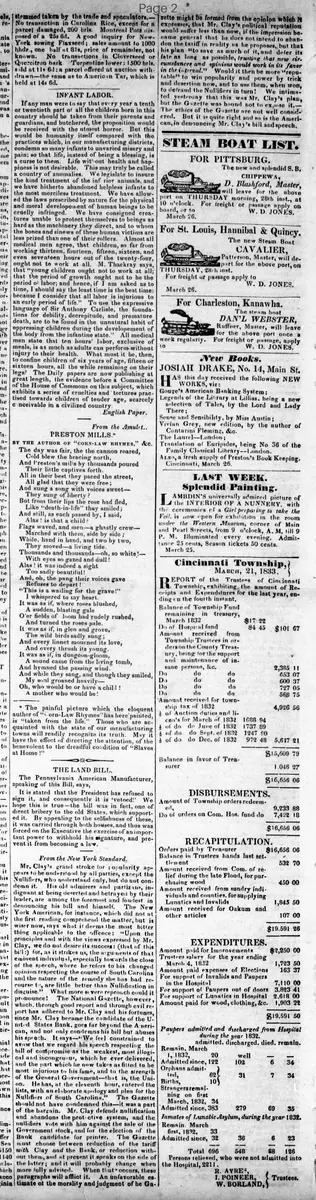
Mr. Clay's grand stroke for popularity appears to be understood by all parties, except the Nullifiers, who understand only, but do not condemn it. His old admirers and partisans, indignant at being deserted and betrayed by their leader, are among the foremost and loudest in denouncing his bill and himself. The New York American, for instance, which did not at the first reading comprehend the matter, but is wiser now, says what it deems the most bitter thing applicable to the offence: "Upon the principles and with the views expressed by Mr. Clay, we do not desire its success: (that of this bill) for, as it strikes us, the arguments of that eminent individual, especially towards the close of the speech, where he refers to his changed opinion respecting the course of South Carolina and the nature of the remedy she has had recourse to, are little better than Nullification in disguise." What more severe reproach could it pronounce! The National Gazette, however, which, through good report and through evil report has adhered to Mr. Clay and his fortunes, since Mr. Clay became the candidate of the United States Bank, goes far beyond the American, and not only condemns his bill but abuses his speech. It says-"We feel constrained to avow that we regard his speech respecting the bill of compromise as the weakest, most illogical and incongruous, which he ever delivered. and the part which he now takes as fitted to be most injurious to his fame, and to the strength of the General Government-that is, the Union. He has, at the eleventh hour, entered the lists, with an elaborate apology and plea for the Nullifiers of South Carolina." The Gazette should not have condemned this-it was a part of the bargain. Mr. Clay defends nullification and abandons the protective system, and the nullifiers vote with him against the sale of the Government stock, and for the election of the Bank candidate for printer. The Gazette must choose between reduction of the tariff with Clay and the Bank, or reduction without them, and at present it speaks on the side of the latter; and it will probably change when more fully advised. When that occurs, these paragraphs will afflict it. An unfavorable estimate of the morality and judgment of the Gazette might be formed from the opinion which it expresses, that Mr. Clay's political reputation would suffer less than now, if the impression became general that he does not intend to abandon the tariff in reality as he proposes, but that his plan "to save as much of it, and defer its fate as long as possible, trusting that new circumstances and opinions would work in its favor in the interval." Would it then be more "reputable" to win popularity and power by trick and desertion now, and to use them, when won, to defraud the Nullifiers in turn! We intimated yesterday that this was Mr. Clay's plan, but the Gazette was bound not to expose it.-- The ethics of the Gazette are not well considered. But it is quite right and so is the American, in denouncing Mr. Clay's bill and speech.
Mr. Clay's grand stroke for popularity appears to be understood by all parties, except the Nullifiers, who understand only, but do not condemn it. His old admirers and partisans, indignant at being deserted and betrayed by their leader, are among the foremost and loudest in denouncing his bill and himself. The New York American, for instance, which did not at the first reading comprehend the matter, but is wiser now, says what it deems the most bitter thing applicable to the offence: "Upon the principles and with the views expressed by Mr. Clay, we do not desire its success: (that of this bill) for, as it strikes us, the arguments of that eminent individual, especially towards the close of the speech, where he refers to his changed opinion respecting the course of South Carolina and the nature of the remedy she has had recourse to, are little better than Nullification in disguise." What more severe reproach could it pronounce! The National Gazette, however, which, through good report and through evil report has adhered to Mr. Clay and his fortunes, since Mr. Clay became the candidate of the United States Bank, goes far beyond the American, and not only condemns his bill but abuses his speech. It says-"We feel constrained to avow that we regard his speech respecting the bill of compromise as the weakest, most illogical and incongruous, which he ever delivered. and the part which he now takes as fitted to be most injurious to his fame, and to the strength of the General Government-that is, the Union. He has, at the eleventh hour, entered the lists, with an elaborate apology and plea for the Nullifiers of South Carolina." The Gazette should not have condemned this-it was a part of the bargain. Mr. Clay defends nullification and abandons the protective system, and the nullifiers vote with him against the sale of the Government stock, and for the election of the Bank candidate for printer. The Gazette must choose between reduction of the tariff with Clay and the Bank, or reduction without them, and at present it speaks on the side of the latter; and it will probably change when more fully advised. When that occurs, these paragraphs will afflict it. An unfavorable estimate of the morality and judgment of the Gazette might be formed from the opinion which it expresses, that Mr. Clay's political reputation would suffer less than now, if the impression became general that he does not intend to abandon the tariff in reality as he proposes, but that his plan "to save as much of it, and defer its fate as long as possible, trusting that new circumstances and opinions would work in its favor in the interval." Would it then be more "reputable" to win popularity and power by trick and desertion now, and to use them, when won, to defraud the Nullifiers in turn! We intimated yesterday that this was Mr. Clay's plan, but the Gazette was bound not to expose it.-- The ethics of the Gazette are not well considered. But it is quite right and so is the American, in denouncing Mr. Clay's bill and speech.
What sub-type of article is it?
Partisan Politics
Economic Policy
Constitutional
What keywords are associated?
Henry Clay
Tariff Compromise
Nullification
South Carolina
Protective System
United States Bank
Partisan Betrayal
What entities or persons were involved?
Mr. Clay
Nullifiers
South Carolina
New York American
National Gazette
United States Bank
Editorial Details
Primary Topic
Criticism Of Henry Clay's Tariff Compromise Bill And Sympathy For Nullification
Stance / Tone
Strongly Critical Of Clay And His Bill, Mocking Pro Clay Papers
Key Figures
Mr. Clay
Nullifiers
South Carolina
New York American
National Gazette
United States Bank
Key Arguments
Clay's Bill Betrays His Old Supporters And Abandons The Protective Tariff System
Clay's Speech Defends Nullification In Disguise And Apologizes For South Carolina's Actions
Clay's Move Is A Strategic Ploy For Popularity, Involving A Bargain With Nullifiers
Pro Clay Papers Like The American And Gazette Denounce The Bill As Illogical And Injurious To The Union
Clay's Plan May Involve Deceiving Nullifiers Later To Preserve The Tariff