Thank you for visiting SNEWPapers!
Sign up free
Literary
December 28, 1764
The New Hampshire Gazette And Historical Chronicle
Portsmouth, Greenland, Rockingham County, New Hampshire
What is this article about?
A collection of historical anecdotes detailing how individuals rose to honors through witty repartees, lucky accidents, or chance events, including stories from King Henry I, Philip II of Spain, Henry VII, Queen Elizabeth, Roman Emperor Gallienus, Henry VIII, and the Earl of Holland under Charles I.
Clipping
OCR Quality
95%
Excellent
Full Text
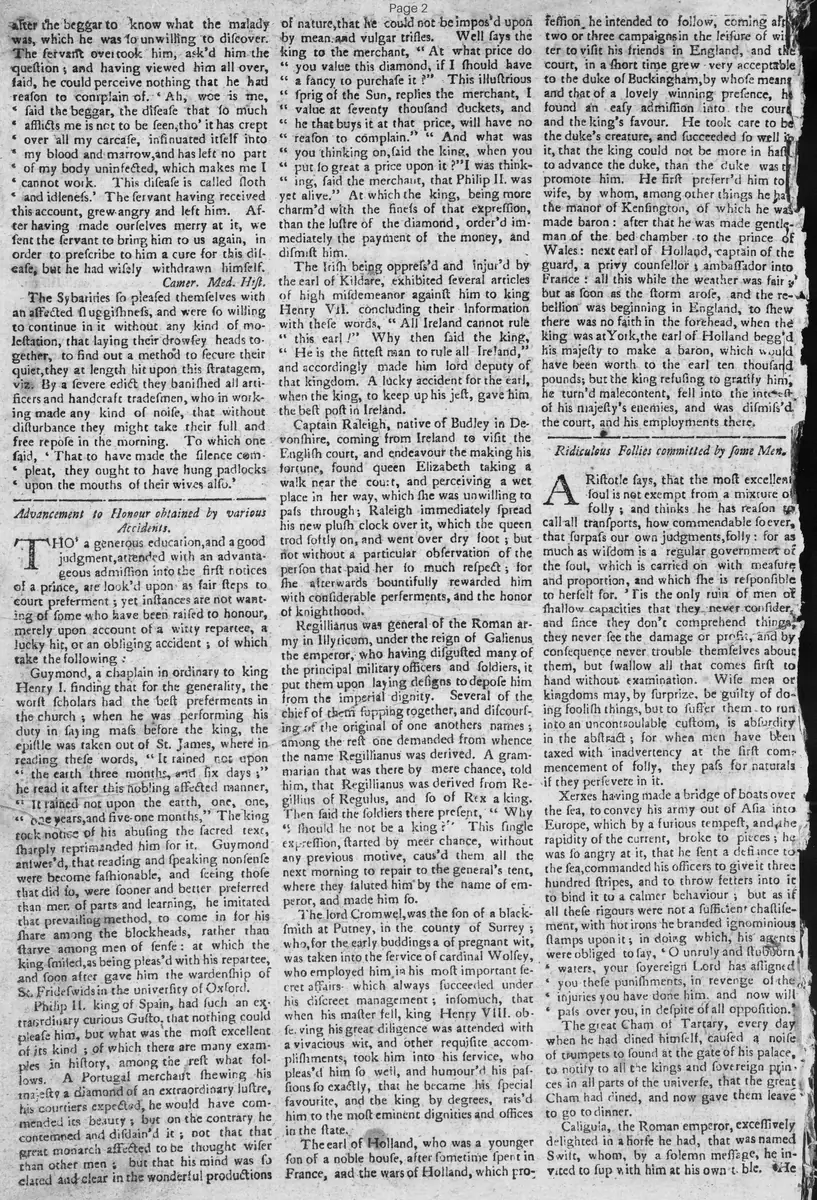
Advancement to Honour obtained by various Accidents.
Tho' a generous education, and a good judgment, attended with an advantageous admission into the first notices of a prince, are look'd upon as fair steps to court preferment; yet instances are not wanting of some who have been raised to honour, merely upon account of a witty repartee, a lucky hit, or an obliging accident; of which take the following:
Guymond, a chaplain in ordinary to king Henry I. finding that for the generality, the worst scholars had the best preferments in the church; when he was performing his duty in saying mass before the king, the epistle was taken out of St. James, where in reading these words, "It rained not upon the earth three years and six months;" he read it after this hobbling affected manner, "It rained not upon the earth, one, one, one years, and five, one months," The king took notice of his abusing the sacred text, sharply reprimanded him for it. Guymond answered, that reading and speaking nonsense were become fashionable, and seeing those that did so, were sooner and better preferred than men of parts and learning, he imitated that prevailing method, to come in for his share among the blockheads, rather than starve among men of sense: at which the king smiled, as being pleas'd with his repartee, and soon after gave him the wardenship of St. Frideswide in the university of Oxford.
Philip II. king of Spain, had such an extraordinary curious gusto, that nothing could please him, but what was the most excellent of its kind; of which there are many examples in history, among the rest what follows. A Portugal merchant shewing his majesty a diamond of an extraordinary lustre, his courtiers expected, he would have commended its beauty; but on the contrary he contemned and disdained it; not that that great monarch affected to be thought wiser than other men; but that his mind was so elevated and clear in the wonderful productions of nature that he could not be imposed upon by mean and vulgar trifles. Well says the king to the merchant, "At what price do you value this diamond, if I should have a fancy to purchase it?" This illustrious prince of the Sun, replies the merchant, I value at seventy thousand ducats, and see he that buys it at that price, will have no reason to complain. "And what was you thinking on, said the king, when you put so great a price upon it?" I was thinking, said the merchant, that Philip II. was yet alive. At which the king, being more charmed with the fineness of that expression, than the lustre of the diamond, order'd immediately the payment of the money, and dismissed him.
The Irish being oppres'd and injur'd by the earl of Kildare, exhibited several articles of high misdemeanor against him to king Henry VII. concluding their information with these words, "All Ireland cannot rule this earl!" Why then said the king, He is the fittest man to rule all Ireland, and accordingly made him lord deputy of that kingdom. A lucky accident for the earl, when the king, to keep up his jest, gave him the best post in Ireland.
Captain Raleigh, native of Budleigh in Devonshire, coming from Ireland to visit the English court, and endeavour the making his fortune, found queen Elizabeth taking a walk near the court, and perceiving a wet place in her way, which she was unwilling to pass through; Raleigh immediately spread his new plush cloak over it, which the queen trod softly on, and went over dry foot: but not without a particular observation of the person that paid her so much respect; for he, afterwards bountifully rewarded him with considerable preferments, and the honor of knighthood.
Regillianus was general of the Roman army in Illyricum, under the reign of Gallienus the emperor, who having disgusted many of the principal military officers and soldiers, it put them upon laying designs to depose him from the imperial dignity. Several of the chief of them supping together, and discoursing as the original of one anothers names; among the rest one demanded from whence the name Regillianus was derived. A grammarian that was there by mere chance, told him, that Regillianus was derived from Regillius of Regulus, and so of Rex a king. Then said the soldiers there present, Why should he not be a king? This single expression, started by meer chance, without any previous motive, caus'd them. all the next morning to repair to the general's tent, where they saluted him by the name of emperor, and made him so.
The lord Cromwell, was the son of a blacksmith at Putney, in the county of Surrey; who, for the early buddings of pregnant wit, was taken into the service of cardinal Wolsey, who employed him in his most important secret affairs- which always succeeded under his discreet management; insomuch, that when his master fell, king Henry VIII. observing his great diligence was attended with a vivacious wit, and other requisite accomplishments; took him into his service, who pleased him so well, and humour'd his passions so exactly, that he became his special favourite, and the king by degrees, rais'd him to the most eminent dignities and offices in the state.
The earl of Holland, who was a younger son of a noble house, after some time spent in France, and the wars of Holland, which profession he intended to follow, coming after two or three campaigns in the leisure of winter to visit his friends in England, and the court, in a short time grew very acceptable to the duke of Buckingham, by whose means and that of a lovely winning presence, he found an easy admission into the court and the king's favour. He took care to be the duke's creature, and succeeded so well in it, that the king could not be more in haste to advance the duke, than the duke was to promote him. He first preferred him to wife, by whom, among other things he had the manor of Kensington, of which he was made baron: after that he was made gentleman of the bed chamber to the prince of Wales: next earl of Holland, captain of the guard, a privy councellor, ambassador into France: all this while the weather was fair but as soon as the storm arose, and the rebellion was beginning in England, to shew there was no faith in the forehead, when the king was at York, the earl of Holland begg'd his majesty to make a baron, which would have been worth to the earl ten thousand pounds; but the king refusing to gratify him, he turn'd malecontent, fell into the interest of his majesty's enemies, and was dismiss'd the court, and his employments there.
Tho' a generous education, and a good judgment, attended with an advantageous admission into the first notices of a prince, are look'd upon as fair steps to court preferment; yet instances are not wanting of some who have been raised to honour, merely upon account of a witty repartee, a lucky hit, or an obliging accident; of which take the following:
Guymond, a chaplain in ordinary to king Henry I. finding that for the generality, the worst scholars had the best preferments in the church; when he was performing his duty in saying mass before the king, the epistle was taken out of St. James, where in reading these words, "It rained not upon the earth three years and six months;" he read it after this hobbling affected manner, "It rained not upon the earth, one, one, one years, and five, one months," The king took notice of his abusing the sacred text, sharply reprimanded him for it. Guymond answered, that reading and speaking nonsense were become fashionable, and seeing those that did so, were sooner and better preferred than men of parts and learning, he imitated that prevailing method, to come in for his share among the blockheads, rather than starve among men of sense: at which the king smiled, as being pleas'd with his repartee, and soon after gave him the wardenship of St. Frideswide in the university of Oxford.
Philip II. king of Spain, had such an extraordinary curious gusto, that nothing could please him, but what was the most excellent of its kind; of which there are many examples in history, among the rest what follows. A Portugal merchant shewing his majesty a diamond of an extraordinary lustre, his courtiers expected, he would have commended its beauty; but on the contrary he contemned and disdained it; not that that great monarch affected to be thought wiser than other men; but that his mind was so elevated and clear in the wonderful productions of nature that he could not be imposed upon by mean and vulgar trifles. Well says the king to the merchant, "At what price do you value this diamond, if I should have a fancy to purchase it?" This illustrious prince of the Sun, replies the merchant, I value at seventy thousand ducats, and see he that buys it at that price, will have no reason to complain. "And what was you thinking on, said the king, when you put so great a price upon it?" I was thinking, said the merchant, that Philip II. was yet alive. At which the king, being more charmed with the fineness of that expression, than the lustre of the diamond, order'd immediately the payment of the money, and dismissed him.
The Irish being oppres'd and injur'd by the earl of Kildare, exhibited several articles of high misdemeanor against him to king Henry VII. concluding their information with these words, "All Ireland cannot rule this earl!" Why then said the king, He is the fittest man to rule all Ireland, and accordingly made him lord deputy of that kingdom. A lucky accident for the earl, when the king, to keep up his jest, gave him the best post in Ireland.
Captain Raleigh, native of Budleigh in Devonshire, coming from Ireland to visit the English court, and endeavour the making his fortune, found queen Elizabeth taking a walk near the court, and perceiving a wet place in her way, which she was unwilling to pass through; Raleigh immediately spread his new plush cloak over it, which the queen trod softly on, and went over dry foot: but not without a particular observation of the person that paid her so much respect; for he, afterwards bountifully rewarded him with considerable preferments, and the honor of knighthood.
Regillianus was general of the Roman army in Illyricum, under the reign of Gallienus the emperor, who having disgusted many of the principal military officers and soldiers, it put them upon laying designs to depose him from the imperial dignity. Several of the chief of them supping together, and discoursing as the original of one anothers names; among the rest one demanded from whence the name Regillianus was derived. A grammarian that was there by mere chance, told him, that Regillianus was derived from Regillius of Regulus, and so of Rex a king. Then said the soldiers there present, Why should he not be a king? This single expression, started by meer chance, without any previous motive, caus'd them. all the next morning to repair to the general's tent, where they saluted him by the name of emperor, and made him so.
The lord Cromwell, was the son of a blacksmith at Putney, in the county of Surrey; who, for the early buddings of pregnant wit, was taken into the service of cardinal Wolsey, who employed him in his most important secret affairs- which always succeeded under his discreet management; insomuch, that when his master fell, king Henry VIII. observing his great diligence was attended with a vivacious wit, and other requisite accomplishments; took him into his service, who pleased him so well, and humour'd his passions so exactly, that he became his special favourite, and the king by degrees, rais'd him to the most eminent dignities and offices in the state.
The earl of Holland, who was a younger son of a noble house, after some time spent in France, and the wars of Holland, which profession he intended to follow, coming after two or three campaigns in the leisure of winter to visit his friends in England, and the court, in a short time grew very acceptable to the duke of Buckingham, by whose means and that of a lovely winning presence, he found an easy admission into the court and the king's favour. He took care to be the duke's creature, and succeeded so well in it, that the king could not be more in haste to advance the duke, than the duke was to promote him. He first preferred him to wife, by whom, among other things he had the manor of Kensington, of which he was made baron: after that he was made gentleman of the bed chamber to the prince of Wales: next earl of Holland, captain of the guard, a privy councellor, ambassador into France: all this while the weather was fair but as soon as the storm arose, and the rebellion was beginning in England, to shew there was no faith in the forehead, when the king was at York, the earl of Holland begg'd his majesty to make a baron, which would have been worth to the earl ten thousand pounds; but the king refusing to gratify him, he turn'd malecontent, fell into the interest of his majesty's enemies, and was dismiss'd the court, and his employments there.
What sub-type of article is it?
Essay
What themes does it cover?
Political
Moral Virtue
What keywords are associated?
Court Preferment
Witty Repartee
Lucky Accidents
Royal Favor
Historical Anecdotes
Advancement To Honor
Literary Details
Title
Advancement To Honour Obtained By Various Accidents.
Form / Style
Collection Of Historical Anecdotes In Prose
Key Lines
"It Rained Not Upon The Earth, One, One, One Years, And Five, One Months,"
"I Was Thinking, Said The Merchant, That Philip Ii. Was Yet Alive."
"All Ireland Cannot Rule This Earl!" Why Then Said The King, He Is The Fittest Man To Rule All Ireland
Raleigh Immediately Spread His New Plush Cloak Over It, Which The Queen Trod Softly On, And Went Over Dry Foot
Why Should He Not Be A King? This Single Expression, Started By Meer Chance