Thank you for visiting SNEWPapers!
Sign up free
Editorial
February 22, 1860
Lynchburg Daily Virginian
Lynchburg, Virginia
What is this article about?
An editorial from the Staunton Spectator defends Judge Thompson against Mr. Fultz's accusations of inefficiency in his judicial duties, citing official records showing Thompson handled more cases than any other Virginia judge in 1859 and reduced docket backlog.
Clipping
OCR Quality
95%
Excellent
Full Text
From the Staunton Spectator.
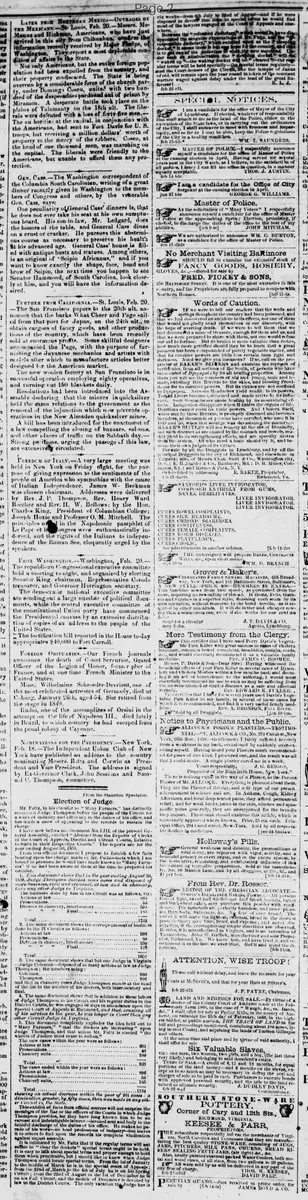
Election of Judge.
Mr. Fultz, in his circular to 'Many Farmers,' has distinctly arraigned Judge Thompson before the people of the Circuit for a want of industry and efficiency in the duties of his office, and has made a show of appealing to the records to sustain the charge.
I have now before me document No. LII. of the present General Assembly, entitled 'Abstract from the Reports of Clerks of the Court of Appeals, District and Circuit Courts, Relative to Suits in their Respective Courts.'
The reports are for the year ending August 30, 1859.
From this official document I propose to furnish a few facts bearing upon the charge made by Mr. Fultz—facts which I am bound to presume he would have made known to 'Many Farmers,' if he had been aware of them at the time he prepared his circular.
1. This document shows that in the year ending August 30, 1859, Judge Thompson decided more cases and disposed more business, civil and criminal, at law and in chancery, than any other Judge in Virginia.
The business done by him in his Circuit was as follows, viz:
Actions at law 896
Prosecutions 543
Decrees in chancery, interlocutory 398
Final 126
Total 1782
2. The same document shows the average amount of business done in the 21 Circuits as follows:
Actions at law 593
Prosecutions 349
Decrees in chancery 253
Final 126
Total 1002
3. The same document shows that but one Judge in Virginia—Judge Coleman—disposed of as many actions at law as Judge Thompson; the numbers being:
Coleman 900
Thompson 896
and that in chancery cases Judge Thompson stands at the head of the list in the number of his decrees, both interlocutory and final.
4. The same document shows that in addition to these labors of Judge Thompson in his Circuit and his regular duties in the District Courts, he was engaged 66 days in attendance upon the Special Court of Appeals at Richmond, and that, counting all of his services in the year, he was longer in Court than any other Circuit Judge in Virginia.
This document completely explodes the idea held out to 'Many Farmers,' 'that the dockets are increasing' upon Judge Thompson, and that unless Mr. Fultz is elected 'the wheels of Justice must cease to roll on.'
The new cases within the year were as follows:
Actions at law 601
Prosecutions 149
Chancery suits 183
Total 933
The cases ended within the year were as follows:
Actions at law 896
Prosecutions 53
Chancery suits 185
Total 1184
showing an actual decrease within the year of 201 cases: a diminution greater, by fifty cases, than was made in any other Circuit in the State.
This exhibit of facts from official sources will not surprise the members of the Bar or the officers of the Courts in which Judge Thompson presides, for they have long known him to be an earnest and indefatigable laborer—devoted soul and body to the faithful discharge of the duties of his office. He makes no parade of his work—no loud profession of industry—but leaves it to others to find upon the records his complete vindication against unjust assaults.
It is intimated by Mr. Fultz that if the regular terms will not suffice to 'clear the dockets' special terms ought to be held. It is easy to talk about special terms and proper enough to hold them when practicable, but I should like to know when Judge Thompson could locate special terms. From the 1st of January to the middle of March he is in the special court of Appeals; from the 22nd of March to the 4th of July he is on his Spring Circuit; from the 22nd of August to the 1st of December he is on his Fall Circuit, and the month of December is devoted by law to the District Courts. The only vacation the Judge has is six weeks from 4th July to 22nd of August—where, between the appointed terms, would he find time to hold special terms?
Under such an administration the 'sleeping docket' seems there to be 'waked up'—the waking docket will be 'cleared'—the recumbent docket aroused—and the Court-houses of the Circuit, like the temple of Janus of old, will remain open the year round in token of the constant warfare waged against delay under the lead of the great Reformer.
R. L. D.
Feb 22—ct.
Election of Judge.
Mr. Fultz, in his circular to 'Many Farmers,' has distinctly arraigned Judge Thompson before the people of the Circuit for a want of industry and efficiency in the duties of his office, and has made a show of appealing to the records to sustain the charge.
I have now before me document No. LII. of the present General Assembly, entitled 'Abstract from the Reports of Clerks of the Court of Appeals, District and Circuit Courts, Relative to Suits in their Respective Courts.'
The reports are for the year ending August 30, 1859.
From this official document I propose to furnish a few facts bearing upon the charge made by Mr. Fultz—facts which I am bound to presume he would have made known to 'Many Farmers,' if he had been aware of them at the time he prepared his circular.
1. This document shows that in the year ending August 30, 1859, Judge Thompson decided more cases and disposed more business, civil and criminal, at law and in chancery, than any other Judge in Virginia.
The business done by him in his Circuit was as follows, viz:
Actions at law 896
Prosecutions 543
Decrees in chancery, interlocutory 398
Final 126
Total 1782
2. The same document shows the average amount of business done in the 21 Circuits as follows:
Actions at law 593
Prosecutions 349
Decrees in chancery 253
Final 126
Total 1002
3. The same document shows that but one Judge in Virginia—Judge Coleman—disposed of as many actions at law as Judge Thompson; the numbers being:
Coleman 900
Thompson 896
and that in chancery cases Judge Thompson stands at the head of the list in the number of his decrees, both interlocutory and final.
4. The same document shows that in addition to these labors of Judge Thompson in his Circuit and his regular duties in the District Courts, he was engaged 66 days in attendance upon the Special Court of Appeals at Richmond, and that, counting all of his services in the year, he was longer in Court than any other Circuit Judge in Virginia.
This document completely explodes the idea held out to 'Many Farmers,' 'that the dockets are increasing' upon Judge Thompson, and that unless Mr. Fultz is elected 'the wheels of Justice must cease to roll on.'
The new cases within the year were as follows:
Actions at law 601
Prosecutions 149
Chancery suits 183
Total 933
The cases ended within the year were as follows:
Actions at law 896
Prosecutions 53
Chancery suits 185
Total 1184
showing an actual decrease within the year of 201 cases: a diminution greater, by fifty cases, than was made in any other Circuit in the State.
This exhibit of facts from official sources will not surprise the members of the Bar or the officers of the Courts in which Judge Thompson presides, for they have long known him to be an earnest and indefatigable laborer—devoted soul and body to the faithful discharge of the duties of his office. He makes no parade of his work—no loud profession of industry—but leaves it to others to find upon the records his complete vindication against unjust assaults.
It is intimated by Mr. Fultz that if the regular terms will not suffice to 'clear the dockets' special terms ought to be held. It is easy to talk about special terms and proper enough to hold them when practicable, but I should like to know when Judge Thompson could locate special terms. From the 1st of January to the middle of March he is in the special court of Appeals; from the 22nd of March to the 4th of July he is on his Spring Circuit; from the 22nd of August to the 1st of December he is on his Fall Circuit, and the month of December is devoted by law to the District Courts. The only vacation the Judge has is six weeks from 4th July to 22nd of August—where, between the appointed terms, would he find time to hold special terms?
Under such an administration the 'sleeping docket' seems there to be 'waked up'—the waking docket will be 'cleared'—the recumbent docket aroused—and the Court-houses of the Circuit, like the temple of Janus of old, will remain open the year round in token of the constant warfare waged against delay under the lead of the great Reformer.
R. L. D.
Feb 22—ct.
What sub-type of article is it?
Partisan Politics
Legal Reform
What keywords are associated?
Judge Election
Judicial Efficiency
Virginia Circuits
Docket Backlog
Court Records
What entities or persons were involved?
Judge Thompson
Mr. Fultz
Judge Coleman
Staunton Spectator
Editorial Details
Primary Topic
Defense Of Judge Thompson's Judicial Efficiency Against Mr. Fultz's Charges
Stance / Tone
Strongly Supportive Of Judge Thompson And Critical Of Mr. Fultz
Key Figures
Judge Thompson
Mr. Fultz
Judge Coleman
Staunton Spectator
Key Arguments
Judge Thompson Decided More Cases Than Any Other Virginia Judge In 1859
Thompson's Circuit Handled 1782 Total Cases Vs. State Average Of 1002
Only Judge Coleman Nearly Matched Thompson In Actions At Law
Thompson Served 66 Days In Special Court Of Appeals And Longest Total Court Time
Dockets Decreased By 201 Cases Under Thompson, More Than Any Other Circuit
Thompson's Schedule Leaves No Time For Special Terms