Thank you for visiting SNEWPapers!
Sign up free
The Savannah Tribune
Savannah, Chatham County, Georgia
What is this article about?
Leaders of colored land-grant colleges met in Nashville to stress need for trained teachers in agriculture and mechanic arts. Discussions covered educational progress in states like Tennessee and Louisiana, Negro farming statistics, vocational training, and committee appointments for curricula and standards. Appreciation expressed to Julius Rosenwald for school-building aid.
Merged-components note: Continuation of domestic news article on Hampton Institute and Negro education needs from page 1 to page 8; relabeled from 'story' on page 8 to match original.
Clippings
1 of 2
OCR Quality
Full Text
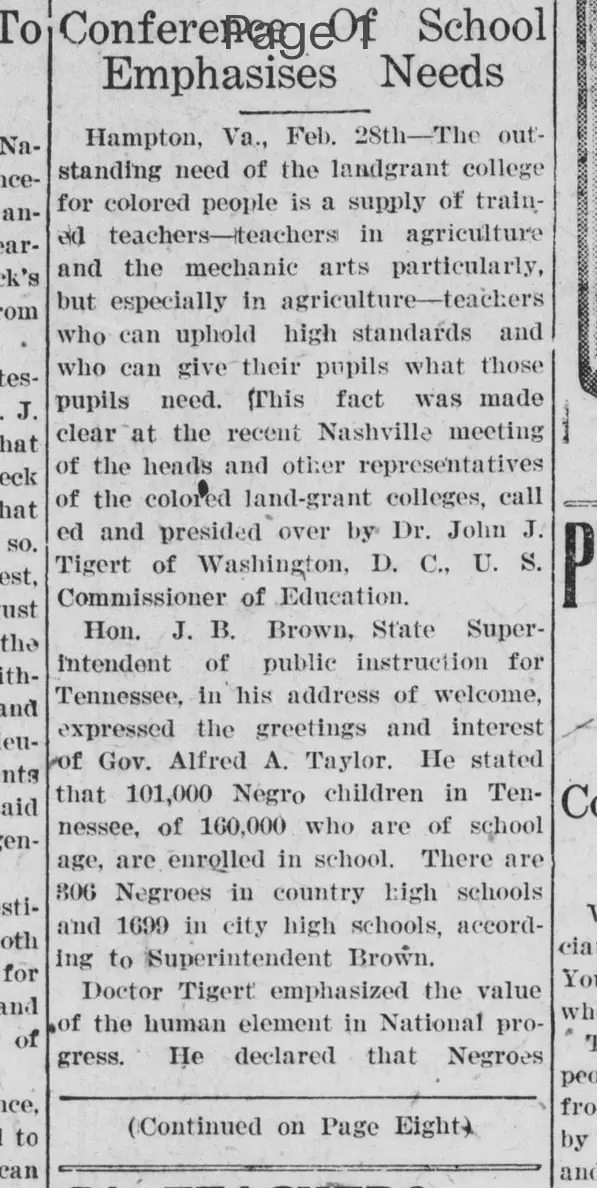
Hampton, Va., Feb. 28th—The outstanding need of the landgrant college for colored people is a supply of trained teachers—teachers in agriculture and the mechanic arts particularly, but especially in agriculture—teachers who can uphold high standards and who can give their pupils what those pupils need. This fact was made clear at the recent Nashville meeting of the heads and other representatives of the colored land-grant colleges, called and presided over by Dr. John J. Tigert of Washington, D. C., U. S. Commissioner of Education.
Hon. J. B. Brown, State Superintendent of public instruction for Tennessee, in his address of welcome, expressed the greetings and interest of Gov. Alfred A. Taylor. He stated that 101,000 Negro children in Tennessee, of 160,000 who are of school age, are enrolled in school. There are 806 Negroes in country high schools and 1699 in city high schools, according to Superintendent Brown.
Doctor Tigert emphasized the value of the human element in National progress.
He declared that Negroes
(Continued on Page Eight)
Continued from Page One.
should be given freely the education which they need and should have. He referred to the progress which States like North Carolina and Louisiana have been making in providing educational facilities for Negroes.
Dr. A. C. True, director of the States Relations Service, U. S. Department of Agriculture, brought the greetings of Secretary Wallace.
Doctor True stated that it is important that the Negro colleges should get a correct idea of their obligations to the people whom they serve, since their work is one phase of a worldwide educational movement for vocational education.
"There are still comparatively few good institutions for vocational training," declared Doctor True. "As long as industries were simple and labor was both cheap and abundant there was comparatively little progress or need of skilled workers. With the application of science to industry, however, there has come a change. The human element in industry is now tremendously important and we cannot have prosperous industrial communities without trained workers."
Education Is Needed for All Groups
"Vocational education is not narrow; it must include the principles and fundamentals of the business and its relations to community life. Negroes need, of course, a certain number of persons who will be professionally trained, as well as mechanics and farmers. There will be gifted Negroes in music, in art, and in literature, who must have the training that is suited to their needs. As with other races however, the majority will be engaged in the more mechanical pursuits. There must be teachers who are well trained to teach others how to farm and how to keep house.
There are 925,000 Negro farmers in the United States, or 15 per cent. of the total number of farmers. Over 700,000 of these Negro farmers are tenant farmers or operators. There are about 2000 Negro farmers who are put down as managers. There are about 218,000 Negro farm owners. In the case of the Negro farm operators, the land and buildings are valued at two and one quarter billion dollars.
"If we can change the standards of living on these farms, which are in charge of Negroes, economic prosperity in general will be likely to increase, because it is so largely dependent on agriculture."
"There are about 160 Negro farm-demonstration agents and about 80 home-demonstration agents who are working under the U. S. Department of Agriculture. There are also two Negro special agents.
"The U. S. Department of Agriculture would like to develop this work further. Yet, even if the Congress should give us a larger fund for this purpose, our greatest difficulty would be to find people with the requisite training and experience. Therefore, the land-grant colleges should try to turn them out. They need more money for this purpose."
Teacher-Training Interests Officials
Charles H. Lane, chief of the agricultural education service of the Federal Board for Vocational Education, outlined the progress which has been made under the Smith-Hughes Act, passed in 1917, in teaching boys and girls in school and in helping farmers and farm-housekeepers through funds which are entirely in the hands of State boards of vocational education. Some State boards, he said, have experienced difficulty in finding teachers upon which they could well spend money. He made a plea for the training of first-class teachers and expressed his belief that State officials are especially interested in the work of teacher-training.
Education for Colored Home-Makers
Miss Anna E. Richardson, chief of the home-economics education service of the Federal Board for Vocational Education, paid a tribute to the excellent work of the home-economics supervisors who are at work in the Southern States. "There are three things which are to be done," she said, "by land-grant colleges for colored girls: train home-makers, train for occupations connected with home-making work and allied activities, and train teachers. These teachers must know what home-making is. They must have a good general education and a good technical or professional training."
Miss Richardson announced that Miss Carrie Alberta Lyford, director of the Hampton Institute Home-Economics School, had been generously released to make a study of the home-economics problems which colored schools are facing.
Negro Institutions Win Public Support
William J. Hale of Nashville, president of the Tennessee Agricultural and Industrial State Normal School, stated that in 1909 three white and one colored normal schools were established in Tennessee. The first year $15,000 were given by Tennessee for its land-grant colleges, while last year $55,000 were given and in addition $75,000 were given for houses. "Word went out," said President Hale, "that 'agricultural' meant training Negroes to plow for white people and that 'industrial' meant training Negro girls to cook for white people."
J. S. Clark, president of Southern University, which is located six miles out of Baton Rouge, La., on the banks of the Mississippi, declared that "the colored land-grant colleges have been called upon to do almost everything." He stated that T. H. Harris, State Superintendent of public instruction, and Gov. John M. Parker have been outstanding figures in Louisiana's educational program.
The first year $10,000 were appropriated for Southern University. The last Legislature appropriated $267,000 for Southern University and also $50,000 for a school for the Negro blind, which has been built on the Southern University campus. Today 1000 colored people own their own homes in the neighborhood of Southern University.
The following Committees on Agricultural Curricula were appointed:
(1) High-School Division—John O. Spencer, chairman, and Wm. J. Hale, secretary; (2) Junior-College Division—L. M. Favrot, chairman, and James B. Rudley, secretary; (3) Senior-College Division—W. B. Bizzell, chairman, and R. S. Wilkinson, secretary.
A Committee on Financial Standings was appointed—J. E. Gregg, chairman, and J. S. Clark, secretary. A Committee on Preparation of Faculty and Standards of Equipment was appointed—J. C. Futrall, chairman, and N. B. Young, secretary. The general chairman was Hon. J. B. Brown and the general secretary was Dr. John M. Gandy, president of the State Normal School at Petersburg, Va.
1223 Rosenwald Schools
The Conference sent a resolution of appreciation to Julius Rosenwald of Chicago for his interest and co-operation in the rural school-building campaign which is going on throughout the South. Today there are 1223 Rosenwald Schools, with a teacher capacity of 2812, built at a total cost of $4,012,923, which has been contributed as follows: Negroes, $1,139,165; whites, $277,668; public funds, $1,840,210, and Rosenwald aid, $775,880.
Dr. Walton C. John of Washington, D. C., specialist in land-grant college statistics, U. S. Bureau of Education, who served as the executive secretary of the Conference, stated the principal objects of this meeting of leaders in colored land-grant college work: the revision of courses of study in agriculture and home economics; the improvement of equipment; the development of higher standards; and the stimulation of more interest so as to secure more adequate financial support for colored land-grant colleges.
What sub-type of article is it?
What keywords are associated?
What entities or persons were involved?
Where did it happen?
Domestic News Details
Primary Location
Nashville, Tennessee
Event Date
Recent (Prior To Feb. 28th)
Key Persons
Outcome
committees appointed on agricultural curricula, financial standings, faculty preparation, and equipment standards. resolution of appreciation sent to julius rosenwald for rural school-building campaign supporting 1223 schools.
Event Details
At a meeting of heads and representatives of colored land-grant colleges in Nashville, presided over by Dr. John J. Tigert, emphasis was placed on the need for trained teachers in agriculture and mechanic arts. Speakers including Hon. J. B. Brown, Dr. A. C. True, Charles H. Lane, and Miss Anna E. Richardson discussed educational progress, statistics on Negro enrollment and farming, vocational training under the Smith-Hughes Act, and the role of land-grant colleges in improving standards and securing funding. Reports from Tennessee and Louisiana highlighted increased appropriations and institutional developments. Statistics provided on Negro farmers, demonstration agents, and Rosenwald schools.