Thank you for visiting SNEWPapers!
Sign up free
Story
February 28, 1882
The Sun
New York, New York County, New York
What is this article about?
George Hendrix arrested without warrant in New York City for allegedly mutilating the André monument in Rockland County; habeas corpus writ granted, remanded pending hearing amid legal protests.
Clipping
OCR Quality
95%
Excellent
Full Text
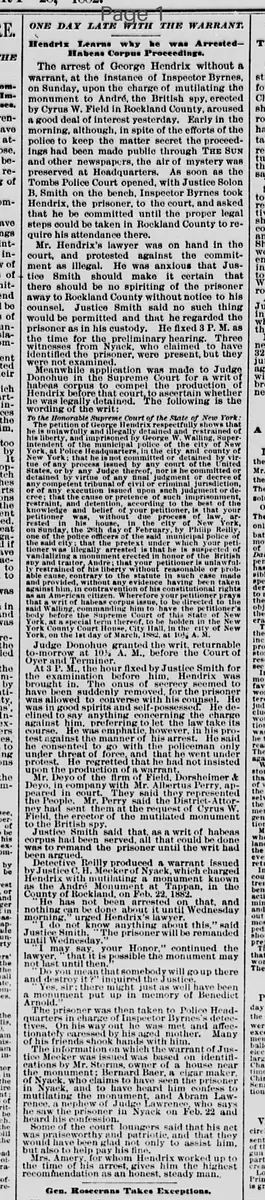
ONE DAY LATE IN THE WARRANT
Hendrix Learns why he was Arrested—Habeas Corpus Proceedings.
The arrest of George Hendrix without a warrant, at the instance of Inspector Byrnes, on Sunday, upon the charge of mutilating the monument to André, the British spy, erected by Cyrus W. Field in Rockland County, aroused a good deal of interest yesterday. Early in the morning, although, in spite of the efforts of the police to keep the matter secret the proceedings had been made public through The Sun and other newspapers, the air of mystery was preserved at Headquarters. As soon as the Tombs Police Court opened, with Justice Solon B. Smith on the bench, Inspector Byrnes took Hendrix, the prisoner, to the court, and asked that he be committed until the proper legal steps could be taken in Rockland County to require his attendance there.
Mr. Hendrix's lawyer was on hand in the court, and protested against the commitment as illegal. He was anxious that Justice Smith should make it certain that there should be no spiriting of the prisoner away to Rockland County without notice to his counsel. Justice Smith said no such thing would be permitted and that he regarded the prisoner as in his custody. He fixed 3 P. M. as the time for the preliminary hearing. Three witnesses from Nyack, who claimed to have identified the prisoner, were present, but they were not examined.
Meanwhile application was made to Judge Donohue in the Supreme Court for a writ of habeas corpus to compel the production of Hendrix before that court, to ascertain whether he was legally detained. The following is the wording of the writ:
To the Honorable Supreme Court of the State of New York:
The petition of George Hendrix respectfully shows that he is unlawfully and illegally detained and restrained of his liberty, and imprisoned by George W. Walling, Superintendent of the municipal police of the city of New York, at Police Headquarters, in the city and county of New York; that he is not committed or detained by virtue of any process issued by any court of the United States, or by any Judge thereof, nor is he committed or detained by virtue of any final judgment or decree of any competent tribunal of civil or criminal jurisdiction, or of any execution issued upon such judgment or decree; that the cause or pretence of such imprisonment, restraint, and detention, according to the best of the knowledge and belief of your petitioner, is that your petitioner was, without due process of law, arrested in his house, in the city of New York, on Sunday, the 26th day of February, by Philip Reilly, one of the police officers of the said municipal police of the said city; that the pretext under which your petitioner was illegally arrested is that he is suspected of vandalizing a monument erected in honor of the British spy and traitor, André; that your petitioner is unlawfully restrained of his liberty without reasonable or probable cause, contrary to the statute in such case made and provided, without any evidence having been taken against him, in contravention of his constitutional rights as an American citizen. Wherefore your petitioner prays that a writ of habeas corpus issue, to be directed to the said Walling, commanding him to have the petitioner's body before the Supreme Court of this State of New York, at a special term thereof, to be holden in the New York County Court House, City Hall, in the city of New York, on the 1st day of March, 1882, at 10½ A. M.
Judge Donohue granted the writ, returnable to-morrow at 10½ A. M., before the Court of Oyer and Terminer.
At 3 P. M., the hour fixed by Justice Smith for the examination before him, Hendrix was brought in. The onus of secrecy seemed to have been suddenly removed, for the prisoner was allowed to converse with his counsel. He was in good spirits and self-possessed. He declined to say anything concerning the charge against him, preferring to let the law take its course. He was emphatic, however, in his protest against the manner of his arrest. He said he consented to go with the policeman only under threat of force, and that he went under protest. He regretted that he had not insisted upon the production of a warrant.
Mr. Deyo of the firm of Field, Dorsheimer & Deyo, in company with Mr. Albertus Perry, appeared in court. They said they represented the People. Mr. Perry said the District-Attorney had sent them at the request of Cyrus W. Field, the erector of the mutilated monument to the British spy.
Justice Smith said that, as a writ of habeas corpus had been served, all that could be done was to remand the prisoner until the writ had been argued.
Detective Reilly produced a warrant issued by Justice C. H. Meeker of Nyack, which charged Hendrix with mutilating a monument known as the André Monument at Tappan, in the County of Rockland, on Feb. 22, 1882.
"He has not been arrested on that, and nothing can be done about it until Wednesday morning," urged Hendrix's lawyer.
"I do not know anything about this," said Justice Smith. "The prisoner will be remanded until Wednesday."
"I may say, your Honor," continued the lawyer, "that it is possible the monument may not last until then."
"Do you mean that somebody will go up there and destroy it?" inquired the Justice.
"Yes, sir; there might just as well have been a monument put up in memory of Benedict Arnold."
The prisoner was then taken to Police Headquarters in charge of Inspector Byrnes's detectives. On his way out he was met and affectionately caressed by his aged mother. Many of his friends shook hands with him.
The information on which the warrant of Justice Meeker was issued was based on identifications by Mr. Storms, owner of a house near the monument; Bernard Baer, a cigar maker of Nyack, who claims to have seen the prisoner in Nyack, and to have heard him confess to mutilating the monument, and Abram Lawrence, a nephew of Judge Lawrence, who says he saw the prisoner in Nyack on Feb. 22 and heard his confession.
Some of the court loungers said that his act was praiseworthy and patriotic, and that they would have been glad not only to assist him, but also to help pay his fine.
Mrs. Amery, for whom Hendrix worked up to the time of his arrest, gives him the highest recommendation as an honest, steady man.
Hendrix Learns why he was Arrested—Habeas Corpus Proceedings.
The arrest of George Hendrix without a warrant, at the instance of Inspector Byrnes, on Sunday, upon the charge of mutilating the monument to André, the British spy, erected by Cyrus W. Field in Rockland County, aroused a good deal of interest yesterday. Early in the morning, although, in spite of the efforts of the police to keep the matter secret the proceedings had been made public through The Sun and other newspapers, the air of mystery was preserved at Headquarters. As soon as the Tombs Police Court opened, with Justice Solon B. Smith on the bench, Inspector Byrnes took Hendrix, the prisoner, to the court, and asked that he be committed until the proper legal steps could be taken in Rockland County to require his attendance there.
Mr. Hendrix's lawyer was on hand in the court, and protested against the commitment as illegal. He was anxious that Justice Smith should make it certain that there should be no spiriting of the prisoner away to Rockland County without notice to his counsel. Justice Smith said no such thing would be permitted and that he regarded the prisoner as in his custody. He fixed 3 P. M. as the time for the preliminary hearing. Three witnesses from Nyack, who claimed to have identified the prisoner, were present, but they were not examined.
Meanwhile application was made to Judge Donohue in the Supreme Court for a writ of habeas corpus to compel the production of Hendrix before that court, to ascertain whether he was legally detained. The following is the wording of the writ:
To the Honorable Supreme Court of the State of New York:
The petition of George Hendrix respectfully shows that he is unlawfully and illegally detained and restrained of his liberty, and imprisoned by George W. Walling, Superintendent of the municipal police of the city of New York, at Police Headquarters, in the city and county of New York; that he is not committed or detained by virtue of any process issued by any court of the United States, or by any Judge thereof, nor is he committed or detained by virtue of any final judgment or decree of any competent tribunal of civil or criminal jurisdiction, or of any execution issued upon such judgment or decree; that the cause or pretence of such imprisonment, restraint, and detention, according to the best of the knowledge and belief of your petitioner, is that your petitioner was, without due process of law, arrested in his house, in the city of New York, on Sunday, the 26th day of February, by Philip Reilly, one of the police officers of the said municipal police of the said city; that the pretext under which your petitioner was illegally arrested is that he is suspected of vandalizing a monument erected in honor of the British spy and traitor, André; that your petitioner is unlawfully restrained of his liberty without reasonable or probable cause, contrary to the statute in such case made and provided, without any evidence having been taken against him, in contravention of his constitutional rights as an American citizen. Wherefore your petitioner prays that a writ of habeas corpus issue, to be directed to the said Walling, commanding him to have the petitioner's body before the Supreme Court of this State of New York, at a special term thereof, to be holden in the New York County Court House, City Hall, in the city of New York, on the 1st day of March, 1882, at 10½ A. M.
Judge Donohue granted the writ, returnable to-morrow at 10½ A. M., before the Court of Oyer and Terminer.
At 3 P. M., the hour fixed by Justice Smith for the examination before him, Hendrix was brought in. The onus of secrecy seemed to have been suddenly removed, for the prisoner was allowed to converse with his counsel. He was in good spirits and self-possessed. He declined to say anything concerning the charge against him, preferring to let the law take its course. He was emphatic, however, in his protest against the manner of his arrest. He said he consented to go with the policeman only under threat of force, and that he went under protest. He regretted that he had not insisted upon the production of a warrant.
Mr. Deyo of the firm of Field, Dorsheimer & Deyo, in company with Mr. Albertus Perry, appeared in court. They said they represented the People. Mr. Perry said the District-Attorney had sent them at the request of Cyrus W. Field, the erector of the mutilated monument to the British spy.
Justice Smith said that, as a writ of habeas corpus had been served, all that could be done was to remand the prisoner until the writ had been argued.
Detective Reilly produced a warrant issued by Justice C. H. Meeker of Nyack, which charged Hendrix with mutilating a monument known as the André Monument at Tappan, in the County of Rockland, on Feb. 22, 1882.
"He has not been arrested on that, and nothing can be done about it until Wednesday morning," urged Hendrix's lawyer.
"I do not know anything about this," said Justice Smith. "The prisoner will be remanded until Wednesday."
"I may say, your Honor," continued the lawyer, "that it is possible the monument may not last until then."
"Do you mean that somebody will go up there and destroy it?" inquired the Justice.
"Yes, sir; there might just as well have been a monument put up in memory of Benedict Arnold."
The prisoner was then taken to Police Headquarters in charge of Inspector Byrnes's detectives. On his way out he was met and affectionately caressed by his aged mother. Many of his friends shook hands with him.
The information on which the warrant of Justice Meeker was issued was based on identifications by Mr. Storms, owner of a house near the monument; Bernard Baer, a cigar maker of Nyack, who claims to have seen the prisoner in Nyack, and to have heard him confess to mutilating the monument, and Abram Lawrence, a nephew of Judge Lawrence, who says he saw the prisoner in Nyack on Feb. 22 and heard his confession.
Some of the court loungers said that his act was praiseworthy and patriotic, and that they would have been glad not only to assist him, but also to help pay his fine.
Mrs. Amery, for whom Hendrix worked up to the time of his arrest, gives him the highest recommendation as an honest, steady man.
What sub-type of article is it?
Crime Story
Historical Event
What themes does it cover?
Crime Punishment
Justice
What keywords are associated?
Hendrix Arrest
Andre Monument
Vandalism
Habeas Corpus
Rockland County
British Spy
What entities or persons were involved?
George Hendrix
Inspector Byrnes
Cyrus W. Field
Justice Solon B. Smith
Judge Donohue
Philip Reilly
Where did it happen?
New York City And Rockland County, New York
Story Details
Key Persons
George Hendrix
Inspector Byrnes
Cyrus W. Field
Justice Solon B. Smith
Judge Donohue
Philip Reilly
Location
New York City And Rockland County, New York
Event Date
February 22, 1882 (Mutilation); February 26, 1882 (Arrest); March 1, 1882 (Writ)
Story Details
George Hendrix arrested without warrant in New York for allegedly mutilating the André monument in Rockland County; protests illegality, secures habeas corpus writ; remanded pending hearing as witnesses identify him and legal proceedings unfold.