Thank you for visiting SNEWPapers!
Sign up free
Lynchburg Star
Lynchburg, Virginia
What is this article about?
Samuel G. Ogden's 1806 memorial to U.S. Congress protests his arrest and legal persecution in New York for aiding General Miranda's expedition to Caracas, alleging executive knowledge and approval amid tensions with Spain, coercive testimony, excessive bail, and biased court proceedings by Judge Tallmadge.
Merged-components note: These components form the complete Memorial of Samuel G. Ogden, continued across multiple segments on page 1.
Clipping
OCR Quality
Full Text
FROM THE UNITED STATES' GAZETTE.
To the honorable the Senate and House of Representatives of the United States of America, in Congress assembled,
THE MEMORIAL
Of Samuel G. Ogden Of The city of New-York, Merchant,
[Concluded.]
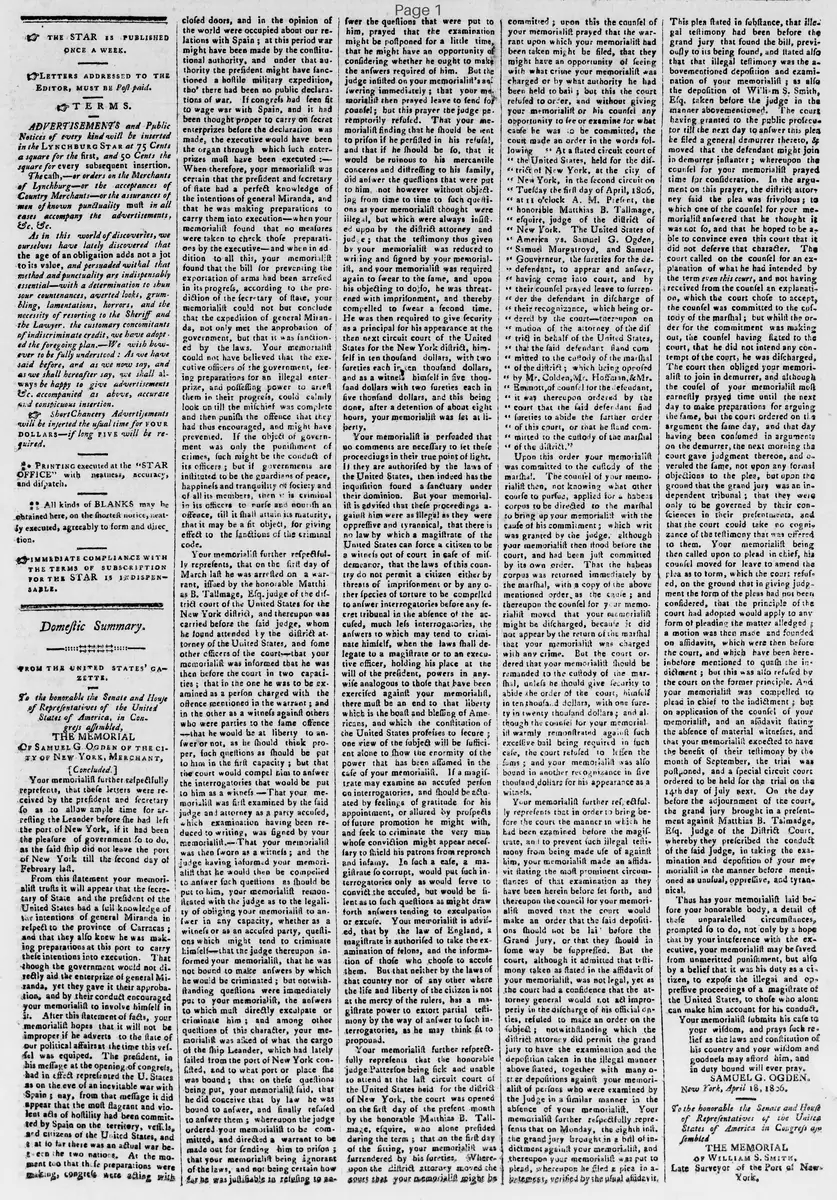
Your memorialist in further respectfully represents, that the letters were received by the president and secretary so as to allow ample time for arresting the Leander before he had left the port of New York, if it had been the pleasure of government so to do, as the said ship did not leave the port of New York till the second day of February last.
From this statement your memorialist trusts it will appear that the secretary of State and the president of the United States had a full knowledge of the intentions of general Miranda in respect to the province of Carracas; and that they also knew he was making preparations at this port to carry those intentions into execution. That though the government would not directly aid the enterprize of general Miranda, yet they gave it their approbation, and by their conduct encouraged your memorialist to involve himself in it. After this statement of facts, your memorialist hopes that it will not be improper if he adverts to the state of our political affairs at the time this vessel was equipped. The president, in his message at the opening of congress, had in effect represented the U. States as on the eve of an inevitable war with Spain; nay, from that message it did appear that the most flagrant and violent acts of hostility had been committed by Spain on the territory, vessels, and citizens of the United States, and that at least there was an actual war between the two nations. At the moment too that these preparations were making, congress were acting with closed doors, and in the opinion of the world were occupied about our relations with Spain; at this period war might have been made by the constitutional authority, and under that authority the president might have sanctioned a hostile military expedition, though there had been no public declarations of war. If congress had seen fit to wage war with Spain, and it had been thought proper to carry on secret enterprizes before the declaration was made, the executive would have been the organ through which such enterprizes must have been executed:-- When therefore, your memorialist was certain that the president and secretary of state had a perfect knowledge of the intentions of general Miranda, and that he was making preparations to carry them into execution--when your memorialist found that no measures were taken to check those preparations by the executive--and when in addition to all this, your memorialist found that the bill for preventing the exportation of arms had been arrested in its progress, according to the prediction of the secretary of state, your memorialist could not but conclude that the expedition of general Miranda, not only met the approbation of government, but that it was sanctioned by the laws. Your memorialist could not have believed that the executive officers of the government, seeing preparations for an illegal enterprize, and possessing power to arrest them in their progress, could calmly look on till the mischief was complete and then punish the offence that they had thus encouraged, and might have prevented. If the object of government was only the punishment of crimes, such might be the conduct of its officers; but if governments are instituted to be the guardians of peace, happiness and tranquility of society and of all its members, then it is criminal in its officers to nurse and nourish an offence, till it shall attain its maturity, that it may be a fit object, for giving effect to the sanctions of the criminal code.
Your memorialist further respectfully represents, that on the first day of March last he was arrested on a warrant, issued by the honorable Matthias B. Tallmage, Esq. judge of the district court of the United States for the New York district, and thereupon was carried before the said judge, whom he found attended by the district attorney of the United States, and some other officers of the court--that your memorialist was informed that he was then before the court in two capacities; that in the one he was to be examined as a person charged with the offence mentioned in the warrant: and in the other as a witness against others who were parties to the same offence --that he would be at liberty to answer or not, as he should think proper, such questions as should be put to him in the first capacity: but that the court would compel him to answer the interrogatories that would be put to him as a witness --That your memorialist was first examined by the said judge and attorney as a party accused, which examination having been reduced to writing, was signed by your memorialist.- That your memorialist was then sworn as a witness; and the judge having informed your memorialist that he would then be compelled to answer such questions as should be put to him, your memorialist remonstrated with the judge as to the legality of obliging your memorialist to answer in any capacity, whether as a witness or as an accused party, questions which might tend to criminate himself--that the judge thereupon informed your memorialist, that he was not bound to make answers by which he would be criminated; but notwithstanding questions were immediately put to your memorialist, the answers to which must directly exculpate or criminate him; and among other questions of this character, your memorialist was asked of what the cargo of the ship Leander, which had lately sailed from the port of New York consisted, and to what port or place she was bound; that on these questions being put, your memorialist said, that he did conceive that by law he was bound to answer, and finally refused to answer them; whereupon the judge ordered your memorialist to be committed, and directed a warrant to be made out for sending him to prison; that your memorialist being ignorant of the laws, and not being certain how far the questions that were put to him, prayed that the examination might be postponed for a little time, that he might have an opportunity of considering whether he ought to make the answers required of him. But the judge insisted on your memorialist's answering immediately; that your memorialist then prayed leave to send for counsel: but this prayer the judge peremptorily refused. That your memorialist finding that he should be sent to prison if he persisted in his refusal, and that if he should be so, that it would be ruinous to his mercantile concerns and distressing to his family, did answer the questions that were put to him, not however without objecting from time to time to such questions as your memorialist thought were illegal, but which were always insisted upon by the district attorney and judge; that the testimony thus given by your memorialist was reduced to writing and signed by your memorialist, and your memorialist was required again to swear to the same, and upon his objecting to do so, he was threatened with imprisonment, and thereby compelled to swear a second time. He was then required to give security as a principal for his appearance at the then next circuit court of the United States for the New York district, himself in ten thousand dollars, with two sureties each in ten thousand dollars, and as a witness himself in five thousand dollars with two sureties each in five thousand dollars, and this being done, after a detention of about eight hours, your memorialist was set at liberty:
Your memorialist is persuaded that no comments are necessary to set these proceedings in their true point of light. If they are authorized by the laws of the United States, then indeed has the inquisition found a sanctuary under their dominion. But your memorialist is advised that these proceedings against him were as illegal as they were oppressive and tyrannical, that there is no law by which a magistrate of the United States can force a citizen to be a witness out of court in case of misdemeanor, that the laws of this country do not permit a citizen either by threats of imprisonment or by any other species of torture to be compelled to answer interrogatories before any secret tribunal in the absence of the accused, much less interrogatories, the answers to which may tend to criminate himself, when the laws shall delegate to a magistrate or to an executive officer, holding his place at the will of the president, powers in anywise analogous to those that have been exercised against your memorialist, there must be an end to that liberty which is the boast and blessing of Americans, and which the constitution of the United States professes to secure; one view of the subject will be sufficient alone to show the enormity of the power that has been assumed in the case of your memorialist. If a magistrate may examine an accused person on interrogatories, and should be actuated by feelings of gratitude for his appointment, or allured by prospects of future promotion he might wish, and seek to criminate the very man whose conviction might appear necessary to shield his patrons from reproach and infamy. In such a case, a magistrate so corrupt, would put such interrogatories only as would serve to convict the accused, but would be silent as to such questions as might draw forth answers tending to exculpation or excuse. Your memorialist is advised, that by the law of England, a magistrate is authorized to take the examination of felons, and the information of those who choose to accuse them. But that neither by the laws of that country nor of any other where the life and liberty of the citizen is not at the mercy of the rulers, has a magistrate power to extort partial testimony by the way of answer to such interrogatories, as he may think fit to propound.
Your memorialist further respectfully represents that the honorable judge Patterson being sick and unable to attend at the last circuit court of the United States held for the district of New York, the court was opened on the first day of the present month by the honorable Matthias B. Tallmage, esquire, who alone presided during the term; that on the first day of the sitting, your memorialist was surrendered by his sureties. Whereupon the district attorney moved the court that your memorialist might be committed; upon this the counsel of your memorialist prayed that the warrant upon which your memorialist had been taken might be filed, that they might have an opportunity of seeing with what crime your memorialist was charged or by what authority he had been held to bail; but this the court refused to order, and without giving your memorialist or his counsel any opportunity to see or examine for what cause he was to be committed, the court made an order in the words following: At a stated circuit court of "the United States, held for the dis- "trict of New York, at the city of "New York, in the second circuit on "Tuesday the first day of April, 1806, "at 10 o'clock A. M. Present, the "honorable Matthias B. Tallmage, "esquire, judge of the district of "New York. The United States of "America vs. Samuel G. Ogden, "Samuel Murgatroyd, and Samuel "Gouverneur, the sureties for the de- "fendant, to appear and answer, "having come into court, and by "their counsel prayed leave to surren- "der the defendant in discharge of "their recognizance, which being or- "dered by the court--thereupon on "motion of the attorney of the dis- "trict in behalf of the United States, "that the said defendant stand com- "mitted to the custody of the marshal "of the district; which being opposed "by Mr. Colden, Mr. Hoffman, & Mr. "Emott, of counsel for the defendant, "it was thereupon ordered by the "court that the said defendant find "sureties to abide the further order "of this court, or that he stand com- "mitted to the custody of the marshal "of the district."
Upon this order your memorialist was committed to the custody of the marshal. The counsel of your memorialist then, not knowing what other course to pursue, applied for a habeas corpus to be directed to the marshal to bring up your memorialist with the cause of his commitment; which writ was granted by the judge; although your memorialist then stood before the court, and had been just committed by its own order. That the habeas corpus was returned immediately by the marshal, with a copy of the above mentioned order as the cause; and thereupon the counsel for your memorialist moved that your memorialist might be discharged, because it did not appear by the return of the marshal that your memorialist was charged with any crime. But the court ordered that your memorialist should be remanded to the custody of the marshal, unless he should give security to abide the order of the court, himself in ten thousand dollars, with one surety in twenty thousand dollars: and although the counsel for your memorialist warmly remonstrated against such excessive bail being required in such case, the court refused to lessen the sums; and your memorialist was also bound in another recognizance in five thousand dollars for his appearance as a witness.
Your memorialist further respectfully represents that in order to bring before the court the manner in which he had been examined before the magistrate, and to prevent such illegal testimony from being made use of against him, your memorialist made an affidavit stating the most prominent circumstances of that examination as they have been herein before set forth, and thereupon the counsel for your memorialist moved that the court would make an order that the said depositions should not be laid before the Grand Jury, or that they should in some way be suppressed. But the court, although it admitted that testimony taken as stated in the affidavit of your memorialist, was not legal, yet as the court had a confidence that the attorney general would not act improperly in the discharge of his official duties, refused to make an order on the subject; notwithstanding which the district attorney did permit the grand jury to have the examination and the deposition taken in the illegal manner above stated, together with many other depositions against your memorialist of persons who were examined by the Judge in a similar manner in the absence of your memorialist. Your memorialist further respectfully represents that on Monday, the eighth inst. the grand jury brought in a bill of indictment against your memorialist, and thereupon your memorialist was put to plead, whereupon he filed a plea in abatement, verified by the usual affidavit. This plea stated in substance, that illegal testimony had been before the grand jury that found the bill, previously to its being found, and stated also that that illegal testimony was the abovementioned deposition and examination of your memorialist; as also the deposition of William S. Smith, Esq. taken before the judge in the manner abovementioned. The court having granted to the public prosecutor till the next day to answer this plea he filed a general demurrer thereto, & moved that the defendant might join in demurrer instanter; whereupon the counsel for your memorialist prayed time for consideration. In the argument on this prayer, the district attorney said the plea was frivolous; to which one of the counsel for your memorialist answered that he thought it was not so, and that he hoped to be able to convince even this court that it did not deserve that character. The court called on the counsel for an explanation of what he had intended by the term even this court, and not having received from the counsel an explanation, which the court chose to accept, the counsel was committed to the custody of the marshal; but whilst the order for the commitment was making out, the counsel having stated to the court, that he did not intend any contempt of the court, he was discharged. The court then obliged your memorialist to join in demurrer, and although the counsel of your memorialist most earnestly prayed time until the next day to make preparations for arguing the same, but the court ordered on the argument the same day, and that day having been consumed in arguments on the demurrer, the next morning the court gave judgment thereon, and overruled the same, not upon any formal objections to the plea, but upon the ground that the grand jury was an independent tribunal; that they were only to be governed by their consciences in their presentments, and that the court could take no cognizance of the testimony that was offered to them. Your memorialist being then called upon to plead in chief, his counsel moved for leave to amend the plea as to form, which the court refused, on the ground that in giving judgment the form of the pleas had not been considered, that the principle of the court had adopted would apply to any form of pleading the matter alleged as a motion was then made and founded on affidavits, which were then before the court, and which have been herein before mentioned to quash the indictment; but this was also refused by the court on the former principle. And your memorialist was compelled to plead in chief to the indictment; but on application of the counsel of your memorialist, and an affidavit stating the absence of material witnesses, and that your memorialist expected to have the benefit of their testimony by the month of September, the trial was postponed, and a special circuit court ordered to be held for the trial on the 14th day of July next. On the day before the adjournment of the court, the grand jury brought in a presentment against Matthias B. Tallmadge, Esq. Judge of the District Court, whereby they prescribed the conduct of the said Judge, in taking the examination and deposition of your memorialist in the manner before mentioned as unusual, oppressive, and tyrannical.
Thus has your memorialist laid before your honorable body, a detail of these unparallelled circumstances, prompted so to do, not only by a hope that by your interference with the executive, your memorialist may be saved from unmerited punishment, but also by a belief that it was his duty as a citizen, to expose the illegal and oppressive proceedings of a magistrate of the United States, to those who alone can make him account for his conduct. Your memorialist submits his case to your wisdom, and prays such relief as the laws and constitution of his country and your wisdom and goodness may afford him, and in duty bound will ever pray.
SAMUEL G. OGDEN.
New York, April 18, 1806.
What sub-type of article is it?
What keywords are associated?
What entities or persons were involved?
Where did it happen?
Domestic News Details
Primary Location
New York
Event Date
1806
Key Persons
Outcome
ogden arrested march 1, 1806; compelled to testify under threat; excessive bail required; indicted april 8, 1806; trial postponed to july 14, 1806; grand jury presentment against judge tallmadge for oppressive conduct.
Event Details
Samuel G. Ogden petitions Congress regarding his involvement in equipping General Miranda's expedition to Caracas aboard the Leander, which departed New York on February 2, 1806. He claims U.S. executive knowledge and tacit approval amid war tensions with Spain. Arrested and subjected to coercive examination by Judge Tallmadge; faced biased circuit court proceedings, illegal testimony use, overruled pleas, and excessive bail.