Thank you for visiting SNEWPapers!
Sign up free
The Calumet News
Calumet, Houghton County, Michigan
What is this article about?
Astronomers, including Prof. S. A. Mitchell of Columbia University, are disappointed by Halley's Comet's dimmer-than-expected brightness, complicating observations. Prof. E. E. Barnard spotted it on April 12. It will brighten, becoming naked-eye visible from May 10-15, peaking on May 18. No danger from cyanogen. Visible in St. Johns, N.F., on April 19.
Clipping
OCR Quality
Full Text
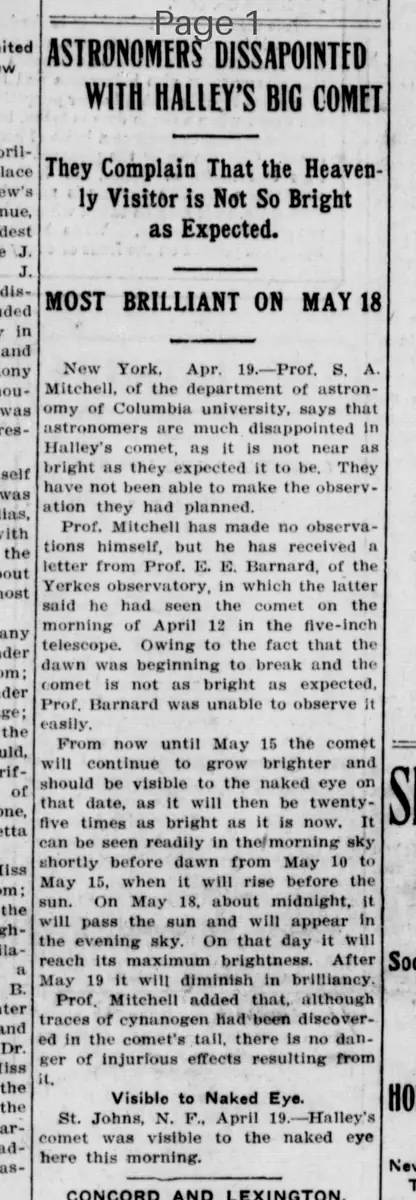
They Complain That the Heavenly Visitor is Not So Bright as Expected.
MOST BRILLIANT ON MAY 18
New York, Apr. 19.—Prof. S. A. Mitchell, of the department of astronomy of Columbia university, says that astronomers are much disappointed in Halley's comet, as it is not near as bright as they expected it to be. They have not been able to make the observation they had planned.
Prof. Mitchell has made no observations himself, but he has received a letter from Prof. E. E. Barnard, of the Yerkes observatory, in which the latter said he had seen the comet on the morning of April 12 in the five-inch telescope. Owing to the fact that the dawn was beginning to break and the comet is not as bright as expected, Prof. Barnard was unable to observe it easily.
From now until May 15 the comet will continue to grow brighter and should be visible to the naked eye on that date, as it will then be twenty-five times as bright as it is now. It can be seen readily in the morning sky shortly before dawn from May 10 to May 15, when it will rise before the sun. On May 18, about midnight, it will pass the sun and will appear in the evening sky. On that day it will reach its maximum brightness. After May 19 it will diminish in brilliancy.
Prof. Mitchell added that, although traces of cyanogen had been discovered in the comet's tail, there is no danger of injurious effects resulting from it.
Visible to Naked Eye
St. Johns, N. F., April 19.—Halley's comet was visible to the naked eye here this morning.
What sub-type of article is it?
What themes does it cover?
What keywords are associated?
What entities or persons were involved?
Where did it happen?
Story Details
Key Persons
Location
New York; Columbia University; Yerkes Observatory; St. Johns, N. F.
Event Date
April 19, 1910; April 12, 1910; May 10 To May 15, 1910; May 18, 1910
Story Details
Astronomers disappointed by Halley's Comet's dimness preventing planned observations; sighted faintly on April 12; expected to brighten 25 times by May 15 for naked-eye visibility before dawn; peaks at maximum brightness on May 18 after passing sun; no harm from cyanogen; visible to naked eye in St. Johns on April 19.