Thank you for visiting SNEWPapers!
Sign up free
The New Hampshire Gazette
Portsmouth, Rockingham County, New Hampshire
What is this article about?
Geographical and economic description of Newfoundland, an English possession discovered by John Cabot in 1497, highlighting its terrain, climate, harbors, sparse settlements focused on cod fishing, wildlife, and the valuable fishery on the Great Bank.
Clipping
OCR Quality
Full Text
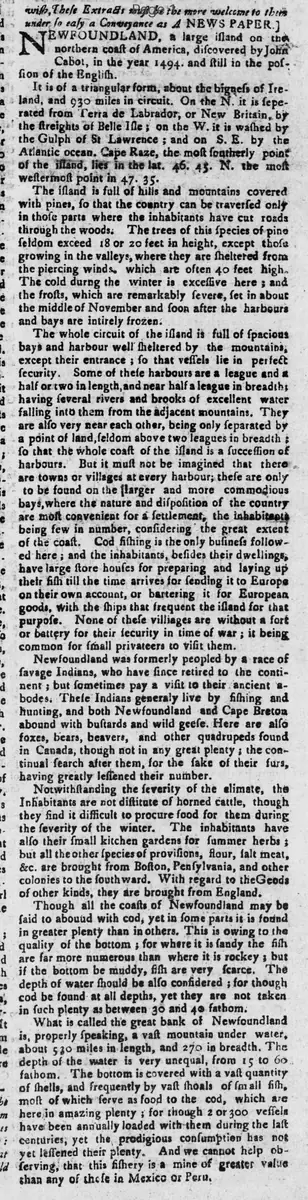
It is of a triangular form, about the bigness of Ireland, and 920 miles in circuit. On the N. it is separated from Terra de Labrador, or New Britain, by the straights of Belle Isle; on the W. it is washed by the Gulph of St Lawrence; and on S. E. by the Atlantic ocean. Cape Race, the most southerly point of the island, lies in the lat. 46° 45' N. the most westermost point in 47° 35'.
The island is full of hills and mountains covered with pines, so that the country can be traversed only in those parts where the inhabitants have cut roads through the woods: The trees of this species of pine seldom exceed 18 or 20 feet in height, except those growing in the valleys, where they are sheltered from the piercing winds, which are often 40 feet high. The cold during the winter is excessive here; and the frosts, which are remarkably severe, set in about the middle of November and soon after the harbours and bays are entirely frozen:
The whole circuit of the island is full of spacious bays and harbours well sheltered by the mountains, except their entrance; so that vessels lie in perfect security. Some of these harbours are a league and a half or two in length, and near half a league in breadth; having several rivers and brooks of excellent water falling into them from the adjacent mountains. They are also very near each other, being only separated by a point of land, seldom above two leagues in breadth: so that the whole coast of the island is a succession of harbours. But it must not be imagined that there are towns or villages at every harbour; these are only to be found on the larger and more commodious bays, where the nature and disposition of the country are most convenient for a settlement, the inhabitants being few in number, considering the great extent of the coast. Cod fishing is the only business followed here; and the inhabitants, besides their dwellings, have large store houses for preparing and laying up their fish till the time arrives for sending it to Europe on their own account, or bartering it for European goods, with the ships that frequent the island for that purpose. None of these villages are without a fort or battery for their security in time of war; it being common for small privateers to visit them.
Newfoundland was formerly peopled by a race of savage Indians, who have since retired to the continent; but sometimes pay a visit to their ancient abodes. These Indians generally live by fishing and hunting, and both Newfoundland and Cape Breton abound with bustards and wild geese. Here are also foxes, bears, beavers, and other quadrupeds found in Canada, though not in any great plenty; the continual search after them, for the sake of their furs, having greatly lessened their number.
Notwithstanding the severity of the climate, the Inhabitants are not destitute of horned cattle, though they find it difficult to procure food for them during the severity of the winter. The inhabitants have also their small kitchen gardens for summer herbs; but all the other species of provisions, flour, salt meat, &c. are brought from Boston, Pennsylvania, and other colonies to the southward. With regard to the Goods of other kinds, they are brought from England.
Though all the coasts of Newfoundland may be said to abound with cod, yet in some parts it is found in greater plenty than in others. This is owing to the quality of the bottom; for where it is sandy the fish are far more numerous than where it is rocky; but if the bottom be muddy, fish are very scarce. The depth of water should be also considered; for though cod be found at all depths, yet they are not taken in such plenty as between 30 and 40 fathom.
What is called the great bank of Newfoundland is, properly speaking, a vast mountain under water, about 300 miles in length, and 200 in breadth. The depth of the water is very unequal, from 15 to 60 fathom. The bottom is covered with a vast quantity of shells, and frequently by vast shoals of small fish, most of which serve as food to the cod, which are here in amazing plenty; for though 200 or 300 vessels have been annually loaded with them during the last centuries, yet the prodigious consumption has not yet lessened their plenty. And we cannot help observing, that this fishery is a mine of greater value than any of those in Mexico or Peru.
What sub-type of article is it?
What keywords are associated?
What entities or persons were involved?
Where did it happen?
Domestic News Details
Primary Location
Newfoundland
Event Date
Discovered By John Cabot, In The Year 1497
Key Persons
Event Details
Newfoundland is an English possession, triangular in shape like Ireland, with hilly pine-covered terrain, severe winters, numerous harbors for secure vessel anchorage, sparse settlements engaged in cod fishing, trade with Europe and southern colonies, former Indian inhabitants now on continent, wildlife including bustards, geese, foxes, bears, beavers; Great Bank yields abundant cod despite heavy fishing.