Thank you for visiting SNEWPapers!
Sign up free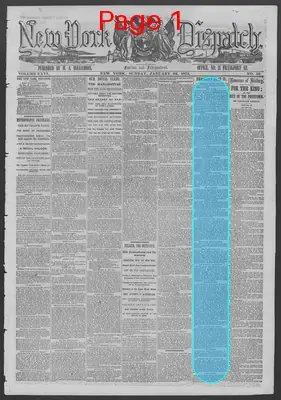
Story
January 22, 1871
New York Dispatch
New York, New York County, New York
What is this article about?
Overview of Brooklyn's rapid growth from a small village in 1825 with 8,000 residents to a major city of over 400,000 by the late 19th century, highlighting its population, government, improvements, connections to New York, financial institutions, warehouses, parks, churches, and cultural associations.
Clipping

OCR Quality
95%
Excellent
Full Text
BROOKLYN AS IT IS.
How "great oaks from little acorns grow" we have few more marked and notable examples than is furnished by Brooklyn.
WHAT IT WAS within the memory of many people still living, is easily told. What it is at the present time we propose, concisely but comprehensively, to show in this article. What it may be at some not far distant day, the reader can as readily imagine and prognosticate as ourselves. Brooklyn, no more than this great metropolis of the New World, or any other of the great cities of America, can reasonably be expected to come to a standstill, or experience retrogression, for a century to come. In the very mutation of things, their movements must be onward. It is right, then, we think, that in contemplating "our sister city over the river," we should consider truthfully and without prejudice WHAT BROOKLYN REALLY IS.
Who will hesitate to acknowledge it a splendid city, transformed within a century from an insignificant Dutch village into metropolitan importance, with strong claims to admiration? Such it unmistakably is; and to show so much, we will endeavor briefly to point out at least a few of its attractions, which we think have heretofore been overlooked, and in the hope that it will interest many readers, and perhaps subserve other useful ends.
BROOKLYN IN 1825, not much more than half an ordinary lifetime, had a population of eight thousand inhabitants, unmarked by any noteworthy characteristics. Now Brooklyn has a population distinguished for public spirit, social excellence, and good morals, and enjoys a world-wide celebrity as the "City of Churches." Its rapid rise and progress may be considered as dating from the year 1855, when an act of consolidation annexed the city of Williamsburg and the town of Bushwick. At that time the population of the consolidated city was two hundred thousand; now it is over four hundred thousand, according to the last census. It has AN AREA OF SIXTEEN THOUSAND ACRES, which are subdivided into 250,000 lots, and the city is nearly six miles in length, and of an average breadth of from two to five miles, and possesses a water front some eight miles long, which gives abundant maritime and transportation facilities, and all the essentials and characteristics of social, commercial, and industrial greatness.
THE CITY GOVERNMENT is considered a fair one, but is as much the subject of complaint as that of our own. There are a Mayor, and a Board of Aldermen, a Comptroller, an Auditor a Treasurer, and a Street Commissioner, a Collector of Taxes, etc. There are also a Water and Sewerage Board, an Excise Board, a Health Board, a Police Commissioner, and a Paid Fire Department. All of whom are as amenable to criticism as are those elsewhere, and probably neither better nor worse than those of other cities.
IMPROVEMENTS COMPLETED within the past year, or now going forward, are strongly indicative of the city's growth. They include some three thousand new buildings of various descriptions, seventeen miles of newly graded and paved streets, and the flagging of 125,000 feet of sidewalk. The Nicolson, the Belgian, an improved Belgian, the Scrimshaw, and other pavements, have been largely introduced. Perhaps one of the most useful and important improvements yet completed is that of THE WALLABOUT by which the city has secured a shorter means of access between the Eastern and Western districts, and the possession of a spacious water front and dock property on the East River. It has already proved largely productive of revenue to the city, and has brought into use a large quantity of adjoining property, hitherto of little value. It has added largely to the advantages of the Eastern District.
THE TAX-PAYERS, however, are becoming impressed with a by no means vague idea of the cost of these enterprises, and only a little while since awoke to a realizing appreciation of the city's annual expenditures, by the information that taxation in Brooklyn was four per cent. on the assessed value of property, or DOUBLE THE TAXATION OF NEW YORK,
The present debt of the city is nearly thirty millions of dollars, including the three millions that have been pledged toward the building of the bridge. The estimated current expenses of the year are three and a half millions of dollars.
THE CONNECTIONS WITH NEW YORK are furnished mainly by a corporation known as the Union Ferry Company, and it is estimated that not less than forty millions of passengers are conveyed on the boats of the company in the course of a year. The ferriage has, for many years, been uniformly two cents for each foot passenger; but it is to be reduced, during certain hours of the day, to one cent, on and after the first of May next. The starting points of these ferries in New York are at the foot of Catharine, Fulton, Wall, and Whitehall streets. The other ferries running between the two cities are the Roosevelt street, and at different points along the East river to Thirty-fourth street, and furnish channels of intercommunication between the two cities, and convey more than fifty millions of passengers annually.
THE OUTLET FROM BROOKLYN to all parts of Long Island, is furnished by means of three lines of steam cars—the Long Island railroad, the Flushing and Northside railroad, and the Southside railroad.
THE STREET RAILROADS also constitute an important element of the city's greatness. The most important, useful and extensive lines are those under the control of the Brooklyn City Railroad Company, and run on twelve routes, and cover nearly forty miles in length of track, and annually carry twenty-five millions of passengers. The other companies are the Atlantic Street and Greenwood, the De Kalb Avenue and Coney Island routes. By these several companies all sections of the city are united by bands of iron.
THE FINANCIAL INSTITUTIONS of Brooklyn are far from insignificant, and are steadily progressive. There are ten Fire Insurance companies, with an aggregate capital of nearly four millions of dollars. They are, without exception, solvent and progressive. There are also two Life Insurance Companies, the "Brooklyn" and the "Home." They both occupy a creditable position, and admirably illustrate the progress of the city which they belong. Of Savings Banks, the city can boast ten. But perhaps the most important feature, and the least known of Brooklyn's claims to commercial importance, is to be found in THE WAREHOUSES that line her shores. From a point between the Catharine and Fulton Ferry slips to the Gowanus district, there extends along the entire front an almost unbroken line of extensive storage, stores, elevators, basins, and other accessories of commerce, which furnish every needed facility for the prompt and convenient transaction of a constantly increasing business. The most extensive and notable of these great warehouses are those of the Atlantic Dock Company, opposite Governor's Island. They cover a space of twenty acres, and inclose a basin of forty acres in area, the arrangement being such as to admit of vessels of any size discharging cargoes at their very doors. Here most of the grain brought from the West is handled, stored and transhipped, and numerous elevators offer requisite accommodation for a business of the vastest proportions. Here, too, is gathered together immense quantities of merchandise. Hundreds of vessels of every class and description here discharge their rich stores from foreign lands. And perhaps there is no point in Brooklyn so worthy of a visit, so full of material, or so suggestive as that we have briefly described. It evinces and attests in the most marked manner the important position of the city in a commercial sense. It is a miniature mercantile world. It is a feature of Brooklyn well worthy of examination, though for some, to us inexplicable reason, quite overlooked by others than those personally interested.
In aesthetic, quite as much as in merely material matters, Brooklyn has made gigantic strides. In nothing is this exemplified more completely than in the PARKS AND PLEASURE GROUNDS with which the city abounds and the greatest of these is Prospect Park. It contains an area of 550 acres, and will cost, when completed, about nine million dollars. The site is full of natural beauty, and abounds in magnificent views, a variety of prospect, fine forest trees, and a fertile soil. Many years will yet be required for its completion. If in nothing else than as a sanitary adjunct to the city, it presents a value beyond any dollar and cent computation. Beside Prospect, the city boasts its Washington, Carroll, and City Parks, each of which constitutes a rich reservoir of fresh air, which is a matter of more importance than even its aesthetic character. Pseudonyms, appropriate or otherwise, are applied to perhaps all the cities of the United States, and Brooklyn has, in this respect, been made famous by ITS CHURCHES, of which there are upward of two hundred. To a large extent they are edifices of grace and beauty, and high exemplifications of architectural excellence. In this regard St. Ann's, on the Heights, is undoubtedly the most notable example, and Trinity ranks next.
LITERARY AND ART ASSOCIATIONS of Brooklyn take a high rank. The Mercantile Library Association would reflect credit upon any community. Five first-class places of public amusement contribute satisfactorily to the entertainment of the public, while the Academy of Design, the Long Island Historical Society, and the Lyceum attest the intellectual character of the people. In educational facilities, Brooklyn is likewise eminent. It has, too, its Philharmonic Society, and numerous first class SOCIAL CLUBS, which are attractively fitted up and furnished, and generously patronized. In short, Brooklyn is characterized by an uncommonly bright career, and is less known and admired than, perhaps, she should be, and it is for this reason that this brief and imperfect sketch of the city has been made.
How "great oaks from little acorns grow" we have few more marked and notable examples than is furnished by Brooklyn.
WHAT IT WAS within the memory of many people still living, is easily told. What it is at the present time we propose, concisely but comprehensively, to show in this article. What it may be at some not far distant day, the reader can as readily imagine and prognosticate as ourselves. Brooklyn, no more than this great metropolis of the New World, or any other of the great cities of America, can reasonably be expected to come to a standstill, or experience retrogression, for a century to come. In the very mutation of things, their movements must be onward. It is right, then, we think, that in contemplating "our sister city over the river," we should consider truthfully and without prejudice WHAT BROOKLYN REALLY IS.
Who will hesitate to acknowledge it a splendid city, transformed within a century from an insignificant Dutch village into metropolitan importance, with strong claims to admiration? Such it unmistakably is; and to show so much, we will endeavor briefly to point out at least a few of its attractions, which we think have heretofore been overlooked, and in the hope that it will interest many readers, and perhaps subserve other useful ends.
BROOKLYN IN 1825, not much more than half an ordinary lifetime, had a population of eight thousand inhabitants, unmarked by any noteworthy characteristics. Now Brooklyn has a population distinguished for public spirit, social excellence, and good morals, and enjoys a world-wide celebrity as the "City of Churches." Its rapid rise and progress may be considered as dating from the year 1855, when an act of consolidation annexed the city of Williamsburg and the town of Bushwick. At that time the population of the consolidated city was two hundred thousand; now it is over four hundred thousand, according to the last census. It has AN AREA OF SIXTEEN THOUSAND ACRES, which are subdivided into 250,000 lots, and the city is nearly six miles in length, and of an average breadth of from two to five miles, and possesses a water front some eight miles long, which gives abundant maritime and transportation facilities, and all the essentials and characteristics of social, commercial, and industrial greatness.
THE CITY GOVERNMENT is considered a fair one, but is as much the subject of complaint as that of our own. There are a Mayor, and a Board of Aldermen, a Comptroller, an Auditor a Treasurer, and a Street Commissioner, a Collector of Taxes, etc. There are also a Water and Sewerage Board, an Excise Board, a Health Board, a Police Commissioner, and a Paid Fire Department. All of whom are as amenable to criticism as are those elsewhere, and probably neither better nor worse than those of other cities.
IMPROVEMENTS COMPLETED within the past year, or now going forward, are strongly indicative of the city's growth. They include some three thousand new buildings of various descriptions, seventeen miles of newly graded and paved streets, and the flagging of 125,000 feet of sidewalk. The Nicolson, the Belgian, an improved Belgian, the Scrimshaw, and other pavements, have been largely introduced. Perhaps one of the most useful and important improvements yet completed is that of THE WALLABOUT by which the city has secured a shorter means of access between the Eastern and Western districts, and the possession of a spacious water front and dock property on the East River. It has already proved largely productive of revenue to the city, and has brought into use a large quantity of adjoining property, hitherto of little value. It has added largely to the advantages of the Eastern District.
THE TAX-PAYERS, however, are becoming impressed with a by no means vague idea of the cost of these enterprises, and only a little while since awoke to a realizing appreciation of the city's annual expenditures, by the information that taxation in Brooklyn was four per cent. on the assessed value of property, or DOUBLE THE TAXATION OF NEW YORK,
The present debt of the city is nearly thirty millions of dollars, including the three millions that have been pledged toward the building of the bridge. The estimated current expenses of the year are three and a half millions of dollars.
THE CONNECTIONS WITH NEW YORK are furnished mainly by a corporation known as the Union Ferry Company, and it is estimated that not less than forty millions of passengers are conveyed on the boats of the company in the course of a year. The ferriage has, for many years, been uniformly two cents for each foot passenger; but it is to be reduced, during certain hours of the day, to one cent, on and after the first of May next. The starting points of these ferries in New York are at the foot of Catharine, Fulton, Wall, and Whitehall streets. The other ferries running between the two cities are the Roosevelt street, and at different points along the East river to Thirty-fourth street, and furnish channels of intercommunication between the two cities, and convey more than fifty millions of passengers annually.
THE OUTLET FROM BROOKLYN to all parts of Long Island, is furnished by means of three lines of steam cars—the Long Island railroad, the Flushing and Northside railroad, and the Southside railroad.
THE STREET RAILROADS also constitute an important element of the city's greatness. The most important, useful and extensive lines are those under the control of the Brooklyn City Railroad Company, and run on twelve routes, and cover nearly forty miles in length of track, and annually carry twenty-five millions of passengers. The other companies are the Atlantic Street and Greenwood, the De Kalb Avenue and Coney Island routes. By these several companies all sections of the city are united by bands of iron.
THE FINANCIAL INSTITUTIONS of Brooklyn are far from insignificant, and are steadily progressive. There are ten Fire Insurance companies, with an aggregate capital of nearly four millions of dollars. They are, without exception, solvent and progressive. There are also two Life Insurance Companies, the "Brooklyn" and the "Home." They both occupy a creditable position, and admirably illustrate the progress of the city which they belong. Of Savings Banks, the city can boast ten. But perhaps the most important feature, and the least known of Brooklyn's claims to commercial importance, is to be found in THE WAREHOUSES that line her shores. From a point between the Catharine and Fulton Ferry slips to the Gowanus district, there extends along the entire front an almost unbroken line of extensive storage, stores, elevators, basins, and other accessories of commerce, which furnish every needed facility for the prompt and convenient transaction of a constantly increasing business. The most extensive and notable of these great warehouses are those of the Atlantic Dock Company, opposite Governor's Island. They cover a space of twenty acres, and inclose a basin of forty acres in area, the arrangement being such as to admit of vessels of any size discharging cargoes at their very doors. Here most of the grain brought from the West is handled, stored and transhipped, and numerous elevators offer requisite accommodation for a business of the vastest proportions. Here, too, is gathered together immense quantities of merchandise. Hundreds of vessels of every class and description here discharge their rich stores from foreign lands. And perhaps there is no point in Brooklyn so worthy of a visit, so full of material, or so suggestive as that we have briefly described. It evinces and attests in the most marked manner the important position of the city in a commercial sense. It is a miniature mercantile world. It is a feature of Brooklyn well worthy of examination, though for some, to us inexplicable reason, quite overlooked by others than those personally interested.
In aesthetic, quite as much as in merely material matters, Brooklyn has made gigantic strides. In nothing is this exemplified more completely than in the PARKS AND PLEASURE GROUNDS with which the city abounds and the greatest of these is Prospect Park. It contains an area of 550 acres, and will cost, when completed, about nine million dollars. The site is full of natural beauty, and abounds in magnificent views, a variety of prospect, fine forest trees, and a fertile soil. Many years will yet be required for its completion. If in nothing else than as a sanitary adjunct to the city, it presents a value beyond any dollar and cent computation. Beside Prospect, the city boasts its Washington, Carroll, and City Parks, each of which constitutes a rich reservoir of fresh air, which is a matter of more importance than even its aesthetic character. Pseudonyms, appropriate or otherwise, are applied to perhaps all the cities of the United States, and Brooklyn has, in this respect, been made famous by ITS CHURCHES, of which there are upward of two hundred. To a large extent they are edifices of grace and beauty, and high exemplifications of architectural excellence. In this regard St. Ann's, on the Heights, is undoubtedly the most notable example, and Trinity ranks next.
LITERARY AND ART ASSOCIATIONS of Brooklyn take a high rank. The Mercantile Library Association would reflect credit upon any community. Five first-class places of public amusement contribute satisfactorily to the entertainment of the public, while the Academy of Design, the Long Island Historical Society, and the Lyceum attest the intellectual character of the people. In educational facilities, Brooklyn is likewise eminent. It has, too, its Philharmonic Society, and numerous first class SOCIAL CLUBS, which are attractively fitted up and furnished, and generously patronized. In short, Brooklyn is characterized by an uncommonly bright career, and is less known and admired than, perhaps, she should be, and it is for this reason that this brief and imperfect sketch of the city has been made.
What sub-type of article is it?
Historical Event
Biography
What themes does it cover?
Triumph
Fortune Reversal
What keywords are associated?
Brooklyn Growth
City Development
Population Increase
Infrastructure
Churches
Parks
Where did it happen?
Brooklyn
Story Details
Location
Brooklyn
Event Date
1825 To Present
Story Details
Brooklyn transformed from an insignificant Dutch village to a metropolitan city with over 400,000 population, known as the City of Churches, featuring extensive infrastructure, parks, churches, and commercial facilities.