Thank you for visiting SNEWPapers!
Sign up free
Daily National Intelligencer
Washington, District Of Columbia
What is this article about?
The London Statesman critiques the East India Company's monopoly as an overgrowth harming British interests, praises the government's resolve to reform the charter through negotiation led by the Earl of Buckinghamshire, and highlights historical costs and abuses in India.
Clipping
OCR Quality
Full Text
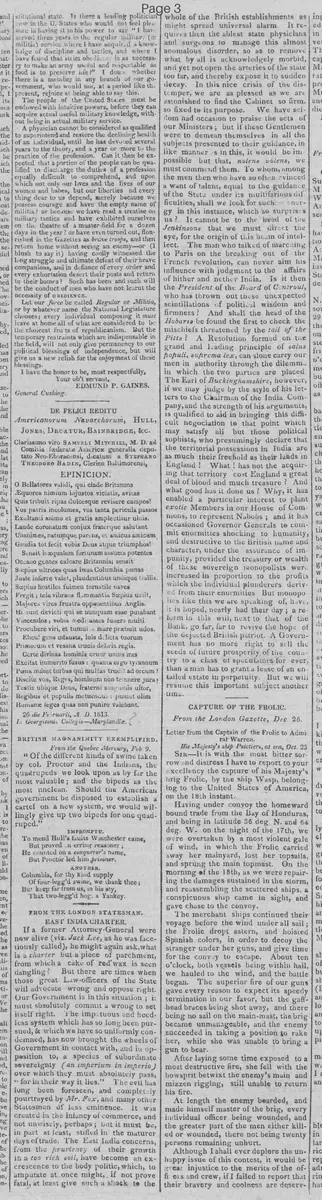
EAST INDIA CHARTER.
If a former Attorney-General were now alive (viz. Jack Lee, as he was facetiously called), he might again ask, what is a charter but a piece of parchment, from which a cake of red wax is seen dangling? But there are times when those great Law-officers of the State will advocate wrong and oppose right.
Our Government is in this situation; it must absolutely commit a wrong to set itself right. The impetuous and heedless system which has so long been pursued, & which we have so uniformly condemned, has now brought the wheels of Government in contact with, and in opposition to, a species of subordinate sovereignty (an imperium in imperio) over which they must absolutely pass, "for in their way it lies." The evil has long been foreseen, and completely pourtrayed by Mr. Fox, and many other Statesmen of less eminence. It was created in the infancy of commerce, and not unwisely, perhaps; but it must be, in part at least, stifled in the maturer days of trade. The East India concerns, from the luxuriancy of their growth in a too rich soil, have become an excrescence to the body politic, which, to amputate at once might, if not prove fatal, at least give such a shock to the whole of the British establishments as might spread universal alarm.
It requires then the ablest state physicians and surgeons to manage this almost anomalous disorder, so as to remove what by all is acknowledged morbid, and yet not open the arteries of the state too far, and thereby expose it to sudden decay. In this nice crisis of the distemper, we are as pleased as we are astonished to find the Cabinet so firm, so fixed to its purpose. We have seldom had occasion to praise the acts of our Ministers; but if these Gentlemen were to demean themselves in all the subjects presented to their guidance, in like manner as in this, it would be impossible but that, nolens volens, we must commend them. To whom, among the men then who have so often evinced a want of talent, equal to the guidance of the State under its multifarious difficulties, shall we look for such energy in this instance, which so surprises us? It cannot be to the head of the Jenkinsons that we must direct the eye, for the origin of this beam of intellect. The man who talked of marching to Paris on the breaking out of the French revolution, can never aim his influence with judgment to the affairs of hither and nether India. Is it then the President of the Board of Control, who has thrown out these unexpected scintillations of political wisdom and firmness? And shall the head of the Hobarra be found the first to check the mischiefs threatened by the tail of the Pitts? A Resolution formed on the grand and leading principle of salus populi, suprema lex, can alone carry our men in authority through the dilemma in which the two parties are placed.
The Earl of Buckinghamshire, however, if we may judge by the style of his letters to the Chairman of the India Company, and the strength of his arguments, is qualified to aid in bringing this difficult negociation to that point which may satisfy all but those political sophists, who presumingly declare that the territorial possessions in India are as much their freehold as their lands in England! What! has not the acquiring that territory cost England a great deal of blood and much treasure? And what good has it done us? Why, it has enabled a particular interest to plant exotic Members in our House of Commons, to represent Nabobs; and it has occasioned Governor Generals to commit enormities shocking to humanity, and destructive to the British name and character, under the assurance of impunity, provided the treasury or wealth of these sovereign monopolists were increased in proportion to the profits which the individual plunderers derived from their enormities. But monopolies like this we are speaking of, have, it is hoped, nearly had their day; a reform in this will, next to that of the Bank, go far, far to revive the hope of the dejected British patriot. A Government has no more right to sell the seeds of future prosperity of the country to a class of speculators for ever, than a man has to grant a lease of an entailed estate in perpetuity. But we will resume this important subject another time.
What sub-type of article is it?
What keywords are associated?
What entities or persons were involved?
Where did it happen?
Foreign News Details
Primary Location
India
Key Persons
Outcome
ongoing negotiations for reform of the east india company's charter to address monopoly, territorial possessions, and abuses; hoped to revive british prosperity without causing national shock.
Event Details
The article discusses the British government's need to reform the East India Company's charter, criticizing its growth into a subordinate sovereignty, historical creation, and associated abuses like corruption and influence in Parliament. It praises the Cabinet's firmness and the Earl of Buckinghamshire's role in negotiations, foreseeing benefits from ending the monopoly.