Thank you for visiting SNEWPapers!
Sign up free
Editorial
June 18, 1840
Liberty Advocate
Liberty, Amite County, Mississippi
What is this article about?
This editorial critiques the U.S. government's policy of reducing currency circulation, arguing it doubles money's value, reduces property worth, and imposes a $210 million tax on debtors to benefit creditors and office-holders. It urges Southern State Rights supporters to resist this injustice, drawing parallels to revolutionary resistance.
Clipping
OCR Quality
95%
Excellent
Full Text
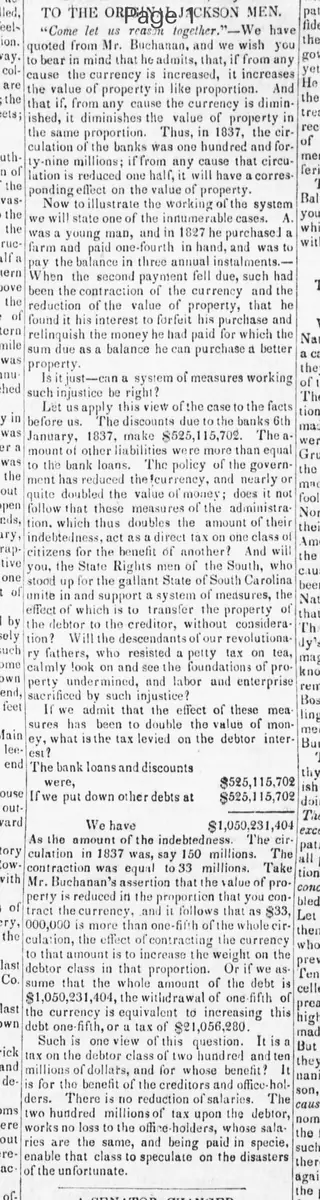
"Come let us reason together."—We have quoted from Mr. Buchanan, and we wish you to bear in mind that he admits, that, if from any cause the currency is increased, it increases the value of property in like proportion. And that if, from any cause the currency is diminished, it diminishes the value of property in the same proportion. Thus, in 1837, the circulation of the banks was one hundred and forty-nine millions; if from any cause that circulation is reduced one half, it will have a corresponding effect on the value of property.
Now to illustrate the working of the system we will state one of the innumerable cases. A. was a young man, and in 1827 he purchased a farm and paid one-fourth in hand, and was to pay the balance in three annual instalments.— When the second payment fell due, such had been the contraction of the currency and the reduction of the value of property, that he found it his interest to forfeit his purchase and relinquish the money he had paid for which the sum due as a balance he can purchase a better property.
Is it just—can a system of measures working such injustice be right?
Let us apply this view of the case to the facts before us. The discounts due to the banks 6th January, 1837, make $525,115,702. The amount of other liabilities were more than equal to the bank loans. The policy of the government has reduced the currency, and nearly or quite doubled the value of money; does it not follow that these measures of the administration. which thus doubles the amount of their indebtedness, act as a direct tax on one class of citizens for the benefit of another? And will you, the State Rights men of the South, who stood up for the gallant State of South Carolina unite in and support a system of measures, the effect of which is to transfer the property of the debtor to the creditor, without consideration? Will the descendants of our revolutionary fathers, who resisted a petty tax on tea, calmly look on and see the foundations of property undermined, and labor and enterprise sacrificed by such injustice?
If we admit that the effect of these measures has been to double the value of money, what is the tax levied on the debtor interest?
The bank loans and discounts were,
$525,115,702
If we put down other debts at
$525,115,702
As the amount of the indebtedness. The circulation in 1837 was, say 150 millions.
The contraction was equal to 33 millions.
Take Mr. Buchanan's assertion that the value of property is reduced in the proportion that you contract the currency, and it follows that as $33,000,000 is more than one-fifth of the whole circulation, the effect of contracting the currency to that amount is to increase the weight on the debtor class in that proportion. Or if we assume that the whole amount of the debt is $1,050,231,404, the withdrawal of one-fifth of the currency is equivalent to increasing this debt one-fifth, or a tax of $21,056,280.
Such is one view of this question. It is a tax on the debtor class of two hundred and ten millions of dollars, and for whose benefit? It is for the benefit of the creditors and office-holders. There is no reduction of salaries. The two hundred millions of tax upon the debtor, works no loss to the office-holders, whose salaries are the same, and being paid in specie, enable that class to speculate on the disasters of the unfortunate.
Now to illustrate the working of the system we will state one of the innumerable cases. A. was a young man, and in 1827 he purchased a farm and paid one-fourth in hand, and was to pay the balance in three annual instalments.— When the second payment fell due, such had been the contraction of the currency and the reduction of the value of property, that he found it his interest to forfeit his purchase and relinquish the money he had paid for which the sum due as a balance he can purchase a better property.
Is it just—can a system of measures working such injustice be right?
Let us apply this view of the case to the facts before us. The discounts due to the banks 6th January, 1837, make $525,115,702. The amount of other liabilities were more than equal to the bank loans. The policy of the government has reduced the currency, and nearly or quite doubled the value of money; does it not follow that these measures of the administration. which thus doubles the amount of their indebtedness, act as a direct tax on one class of citizens for the benefit of another? And will you, the State Rights men of the South, who stood up for the gallant State of South Carolina unite in and support a system of measures, the effect of which is to transfer the property of the debtor to the creditor, without consideration? Will the descendants of our revolutionary fathers, who resisted a petty tax on tea, calmly look on and see the foundations of property undermined, and labor and enterprise sacrificed by such injustice?
If we admit that the effect of these measures has been to double the value of money, what is the tax levied on the debtor interest?
The bank loans and discounts were,
$525,115,702
If we put down other debts at
$525,115,702
As the amount of the indebtedness. The circulation in 1837 was, say 150 millions.
The contraction was equal to 33 millions.
Take Mr. Buchanan's assertion that the value of property is reduced in the proportion that you contract the currency, and it follows that as $33,000,000 is more than one-fifth of the whole circulation, the effect of contracting the currency to that amount is to increase the weight on the debtor class in that proportion. Or if we assume that the whole amount of the debt is $1,050,231,404, the withdrawal of one-fifth of the currency is equivalent to increasing this debt one-fifth, or a tax of $21,056,280.
Such is one view of this question. It is a tax on the debtor class of two hundred and ten millions of dollars, and for whose benefit? It is for the benefit of the creditors and office-holders. There is no reduction of salaries. The two hundred millions of tax upon the debtor, works no loss to the office-holders, whose salaries are the same, and being paid in specie, enable that class to speculate on the disasters of the unfortunate.
What sub-type of article is it?
Economic Policy
Taxation
Partisan Politics
What keywords are associated?
Currency Contraction
Debtor Tax
Banking Policy
Economic Injustice
Administration Measures
State Rights
What entities or persons were involved?
Mr. Buchanan
Banks
Government
Administration
State Rights Men Of The South
South Carolina
Revolutionary Fathers
Office Holders
Debtor Class
Creditor Class
Editorial Details
Primary Topic
Critique Of Currency Contraction As A Tax On Debtors
Stance / Tone
Strongly Critical Of Administration Policy
Key Figures
Mr. Buchanan
Banks
Government
Administration
State Rights Men Of The South
South Carolina
Revolutionary Fathers
Office Holders
Debtor Class
Creditor Class
Key Arguments
Currency Contraction Reduces Property Value Proportionally
Government Policy Has Doubled Money's Value, Increasing Debt Burdens
Acts As A Direct Tax On Debtors Benefiting Creditors And Office Holders
Injustice Transfers Property From Debtors To Creditors Without Consideration
Southern State Rights Men Should Oppose This Like Revolutionary Resistance To Tea Tax
Contraction Of $33 Million Circulation Increases Debt By One Fifth, Taxing Debtors $210 Million