Thank you for visiting SNEWPapers!
Sign up free
Editorial
July 31, 1798
The New Hampshire Gazette
Portsmouth, Rockingham County, New Hampshire
What is this article about?
Satirical editorial criticizing William Gardner, former Commissioner of Loans for New Hampshire, for his public defense against dismissal, accusing him of falsehoods about salary increases and factious opposition to the government.
Clipping
OCR Quality
95%
Excellent
Full Text
From the Oracle of the Day.
To Wm. Gardner, Esq.
Late Commissioner of Loans for the State of New-Hampshire.
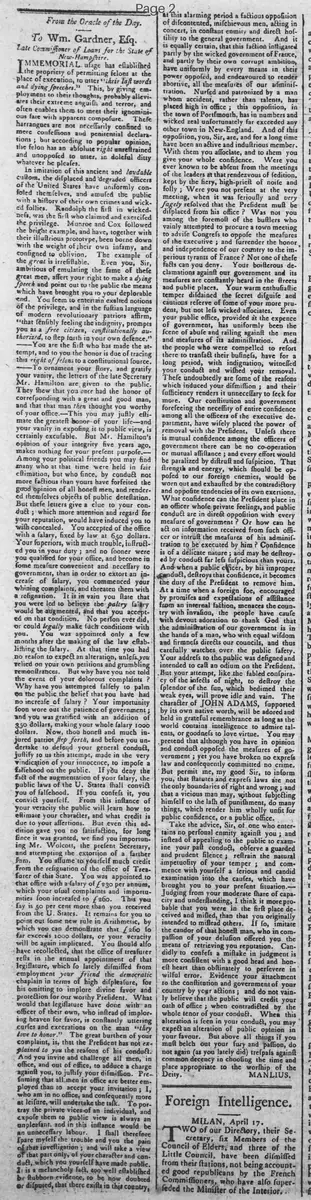
TIME IMMEMORIAL usage has established the propriety of permitting felons at the place of execution, to utter their last words and dying speeches. This, by giving employment to their thoughts, probably alleviates their extreme anguish and terror, and often enables them to meet their ignominious fate with apparent composure. These harangues are not necessarily confined to mere confessions and penitential declarations; but according to popular opinion, the felon has an absolute right unrestrained and unopposed to utter, in doleful ditty whatever he pleases.
In imitation of this ancient and laudable custom, the displaced and degraded officers of the United States have uniformly consoled themselves, and amused the public with a history of their own crimes and wicked follies. Randolph the first in wickedness, was the first who claimed and exercised the privilege. Munroe and Cox followed the bright example, and have, together with their illustrious prototype, been borne down with the weight of their own infamy, and consigned to oblivion. The example of the great is irresistible. Even you, Sir, ambitious of emulating the fame of these great men, assert your right to make a dying speech and point out to the public the means which have brought you to your deplorable end. You seem to entertain exalted notions of the privilege, and in the fluent language of modern revolutionary patriots affirm, "that deeply feeling the indignity, prompts you as a free citizen, constitutionally authorized, to step forth in your own defence."
--You are the first who has made the attempt, and to you the honor is due of tracing this right of felons to a constitutional source. —To ornament your story, and gratify your vanity, the letters of the late Secretary Mr. Hamilton are given to the public. They show that you once had the honor of corresponding with a great and good man, and that that man then thought you worthy of your office.-This you may justly estimate the greatest honor of your life--and your vanity in exposing it to public view, is certainly excusable. But Mr. Hamilton's opinion of your integrity five years ago, makes nothing for your present purpose.-- Among your political friends you may find many who at that time were held in fair estimation, but who since, by conduct not more factious than yours have forfeited the good opinion of all honest men, and rendered themselves objects of public detestation. But these letters give a clue to your conduct; which more attention and regard for your reputation, would have induced you to wish concealed. You accepted of the office with a salary, fixed by law at 650 dollars. Your superiors, with much trouble, instructed you in your duty; and no sooner were you qualified for your office, and become in some measure convenient and necessary to government, than in order to extort an increase of salary, you commenced your whining complaints, and threaten them with a resignation. It is in vain you state that you were led to believe the paltry salary would be augmented, and that you accepted on that condition. No person ever did, or could legally make such conditions with you. You was appointed only a few months after the making of the law establishing the salary. At that time you had no reason to expect an alteration, unless you relied on your own petitions and grumbling remonstrances. But why have you not told the event of your dolorous complaints? Why have you attempted falsely to palm on the public the belief that you have had no increase of salary? Your importunity soon wore out the patience of government; and you was gratified with an addition of 350 dollars, making your whole salary 1000 dollars. Now, thou honest and much injured patriot step forth, and before you undertake to defend your general conduct, justify to us this attempt, made in the very vindication of your innocence, to impose a falsehood on the public. If you deny the fact of the augmentation of your salary, the public laws of the U. States shall convict you of falsehood. If you confess it, you convict yourself. From this instance of your veracity the public will learn how to estimate your character, and what credit is due to your assertions. But even this addition gave you no satisfaction, for long since it was granted, we find you importuning Mr. Wolcott, the present Secretary, and attempting the extortion of a farther sum. You assume to yourself much credit From the resignation of the office of Treasurer of this State. You was appointed to that office with a salary of 650 per annum, which your usual complaints and importunities soon increased to 260. This you say is 50 per cent more than you received from the U. States. It remains for you to point out some new rule in Arithmetic, by which you can demonstrate that 650 so far exceeds 1000 dollars, or your veracity will be again implicated. You should also have recollected, that the office of treasurer rests in the annual appointment of that legislature, which so lately dismissed from employment your friend the democratic chaplain in terms of high displeasure, for his omitting to implore divine favor and protection for our worthy President. What would that legislature have done with an officer of their own, who instead of imploring heaven for favor, is constantly uttering curses and execrations on the man "they love to honor." The great burthen of your complaint, is, that the President has not explained to you the reasons of his conduct. And you invite and challenge all men, in office, and out of office, to adduce a charge against you, to justify your dismission. Presuming that all men in office are better employed than to accept your invitation; I, who am in no office, and consequently more at leisure, will undertake the task. To portray the private vices of an individual, and expose them to public view is always an unpleasant. and in this instance would be an unnecessary labour. I shall therefore spare myself the trouble and you the pain of that investigation'; and will take a view of that part only, of your character and conduct, which you yourself have made public. It is a melancholy fact, too well established by stubborn evidence, to be now doubted or disputed. that there exists in this country at this alarming period a factious opposition
To Wm. Gardner, Esq.
Late Commissioner of Loans for the State of New-Hampshire.
TIME IMMEMORIAL usage has established the propriety of permitting felons at the place of execution, to utter their last words and dying speeches. This, by giving employment to their thoughts, probably alleviates their extreme anguish and terror, and often enables them to meet their ignominious fate with apparent composure. These harangues are not necessarily confined to mere confessions and penitential declarations; but according to popular opinion, the felon has an absolute right unrestrained and unopposed to utter, in doleful ditty whatever he pleases.
In imitation of this ancient and laudable custom, the displaced and degraded officers of the United States have uniformly consoled themselves, and amused the public with a history of their own crimes and wicked follies. Randolph the first in wickedness, was the first who claimed and exercised the privilege. Munroe and Cox followed the bright example, and have, together with their illustrious prototype, been borne down with the weight of their own infamy, and consigned to oblivion. The example of the great is irresistible. Even you, Sir, ambitious of emulating the fame of these great men, assert your right to make a dying speech and point out to the public the means which have brought you to your deplorable end. You seem to entertain exalted notions of the privilege, and in the fluent language of modern revolutionary patriots affirm, "that deeply feeling the indignity, prompts you as a free citizen, constitutionally authorized, to step forth in your own defence."
--You are the first who has made the attempt, and to you the honor is due of tracing this right of felons to a constitutional source. —To ornament your story, and gratify your vanity, the letters of the late Secretary Mr. Hamilton are given to the public. They show that you once had the honor of corresponding with a great and good man, and that that man then thought you worthy of your office.-This you may justly estimate the greatest honor of your life--and your vanity in exposing it to public view, is certainly excusable. But Mr. Hamilton's opinion of your integrity five years ago, makes nothing for your present purpose.-- Among your political friends you may find many who at that time were held in fair estimation, but who since, by conduct not more factious than yours have forfeited the good opinion of all honest men, and rendered themselves objects of public detestation. But these letters give a clue to your conduct; which more attention and regard for your reputation, would have induced you to wish concealed. You accepted of the office with a salary, fixed by law at 650 dollars. Your superiors, with much trouble, instructed you in your duty; and no sooner were you qualified for your office, and become in some measure convenient and necessary to government, than in order to extort an increase of salary, you commenced your whining complaints, and threaten them with a resignation. It is in vain you state that you were led to believe the paltry salary would be augmented, and that you accepted on that condition. No person ever did, or could legally make such conditions with you. You was appointed only a few months after the making of the law establishing the salary. At that time you had no reason to expect an alteration, unless you relied on your own petitions and grumbling remonstrances. But why have you not told the event of your dolorous complaints? Why have you attempted falsely to palm on the public the belief that you have had no increase of salary? Your importunity soon wore out the patience of government; and you was gratified with an addition of 350 dollars, making your whole salary 1000 dollars. Now, thou honest and much injured patriot step forth, and before you undertake to defend your general conduct, justify to us this attempt, made in the very vindication of your innocence, to impose a falsehood on the public. If you deny the fact of the augmentation of your salary, the public laws of the U. States shall convict you of falsehood. If you confess it, you convict yourself. From this instance of your veracity the public will learn how to estimate your character, and what credit is due to your assertions. But even this addition gave you no satisfaction, for long since it was granted, we find you importuning Mr. Wolcott, the present Secretary, and attempting the extortion of a farther sum. You assume to yourself much credit From the resignation of the office of Treasurer of this State. You was appointed to that office with a salary of 650 per annum, which your usual complaints and importunities soon increased to 260. This you say is 50 per cent more than you received from the U. States. It remains for you to point out some new rule in Arithmetic, by which you can demonstrate that 650 so far exceeds 1000 dollars, or your veracity will be again implicated. You should also have recollected, that the office of treasurer rests in the annual appointment of that legislature, which so lately dismissed from employment your friend the democratic chaplain in terms of high displeasure, for his omitting to implore divine favor and protection for our worthy President. What would that legislature have done with an officer of their own, who instead of imploring heaven for favor, is constantly uttering curses and execrations on the man "they love to honor." The great burthen of your complaint, is, that the President has not explained to you the reasons of his conduct. And you invite and challenge all men, in office, and out of office, to adduce a charge against you, to justify your dismission. Presuming that all men in office are better employed than to accept your invitation; I, who am in no office, and consequently more at leisure, will undertake the task. To portray the private vices of an individual, and expose them to public view is always an unpleasant. and in this instance would be an unnecessary labour. I shall therefore spare myself the trouble and you the pain of that investigation'; and will take a view of that part only, of your character and conduct, which you yourself have made public. It is a melancholy fact, too well established by stubborn evidence, to be now doubted or disputed. that there exists in this country at this alarming period a factious opposition
What sub-type of article is it?
Satire
Partisan Politics
Economic Policy
What keywords are associated?
Gardner Dismissal
Salary Complaints
Political Satire
Federal Office
Factious Opposition
Hamilton Letters
What entities or persons were involved?
Wm. Gardner
Mr. Hamilton
Randolph
Munroe
Cox
Mr. Wolcott
President
Editorial Details
Primary Topic
Critique Of William Gardner's Dismissal And Public Defense
Stance / Tone
Satirical And Strongly Critical
Key Figures
Wm. Gardner
Mr. Hamilton
Randolph
Munroe
Cox
Mr. Wolcott
President
Key Arguments
Compares Dismissed Officials To Felons Making Dying Speeches
Accuses Gardner Of Falsehood About Salary Increase From 650 To 1000 Dollars
Criticizes Continued Demands For More Salary
Mocks Arithmetic Error In Comparing State Treasurer Salary
Highlights Factious Opposition To Government
Defends President's Dismissal Without Explanation