Thank you for visiting SNEWPapers!
Sign up free
Alexandria Gazette & Daily Advertiser
Alexandria, Virginia
What is this article about?
Reports from Richmond papers detail the first issue of 'The Floridian' newspaper in Pensacola, Florida, dated August 18, 1821, including General Jackson's appointments to local offices, criticism of J.G. Forbes' 'Sketches of the Floridas,' health regulations on reporting fevers, and Jackson's address to the army upon suspending military functions.
Clipping
OCR Quality
Full Text
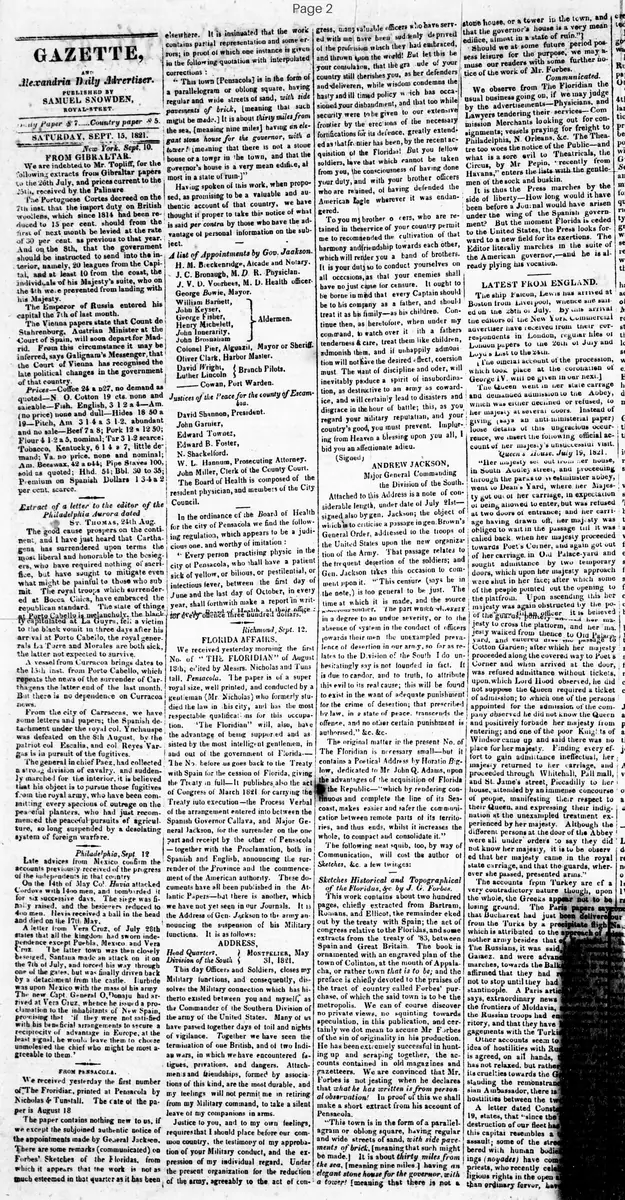
We received yesterday the first number of The Floridian., printed at Pensacola by Nicholas & Tunstall. The date of the paper is August 18.
The paper contains nothing new to us, if we except the subjoined authentic notice of the appointments made by General Jackson.
There are some remarks (communicated) on Forbes' Sketches of the Floridas. from which it appears that the work is not as much esteemed in that quarter as it has been elsewhere. It is insinuated that the work contains partial representation and some errors; in proof of which one instance is given in the following quotation with interpolated corrections:
"This town [Pensacola] is in the form of a parallelogram or oblong square, having regular and wide streets of sand, with side pavements of brick, (meaning that such might be made.) It is about thirty miles from the sea, [meaning nine miles.] having an elegant stone house for the governor, with a tower! [meaning that there is not a stone house or a tower in the town, and that the governor's house is a very mean edifice, almost in a state of ruin.]"
Having spoken of this work, when proposed, as promising to be a valuable and authentic account of that country, we have thought it proper to take this notice of what is said per contra by those who have the advantage of personal information on the subject.
A list of appointments by Gov. Jackson.
H. M. Breckenridge, Alcade and Notary.
J. C. Bronaugh, M. D. R. Physician.
J. V. D. Voorhees, M. D. Health officer
George Bowie, Mayor,
William Barnett,
John Keyser,
George Fisher,
Aldermen.
Henry Michelet,
John Innerarity,
John Brosnaham
Colonel Pier, Alguazil, Mayor or Sheriff
Oliver Clark, Harbor Master,
David Wright,
Luther Lincoln
Branch Pilots.
Cowan, Port Warden.
Justices of the Peace for the county of Escambia.
David Shannon, President.
John Garnier,
Edward Townes,
Edward B. Foster,
N. Shackelford.
W. L. Hannum, Prosecuting Attorney.
John Miller, Clerk of the County Court.
The Board of Health is composed of the resident physician, and three members of the City Council.
In the ordinance of the Board of Health for the city of Pensacola we find the following regulation, which appears to be a judicious one. and worthy of imitation :
" Every person practising physic in the city of Pensacola, who shall have a patient sick of yellow, or bilious, or pestilential, or infectious fever, between the first day of June and the last day of October, in every year, shall forthwith make a report in writing to the Board of Health, at their office :
for every offense three hundred dollars."
Richmond, Sept. 12.
FLORIDA AFFAIRS.
We received yesterday morning the first No. of " THE FLORIDIAN" of August 18th, edited by Messrs. Nicholas and Tunstall. Pensacola. The paper is of a super royal size, well printed, and conducted by a gentleman (Mr. Nicholas) who formerly studied the law in this city, and has the most respectable qualifications for this occupation.
"The Floridian" will, also, have the advantage of being supported and assisted by the most intelligent gentlemen, in and out of the government of Florida.
The No. before us goes back to the Treaty with Spain for the cession of Florida, giving the Treaty in full-It publishes also the act of Congress of March 1821 for carrying the Treaty into execution-the Process Verbal of the arrangement entered into between the Spanish Governor Callava, and Major General Jackson, for the surrender on the one part and receipt by the other of Pensacola - together with the Proclamation, both in Spanish and English, announcing the surrender of the Province and the commencement of the American authority. These documents have all been published in the Atlantic Papers--but there is another, which we have not yet seen in our Journals. It is the Address of Gen. Jackson to the army announcing the suspension of his Military functions. It is as follows:
ADDRESS
Head Quarters,
MONTPELIER, May 31, 1821.
Division of the South
This day Officers and Soldiers, closes my Military functions, and consequently, dissolves the Military connection which has hitherto existed between you and myself, as the Commander of the Southern Division of the army of the United States. Many of us have passed together days of toil and nights of vigilance.
Together we have seen the termination of one British, and of two Indian wars, in which we have encountered fatigues, privations. and dangers. Attachments and friendships, formed by associations of this kind, are the most durable, and my feelings will not permit me in retiring from my Military command, to take a silent leave of my companions in arms.
Justice to you, and to my own feelings, requires that I should place before our common country, the testimony of my approbation of your Military conduct, and the expression of my individual regard. Under the present organization for the reduction of the army. agreeably to the act of congress; many valuable officers who have served with me have been suddenly deprived of the provision which they had embraced, and thrown upon the world! But let this be your consolation, that the gratitude of your country still cherishes you, as her defenders and deliverers, while wisdom condemns the hasty and ill timed policy which has occasioned your disbandment, and that too while security were to be given to our extensive frontier by the erections of the necessary fortifications for its defence, greatly extended as that frontier has been, by the recent acquisition of the Floridas! But you fellow soldiers, have that which cannot be taken from you, the consciousness of having done your duty, and with your brother officers who are retained, of having defended the American Eagle wherever it was endangered.
To you my brother officers, who are retained in the service of your country permit me to recommend the cultivation of that harmony and friendship towards each other, which will render you a band of brothers.
It is your duty so to conduct yourselves on all occasions, as that your enemies shall have no just cause for censure. It ought to be borne in mind that every Captain should be to his company as a father, and should treat it as his family-as his children. Continue then, as heretofore, when under my command, to watch over it with a father's tenderness & care, treat them like children, admonish them, and if unhappily admonition will not have the desired effect, coercion must. The want of discipline and order, will inevitably produce a spirit of insubordination, as destructive to an army as cowardice, and will certainly lead to disasters and disgrace in the hour of battle; this, as you regard your military reputation, and your country's good, you must prevent. Imploring from Heaven a blessing upon you all, I bid you an affectionate adieu.
(Signed)
ANDREW JACKSON.
Major General Commanding the Division of the South.
Attached to this Address is a note of considerable length, under date of July 31st- signed also by Gen. Jackson; the object of which is to criticise a passage in Gen. Brown's General Order, addressed to the troops of the United States upon the new organization of the Army. That passage relates to the frequent desertion of the soldiers; and Gen. Jackson takes this occasion to comment upon it. "This censure (says he in the note,) is too general to be just. The time at which it is made, and the source from which it comes, may have contributed in a degree to an undue severity, or to the absence of system in the conduct of officers towards their men the unexampled prevalence of desertion in our army, so far as relates to the Division of the South I do unhesitatingly say is not founded in fact. It is due to candor, and to truth. to attribute this evil to its real cause; this will be found to exist in the want of adequate punishment for the crime of desertion; that prescribed by law. in a state of peace, transcends the offence. and no other certain punishment is authorised," &c. &c.
The original matter in the present No. of The Floridian is necessarily small-but it contains a Poetical Address by Horatio Biglow, dedicated to Mr John Q. Adams, upon the advantages of the acquisition of Florida to the Republic-"which by rendering continuous and complete the line of its Sea-coast, makes easier and safer the communication between remote parts of its territories, and thus ends, whilst it increases the whole, to compact and consolidate it."
The following neat squib, too, by way of Communication, will cost the author of Sketches, &c. a few twinges:
Sketches Historical and Topographical of the Floridas, &c. by J. G. Forbes.
This work contains about two hundred pages, chiefly extracted from Bartram, Romans, and Ellicott, the remainder eked out by the treaty with Spain; the act of congress relative to the Floridas, and some extracts from the treaty of '83, between Spain and Great Britain. The book is ornamented with an engraved plan of the town of Colinton, at the mouth of Appalachicola, or rather town that is to be; and the preface is chiefly devoted to the praises of the tract of country called Forbes' purchase, of which the said town is to be the metropolis. We can of course discover no private views, no squinting towards speculation, in this publication, and certainly we do not mean to accuse Mr Forbes of the sin of originality in his production.
He has been extremely successful in hunting up and scraping together, the accounts contained in old magazines and gazetteers. We are convinced that Mr. Forbes is not jesting when he declares that what he has written is from personal observation! In proof of this we shall make a short extract from his account of Pensacola.
"This town is in the form of a parallelogram or oblong square, having regular and wide streets of sand, with side pavements of brick. [meaning that such might be made.] It is about thirty miles from the sea, [meaning nine miles.] having an elegant stone house for the governor, with a tower! [meaning that there is not a stone store house, or a tower in the town, and that the governor's house is a very mean edifice. almost in a state of ruin.]"
Should we at some future period possess leisure for the purpose, we may amuse our readers with some further notice of the work of Mr. Forbes.
Communicated.
We observe from The Floridian the usual business going on, if we may judge by the advertisements-Physicians, and Lawyers tendering their services-Commission Merchants looking out for consignments; vessels praying for freight to Philadelphia, N. Orleans, &c. The Theatre too woos the notice of the Public~-and what is a sore evil to Theatricals, the Circus, by Mr Pepin, recently from Havana," enters the lists with the gentlemen of the sock and buskin.
It is thus the Press marches by the side of liberty-How long would it have been before a Journal would have arisen under the wing of the Spanish government?
But the moment Florida is ceded to the United States, the Press looks forward to a new field for its exertions. The Editor literally marches in the suite of the American governor,-and he is already plying his vocation.
What sub-type of article is it?
What keywords are associated?
What entities or persons were involved?
Where did it happen?
Domestic News Details
Primary Location
Pensacola, Florida
Event Date
August 18, 1821
Key Persons
Outcome
appointments to various local offices including mayor, aldermen, justices, health officers; regulation requiring physicians to report fevers with $300 fine for non-compliance; criticism of forbes' book highlighting inaccuracies.
Event Details
Richmond papers report on the inaugural issue of 'The Floridian' newspaper in Pensacola, edited by Nicholas and Tunstall, covering General Jackson's appointments to civil offices, Board of Health composition and fever reporting ordinance, reprints of treaties and proclamations for Florida's cession, Jackson's farewell address to the army dated May 31, 1821, and critical remarks on J.G. Forbes' 'Sketches of the Floridas' for factual errors and partiality.