Thank you for visiting SNEWPapers!
Sign up free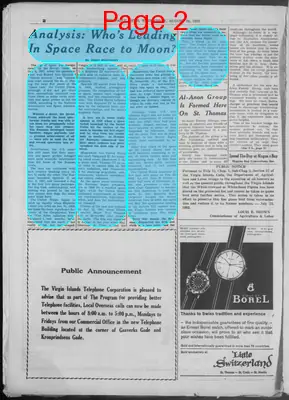
The Daily News Of The Virgin Islands
Charlotte Amalie, Saint Thomas County, Virgin Islands
What is this article about?
Overview of the US-USSR space race from 1957 to 1962, highlighting key launches, achievements, and manned flights, with the US leading in scientific data and the Soviets in propaganda impact.
Clipping
OCR Quality
Full Text
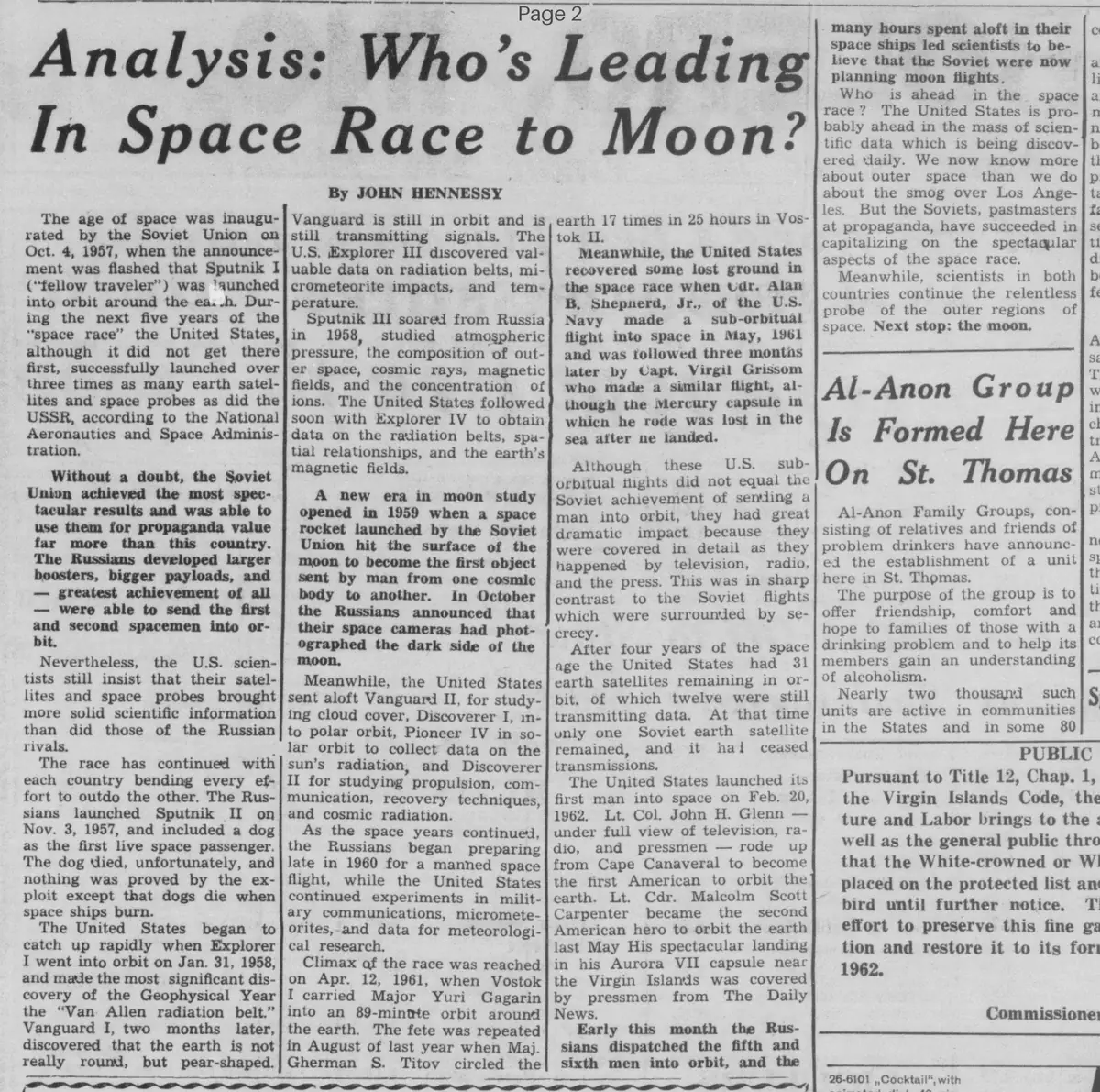
By JOHN HENNESSY
The age of space was inaugurated by the Soviet Union on Oct. 4, 1957, when the announcement was flashed that Sputnik I ("fellow traveler") was launched into orbit around the earth. During the next five years of the "space race" the United States, although it did not get there first, successfully launched over three times as many earth satellites and space probes as did the USSR, according to the National Aeronautics and Space Administration.
Without a doubt, the Soviet Union achieved the most spectacular results and was able to use them for propaganda value far more than this country. The Russians developed larger boosters, bigger payloads, and greatest achievement of all were able to send the first and second spacemen into orbit.
Nevertheless, the U.S. scientists still insist that their satellites and space probes brought more solid scientific information than did those of the Russian rivals.
The race has continued with each country bending every effort to outdo the other. The Russians launched Sputnik II on Nov. 3, 1957, and included a dog as the first live space passenger. The dog died, unfortunately, and nothing was proved by the exploit except that dogs die when space ships burn.
The United States began to catch up rapidly when Explorer I went into orbit on Jan. 31, 1958, and made the most significant discovery of the Geophysical Year the Van Allen radiation belt."
Vanguard I, two months later, discovered that the earth is not really round, but pear-shaped.
Vanguard is still in orbit and is still transmitting signals. The U.S. Explorer III discovered valuable data on radiation belts, micrometeorite impacts, and temperature.
Sputnik III soared from Russia in 1958. studied atmospheric pressure, the composition of outer space, cosmic rays, magnetic fields, and the concentration of ions.
The United States followed soon with Explorer IV to obtain data on the radiation belts, spatial relationships, and the earth's magnetic fields.
A new era in moon study opened in 1959 when a space rocket launched by the Soviet Union hit the surface of the moon to become the first object sent by man from one cosmic body to another.
In October the Russians announced that their space cameras had photographed the dark side of the moon.
Meanwhile, the United States sent aloft Vanguard II, for studying cloud cover, Discoverer I, into polar orbit, Pioneer IV in solar orbit to collect data on the sun's radiation. and Discoverer II for studying propulsion, communication, recovery techniques, and cosmic radiation.
As the space years continued, the Russians began preparing late in 1960 for a manned space flight, while the United States continued experiments in military communications, micrometeorites, and data for meteorological research.
Climax of the race was reached on Apr. 12, 1961, when Vostok I carried Major Yuri Gagarin into an 89-minute orbit around the earth.
The fete was repeated in August of last year when Maj. Gherman S. Titov circled the earth 17 times in 25 hours in Vostok II.
Meanwhile, the United States recovered some lost ground in the space race when Cdr. Alan B. Shepard, Jr., of the U.S. Navy made a sub-orbital flight into space in May, 1961 and was followed three months later by Capt. Virgil Grissom who made a similar flight, although the Mercury capsule in which he rode was lost in the sea after he landed.
Although these U.S. sub-orbital flights did not equal the Soviet achievement of sending a man into orbit, they had great dramatic impact because they were covered in detail as they happened by television, radio, and the press. This was in sharp contrast to the Soviet flights which were surrounded by secrecy.
After four years of the space age the United States had 31 earth satellites remaining in orbit. of which twelve were still transmitting data.
At that time only one Soviet earth satellite remained, and it had ceased transmissions.
The United States launched its first man into space on Feb. 20, 1962.
Lt. Col. John H. Glenn - under full view of television, radio, and pressmen- rode up from Cape Canaveral to become the first American to orbit the earth. Lt. Cdr. Malcolm Scott Carpenter became the second American hero to orbit the earth last May His spectacular landing in his Aurora VII capsule near the Virgin Islands was covered by pressmen from The Daily News.
Early this month the Russians dispatched the fifth and sixth men into orbit, and the
many hours spent aloft in their space ships led scientists to believe that the Soviets were now planning moon flights.
Who is ahead in the space race?
The United States is probably ahead in the mass of scientific data which is being discovered daily. We now know more about outer space than we do about the smog over Los Angeles. But the Soviets, past masters at propaganda, have succeeded in capitalizing on the spectacular aspects of the space race.
Meanwhile, scientists in both countries continue the relentless probe of the outer regions of space. Next stop: the moon.
What sub-type of article is it?
What keywords are associated?
What entities or persons were involved?
Foreign News Details
Event Date
1957 1962
Key Persons
Outcome
us leads in scientific data from satellites; soviets lead in manned orbital flights and propaganda; ongoing preparations for moon missions.
Event Details
Historical overview of US-USSR space race starting with Sputnik I in 1957, including key launches like Explorer I discovering Van Allen belt, Soviet moon impact and dark side photos in 1959, manned flights by Gagarin in 1961, Shepard and Grissom sub-orbital in 1961, Glenn orbital in 1962, and recent Soviet multi-hour orbits suggesting moon plans.