Thank you for visiting SNEWPapers!
Sign up free
Story
July 2, 1834
Morning Star
Limerick, York County, Maine
What is this article about?
Mathew Carey recounts his marriage to a prudent, economical wife and their commitment to frugality, avoiding unnecessary expenses despite his successful business, which prevented potential misery and exemplified a moral lesson in saving.
Clipping
OCR Quality
98%
Excellent
Full Text
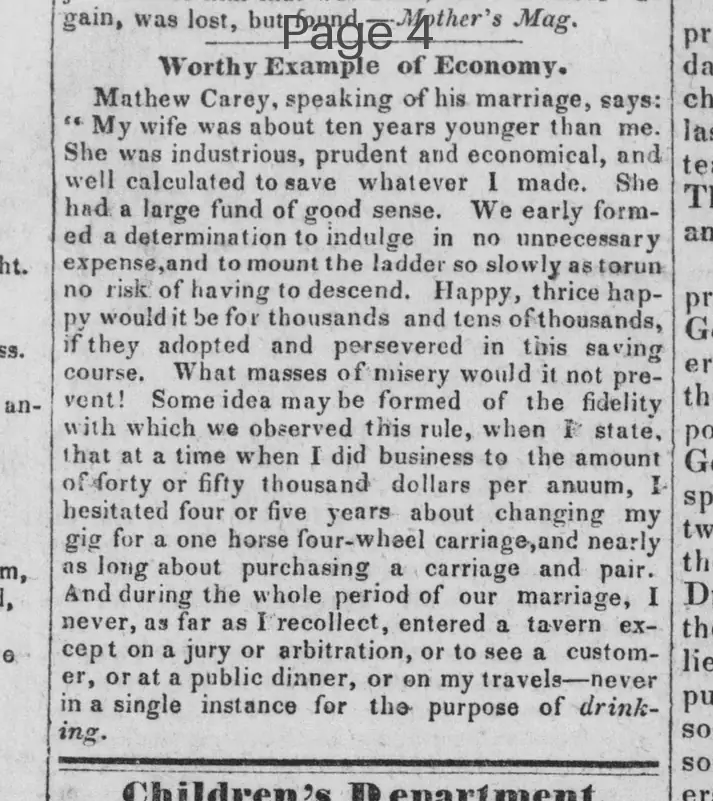
Worthy Example of Economy.
Mathew Carey, speaking of his marriage, says:
"My wife was about ten years younger than me. She was industrious, prudent and economical, and well calculated to save whatever I made. She had a large fund of good sense. We early formed a determination to indulge in no unnecessary expense, and to mount the ladder so slowly as to run no risk of having to descend. Happy, thrice happy would it be for thousands and tens of thousands, if they adopted and persevered in this saving course. What masses of misery would it not prevent! Some idea may be formed of the fidelity with which we observed this rule, when I state that at a time when I did business to the amount of forty or fifty thousand dollars per annum, I hesitated four or five years about changing my gig for a one horse four-wheel carriage, and nearly as long about purchasing a carriage and pair. And during the whole period of our marriage, I never, as far as I recollect, entered a tavern except on a jury or arbitration, or to see a customer, or at a public dinner, or on my travels—never in a single instance for the purpose of drinking."
Mathew Carey, speaking of his marriage, says:
"My wife was about ten years younger than me. She was industrious, prudent and economical, and well calculated to save whatever I made. She had a large fund of good sense. We early formed a determination to indulge in no unnecessary expense, and to mount the ladder so slowly as to run no risk of having to descend. Happy, thrice happy would it be for thousands and tens of thousands, if they adopted and persevered in this saving course. What masses of misery would it not prevent! Some idea may be formed of the fidelity with which we observed this rule, when I state that at a time when I did business to the amount of forty or fifty thousand dollars per annum, I hesitated four or five years about changing my gig for a one horse four-wheel carriage, and nearly as long about purchasing a carriage and pair. And during the whole period of our marriage, I never, as far as I recollect, entered a tavern except on a jury or arbitration, or to see a customer, or at a public dinner, or on my travels—never in a single instance for the purpose of drinking."
What sub-type of article is it?
Biography
Personal Triumph
What themes does it cover?
Moral Virtue
Family
What keywords are associated?
Economy
Frugality
Marriage
Prudence
Mathew Carey
What entities or persons were involved?
Mathew Carey
Story Details
Key Persons
Mathew Carey
Story Details
Mathew Carey describes his marriage to an industrious and economical wife, their mutual resolve to avoid unnecessary expenses despite his prosperous business, and his personal habits of frugality, such as delaying carriage purchases and avoiding taverns for drinking.