Thank you for visiting SNEWPapers!
Sign up free
Story
November 26, 1937
The Midland Journal
Rising Sun, Cecil County, Maryland
What is this article about?
At Rising Sun High School, science teacher Mr. Hovermill demonstrates ultra-violet rays to students, explaining invisible light spectra, effects on materials causing glows, and odd visual changes like gray hair and ghastly fingernails.
Clipping
OCR Quality
100%
Excellent
Full Text
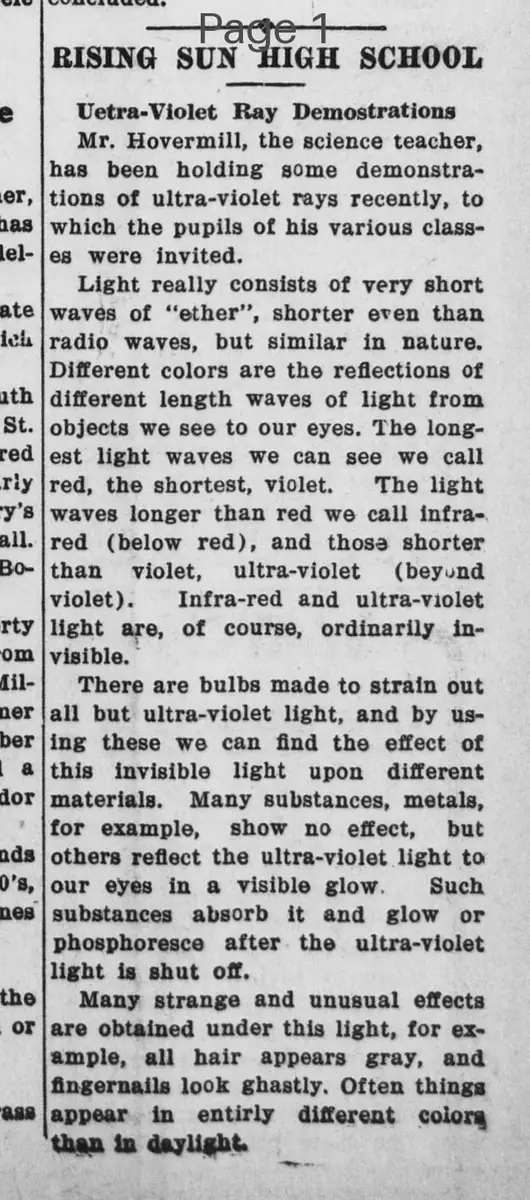
RISING SUN HIGH SCHOOL
Ultra-Violet Ray Demonstrations
Mr. Hovermill, the science teacher, has been holding some demonstrations of ultra-violet rays recently, to which the pupils of his various classes were invited.
Light really consists of very short waves of "ether", shorter even than radio waves, but similar in nature. Different colors are the reflections of different length waves of light from objects we see to our eyes. The longest light waves we can see we call red, the shortest, violet. The light waves longer than red we call infra-red (below red), and those shorter than violet, ultra-violet (beyond violet).
Infra-red and ultra-violet light are, of course, ordinarily invisible.
There are bulbs made to strain out all but ultra-violet light, and by using these we can find the effect of this invisible light upon different materials. Many substances, metals, for example, show no effect, but others reflect the ultra-violet light to our eyes in a visible glow.
Such substances absorb it and glow or phosphoresce after the ultra-violet light is shut off.
Many strange and unusual effects are obtained under this light, for example, all hair appears gray, and fingernails look ghastly. Often things appear in entirely different colors than in daylight.
Ultra-Violet Ray Demonstrations
Mr. Hovermill, the science teacher, has been holding some demonstrations of ultra-violet rays recently, to which the pupils of his various classes were invited.
Light really consists of very short waves of "ether", shorter even than radio waves, but similar in nature. Different colors are the reflections of different length waves of light from objects we see to our eyes. The longest light waves we can see we call red, the shortest, violet. The light waves longer than red we call infra-red (below red), and those shorter than violet, ultra-violet (beyond violet).
Infra-red and ultra-violet light are, of course, ordinarily invisible.
There are bulbs made to strain out all but ultra-violet light, and by using these we can find the effect of this invisible light upon different materials. Many substances, metals, for example, show no effect, but others reflect the ultra-violet light to our eyes in a visible glow.
Such substances absorb it and glow or phosphoresce after the ultra-violet light is shut off.
Many strange and unusual effects are obtained under this light, for example, all hair appears gray, and fingernails look ghastly. Often things appear in entirely different colors than in daylight.
What sub-type of article is it?
Curiosity
What themes does it cover?
Nature
What keywords are associated?
Ultra Violet Rays
Science Demonstration
Phosphorescence
Light Waves
What entities or persons were involved?
Mr. Hovermill
Where did it happen?
Rising Sun High School
Story Details
Key Persons
Mr. Hovermill
Location
Rising Sun High School
Story Details
Mr. Hovermill conducts demonstrations of ultra-violet rays for pupils, explaining light waves, colors, and effects like phosphorescence and unusual appearances under UV light.