Thank you for visiting SNEWPapers!
Sign up free
The Augusta Courier
Augusta, Richmond County, Georgia
What is this article about?
Article on anticipated stricter congressional control of tax-exempt foundations due to abuses, discussed at NYU conference May 19-21, 1955. Dean Rusk defends foundations' role in controversial issues like racial segregation. Ford Foundation grants $247,000 to Southern Regional Council (SRC) in Atlanta to fight segregation, criticized as successor to communist-front group.
Clipping
OCR Quality
Full Text
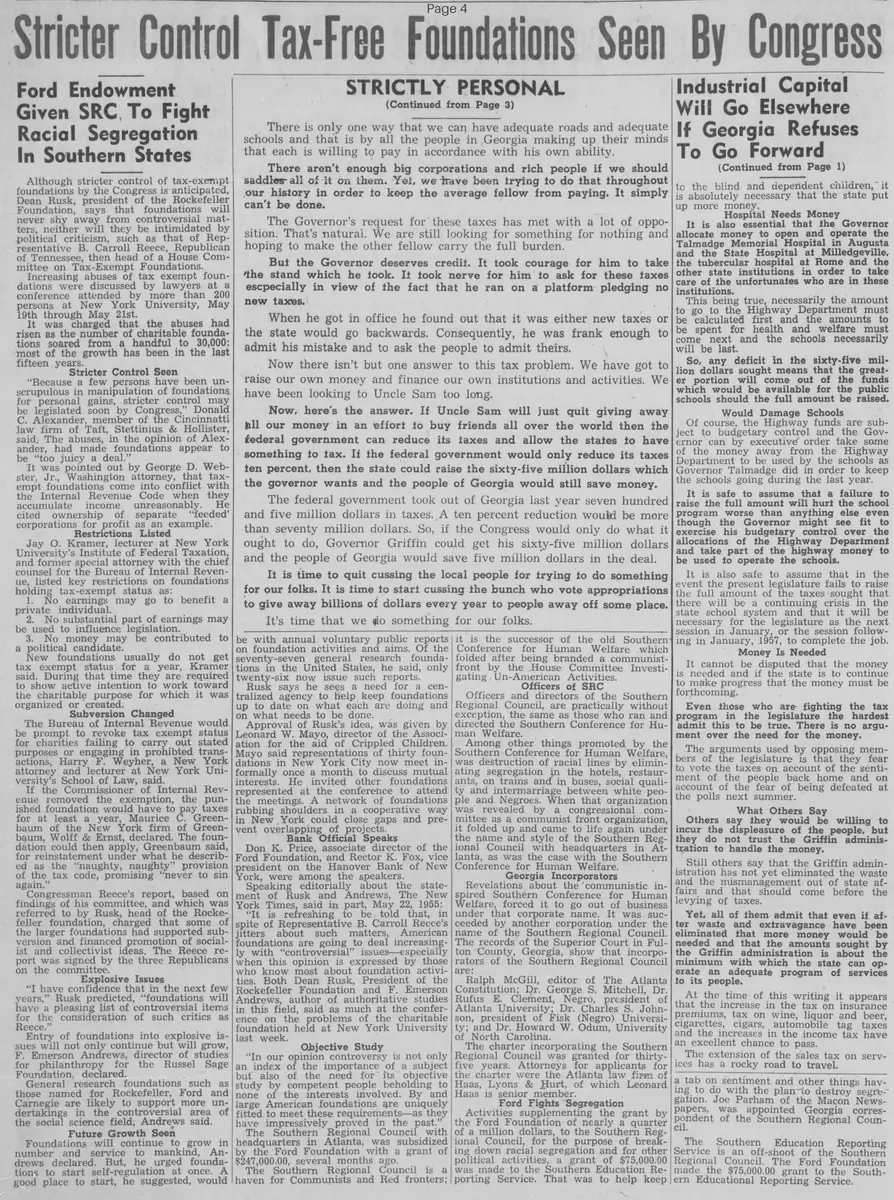
Ford Endowment Given SRC. To Fight Racial Segregation In Southern States
Although stricter control of tax-exempt foundations by the Congress is anticipated, Dean Rusk, president of the Rockefeller Foundation, says that foundations will never shy away from controversial matters, neither will they be intimidated by political criticism, such as that of Representative B. Carroll Reece, Republican of Tennessee, then head of a House Committee on Tax-Exempt Foundations.
Increasing abuses of tax exempt foundations were discussed by lawyers at a conference attended by more than 200 persons at New York University, May 19th through May 21st.
It was charged that the abuses had risen as the number of charitable foundations soared from a handful to 30,000; most of the growth has been in the last fifteen years.
Stricter Control Seen
"Because a few persons have been unscrupulous in manipulation of foundations for personal gains, stricter control may be legislated soon by Congress," Donald C. Alexander, member of the Cincinnati law firm of Taft, Stettinius & Hollister, said. The abuses, in the opinion of Alexander, had made foundations appear to be "too juicy a deal."
It was pointed out by George D. Webster, Jr., Washington attorney, that tax-exempt foundations come into conflict with the Internal Revenue Code when they accumulate income unreasonably. He cited ownership of separate "feeder" corporations for profit as an example.
Restrictions Listed
Jay O. Kramer, lecturer at New York University's Institute of Federal Taxation, and former special attorney with the chief counsel for the Bureau of Internal Revenue, listed key restrictions on foundations holding tax-exempt status as:
1. No earnings may go to benefit a private individual.
2. No substantial part of earnings may be used to influence legislation.
3. No money may be contributed to a political candidate.
New foundations usually do not get tax exempt status for a year, Kramer said. During that time they are required to show active intention to work toward the charitable purpose for which it was organized or created.
Subversion Changed
The Bureau of Internal Revenue would be prompt to revoke tax exempt status for charities failing to carry out stated purposes or engaging in prohibited transactions, Harry F. Weyher, a New York attorney and lecturer at New York University's School of Law, said.
If the Commissioner of Internal Revenue removed the exemption, the punished foundation would have to pay taxes for at least a year. Maurice C. Greenbaum of the New York firm of Greenbaum, Wolff & Ernst, declared. The foundation could then apply, Greenbaum said, for reinstatement under what he described as the "naughty, naughty" provision of the tax code, promising "never to sin again."
Congressman Reece's report, based on findings of his committee, and which was referred to by Rusk, head of the Rockefeller foundation, charged that some of the larger foundations had supported subversion and financed promotion of socialist and collectivist ideas. The Reece report was signed by the three Republicans on the committee.
Explosive Issues
"I have confidence that in the next few years," Rusk predicted, "foundations will have a pleasing list of controversial items for the consideration of such critics as Reece."
Entry of foundations into explosive issues will not only continue but will grow, F. Emerson Andrews, director of studies for philanthropy for the Russell Sage Foundation, declared.
General research foundations such as those named for Rockefeller, Ford and Carnegie are likely to support more undertakings in the controversial area of the social science field, Andrews said.
Future Growth Seen
Foundations will continue to grow in number and service to mankind, Andrews declared. But, he urged foundations to start self-regulation at once. A good place to start, he suggested, would be with annual voluntary public reports on foundation activities and aims. Of the seventy-seven general research foundations in the United States, he said, only twenty-six now issue such reports.
Rusk says he sees a need for a centralized agency to help keep foundations up to date on what each are doing and on what needs to be done.
Approval of Rusk's idea, was given by Leonard W. Mayo, director of the Association for the aid of Crippled Children.
Mayo said representations of thirty foundations in New York City now meet informally once a month to discuss mutual interests. He invited other foundations represented at the conference to attend the meetings. A network of foundations rubbing shoulders in a cooperative way in New York could close gaps and prevent overlapping of projects.
Bank Official Speaks
Don K. Price, associate director of the Ford Foundation, and Rector K. Fox, vice president on the Hanover Bank of New York, were among the speakers.
Speaking editorially about the statement of Rusk and Andrews, The New York Times, said in part, May 22, 1955:
"It is refreshing to be told that, in spite of Representative B. Carroll Reece's jitters about such matters, American foundations are going to deal increasingly with "controversial" issues—especially when this opinion is expressed by those who know most about foundation activities. Both Dean Rusk, President of the Rockefeller Foundation and F. Emerson Andrews, author of authoritative studies in this field, said as much at the conference on the problems of the charitable foundation held at New York University last week."
Objective Study
"In our opinion controversy is not only an index of the importance of a subject but also of the need for its objective study by competent people beholden to none of the interests involved. By and large American foundations are uniquely fitted to meet these requirements—as they have impressively proved in the past."
The Southern Regional Council with headquarters in Atlanta, was subsidized by the Ford Foundation with a grant of $247,000.00, several months ago.
The Southern Regional Council is a haven for Communists and Red fronters; it is the successor of the old Southern Conference for Human Welfare which folded after being branded a communist-front by the House Committee Investigating Un-American Activities.
Officers of SRC
Officers and directors of the Southern Regional Council, are practically without exception, the same as those who ran and directed the Southern Conference for Human Welfare.
Among other things promoted by the Southern Conference for Human Welfare, was destruction of racial lines by eliminating segregation in the hotels, restaurants, on trains and in buses, social equality and intermarriage between white people and Negroes. When that organization was revealed by a congressional committee as a communist front organization, it folded up and came to life again under the name and style of the Southern Regional Council with headquarters in Atlanta, as was the case with the Southern Conference for Human Welfare.
Georgia Incorporators
Revelations about the communistic inspired Southern Conference for Human Welfare, forced it to go out of business under that corporate name. It was succeeded by another corporation under the name of the Southern Regional Council.
The records of the Superior Court in Fulton County, Georgia, show that incorporators of the Southern Regional Council are:
Ralph McGill, editor of The Atlanta Constitution; Dr. George S. Mitchell, Dr. Rufus E. Clement, Negro, president of Atlanta University; Dr. Charles S. Johnson, president of Fisk (Negro) University; and Dr. Howard W. Odum, University of North Carolina.
The charter incorporating the Southern Regional Council was granted for thirty-five years. Attorneys for applicants for the charter were the Atlanta law firm of Haas, Lyons & Hurt, of which Leonard Haas is senior member.
Ford Fights Segregation
Activities supplementing the grant by the Ford Foundation of nearly a quarter of a million dollars, to the Southern Regional Council, for the purpose of breaking down racial segregation and for other political activities, a grant of $75,000.00 was made to the Southern Education Reporting Service. That was to help keep
What sub-type of article is it?
What themes does it cover?
What keywords are associated?
What entities or persons were involved?
Where did it happen?
Story Details
Key Persons
Location
New York University; Atlanta, Georgia
Event Date
1955 05 19 To 1955 05 21
Story Details
Conference at NYU discusses abuses in tax-exempt foundations and need for stricter controls. Dean Rusk defends foundations' involvement in controversial issues. Ford Foundation grants $247,000 to Southern Regional Council to fight racial segregation in South, accused of being communist successor organization.