Thank you for visiting SNEWPapers!
Sign up free
The Virginian
Lynchburg, Virginia
What is this article about?
This letter to the Virginian newspaper urges support for Andrew Jackson over incumbent John Quincy Adams in the 1828 presidential election, criticizing Adams' lack of republican credentials, diplomatic background, and the risk of establishing a hereditary executive dynasty against the people's will. It emphasizes the need for public vigilance in choosing leaders to preserve liberty. (278 characters)
Clipping
OCR Quality
Full Text
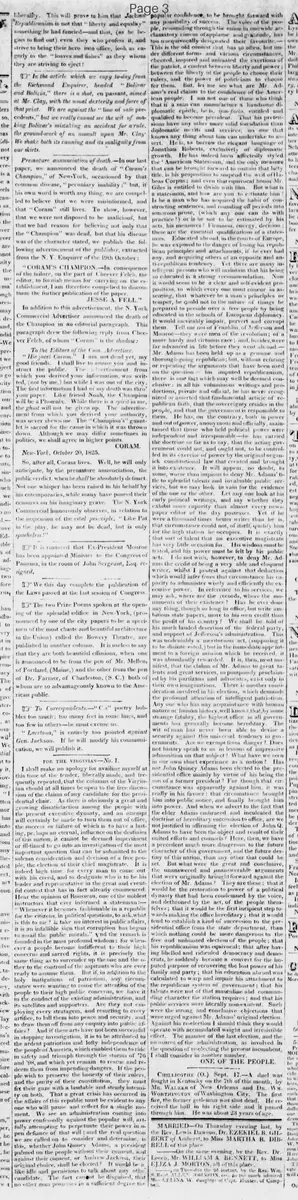
I shall make no apology for availing myself at this time of the tender, liberally made, and frequently repeated, that the columns of the Virginian should at all times be open to the free discussion of the claims of any candidate for the presidential chair. As there is obviously a great and growing dissatisfaction among the people with the present executive dynasty, and an attempt will certainly be made to turn them out of office, the success or failure of which is to have a lasting, perhaps an eternal, influence on the destinies of this nation, it cannot be deemed impertinent or ill-timed to go into an investigation of the most important question that can be submitted to the solemn consideration and decision of a free people, the election of their chief magistrate. It is indeed high time for every man to come out with his creed, and to designate who is to be his leader and representative in the great and eventful contest that has in fact already commenced. Hear the opinion of Rousseau, one of the noblest instructors that ever informed a statesman:——
"Whenever it becomes fashionable in a republic for the citizens, in political questions, to ask, what is this to me? & take no interest in public affairs it is an infallible sign that corruption has begun to assail the public morals." And the remark is founded in the most profound wisdom: for whenever a people become indifferent to their high concerns and sacred rights, it is precisely the same thing as to surrender up the one and the other to the controul of the aspirants who are ever ready to assume them. But if, in addition to the holy instigations of patriotism, any circumstance were wanting to rouse the attention of the people to their high public concerns, we have it in the conduct of the existing administration, and its satellites and supporters. Are they not employing every stratagem, and resorting to every artifice, to lull them into peace and security, and to draw them off from any enquiry into public affairs? And if these arts have not been successful in stopping investigation, it is to be attributed to the ardent patriotism and lofty independence of the people of America, which enabled them to ride in safety and triumph through the storms of '76 and '98, and which yet remain to rescue and redeem them from impending dangers. If the people wish to preserve the honesty of their rulers and the purity of their constitution, they must fix their gaze with a laudable and steady intensity on both. That a great crisis has occurred in the affairs of this republic must be evident to any one who will pause and reflect for a single moment. We see an administration coming into power confessedly against the popular will, artfully attempting to perpetuate their power in open defiance of that will; and the real question we are called on to consider and determine, is this, whether John Quincy Adams, a president palmed on the people without their consent, and against their consent, or Andrew Jackson, their original choice, shall be elected? It would be alike idle and pernicious to talk about any other candidate. The fact cannot be disguised, that no other man possesses in a sufficient degree the popular confidence, to be brought forward with any possibility of success. The voice of the people, resounding through the union in one wide acclaimatory chorus of applause and gratitude, has too unequivocally designated their favourite.—This is the old contest that has so often, but under different forms and various circumstances, cheered, inspired and animated the exertions of the patriot, a contest between liberty and power between the liberty of the people to choose their rulers, and the power of politicians to choose for them. But, let me see what are Mr. Adams's real claims to the confidence of the American people. I am not one of those who think that if a man can manufacture a handsome diplomatic epistle, he is, ipso facto, entitled and qualified to become president. That his pretensions have any other more solid foundation than diplomatic merits and services, no one that knows any thing about him can undertake to assert. He is, to borrow the elegant language of Jonathan Roberts, exclusively of diplomatic growth. He has indeed been affectedly styled the 'American Statesman,' and the only measure that can be brought forward to sustain that lofty title, is his proposition to suspend the writ of Habeas Corpus; and even that equivocal honor Mr. Giles is entitled to divide with him. But what is a statesman, and how are you to estimate him! Is he a man who has acquired the habit of constructing sentences, and rounding off periods into sonorous prose, (which any one can do with practice?) or is he not to be estimated by his acts, his measures? Firmness, energy, decision: these are the essential qualifications of a statesman. Educated abroad, in the courts of Europe, he was exposed to the danger of losing his republican principles and attachments, if he ever had any, and acquiring others of an opposite and anti-republican tendency. Yet there are many intelligent persons who will maintain that his being so educated is a strong recommendation. Now it would seem to be a clear and self-evident proposition, to which every one must concur in assenting, that whatever be a man's principles or temper, he could not in the nature of things be prepared to preside over a free people by being educated in the schools of European diplomacy. It would inevitably impair, pervert and corrupt them. Tell me not of Franklin, of Jefferson and Monroe—they were men of the revolution; of more hardy and virtuous race; and, besides, were far advanced in life before they went abroad.—Mr. Adams has been held up as a genuine and thorough-going republican; but, without refuting or repeating the arguments that have been used on the question his imputed republicanism, there is one fact which may well be deemed conclusive: in all his voluminous writings and productions, private and official, he has never recognized or asserted that fundamental article of republican faith, that the sovereignty resides in the people, and that the government is responsible to them. He has, on the contrary, both in power and out of power, anonymous and officially, maintained that those who held political power were independent and irresponsible—he has carried the doctrine so far as to say, that the acting government could not, and ought not, to be controlled in its exercise of power by the original organic constitutional law that created and brought it into existence. It will appear, no doubt, to some, worse than impious to deny Mr. Adams's title to splendid talents and invaluable public services, but we may look in vain for the evidence of the one or the other. Let any one look at his early political writings, and say whether they exhibit more capacity than almost every newspaper editor of the day possesses. Yet if he were a thousand times better writer than he is, that circumstance could not, of itself, qualify him for the high station he occupies. It is exactly that sort of talent that an executive magistrate has very little occasion for. His wisdom must be tested, and his power must be felt by his public acts. I do not wish, however, to deny Mr. Adams the credit of being a very able and eloquent writer, whilst I protest against that deduction which would infer from that circumstance his capacity to administer wisely and efficiently the executive power. In reference to his services, we may ask, where are the records, where the monuments of their existence? Has he ever done any thing, though so long in office, but write ambitious state papers, more to his own credit than the profit of his country? We shall be told of his much lauded desertion of the federal party, and support of Jefferson's administration. This was undeniably a meritorious act, (supposing it to be disinterested.) but in the immediate appointment to a foreign mission which he received, it was abundantly rewarded. It is, then, most manifest, that the claims of Mr. Adams to great talents and great services, so pompously proclaimed by his partizans and advocates, exist only in their own imaginations. There is another consideration involved in his election, which demands the profound attention of intelligent patriotism. Any one who has any acquaintance with human nature or human history, well knows, that, by some strange fatality, the highest office in all governments has generally become hereditary. The wit of man has never been able to devise a security against this universal tendency in governments. Are we exempt from danger? Does not history speak to us in lessons of impressive admonition on that subject? What have we seen in our own short experience as a nation? Has not John Quincy Adams been elected to the presidential office mainly by virtue of his being the son of a former president? For though that circumstance was apparently against him, it was really in his favour: that circumstance brought him into public notice, and finally brought him into power. And when we advert to the fact that the elder Adams embraced and inculcated the doctrine of hereditary succession to office, are we not justified in affirming the election of John Q. Adams to have been the object and result of their united efforts and counsels? Here, then, we have a precedent much more dangerous to the future character of this government, and the future destiny of this nation, than any other that could be set. But what were the great and conclusive the unanswered and unanswerable arguments that were originally brought forward against the election of Mr. Adams? They are these: that it would be the restoration to power of a political dynasty that had been condemned by the voice, and dethroned by the act, of the people themselves; that it would be the first incipient step towards making the office hereditary; that it would tend to establish a kind of succession to the presidential office from the state department, than which nothing could be more dangerous to the free and unbiassed election of the people; that his republicanism was equivocal; that after having libelled and ridiculed democracy and democrats, he suddenly became a convert for the imputed purpose of recovering the lost power of his family and party; that his education abroad was calculated to warp and impair his attachment to the republican system of government; that his talents were not of that masculine and commanding character the station requires; and that his public services were literally non-existent. Such were the strong and conclusive objections that were urged against Mr. Adams's original election. Against his re-election I should think they would operate with accumulated weight and irresistible effect. The manner of the last election, and the measures of the administration, as involved in the question of re-electing the present incumbent
What sub-type of article is it?
What themes does it cover?
What keywords are associated?
What entities or persons were involved?
Letter to Editor Details
Recipient
The Virginian
Main Argument
the letter argues against the re-election of john quincy adams, portraying him as unqualified, un-republican, and part of a dangerous executive dynasty imposed against the people's will, while advocating for andrew jackson as the true choice of the people to preserve liberty and prevent hereditary power.
Notable Details