Thank you for visiting SNEWPapers!
Sign up free
The New York Journal, And Weekly Register
New York, New York County, New York
What is this article about?
Proceedings of the New York House of Assembly from March 1-9, discussing petitions for relief from banishment and sequestration, tax bills on bachelors, lands, mills, and theaters, nominations of delegates to the federal constitutional convention, and various legislative matters including hospital support and ferry rights.
Clipping
OCR Quality
Full Text
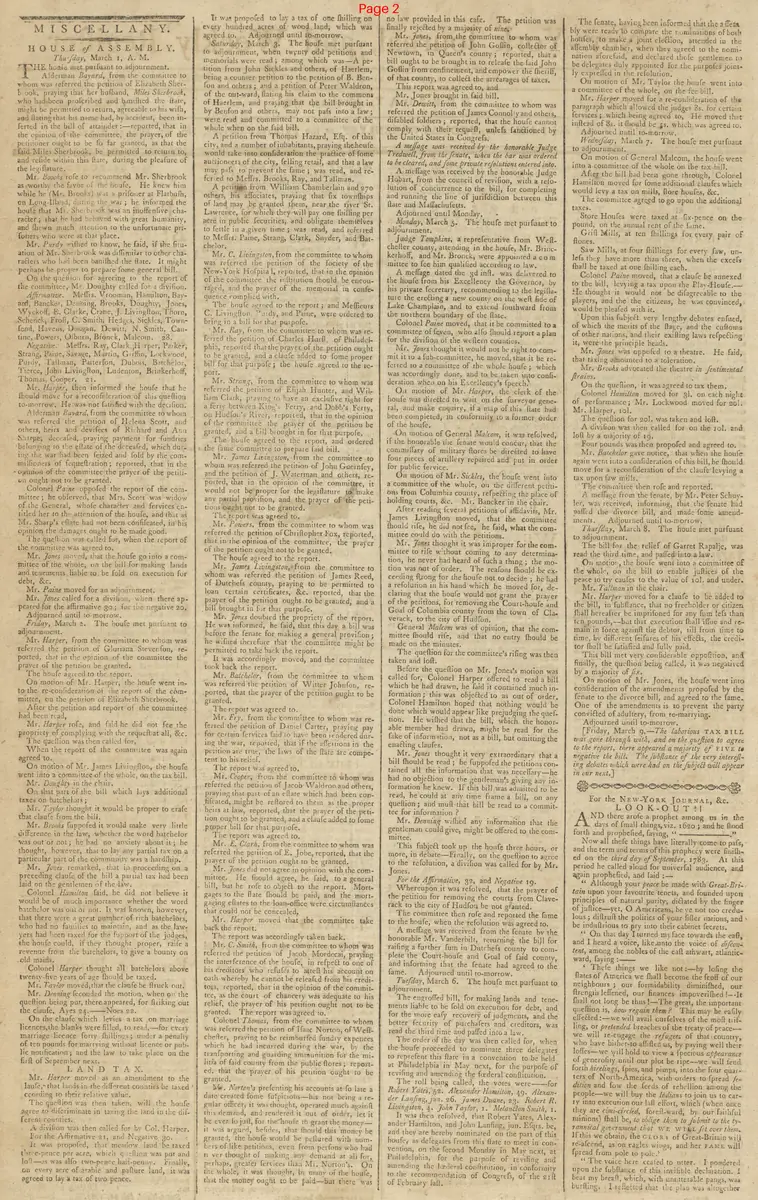
HOUSE of ASSEMBLY
Thursday, March 1, A. M.
The house met pursuant to adjournment.
Alderman Bayard, from the committee to whom was referred the petition of Elizabeth Sherbrook, praying that her husband, Miles Sherbrook, who had been proscribed and banished the state, might be permitted to return, agreeable to his wish, and stating that his name had, by accident, been inserted in the bill of attainder: reported, that in the opinion of the committee, the prayer of the petitioner ought to be so far granted, as that the said Miles Sherbrook, be permitted to return to, and reside within this state, during the pleasure of the legislature.
Mr. Brooks rose to recommend Mr. Sherbrook as worthy the favor of the house. He knew him while he (Mr. Brooks) was a prisoner at Flatbush, on Long-Island, during the war; he informed the house that Mr. Sherbrook was an inoffensive character; that he had behaved with great humanity, and shewn much attention to the unfortunate prisoners who were at that place.
Mr. Purdy wished to know, he said, if the situation of Mr. Sherbrook was dissimilar to other characters who had been banished the state. It might perhaps be proper to prepare some general bill.
On the question for agreeing to the report of the committee, Mr. Doughty called for a division.
Affirmative. Messrs. Vrooman, Hamilton, Bayard, Bancker, Denning, Brooks, Doughty, Jones, Wyckoff, E. Clarke, Crane, J. Livingston, Thorn, Schenck, Frost, C. Smith, Hedges, Sickles, Townsend, Havens, Dongan, Dewitt, N. Smith, Cantine, Powers, Osburn, Bronck, Malcom. 28.
Negative. Messrs. Ray, Clark, Harper, Parker, Strang, Paine, Savage, Martin, Griffin, Lockwood, Purdy, Tallman, Patterson, Dubois, Batchelor, Tierce, John Livingston, Ludinton, Brinkerhoff, Thomas, Cooper. 21.
Mr. Harper, then informed the house that he should move for a reconsideration of this question to-morrow. He was not satisfied with the decision.
Alderman Bayard, from the committee to whom was referred the petition of Helena Scott, and others, heirs and devisees of Richard and Ann Sharpe, deceased, praying payment for sundries belonging to the estate of the deceased, which during the war had been seized and sold by the commissioners of sequestration; reported, that in the opinion of the committee the prayer of the petition ought not to be granted.
Colonel Paine opposed the report of the committee; he observed, that Mrs. Scott was widow of the General, whose character and services entitled her to the attention of the house, and that as Mr. Sharpe's estate had not been confiscated, in his opinion the damages ought to be made good.
The question was called for, when the report of the committee was agreed to.
Mr. Jones moved, that the house go into a committee of the whole, on the bill for making lands and tenements liable to be sold on execution for debt, &c.
Mr. Paine moved for an adjournment.
Mr. Jones called for a division, when there appeared for the affirmative 30; for the negative 20.
Adjourned until to-morrow.
Friday, March 2. The house met pursuant to adjournment.
Mr. Harper, from the committee to whom was referred the petition of Gloriana Stevenson, reported, that in the opinion of the committee the prayer of the petition be granted.
The house agreed to the report.
On motion of Mr. Harper, the house went into the re-consideration of the report of the committee, on the petition of Elizabeth Sherbrook.
After the petition and report of the committee had been read,
Mr. Harper rose, and said he did not see the propriety of complying with the request at all, &c.
The question was then called for,
When the report of the committee was again agreed to.
On motion of Mr. James Livingston, the house went into a committee of the whole, on the tax bill.
Mr. Doughty in the chair.
On that part of the bill which lays additional taxes on bachelors;
Mr. Taylor thought it would be proper to erase that clause from the bill.
Mr. Brooks supposed it would make very little difference in the law, whether the word bachelor was out or not; he had no anxiety about it; he thought, however, that to lay any partial tax on a particular part of the community was a hardship.
Mr. Jones remarked, that in proceeding on a preceding clause of the bill a partial tax had been laid on the gentlemen of the law.
Colonel Hamilton said, he did not believe it would be of much importance whether the word bachelor was out or not. It was known, however, that there were a great number of rich bachelors, who had no families to maintain, and as the lawyers had been taxed for the support of the judges, the house could, if they thought proper, raise a revenue from the bachelors, to give a bounty on old maids.
Colonel Harper thought all bachelors above twenty-five years of age should be taxed.
Mr. Taylor moved, that the clause be struck out.
Mr. Denning seconded the motion, when on the question being put, there appeared, for striking out the clause, Ayes 24.-Noes 22.
On the clause which levies a tax on marriage licences, the blanks were filled, to read,-for every marriage licence forty shillings; under a penalty of ten pounds for marrying without licence or public notification; and the law to take place on the first of September next.
LAND TAX.
Mr. Harper moved as an amendment to the law,-that lands in the different counties be taxed according to their relative value.
The question was then taken, will the house agree to discriminate in taxing the land in the different counties.
A division was then called for by Col. Harper.
For the Affirmative 21, and Negative 30.
It was proposed, that meadow land be taxed three-pence per acre, which question was put and lost-as was also two-pence half-penny. Finally, on every acre of arable and pasture land, it was agreed to lay a tax of two pence.
It was proposed to lay a tax of one shilling on every hundred acres of wood land; which was agreed to. Adjourned until to-morrow.
Saturday, March 3. The house met pursuant to adjournment, when twenty odd petitions and memorials were read; among which was—A petition from John Sickles and others, of Haerlem, being a counter petition to the petition of B. Benson and others; and a petition of Peter Waldron, of the out-ward, stating his claim to the commons of Haerlem, and praying that the bill brought in by Benson and others, may not pass into a law; were read and committed to a committee of the whole when on the said bill.
A petition from Thomas Hazard, Esq. of this city, and a number of inhabitants, praying the house would take into consideration the practice of some auctioneers of the city, selling retail, and that a law may pass to prevent the same; was read, and referred to Messrs. Brooks, Ray, and Tallman.
A petition from William Chamberlain and 270 others, his associates, praying that six townships of land may be granted them, near the river St. Lawrence. for which they will pay one shilling per acre in public securities, and obligate themselves to settle in a given time ; was read, and referred to Messrs. Paine, Strang, Clark, Snyder, and Batchelor.
Mr. C. Livingston, from the committee to whom was referred the petition of the society of the New-York Hospital, reported, that in the opinion of the committee the institution should be encouraged, and the prayer of the memorial in consequence complied with.
The house agreed to the report; and Messieurs C. Livingston. Purdy, and Paine, were ordered to bring in a bill for that purpose.
Mr. Ray, from the committee to whom was referred the petition of Charles Hurst, of Philadelphia, reported that the prayer of the petition ought to be granted, and a clause added to some proper bill for that purpose; the house agreed to the report.
Mr. Strang, from the committee to whom was referred the petition of Elijah Hunter, and William Clark, praying to have an exclusive right for a ferry between King's Ferry, and Dobb's Ferry, on Hudson's River, reported, that in the opinion of the committee the prayer of the petition be granted, and a bill brought in for that purpose.
The house agreed to the report, and ordered the same committee to prepare said bill.
Mr. James Livingston, from the committee to whom was referred the petition of John Guerney, and the petition of J. Waterman and others, reported, that in the opinion of the committee, it would not be proper for the legislature to make any partial provision, and the prayer of the petitions ought not to be granted.
The report was agreed to.
Mr. Powers, from the committee to whom was referred the petition of Christopher Fox, reported, that in the opinion of the committee, the prayer of the petition ought not to be granted.
The house agreed to the report.
Mr. James Livingston, from the committee to whom was referred the petition of James Reed, of Dutchess county, praying to be permitted to loan certain certificates, &c. reported, that the prayer of the petition ought to be granted, and a bill brought in for that purpose.
Mr. Jones doubted the propriety of the report. He was informed, he said, that this day a bill was before the senate for making a general provision; he wished therefore that the committee might be permitted to take back the report.
It was accordingly moved, and the committee took back the report.
Mr. Batchelor, from the committee to whom was referred the petition of Witter Johnson, reported, that the prayer of the petition ought to be granted.
The report was agreed to.
Mr. Fry, from the committee to whom was referred the petition of Daniel Carter, praying pay for certain services said to have been rendered during the war, reported, that if the assertions in the petition are true, the laws of the state are competent to his relief.
The report was agreed to.
Mr. Cooper, from the committee to whom was referred the petition of Jacob Waldron and others, praying that part of an estate which had been confiscated, might be restored to them as the proper heirs at law, reported, that the prayer of the petition ought to be granted, and a clause added to some proper bill for that purpose.
The report was agreed to.
Mr. E. Clark, from the committee to whom was referred the petition of E. Jobes, reported, that the prayer of the petition ought to be granted.
Mr. Jones did not agree in opinion with the committee. He should agree, he said, to a general bill, but he rose to object to the report. Mortgages to the state should be paid, and the mortgaging estates to the loan-office were circumstances that could not be concealed.
Mr. Harper moved that the committee take back the report.
The report was accordingly taken back.
Mr. C. Smith, from the committee to whom was referred the petition of Jacob Mordecai, praying the interference of the house, in respect to one of his creditors who refuses to attest his account on oath whereby he cannot be released from his creditors, reported, that in the opinion of the committee, as the court of chancery was adequate to his relief, the prayer of his petition ought not to be granted. The report was agreed to.
Colonel Thomas, from the committee to whom was referred the petition of Isaac Norton, of Westchester, praying to be reimbursed sundry expences which he had incurred during the war, by the transporting and guarding ammunition for the militia of said county from the public stores; reported, that the prayer of his petition ought to be granted.
Mr. Norton's presenting his accounts at so late a date created some suspicions-his not being a regular officer, it was thought, operated much against this demand, and rendered it out of order, let it be ever so justly, for the house to grant the money— it was argued, besides, that should this money be granted, the house would be pestered with numbers of like petitions, even from persons who had never thought of making any demand at all for, perhaps, greater services than Mr. Norton's. On the whole, it was thought, by many of the house, that the money ought to be paid -but there was
no law provided in this case. The petition was finally rejected by a majority of nine.
Mr. Jones, from the committee to whom was referred the petition of John Goslin, collector of Newtown, in Queen's county; reported, that a bill ought to be brought in to release the said John Goslin from confinement, and empower the sheriff, of that county, to collect the arrearages of taxes.
This report was agreed to, and Mr. Jones brought in said bill.
Mr. Dewitt, from the committee to whom was referred the petition of James Connolly and others, disabled soldiers; reported, that the house cannot comply with their request, unless sanctioned by the United States in Congress.
A message was received by the honorable Judge Tredwell, from the senate, when the bar was ordered to be cleared, and some private resolutions entered into.
A message was received by the honorable Judge Hobart, from the council of revision, with a resolution of concurrence to the bill, for completing and running the line of jurisdiction between this State and Massachusetts.
Adjourned until Monday.
Monday, March 5. The house met pursuant to adjournment.
Judge Tompkins, a representative from Westchester county, attending in the house, Mr. Brinkerhoff, and Mr. Bronck, were appointed a committee to see him qualified according to law.
A message dated the 3d inst. was delivered to the house from his Excellency the Governor, by his private secretary, recommending to the legislature the erecting a new county on the west side of Lake Champlain, and to extend southward from the northern boundary of the state.
Colonel Paine moved, that it be committed to a committee of seven, who also should report a plan for the division of the western counties.
Mr. Jones thought it would not be right to commit it to a sub-committee, he moved, that it be referred to a committee of the whole house; which was accordingly done, and to be taken into consideration when on his Excellency's speech.
On motion of Mr. Harper, the clerk of the house was directed to wait on the surveyor general, and make enquiry, if a map of this state had been completed, in conformity to a former order of the house.
On motion of General Malcom, it was resolved, if the honorable the senate would concur, that the commissary of military stores be directed to have four pieces of artillery repaired and put in order for public service.
On motion of Mr. Sickles, the house went into a committee of the whole, on the different petitions from Columbia county, respecting the place of holding courts, &c. Mr. Bancker in the chair.
After reading several petitions of affidavits, Mr. James Livingston moved, that the committee should rise, he did not see, he said, what the committee could do with the petitions.
Mr. Jones thought it was improper for the committee to rise without coming to any determination, he never had heard of such a thing ; the motion was out of order. The reasons should be exceeding strong for the house not to decide ; he had a resolution in his hand which he moved for, declaring that the house would not grant the prayer of the petitions, for removing the Court-house and Goal of Columbia county from the town of Claverack, to the city of Hudson.
General Malcom was of opinion, that the committee should rise, and that no entry should be made on the minutes.
The question for the committee's rising was then taken and lost.
Before the question on Mr. Jones's motion was called for, Colonel Harper offered to read a bill which he had drawn, he said it contained much information; this was objected to as out of order.
Colonel Hamilton hoped that nothing would be done which would appear like prejudging the question. He wished that the bill, which the honorable member had drawn, might be read for the sake of information, not as a bill, but omitting the enacting clauses.
Mr. Jones thought it very extraordinary that a bill should be read ; he supposed the petitions contained all the information that was necessary-he had no objection to the gentleman's giving any information he knew. If this bill was admitted to be read, he could at any time frame a bill, on any question; and must that bill be read to a committee for information ?
Mr. Denning wished any information that the gentleman could give, might be offered to the committee,
This subject took up the house three hours, or more, in debate—Finally, on the question to agree to the resolution, a division was called for by Mr. Jones.
For the Affirmative, 32, and Negative 19.
Whereupon it was resolved, that the prayer of the petition for removing the courts from Claverack to the city of Hudson be not granted.
The committee then rose and reported the same to the house, when the resolution was agreed to.
A message was received from the senate by the honorable Mr. Vanderbilt, returning the bill for raising a further sum in Dutchess county to complete the Court-house and Goal of said county, and informing that the senate had agreed to the same. Adjourned until to-morrow.
Tuesday, March 6. The house met pursuant to adjournment.
The engrossed bill, for making lands and tenements liable to be sold on execution for debt, and for the more easy recovery of judgments, and the better security of purchasers and creditors, was read the third time and passed into a law.
The order of the day was then called for, when the house proceeded to nominate three delegates to represent this state in a convention to be held at Philadelphia in May next, for the purpose of revising and amending the federal constitution.
The roll being called, the votes were---for Robert Yates, 52. Alexander Hamilton, 49. Alexander Lansing, jun. 26. James Duane, 23. Robert R. Livingston, 4. John Taylor, 1. Melancton Smith, 1.
It was then resolved, that Robert Yates, Alexander Hamilton, and John Lansing, jun. Esqrs. be, and they are hereby nominated on the part of this house, as delegates from this state to meet in convention, on the second Monday in May next, at Philadelphia, for the purpose of revising and amending the federal constitution, in conformity to the recommendation of Congress, of the 21st of February last.
The senate, having been informed that the assembly were ready to compare the nominations of both houses, to make a joint election, attended in the assembly chamber, when they agreed to the nomination aforesaid, and declared those gentlemen to be delegates duly appointed for the purposes jointly expressed in the resolution.
On motion of Mr. Taylor the house went into a committee of the whole, on the fee bill.
Mr. Harper moved for a re-consideration of the paragraph which allowed the judges 8s. for certain services: which being agreed to, He moved that instead of 8s. it should be 5s. which was agreed to.
Adjourned until to-morrow.
Wednesday, March 7. The house met pursuant to adjournment.
On motion of General Malcom, the house went into a committee of the whole on the tax bill.
After the bill had been gone through, Colonel Hamilton moved for some additional clauses which would levy a tax on mills, store houses, &c.
The committee agreed to go upon the additional taxes.
Store Houses were taxed at six-pence on the pound, on the annual rent of the same.
Grist Mills, at ten Shillings for every pair of stones.
Saw Mills, at four shillings for every saw, unless they have more than three, when the excess shall be taxed at one shilling each.
Colonel Paine moved, that a clause be annexed to the bill, levying a tax upon the Play-House.-- He thought it would not be disagreeable to the players, and the citizens, he was convinced, would be pleased with it.
Upon this subject very lengthy debates ensued. of which the merits of the stage, and the customs of other nations, and their existing laws respecting it, were the principle heads.
Mr. Jones was opposed to a theatre. He said, that taxing amounted to a toleration.
Mr. Brooks advocated the theatre in sentimental trains.
On the question, it was agreed to tax them.
Colonel Hamilton moved for 3l. on each night of performance; Mr. Lockwood moved for 20l. Mr. Harper, 10l.
The question for 20l. was taken and lost.
A division was then called for on the 10l. and lost by a majority of 19.
Four pounds was then proposed and agreed to.
Mr. Batchelor gave notice, that when the house again went into a consideration of this bill, he should move for a reconsideration of the clause levying a tax upon saw mills.
The committee then rose and reported.
A message from the senate, by Mr. Peter Schuyler, was received, informing, that the senate had passed the divorce bill, and made some amendments. Adjourned until to-morrow.
Thursday, March 8. The house met pursuant to adjournment.
The bill for the relief of Garret Rapalje, was read the third time, and passed into a law.
On motion, the house went into a committee of the whole, on the bill to enable justices of the peace to try causes to the value of 10l. and under.
Mr. Tallman in the chair.
Mr. Harper moved for a clause to be added to the bill. in substance, that no freeholder or citizen shall hereafter be imprisoned for any sum less than ten pounds,--but that execution shall issue and remain in force against the debtor, till from time to time, by different seizures of his effects, the creditor shall be satisfied and fully paid.
This bill met very considerable opposition, and finally, the question being called, it was negatived by a majority of six.
On motion of Mr. Jones, the house went into consideration of the amendments proposed by the senate to the divorce bill, and agreed to the same.
One of the amendments is to prevent the party convicted of adultery, from re-marrying.
Adjourned until to-morrow.
[Friday, March 9,--The laborious TAX BILL was gone through with, and on the question to agree to the report, there appeared a majority of FIVE to negative the bill. The substance of the very interesting debates which were had on the subject will appear in our next.]
What sub-type of article is it?
What themes does it cover?
What keywords are associated?
What entities or persons were involved?
Where did it happen?
Story Details
Key Persons
Location
New York House Of Assembly
Event Date
March 1 To March 9
Story Details
The assembly met daily to consider petitions for allowing banished individuals to return, compensating estates seized during the war, granting land and rights, rejecting or approving various claims, debating and amending tax bills including on bachelors, lands, mills, and theaters, supporting the New-York Hospital, nominating delegates to the Philadelphia convention for revising the federal constitution, and passing bills on executions, divorces, and justices' powers.