Thank you for visiting SNEWPapers!
Sign up free
The National Intelligencer And Washington Advertiser
Washington, District Of Columbia
What is this article about?
Editorial from The Aurora praises the superior progress of American manufacturing in Philadelphia and the state compared to 1760s Britain, lists home-produced goods outcompeting imports, advocates for encouraging artisan immigration and domestic industry to secure independence, critiques Congress's inaction.
Clipping
OCR Quality
Full Text
AMERICAN POLICY:
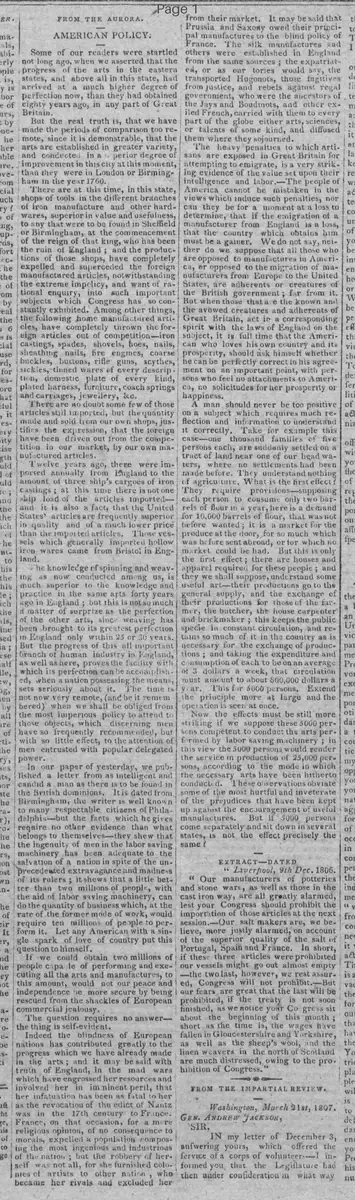
Some of our readers were startled not long ago, when we asserted that the progress of the arts in the eastern states, and above all in this state, had arrived at a much higher degree of perfection now, than they had obtained eighty years ago, in any part of Great Britain. But the real truth is, that we have made the periods of comparison too remote, since it is demonstrable, that the arts are established in greater variety, and conducted in a superior degree of improvement in this city at this moment, than they were in London or Birmingham in the year 1760. There are at this time, in this state, shops of tools in the different branches of iron manufacture and other hard-wares, superior in value and usefulness, to any that were to be found in Sheffield or Birmingham, at the commencement of the reign of that king, who has been the ruin of England; and the productions of those shops, have completely expelled and superceded the foreign manufactured articles, notwithstanding the extreme imbecility, and want of rational enquiry, into such important subjects which Congress has so constantly exhibited. Among other things, the following home manufactured articles, have completely thrown the foreign articles out of competition—iron castings, spades, shovels, hoes, nails, sheathing nails, fire engines, coarse buckles, buttons, rifle guns, scythes, sickles,—tinned wares of every description, domestic plate of every kind, plated harness, furniture, coach springs and carriages, jewellery, &c. There are no doubt some few of those articles still imported, but the quantity made and sold from our own shops, justifies the expression, that the foreign have been driven out from the competition in our market, by our own manufactured articles. Twelve years ago, there were imported annually from England to the amount of three ship's cargoes of iron castings; at this time there is not one ship load of the articles imported—and it is also a fact, that the United States' articles are frequently superior in quality and of a much lower price than the imported articles. Those vessels which generally imported hollow iron wares came from Bristol in England. The knowledge of spinning and weaving as now conducted among us, is much superior to the knowledge and practice in the same arts forty years ago in England; but this is not so much a matter of surprize as the perfection of the other arts, since weaving has been brought to its greatest perfection in England only within 25 or 30 years. But the progress of this all important branch of human industry in England, as well as here, proves the facility with which its perfection can be accomplished, when a nation possessing the means, sets seriously about it. The time is not now very remote, (and be it remembered) when we shall be obliged from the most imperious policy to attend to those objects, which discerning men have so frequently recommended, but with so little effect, to the attention of men entrusted with popular delegated power. In our paper of yesterday, we published a letter from as intelligent and candid a man as there is to be found in the British dominions. It is dated from Birmingham, the writer is well known to many respectable citizens of Philadelphia—but the facts which he gives require no other evidence than what belongs to themselves—they shew that the ingenuity of men in the labor saving machinery has been adequate to the salvation of a nation in spite of the unprecedented extravagance and madness of its rulers; it shews that a little better than two millions of people, with the aid of labor saving machinery, can do the quantity of business which, at the rate of the former mode of work, would require ten millions of people to perform it. Let any American with a single spark of love of country put this question to himself, If we could obtain two millions of people capable of performing and executing all the arts and manufactures, to this amount, would not our peace and independence be more secure by being rescued from the shackles of European commercial jealousy. The question requires no answer—the thing is self-evident. Indeed the blindness of European nations has contributed greatly to the progress which we have already made in the arts; and it may be said with truth of England. in the mad wars which have engrossed her resources and involved her in imminent peril, that her infatuation has been as fatal to her as the revocation of the edict of Nantz was in the 17th century to France. France, on that occasion, for a mere religious opinion, of no consequence to morals, expelled a population composing the most ingenious and industrious of the nation; but the robbery of herself was not all, for she furnished colonies of artists to other nations, who became her rivals and excluded her from their market. It may be said that Prussia and Saxony owed their principal manufactures to the blind policy of France. The silk manufactures and others were established in England from the same sources; the expatriated, or as our tories would say, the transported Hugonots, those fugitives from justice, and rebels against regal government, who were the ancestors of the Jays and Boudinots, and other exiled French, carried with them to every part of the globe either arts, sciences, or talents of some kind, and diffused them where they sojourned. The heavy penalties to which artisans are exposed in Great Britain for attempting to emigrate, is a very striking evidence of the value set upon their intelligence and labor.—The people of America cannot be mistaken in the views which induce such penalties, nor can they be for a moment at a loss to determine, that if the emigration of a manufacturer from England is a loss, that the country which obtains him must be a gainer. We do not say, neither do we suppose that all those who are opposed to manufactures in America, or opposed to the migration of manufacturers from Europe to the United States, are adherents or creatures of the British government: far from it. But when those that are the known and the avowed creatures and adherents of Great Britain, act in a corresponding spirit with the laws of England on the subject, it is full time that the American who loves his own country and its prosperity, should ask himself whether he can be perfectly correct in his agreement on an important point, with persons who feel no attachments to America, no solicitudes for her prosperity or happiness. A man should never be too positive on a subject which requires much reflection and information to understand it correctly. Take for example this case—one thousand families of five persons each, are suddenly settled on a tract of land near one of our head waters, where no settlements had been made before. They understand nothing of agriculture. What is the first effect? They require provisions—supposing each person to consume only two barrels of flour in a year, here is a demand for 10,000 barrels of flour, that was not before wanted; it is a market for the produce at the door, for so much which was before sent abroad. or for which no market could be had. But this is only the first effect: there are houses and apparel required for these people; and they we shall suppose, understand some useful art—their productions go to the general supply, and the exchange of their productions for those of the farmer, the butcher, the house carpenter and brickmaker: this keeps the public specie in constant circulation, and retains so much of it in the country as is necessary for the exchange of productions; and taking the expenditure and consumption of each to be on an average of 3 dollars a week, that circulation must amount to about 800,000 dollars a year. This for 5000 persons. Extend the principle more at large and the operation is seen at once. Now the effects must be still more striking if we suppose these 5000 persons Competent to conduct the arts performed by labor saving machinery: in this view the 5000 persons would render the service in production of 25,000 persons, according to the mode in which the necessary arts have been hitherto conducted. These observations obviate some of the most hurtful and inveterate of the prejudices that have been kept up against the encouragement of useful manufactures. But if 5000 persons come separately and sit down in several states, is not the effect precisely the same?
What sub-type of article is it?
What keywords are associated?
What entities or persons were involved?
Where did it happen?
Domestic News Details
Primary Location
Philadelphia
Key Persons
Event Details
Editorial asserts superior American manufacturing progress in Philadelphia and state over 1760s Britain, lists domestic goods outcompeting imports like iron castings reduced from three ship cargoes to none, advocates artisan immigration and policy focus on manufactures for independence, critiques Congress inaction, references Birmingham letter on labor-saving machinery.