Thank you for visiting SNEWPapers!
Sign up free
Story
May 9, 1940
The Republican
Oakland, Garrett County, Maryland
What is this article about?
Practical guide for homemakers on spring painting projects, offering advice from Ray W. Carpenter on paint selection, surface preparation, brush care, and optimal conditions.
Clipping
OCR Quality
98%
Excellent
Full Text
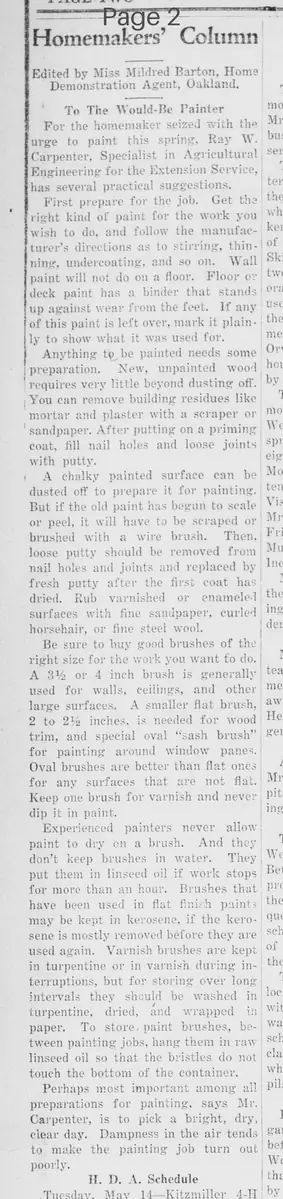
Homemakers' Column
Edited by Miss Mildred Barton. Home Demonstration Agent, Oakland,
To The Would-Be Painter
For the homemaker seized with the urge to paint this spring, Ray W. Carpenter, Specialist in Agricultural Engineering for the Extension Service, has several practical suggestions.
First prepare for the job. Get the right kind of paint for the work you wish to do, and follow the manufacturer's directions as to stirring, thinning, undercoating, and so on. Wall paint will not do on a floor. Floor or deck paint has a binder that stands up against wear from the feet. If any of this paint is left over, mark it plainly to show what it was used for.
Anything to be painted needs some preparation. New, unpainted wood requires very little beyond dusting off. You can remove building residues like mortar and plaster with a scraper or sandpaper. After putting on a priming coat, fill nail holes and loose joints with putty.
A chalky painted surface can be dusted off to prepare it for painting. But if the old paint has begun to scale or peel, it will have to be scraped or brushed with a wire brush. Then loose putty should be removed from nail holes and joints and replaced by fresh putty after the first coat has dried. Rub varnished or enameled surfaces with fine sandpaper, curled horsehair, or fine steel wool.
Be sure to buy good brushes of the right size for the work you want to do. A 3½ or 4 inch brush is generally used for walls, ceilings, and other large surfaces. A smaller flat brush, 2 to 2½ inches, is needed for wood trim, and special oval "sash brush" for painting around window panes. Oval brushes are better than flat ones for any surfaces that are not flat.
Keep one brush for varnish and never dip it in paint. Experienced painters never allow paint to dry on a brush. And they don't keep brushes in water. They put them in linseed oil if work stops for more than an hour. Brushes that have been used in flat finish paint may be kept in kerosene, if the kerosene is mostly removed before they are used again. Varnish brushes are kept in turpentine or in varnish during interruptions, but for storing over long intervals they should be washed in turpentine, dried, and wrapped in paper. To store paint brushes, between painting jobs, hang them in raw linseed oil so that the bristles do not touch the bottom of the container.
Perhaps most important among all preparations for painting, says Mr. Carpenter, is to pick a bright, dry, clear day. Dampness in the air tends to make the painting job turn out poorly.
Edited by Miss Mildred Barton. Home Demonstration Agent, Oakland,
To The Would-Be Painter
For the homemaker seized with the urge to paint this spring, Ray W. Carpenter, Specialist in Agricultural Engineering for the Extension Service, has several practical suggestions.
First prepare for the job. Get the right kind of paint for the work you wish to do, and follow the manufacturer's directions as to stirring, thinning, undercoating, and so on. Wall paint will not do on a floor. Floor or deck paint has a binder that stands up against wear from the feet. If any of this paint is left over, mark it plainly to show what it was used for.
Anything to be painted needs some preparation. New, unpainted wood requires very little beyond dusting off. You can remove building residues like mortar and plaster with a scraper or sandpaper. After putting on a priming coat, fill nail holes and loose joints with putty.
A chalky painted surface can be dusted off to prepare it for painting. But if the old paint has begun to scale or peel, it will have to be scraped or brushed with a wire brush. Then loose putty should be removed from nail holes and joints and replaced by fresh putty after the first coat has dried. Rub varnished or enameled surfaces with fine sandpaper, curled horsehair, or fine steel wool.
Be sure to buy good brushes of the right size for the work you want to do. A 3½ or 4 inch brush is generally used for walls, ceilings, and other large surfaces. A smaller flat brush, 2 to 2½ inches, is needed for wood trim, and special oval "sash brush" for painting around window panes. Oval brushes are better than flat ones for any surfaces that are not flat.
Keep one brush for varnish and never dip it in paint. Experienced painters never allow paint to dry on a brush. And they don't keep brushes in water. They put them in linseed oil if work stops for more than an hour. Brushes that have been used in flat finish paint may be kept in kerosene, if the kerosene is mostly removed before they are used again. Varnish brushes are kept in turpentine or in varnish during interruptions, but for storing over long intervals they should be washed in turpentine, dried, and wrapped in paper. To store paint brushes, between painting jobs, hang them in raw linseed oil so that the bristles do not touch the bottom of the container.
Perhaps most important among all preparations for painting, says Mr. Carpenter, is to pick a bright, dry, clear day. Dampness in the air tends to make the painting job turn out poorly.
What sub-type of article is it?
Instructional Guide
Practical Advice
What keywords are associated?
Painting Tips
Surface Preparation
Brush Care
Homemaking Advice
Extension Service
What entities or persons were involved?
Miss Mildred Barton
Ray W. Carpenter
Where did it happen?
Oakland
Story Details
Key Persons
Miss Mildred Barton
Ray W. Carpenter
Location
Oakland
Story Details
Ray W. Carpenter provides tips for homemakers on selecting appropriate paints, preparing surfaces like new wood or old painted areas, choosing and maintaining brushes, and painting on a bright dry day.