Thank you for visiting SNEWPapers!
Sign up free
The Indianapolis Journal
Indianapolis, Marion County, Indiana
What is this article about?
The Presbyterian Church of Ireland's General Assembly in Belfast on March 9, 1886, unanimously passed resolutions opposing Home Rule and a separate Irish Parliament, affirming loyalty to Queen Victoria, supporting land reforms, and warning of threats to minorities and the union with Britain. Mr. Thomas Sinclair's speech highlighted economic and religious concerns.
Clipping
OCR Quality
Full Text
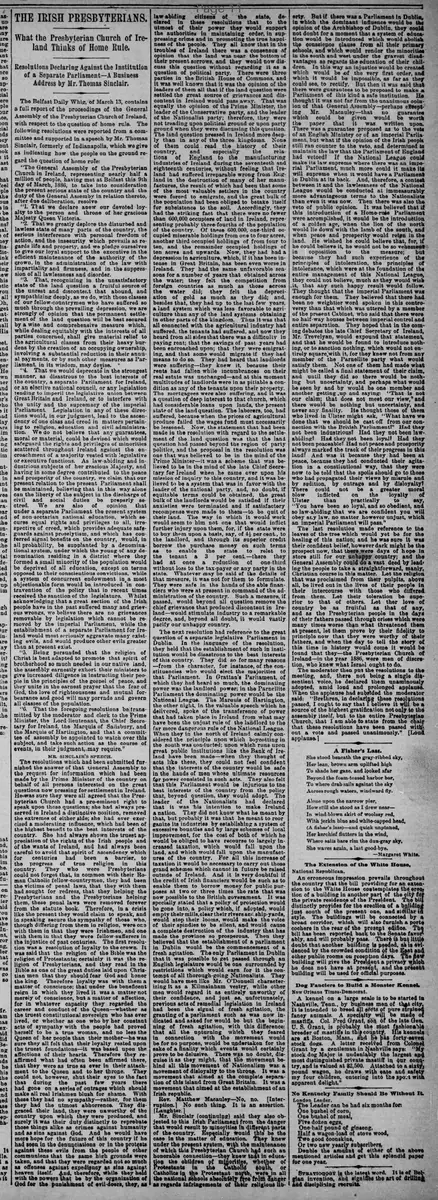
What the Presbyterian Church of Ireland Thinks of Home Rule.
Resolutions Declaring Against the Institution of a Separate Parliament-A Business Address by Mr. Thomas Sinclair.
The Belfast Daily Whig, of March 13, contains a full report of the proceedings of the General Assembly of the Presbyterian Church of Ireland, with respect to the question of home rule. The following resolutions were reported from a committee and supported in a speech by Mr. Thomas Sinclair, formerly of Indianapolis, which we give as indicating how the people on the ground regard the question of home rule:
"The General Assembly of the Presbyterian Church in Ireland, representing nearly half a million of people, having met at Belfast this 9th day of March, 1886, to take into consideration the present serious state of the country and the duty of the General Assembly in relation thereto, after due deliberation, resolve
"1. That we declare anew our devoted loyalty to the person and throne of her gracious Majesty Queen Victoria.
"2. That we greatly deplore the disturbed and lawless state of many parts of the country, the serious interference with personal freedom of action, and the insecurity which prevails as regards life and property, and we pledge ourselves to give our loyal support to the executive in the efficient maintenance of the authority of the crown, in the administration of the law with impartiality and firmness, and in the suppression of all lawlessness and disorder.
"3. That, recognizing in the unsatisfactory state of the land question a fruitful source of the unrest and discontent that abound, and sympathizing deeply, as we do, with those classes of our fellow-countrymen who have suffered so much through the prevailing depression, we are strongly of opinion that the permanent settlement of the land question will be best secured by a wise and comprehensive measure which, while dealing equitably with the interests of all parties concerned, shall give material relief to the agricultural classes from their heavy burdens by the creation of an occupying ownership, involving a substantial reduction in their annual payments, or by such other measures as Parliament, in its wisdom, may devise.
"4. That we would deprecate in the strongest manner, as disastrous to the best interests of the country, a separate Parliament for Ireland, or an elective national council, or any legislation tending to imperil the legislative union between Great Britain and Ireland, or to interfere with the unity and the supremacy of the imperial Parliament. Legislation in any of these directions would, in our judgment, lead to the ascendency of one class and creed in matters pertaining to religion, education and civil administration. We do not believe that any guarantees, moral or material, could be devised which would safeguard the rights and privileges of minorities scattered throughout Ireland against the encroachment of a majority vested with legislative or executive functions. As law-abiding and industrious subjects of her gracious Majesty, and having in some degree contributed to the peace and prosperity of the country, we claim that our present relation to the present Parliament shall be maintained, believing that in this way alone can the liberty of the subject in the discharge of civil and social duties be properly secured. We are also of opinion that under a separate Parliament the present system of non-sectarian national education, which secures equal rights and privileges to all, irrespective of creed, which provides adequate safeguards against proselytism, and which has conferred signal benefits on the country, would, in all probability, be supplanted by a denominational system, under which the young of any denomination residing in a district where they formed a small minority of the population would be deprived of all education, except on terms opposed to their conscientious convictions, while a system of concurrent endowment in a most objectionable form would be introduced in contravention of the policy that in recent times received the sanction of the legislature. Whilst acknowledging that a great section of the Irish people have in the past suffered many and grievous wrongs, we believe there are no grievances removable by legislation which cannot be removed by the imperial Parliament, while the establishment of a separate Parliament for Ireland would most seriously aggravate many existing evils, and would produce other evils greater than at present exist.
"5. Being persuaded that the religion of Christ is best adapted to promote that spirit of brotherhood so much needed in our native land, the assembly earnestly exhort their ministers to give increased diligence in instructing their people in the principles of the gospel of peace, and they unite in the earnest prayer that the fear of God, the love of righteousness and mutual forbearance and good will may pervade and govern all classes of the population.
"6. That the foregoing resolutions be transmitted by the moderator and clerk to the Prime Minister, the Lord-Lieutenant, the Chief Secretary for Ireland, the Marquis of Salisbury, and the Marquis of Hartington, and that a committee of assembly be appointed to watch over this subject, and take such action as the course of events, in their judgment, may require."
MR. SINCLAIR'S SPEECH
The resolutions which had been submitted furnished the answer of that General Assembly to the request for information which had been made by the Prime Minister of the country on behalf of all persons interested on the great questions now pressing for settlement in Ireland. He was sure they were all agreed that the Presbyterian Church had a pre-eminent right to speak upon those questions; she had always preserved in Ireland a distinctive position, removed the extremes of either side: she had ever exercised a moderating influence, which had been of the highest benefit to the best interests of the country. She had always shown the truest appreciation of the rights of the Irish people and of the wants of Ireland, and had always been careful to avoid that spirit of ascendency which for centuries had been a barrier to the progress of true religion in this country. They who were Presbyterians could not forget that, in common with their Roman Catholic fellow-countrymen, they had been the victims of penal laws, that they with them had sought for redress, that they helping the Presbyterians and the Presbyterians helping them, these penal laws were removed forever from the statute book. Therefore, in a crisis like the present they would claim to speak, and in speaking secure the sympathy of those who, though differing from them in religion, were one with them in that they were Irishmen, and one with them in that they were fellow-sufferers in the injustice of past centuries. The first resolution was a resolution of loyalty to the crown. It was said that the religion of the Bible was the religion of Protestants; certainly it was the religion of Presbyterians, and they read in the Bible as one of the great duties laid upon Christian men that they should fear God and honor the king. Therefore loyalty was with them a matter of conscience; that under the beneficent reign in which they lived it was a matter not merely of conscience, but a matter of affection, for in whatever capacity they regarded the career and conduct of the Queen-whether as the truest constitutional sovereign who has ever lived, or whether as one who by her constant acts of sympathy with the people had proved herself to be a true woman, and no less the Queen of her people than their mother-he was sure they all felt that their loyalty rested upon the truest foundations-it was based upon the affections of their hearts. Therefore they re-affirmed what had often been affirmed there, that they were as true as ever in their attachment to the Queen and to her throne. They could not, however, shut their eyes to the fact that during the past few years there had gone on a series of outrages which should make all real Irishmen blush for shame. With these they had no sympathy-rather, for them they had the utmost abhorrence. They disgraced their land, they were unworthy of the country upon which they were produced, and surely it was their duty distinctly to reprobate those things alike as crimes against humanity and as sins against God. And he would have more hope for the future of this country if he had seen in the denunciations or in the protests against these evils from the people of other communions that the same high grounds were taken, and that they were regarded not so much as offenses against expediency as sins against heaven itself. And, therefore, while they held with the powers that be by the organization of God for the punishment of evil-doers, they, as law-abiding citizens of the state, declared in these resolutions that to the utmost of their power they would support the authorities in maintaining order, in suppressing crime and in promoting the true happiness of the people. They all know that in the troubles of Ireland there was a consensus of opinion that the land was near the bottom of their present sorrows, and they would now discuss this question without regarding it as a question of political party. There were three parties in the British House of Commons, and it was well known that it was the opinion of the leaders of them all that if the land question were settled the great source of grievances and discontent in Ireland would pass away. That was equally the opinion of the Prime Minister, the leader of the Conservative party, and the leader of the Nationalist party; therefore, they were not treading upon political ground or upon party ground when they were discussing this question. The land question pressed in Ireland more deeply than in any of the three kingdoms. None of them could read the history of their country, and especially the relations of England to the manufacturing industries of Ireland during the seventeenth and eighteenth centuries, without feeling that Ireland had suffered irreparable wrong from England in the destruction of many of her manufactures, the result of which had been that some of the most valuable settlers in the country were forced to emigrate, and the great bulk of the population had been obliged to betake itself for subsistence to the soil. Accordingly, they had the striking fact that there were no fewer than 600,000 occupiers of land in Ireland, representing probably three-fourths of the population of the country. Of these 600,000, one-third occupied miserable holdings from one to four acres, another third occupied holdings of from four to ten, and the remainder occupied holdings of ten acres and upwards. Now, they had had a depression in agriculture, which, if it has been intense in Great Britain, has been even worse in Ireland. They had the same unfavorable seasons for a number of years that obtained across the water; they felt the competition from foreign countries as much as those across the water did; they felt the depreciation of gold as much as they did; and, besides that, they had up to the last few years, a land system which was less favorable to agriculture than any of the land systems obtaining in other parts of the kingdom. Thus it was that all connected with the agricultural industry had suffered, the tenants had suffered, and now they heard from all sides that there was a difficulty in paying rent; that the savings of past years had been encroached upon; that they were emigrating, and that some would migrate if they had means to do so. They had heard that landlords were suffering-they knew it, because their rents had fallen while incumbrances on their real estate was unchanged-and at this moment multitudes of landlords were in as pitiable a condition as any of the tenants upon their property. The mortgagees were also suffering, and it was a question of deep interest to that church, which had considerable loans upon lands, the present state of the land question. The laborers, too, had suffered, because when the prices of agricultural produce failed the wages fund must necessarily be lessened. Now, the statement that had been made in the resolution with regard to the settlement of the land question was that the land question had passed beyond the region of party politics, and the proposal in the resolution was one that was believed to be in the mind of the Prime Minister-it was a scheme that was believed to be in the mind of the late Chief Secretary for Ireland when he came over upon his mission of inquiry to this country, and it was believed to be a system that was in favor with the leader of the national party, and, no doubt, if equitable terms could be obtained, the great bulk of the landlords would be satisfied if their anxieties were terminated and if satisfactory recompense were made to them-to be quit of their land. The way in which it would work would seem to him not one that would inflict further injury upon them, for, if the state were to buy them upon a basis, say, of 4 per cent., to the landlord, and through its superior credit borrow the purchase money on such terms as to enable the state to relet to the tenant a 3 per cent.,-there they had at once a reduction of one-third without loss to the tax-payer or any party in the state. Whatever may be said of the details of that measure, it was not for them to formulate. They were safe in the hands of the able financiers who were at present in command of the administration of the country. Such a measure, if passed, would beyond all question remove the chief grievance that produced discontent in Ireland-would stimulate industry to a remarkable degree, and, beyond all doubt, it would vastly pacify our unhappy country.
The next resolution had reference to the great question of a separate legislative Parliament in Dublin. In the language of the resolution, they held that the establishment of such an institution would be disastrous to the best interests of this country. They did so for many reasons-from the character, for instance, of the constituencies who would elect the majorities of that Parliament. In Grattan's Parliament, of which they had heard so much, the dominating power was the landlord power; in the Parnellite Parliament the dominating power would be the National League. The Marquis of Hartington, the other night, in the valuable speech which he delivered, spoke of the transference of power that had taken place in Ireland from what may have been the unjust rule of the landlord to the far more dangerous rule of the National League. When they in the north of Ireland calmly considered the principle upon which boycotting in the south was conducted; upon which runs upon great public institutions like the Bank of Ireland have been made--when they thought of acts like these, they could not feel confident that the interests of the country would be safe in the hands of men whose ultimate resources for power consisted in such acts. They also felt that this Parliament would be injurious to the best interests of the country from the policy that, beyond question, they would adopt. The leader of the Nationalists had declared that it was his intention to make Ireland a nation. They did not know what he meant by that, but probably it was that he meant to reorganize its industries by establishing a system of excessive bounties and by large schemes of local improvement, for the cost of both of which he would be obliged to have recourse to largely increased taxation, which would fall upon the land, and which would fall upon the manufactures of the country. For all this increase of taxation it would be necessary to carry out those grand schemes which cannot in future be raised outside of Ireland. And it is very doubtful if the credit of Irish financiers would be such as to enable them to borrow money for public purposes at two or three times the rate that was now possible to the British government. It was specially stated that a policy of protection would be gone into, a policy which, if adopted, would empty their mills, clear their rivers and ship-yards, would stop their looms, would make the voice of their spindles to be silent, and would cause a complete destruction of the industry that has made the province so prosperous. Then they believed that the establishment of a parliament in Dublin would be the commencement of a fresh agitation. The only Parliament in Dublin that it was possible to get passed through an English legislature would be one surrounded by restrictions which would earn for it the contempt of all thorough-going Nationalists. They would have men like Mr. O'Donnell characterizing it as a Kilmainham vestry, while other men would regard it as entirely unworthy of their confidence, and just as, unfortunately, previous acts of remedial legislation in Ireland had been the signal of fresh agitation, the granting of a parliament such as was now indicated and asked for would be but the beginning of fresh agitation, with this difference: that all the upturning which they feared in connection with the movement would be for no purpose, would be undertaken for the sake of a finality which events would certainly prove to be delusive. There was no doubt, disguise it as they might, that the movement behind all this movement of Nationalism was a movement of disloyalty to the throne. It was a movement that aimed at the complete separation of this island from Great Britain. It was a movement that aimed at the establishment of an Irish republic.
Rev. Matthew Macauley-No, no. [Interruption.] No such thing. It is an assertion. [Laughter.]
Mr. Sinclair (continuing) said they also objected to this Irish Parliament from the danger that would result to minorities in different parts of the country. Especially would this be the case in the matter of education. They knew under the present system, with the maintenance of which this Presbyterian Church had such an honorable connection-they knew that in education the children of minorities, whether of Protestants in the Catholic south, or Catholics in the Protestant north, were in all the national schools absolutely free from danger as regards infringements of their religious liberty. But if there was a Parliament in Dublin in which the dominant influence would be the opinion of the Archbishop of Dublin, they could not doubt for a moment that a system of education would be introduced which would abolish the conscience clause from all their primary schools, and which would render the minorities in the south and west under the gravest disadvantages as regards the education of their children. In this way an injustice would be created which would be of the very first order, and which it would be impossible, as far as they could see, to rectify. But then it was said that there were guarantees to be proposed to make Parliament of this kind a safe institution. He thought it was not far from the unanimous opinion of that General Assembly-perhaps excepting Mr. Macauley-that no guarantee which could be given would be worth the paper that it was written upon. There was a guarantee proposed as to the veto of an English Ministry or of an imperial Parliament, but what if the opinion of the Irish people still ran counter to the veto, and determined to maintain the law that the Parliament of England had vetoed! If the National League could make its law supreme where there was an imperial Parliament, much more could it make its will supreme when it would have a Parliament in Dublin at its back. And, therefore, a contest between it and the lawlessness of the National League would be conducted at immeasurably more advantageous terms to the Nationalists than even it was now. Then there was also the veto of public opinion. It was believed that if this introduction of a Home-rule Parliament were accomplished, it would be the introduction of a golden age, when the lion of the north would lie down with the lamb of the south, and when peace and prosperity would reign in the land. He wished he could believe that, for, if he could believe it, he would not be so vehement in opposition to the measure; but because they had such experience of the principles of intoleration, the principles of intolerance, which were at the foundation of the entire management of this National League, they could not believe, much as they would wish it, that any such happy result would follow. They thought that the imperial Parliament was enough for them. They believed that there had been no weightier word spoken in this controversy than that which was uttered by a member of the present Cabinet, who said that there were no half-way houses between imperial control and entire separation. They hoped that in the coming debates the late Chief Secretary of Ireland, Mr. Trevelyan, would expound that statement and that he would be found to introduce nothing, or to sanction nothing, which would not entirely square with it, for they knew not from any member of the Parnellite party what would satisfy them. Not one of them had made what might be called a final statement of their claim, and until they did so there would be nothing but uncertainty, and perhaps what would be seen by and by would be one member and another getting up and saying: "That is not our claim; that does not meet our view," and there would be nothing but uncertainty, and never any finality. He thought those of them who lived in Ulster might ask, "What have we done that we should be cast off from our connection with the British Parliament?" Had they not been industrious? Had they not been law-abiding? Had they not been loyal? Had they not been peaceable? Had not peace and prosperity always marked the track of their progress in this land? And was it because they had been at peace, because they had conducted their agitation in a constitutional way, that they were now to be told that the spoils should go to those who had propagated their views by misrule and by sedition, by outrage and by disloyalty? There could not be a greater moral blow inflicted on the loyalty of Ulster than practically to say, "You have been so loyal, and so obedient, and so law-abiding that we are confident you will obey any law, no matter however unjust, which an imperial Parliament will pass."
The last resolution made reference to the leaves of the tree which would yet be for the healing of this nation; and he was sure it was their confident belief, however dark might be the prospect now, that there were days of hope in store still for our unhappy country; and the General Assembly could do a vast deed by leading the people to take a straightforward, manly, Christian course in this matter. Let the religion that was proclaimed from their pulpits, above all, be lived out in the lives of their people in their intercourse with those who differed from them. Let their toleration be superior to that of others. Let their love of country be as fruitful as that of any, and as the Presbyterian people in the days of their fathers passed through crises which were many times worse than what threatened them at present, let them prove by their fidelity to principle now that they were worthy of their fathers, and when the day to tell the story of this time in history would come it would be found that they-the Presbyterian Church of Ireland-in the year 1886, were men of discretion, who knew what Israel ought to do.
The moderator then put the resolutions to the meeting, and, there not being a single dissenting voice, he declared them unanimously adopted, amid loud and prolonged applause.
When the applause had subsided the moderator said: "Brethren, in declaring these resolutions passed, I ought to say that I believe it will be a source of the highest gratification not only to the assembly itself, but to the entire Presbyterian Church, that I am able to state from the chair that these resolutions have been passed without a vote and passed unanimously." [Loud applause.]
What sub-type of article is it?
What keywords are associated?
What entities or persons were involved?
Where did it happen?
Foreign News Details
Primary Location
Belfast, Ireland
Event Date
March 9, 1886
Key Persons
Outcome
resolutions unanimously adopted opposing a separate parliament for ireland, supporting land reform, and affirming loyalty to the crown.
Event Details
The General Assembly of the Presbyterian Church in Ireland, representing nearly half a million people, met in Belfast on March 9, 1886, and passed resolutions declaring loyalty to Queen Victoria, deploring lawlessness, advocating for land question settlement through occupying ownership, strongly opposing a separate Parliament or national council that would imperil the union with Great Britain, warning of risks to minorities in religion and education, and exhorting ministers to promote gospel principles. Mr. Thomas Sinclair delivered a speech supporting these resolutions, emphasizing the church's moderating role, historical grievances, economic impacts of land issues, dangers of Nationalism, and the sufficiency of the imperial Parliament.