Thank you for visiting SNEWPapers!
Sign up free
Domestic News
February 25, 1825
Constitutional Whig
Richmond, Virginia
What is this article about?
Editorial supporting Henry Clay's acceptance of the Department of State position under Mr. Adams, arguing it demonstrates independence and dismissing claims of a corrupt compact.
Clipping
OCR Quality
95%
Excellent
Full Text
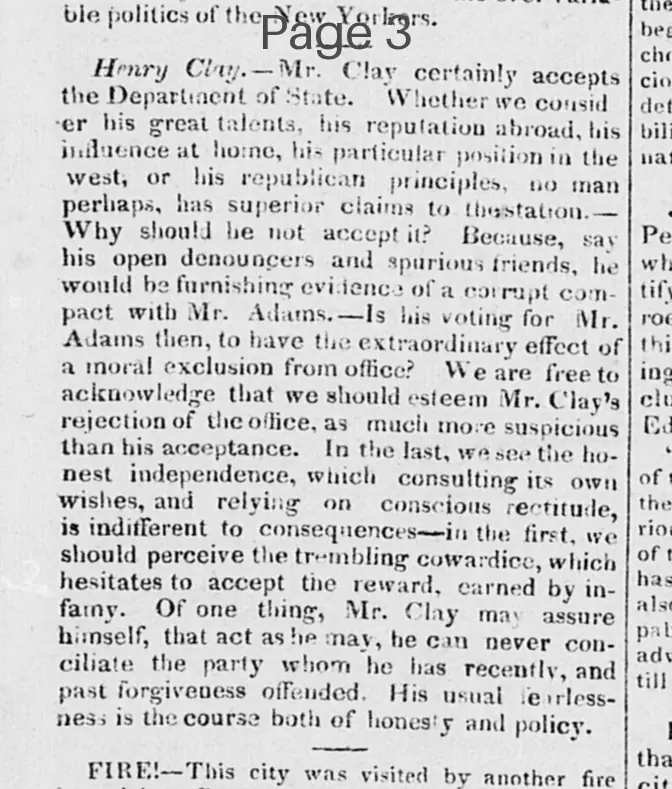
Henry Clay.—Mr. Clay certainly accepts the Department of State. Whether we consider his great talents, his reputation abroad, his influence at home, his particular position in the west, or his republican principles, no man perhaps, has superior claims to that station.—Why should he not accept it? Because, say his open denouncers and spurious friends, he would be furnishing evidence of a corrupt compact with Mr. Adams.—Is his voting for Mr. Adams then, to have the extraordinary effect of a moral exclusion from office? We are free to acknowledge that we should esteem Mr. Clay's rejection of the office, as much more suspicious than his acceptance. In the last, we see the honest independence, which consulting its own wishes, and relying on conscious rectitude, is indifferent to consequences—in the first, we should perceive the trembling cowardice, which hesitates to accept the reward, earned by infamy. Of one thing, Mr. Clay may assure himself, that act as he may, he can never conciliate the party whom he has recently, and past forgiveness offended. His usual fearlessness is the course both of honesty and policy.
What sub-type of article is it?
Appointment
Politics
What keywords are associated?
Henry Clay
Department Of State
Mr Adams
Political Appointment
Corrupt Compact
What entities or persons were involved?
Henry Clay
Mr. Adams
Domestic News Details
Key Persons
Henry Clay
Mr. Adams
Outcome
henry clay accepts the department of state position, countering accusations of corrupt compact.
Event Details
Mr. Clay accepts the Department of State due to his talents, reputation, influence, western position, and republican principles. Critics claim it evidences a corrupt compact with Mr. Adams from his vote; the piece argues acceptance shows honest independence, while rejection would suggest cowardice, and he cannot reconcile with offended party.