Thank you for visiting SNEWPapers!
Sign up free
The New North West
Deer Lodge, Powell County, Montana
What is this article about?
In Deer Lodge, Montana Territory, Republican candidates A.C. Botkin and Judge Hiram Knowles delivered speeches criticizing Democratic Delegate Martin Maginnis for neglect of duties, ties to railroads and military rings, and failure to push statehood and reforms, while defending Botkin's record and advocating Republican policies.
Merged-components note: These components are parts of the same article reporting on political speeches by Botkin and Knowles at Deer Lodge, in sequential reading order.
Clipping
OCR Quality
Full Text
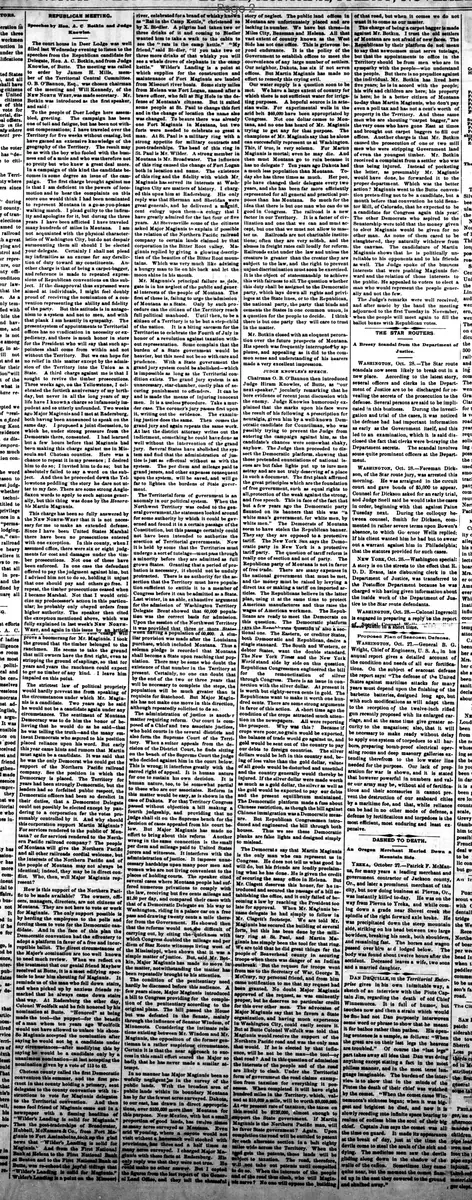
The court house in Deer Lodge was well filled last Wednesday evening to listen to the speeches from the Republican candidate for Delegate, Hon. A. C. Botkin, and from Judge Knowles, of Butte. The meeting was called to order by James H. Mills, member of the Territorial Central Committee. O. B. O'Bannon, Esq., was chosen chairman of the meeting and Will Kennedy, of the New North West, was made secretary. Mr. Botkin was introduced as the first speaker, and said:
To the people of Deer Lodge here assembled, greeting.
The campaign has been one of toil and fatigue, but has been not without compensations; I have traveled over the Territory for five weeks without ceasing, but have gained an extensive knowledge of the geography of the Territory. The result may be as with the boy who fooled with the business end of a mule and who was therefore not so pretty but who knew a great deal more.
In a campaign of this kind the candidate becomes in some degree an issue of the campaign. The first charge brought against me is that I am deficient in the powers of locomotion and to hear the complaints on this score one would think I had been nominated to represent Montana in a go-as-you-please walking match. I plead guilty to the infirmity and apologize for it, but during the three years I have been afflicted I have traveled many hundreds of miles in Montana. I am not acquainted with the physical characteristics of Washington City, but do not despair surmounting them all should I be elected your delegate. Certainly I shall not plead my infirmities as an excuse for any dereliction of duty toward my constituents. Another charge is that of being a carpet-bagger, and reference is made to repeated expressions of Republican conventions on this subject. If the disapproval thus expressed were aimed at individuals, I might feel doubly proud of receiving the nomination of a convention representing the ability and fidelity of the party. But this attitude is in antagonism to a system and not to men, and with that plank I am heartily in sympathy. The present system of appointments to Territorial offices has no vindication in necessity or expediency, and there is much honor in store for the President who will say that such appointees shall come from within and not without the Territory. But we can hope for no relief in this matter except by the admission of the Territory into the Union as a State. A third charge against me is that I sought to revive the timber prosecutions. Three weeks ago, on the Yellowstone, I celebrated the fortieth anniversary of my birthday, but never in all the long years of my life have I known a charge so infamously impudent and so utterly unfounded. Two weeks ago Major Maginnis and I met at Radersburg, both having been announced to speak on the same day. I proposed a joint discussion, to which he, under strong pressure from the Democrats there, consented. I had learned but a few hours before that Maginnis had been making this charge against me in Missoula and Choteau counties. Here was a chance to repeat it in my presence: I desired him to do so; I invited him to do so; but he absolutely failed to say a word on the subject. And then he proceeded down the Yellowstone peddling the story he dare not utter to my face. There are some strong Anglo-Saxon words to apply to such actions generally, but this thing was done by the Honorable Martin Maginnis.
This charge has been so fully answered by the New North-West that it is not necessary for me to make an extended defense. Since I have been United States Marshal there have been no prosecutions entered with one exception. In this county, when I assumed office, there were six or eight judgments for cost and damages under the timber prosecutions. Not one of these have been enforced. In one case the defendant offered to pay the judgment against him, but I advised him not to do so, holding it unjust that one should pay and others go free. I repeat, the timber prosecutions ceased when I became Marshal. Not that I would criticize my predecessor's action in this particular; he probably only obeyed orders from higher authority. The speaker then cited the exception mentioned above, which was fully explained in last week's New North-West, and again in this issue by an article which will prove a boomerang for Mr. Maginnis. I took the ground that the timber belonged to the ranchmen. He seems to take the ground that mill owners have the first right, even to stripping the ground of saplings, so that for years and years the ranchmen could expect no timber of any kind. I leave him impaled on this point.
The strictest law of political propriety would hardly prevent me from speaking of the circumstances under which Mr. Maginnis is a candidate. Two years ago he said he would not be a candidate again under any circumstances. The sentiment of Montana Democracy was to do him the honor of believing that he would do as he said-that he was telling the truth-and the many eminent Democrats who aspired to his position placed reliance upon his word. But early this year came hints and rumors that Martin must again be a candidate. It was said that he was the only Democrat who could get the support of the Northern Pacific railroad company. See the position in which the Democracy is placed. The Territory for years had been strongly Democratic, but the leaders had so forfeited public respect, the Democratic officers had been so derelict in their duties, that a Democratic Delegate could not possibly be elected except by pandering to a corporation for the votes presumably controlled by it. And why should this corporation support Martin Maginnis? For services rendered to the public of Montana? or for services rendered to the Northern Pacific railroad company? The people of Montana will give the Northern Pacific and all other railroads cordial welcome, but the interests of the Northern Pacific and of the people of Montana may not always be identical; indeed, they may be in direct conflict. Who, then, will Major Maginnis represent?
How is this support of the Northern Pacific to be made available? The owners, officers, managers, directors, are not citizens of Montana. They are not here to vote or work for Maginnis. The only support possible is by herding the employees to the polls and forcing them to vote for the Democratic candidate. And in the face of this plan the Democratic convention had the effrontery to adopt a platform in favor of a free and incorruptible ballot. The direct circumstances of the Major's nomination are too well known to need much review. When we reflect on the treatment that our genial friend Mayhew received at Butte, it is a most edifying spectacle to hear him shouting for Maginnis. It reminds us of the man who fell down stairs, and when picked up by anxious friends remarked that he always came down stairs that way. At Radersburg the other day, Colonel Woolfolk said he felt honored by his nomination at Butte. "Honored" at being made the tool-the puppet-for the benefit of a man whom ten years ago Woolfolk would not have allowed to unlace his shoes. So Maginnis accepted the nomination after saying he would not be a candidate under any circumstances-after modifying this by saying he would be a candidate only by a unanimous nomination-at last accepting the nomination given by a vote of 113 to 42. Choteau county called the first Democratic convention this summer, and the first precinct in that county holding a primary, sent delegates to the county convention with instructions to vote for Maginnis delegates to the Territorial convention. And then some fool friend of Maginnis came out in a newspaper with a flaming headline of "Wilder's Landing is solid for Maginnis." Then the post-traderships of Broadwater, Hubbell, McNamara & Co., from Fort Maginnis to Fort Assiniboine, took up the glad news that "Wilder's Landing is solid for Maginnis." And from the First National Bank at Helena to the First National Bank at Benton and to the First National Bank at Butte, was re-echoed the joyful tidings that "Wilder's Landing is solid for Maginnis." Wilder's Landing is a point on the Missouri river, celebrated for a brand of whisky known as "Rat in the Camp Kettle," christened so by X. Biedler. A pilgrim had taken two or three drinks of it and coming to Biedler wanted him to take a walk to the cabin to see the "rats in the camp kettle." "My friend," said Biedler, "if you take two or three more drinks of that whisky you will see a whole drove of elephants in the camp kettle." Wilder's Landing is a point at which supplies for the construction and maintenance of Fort Maginnis are landed from Missouri river boats. Some sixty miles from Helena was Fort Logan, named after a brave officer, who fell at Big Hole in the defense of Montana's citizens. But it suited some people at St. Paul to change this fort and in the change of location the name also was changed. To be sure there was already one Fort Maginnis in Montana, but two forts were needed to celebrate so great a man. At St. Paul is a military ring with a strong appetite for military contracts and post-traderships. The head of this ring in St. Paul is Mr. Wilder. A strong member in Montana is Mr. Broadwater. The influence of this ring caused the change of Fort Logan both in location and name. The existence of this ring and the fidelity with which Mr. Maginnis has served its interests at Washington City are matters of history. I charged this upon him at Radersburg. His only reply was that Sherman and Sheridan were great generals, and he delivered a magnificent eulogy upon them-a eulogy that I have greatly admired for the last four or five years. At Stevensville some of the citizens asked Major Maginnis to explain if possible the relation of the Northern Pacific railroad company to certain lands claimed by that corporation in the Bitter Root valley. Maginnis replied by giving a glowing description of the beauties of the Bitter Root mountains. Which was very much like advising a hungry man to lie on his back and let the moon shine in his mouth.
Mr. Maginnis's principal failure as delegate is in his neglect of the public and general interests of the people of Montana. The first of these is, failing to urge the admission of Montana as a State. Only by such procedure can the citizen of the Territory reach full political manhood. Until then, to be a citizen of a Territory is to be but a step-child of the nation. It is a biting sarcasm for the Territories to celebrate the Fourth of July in honor of a revolution against taxation without representation. Some complain that the burden of a State government would be heavier, but this need not be so with care and prudence. With a State government the grand jury system could be abolished-which is impossible as long as the Territorial condition exists. The grand jury system is an unnecessary, star-chamber, costly plan of securing punishment to offenders. It can be and is made the means of injuring innocent men. It is a useless procedure. Take a murder case. The coroner's jury passes first upon it, writing out the evidence. The examining justice does the same. Then comes the grand jury and again repeats the same work. At last the district attorney writes out the indictment, something he could have done as well without the intervention of the grand jury. Several States have abolished the system and find that the administration of justice is just as effectual without as with the system. The per diem and mileage paid to grand jurors, and other expenses consequent upon the system, will be saved,-and will go far to lighten the burdens of State government.
The Territorial form of government is an anomaly in our political system. When the Northwest Territory was ceded to the general government, the statesmen looked around for some authority by which it could be governed and found it in a certain passage of the Constitution, but this passage certainly could not have been intended to authorize the erection of Territorial governments. Now it is held by some that the Territories must undergo a sort of tutelage-must pass through a minority before they are admitted as full grown States. Granting that a period of probation is necessary, it should not be unduly protracted. There is no authority for the assertion that the Territory must have population sufficient to entitle it to a member of Congress before it can be admitted as a State. Last winter, in an able, exhaustive argument for the admission of Washington Territory Delegate Brent showed that 60,000 population was the correct basis for admission. Upon the session of the Northwest Territory it was provided that three or more States when having a population of 60,000. A similar provision was made after the Louisiana purchase, which included Montana. Thus a solemn pledge is recorded that Montana shall become a State upon reaching that population. There may be some who doubt the existence of that number in the Territory at present. Certainly, no one can doubt that by the end of the two or three years that will be necessary to complete the steps, the population will be much greater than is requisite for Statehood. But Major Maginnis has not made one move in this direction, although repeatedly solicited to do so.
The administration of justice is another matter requiring reform. Our court is composed of a Chief and two associate justices who hold courts in the several districts and also form the Supreme Court of the Territory. When a suitor appeals from the decision of the District Court, he finds sitting on the bench of the Supreme Court the judge who decided against him in the court below. This is wrong: it interferes greatly with the sacred right of appeal. It is human nature for one to sustain his own decision. It is human nature, too, to be somewhat partial to those who are our associates. Reform in this matter would be easy, as is shown in the case of Dakota. For that Territory Congress passed without objection a bill making a fourth judgeship, and providing that no judge shall sit on the Supreme bench for the decision of cases appealed from his court below. But Major Maginnis has made no effort to bring about this reform. Another wrong in the same connection is the small per diem and mileage paid to United States jurors and witnesses. It interferes with the administration of justice. It imposes unnecessary hardships upon many poor men and women who are not living convenient to the places of holding courts. The speaker cited several cases where Montana people had suffered numerous privations to comply with the law, receiving but five cents mileage and $1.50 per day, and compared their cases with that of a Democratic Delegate on his way to Washington, riding in a palace car on a free pass and drawing twenty cents a mile therefor from the Government. He showed then that the reforms would not be difficult of carrying out, by citing the quickness with which Congress doubled the mileage and per diem of Star Route witnesses living west of the Mississippi, when shown that it was a simple matter of justice. But, said Mr. Botkin, Major Maginnis has made no move in the matter, notwithstanding the matter has been repeatedly brought to his attention.
The condition of the penitentiary need hardly be discussed before this audience. A few years since, Major Maginnis introduced a bill to Congress providing for the completion of the penitentiary according to the original plans. The bill passed the House but was defeated in the Senate, mainly through the influence of Senator Windom, of Minnesota. Considering the intimate relations existing between Mr. Windom and Mr. Maginnis, the opposition of the former gentleman is a rather suspicious circumstance. Certain it is that the near approach to success in this small effort scared the Major so badly that he has never made a similar attempt.
In no manner has Major Maginnis been so wofully negligent as in the survey of the public lands. With the broadest area of public lands within its boundary Montana has by far the fewest acres surveyed. Dakota, to our east, has drawn in direct appropriations, over $100,000 more than Montana for this purpose. New Mexico, with but a small proportion of good lands, has twelve times as many acres surveyed as Montana. Even arid Wyoming, where a coyote would not visit without a haversack well stocked with provisions has three and a half times as many acres surveyed. I charged Major Maginnis with these facts at Radersburg. His only reply was that they were not true. He could make no other answer. But I copied the figures from the last report of the General Land Office, and they tell the shameful story of neglect. The public land offices in Montana are unfortunately placed and are lacking in number. We have but three-in Miles City, Bozeman and Helena. All that vast extent of country known as the West Side has not one office. This is grievous beyond endurance. It is the policy of the Government to establish offices to meet the convenience of any large number of settlers. Our neighbor, Dakota, has six if not seven offices. But Martin Maginnis has made no effort to remedy this crying evil.
Our water supply is a question soon to be met. We have a large extent of country for which there is not sufficient water for irrigation purposes. A hopeful source is in artesian wells. For experimental wells in the arid belt $40,000 have been appropriated by Congress. Not one dollar comes to Montana, and no one has heard of Mr. Maginnis trying to get any for that purpose. The champions of Mr. Maginnis say that he alone can successfully represent us at Washington. This, if true, is very solemn. For Martin Maginnis is mortal; even he may die. And then must Montana go to ruin because it has no delegate? Ten years ago Dakota had a much less population than Montana. To-day she has three times as much. Her people have changed their delegate every two years, and she has been far more efficiently represented for all general and practical purposes than has Montana. So much for the idea that there is but one man who can do us good in Congress. The railroad is a new factor in our Territory. It is a factor of civilization and one that we can and must accept, but one that we must not allow to master us. Railroads are not charitable institutions; often they are very selfish, and the abuses in freight rates call loudly for reform. Railroads exist under the law and unless the creature is greater than the creator they are subject to the law, and the right to prevent unjust discrimination must soon be exercised. It is the object of statesmanship to achieve this with fairness to all. The question whether this duty shall be assigned to the Democratic party, which lays down all rights and privileges at the State lines, or to the Republican, the national party, the party that binds and cements the States in one common union, is a question for the people to decide. I think there is but one party they will care to trust in the matter.
Mr. Botkin closed with an eloquent peroration over the future prospects of Montana. His speech was frequently interrupted by applause, and appealing as it did to the common sense and understanding of his hearers made a very excellent impression.
KNOWLES.
Chairman O. B. O'Bannon then introduced Judge Hiram Knowles, of Butte, as "our next speaker," jocularly remarking that he bore evidence of recent joint discussion with the enemy. Judge Knowles humorously explained that the marks upon his face were the result of his following a prescription for neuralgia, given him by a well-known Democratic candidate for Councilman, who was possibly trying to prevent the Judge from entering the campaign against him, as the candidate's chances were somewhat shaky, anyhow. The Judge then proceeded to dissect the Democratic platform, showing that those pretended enunciations of national issues are but false lights put up to lure men astray and are not truly deserving of a place in such a document. The first plank affirmed the great principles which are the foundation of free government, such as equal rights to all, protection of the weak against the strong, and free speech. This in face of the fact that but a few years ago the Democratic party flaunted on its banners that this was "a white man's government, for white men, by white men." The Democrats of Montana seem to have stolen the Republican banner. They say they are opposed to a protective tariff. The New York Sun says the Democratic party in New York is a protective tariff party. The question of tariff reform is really one of section and not of party. The Republican party of Montana is not in favor of free trade. There are many expenses in the national government that must be met, and the money must be raised by levying a direct tax or making a tariff on imported articles. The Republicans believe in the latter plan, using it at the same time to protect American manufactures and thus raise the wages of American workmen. The Republicans are ready to meet the Democrats on this question. The Democratic platform says the Rosahl-gans question is also a sectional one. The Eastern, or creditor States, both Democratic and Republican, desire a single standard. The South and Western, or debtor States, want the double standard. The New York Times and the New York World stand side by side on this question Republican Congressmen engineered the bill for the remonetization of silver through Congress. There is an issue in connection with the silver dollar. At present it is worth but eighty-seven cents in gold. The Republicans want to make it worth one hundred cents. There are some strong arguments in favor of this action. A short time ago the condition of the crops attracted much attention in the newspapers. All were reporting the prospect. Why was this? Because if crops were poor, no grain would be exported, the balance of trade would go against us, and gold would be sent out of the country to pay our debts to foreign countries. The silver dollars would be left in this country and, being of less value than the gold dollar, values of all goods would be disturbed and unsettled and the country generally would thereby be injured. If the silver dollar were made worth as much as a gold dollar, the silver as well as the gold would be exported to pay our debts and the present equilibrium maintained. The Democratic platform made a fuss about Chinese restriction, as though the bill against Chinese immigration was a Democratic measure. But Republican Congressmen introduced and engineered the bill through both houses. Thus we see these Democratic planks are false lights and designed simply to mislead.
The Democrats say that Martin Maginnis is the only man who can represent us in Congress. He does not tell us what good he will do, but his friends are loudly proclaiming what he has done. He is given the credit of securing the assay office in Helena. But Mr. Clagett deserves this honor, for he introduced and secured the passage of a bill establishing the office, and it only failed of becoming a law by reaching the President too late for approval. When Mr. Maginnis became delegate he had simply to follow in Mr. Clagett's footsteps. We are told Mr. Maginnis has secured the building of several forts, but this has been done by the military ring at St. Paul, and Martin Maginnis has simply been the tool for that ring. We are told that he did great things for the people of Beaverhead county in securing troops-when there was danger of an Indian outbreak. But the request for troops went from me to the Secretary of War, George B. McCrary, my personal friend, and from him came notification to me that my request had been granted. No doubt Major Maginnis approved of the request, as was eminently proper, but he deserves no particular credit for this over other men. The advocates of Major Maginnis say that he favors a State organization, and having much experience in Washington City, could easily secure it. But at Butte Colonel Woolfolk was told that Maginnis would receive the support of the Northern Pacific road and was the only man that would. If he is elected by that influence, will he not be the man-the tool-of that road? And in this question of admission the interests of the people and of the road are likely to clash. Under the Territorial form of government the road claims exemption from taxation for everything it possesses. When completed it will have eight hundred miles in the Territory, which, valued at $10,000 a mile, will be worth $8,000,000. At our present rate of taxation, the taxes on this would be $120,000, almost enough to support the State government. If Martin Maginnis is the Northern Pacific man, will he favor State government? Again. Upon completion the road will be entitled to patent for each alternate section in a belt eighty miles wide across the Territory. When the road gets the patents, those lands will be subject to taxation. The road, therefore, will not take out patents until compelled to do so. When the interests of the people and of the road thus clash, who will Maginnis serve? No one will oppose the building of the road; we want it to come as our friend, but we want it to come as our master.
The charge of being a carpet bagger is made against Mr. Botkin. I trust the old settlers of Montana are not afraid of new faces. The Republicans by their platform do not mean to say that newcomers must serve tutelage, but that the appointments to office in the Territory should be from men who are in sympathy with the people-who understand the people. But there is no prejudice against the individual. Mr. Botkin has lived here five years; he is in accord with the people; his wife and children are here; his property is here; he is a better citizen of Montana to-day than Martin Maginnis, who don't pay even a poll tax and has not a cent's worth of property in the Territory. And these same men who are shouting "carpet bagger," are the very ones who have gone East at times and brought out carpet baggers to fill our offices. Another charge is that Mr. Botkin caused the prosecution of one or two mill men who were stripping Government land of even the youngest timber. Mr. Botkin received a complaint from a settler who was thus being injured. Instead of pocketing the letter, as presumably Mr. Maginnis would have done, he forwarded it to the proper department. Which was the better action? Maginnis went to the Butte convention pretending not to be a candidate, but a month before that convention he told Senator Hill, of Colorado, that he expected to be a candidate for Congress again this year. The other Democrats who aspired to the Senatorship were told that the money given to elect Maginnis would be given for no other man. As none of them cared to be slaughtered, they naturally withdrew from the canvass. The candidature of Martin Maginnis shows that he is politically unreliable to his opponents and to his friends as well. The Judge spoke of the business interests that were pushing Maginnis forward and the relation of those interests to the public. He appealed to voters to elect a man who would represent the people generally and not the few.
The Judge's remarks were well received, and after music by the band the meeting adjourned to the first Tuesday in November, when the people will meet again to fill the ballot boxes with Republican votes.
What sub-type of article is it?
What themes does it cover?
What keywords are associated?
What entities or persons were involved?
Where did it happen?
Story Details
Key Persons
Location
Deer Lodge, Montana Territory
Event Date
Last Wednesday Evening
Story Details
Republican candidates Botkin and Knowles spoke at a rally in Deer Lodge, defending Botkin against charges of infirmity, carpetbaggery, and timber prosecutions; criticizing Maginnis for neglecting statehood, justice reforms, land surveys, and serving railroad and military interests; advocating Republican policies on tariff, silver, and Chinese immigration; calling for election of representatives for the people over corporations.