Thank you for visiting SNEWPapers!
Sign up free
Vermont Watchman And State Journal
Montpelier, Washington County, Vermont
What is this article about?
1837 newspaper article exposes correspondence between Bank of Burlington officials and agent Reuben M. Whitney, revealing efforts to secure government deposits for business and political advantages, implying undue influence and calling for investigation.
Clipping
OCR Quality
Full Text
TUESDAY, APRIL 18, 1837
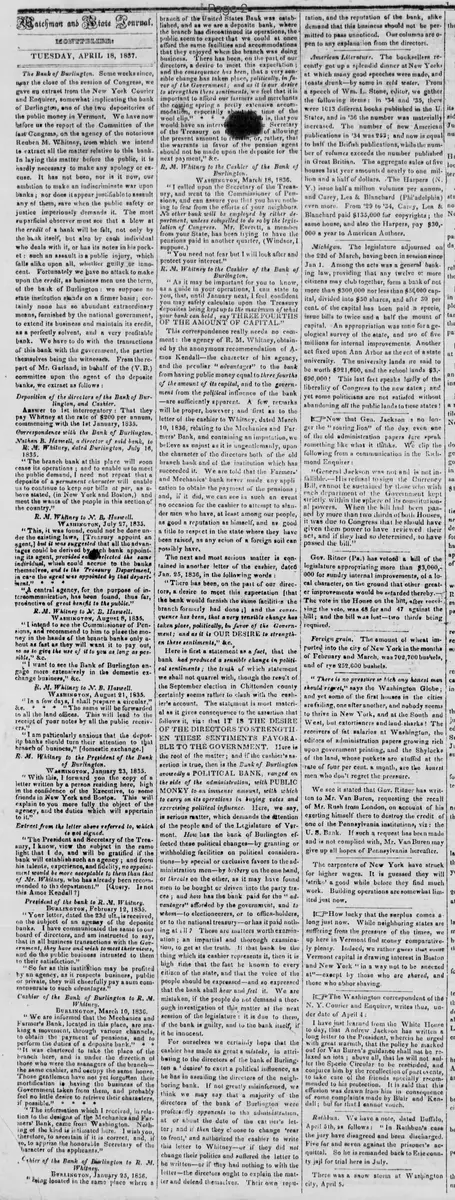
The Bank of Burlington. Some weeks since, near the close of the session of Congress, we gave an extract from the New York Courier and Enquirer, somewhat implicating the bank of Burlington, one of the two depositories of the public money in Vermont. We have now before us the report of the Committee of the last Congress, on the agency of the notorious Reuben M. Whitney, from which we intend to extract all the matter relative to this bank.
In laying this matter before the public, it is hardly necessary to make any apology or excuse. It has not been, nor is it now, our ambition to make an indiscriminate war upon banks; nor does it appear justifiable to assault any of them, save when the public safety or justice imperiously demands it. The most superficial observer must see that a blow at the credit of a bank will be felt, not only by the bank itself, but also by each individual who deals with it, or has its notes in his pocket: such an assault is a public injury, which falls alike upon all, whether guilty or innocent. Fortunately we have no attack to make upon the credit, as business men use the term, of the Bank of Burlington: we suppose no state institution stands on a firmer basis; certainly none has so abundant extraordinary means, furnished by the national government, to extend its business and maintain its credit, as a perfectly solvent, and a very profitable bank. We have to do with the transactions of this bank with the government, the parties themselves being the witnesses. From the report of Mr. Garland, in behalf of the (V.B.) committee upon the agent of the deposit banks, we extract as follows:
Deposition of the directors of the Bank of Burlington, and Cashier.
Answer to 1st interrogatory: That they pay Whitney at the rate of $200 per annum, commencing with the 1st January, 1835.
Correspondence with the Bank of Burlington.
Nathan B. Hassell, a director of said bank, to R. M. Whitney, dated Burlington, July 16, 1835.
"The branch bank at this place will soon cease its operations; and to enable us to meet the public demand, I need not repeat that a deposit of a permanent character will enable us to continue to keep our bills at par, as above stated, (in New York and Boston,) and meet the wants of the people in this section of the country."
R. M. Whitney to N. B. Haswell.
Washington, July 27, 1835.
"This, it was found, could not be done under the existing laws, [Treasury appoint an agent,] but it was suggested that all the advantages could be derived by each bank appointing its agent, provided each selected the same individual, which could accrue to the banks themselves, and to the Treasury Department, in case the agent was appointed by that department."
"A central agency, for the purpose of intercommunication, has been found, thus far, productive of great benefit to the public."
R. M. Whitney to N. B. Haswell.
Washington, August 8, 1835.
"I intend to see the Commissioner of Pensions, and recommend to him to place the money in the hands of the branch banks only about as fast as they will want it to pay out, so as to give the use of it to you as long as possible," &c.
"I want to see the Bank of Burlington engage more extensively in the domestic exchange business," &c.
R. M. Whitney to N. B. Haswell.
Washington, August 21, 1835.
"In a few days, I shall prepare a circular," &c. * * *
"The same will be forwarded to all the land offices. This will lead to the receipt of your notes by all the public receivers."
"I am particularly anxious that the deposit banks should turn their attention to that branch of business," [domestic exchange.]
R. M. Whitney to the President of the Bank of Burlington.
Washington, January 23, 1835.
"With this, I forward you the copy of a letter written by a person residing here, high in the confidence of the Executive, to some friends in New York and Boston. This will explain to you more fully the object of the agency, and the duties which will appertain to it."
Extract from the letter above referred to, which is not signed.
"The President and Secretary of the Treasury, I know, view the subject in the same light that I do, and will be gratified if the bank will establish such an agency; and from his talents, experience, and fidelity, no appointment would be more acceptable to them than that of Mr. Whitney, who has already been recommended to the department." [Query. Is not this Amos Kendall?]
President of the bank to R. M. Whitney.
Burlington, February 12, 1835.
"Your letter, dated the 23d ult., is received, on the subject of an agency of the deposit banks. I have communicated the same to our board of directors, and am instructed to say, that in all business transactions with the Government, they have and wish to meet their views, and do the public business intrusted to them to their satisfaction."
"So far as this institution may be profited by an agency, as it respects business, public or private, they will cheerfully pay a sum commensurate to such advantages."
Cashier of the Bank of Burlington to R. M. Whitney.
Burlington, March 10, 1836.
"We are informed that the Mechanics and Farmers' Bank, located in this place, are making a movement, through various channels, to obtain the payment of pensions, and to perform the duties of a deposit bank." * *
"It was chartered to take the place of the branch here, and is under the direction of those who were the managers of the branch—the same cashier, and occupy the same house.
Those gentlemen have not yet forgotten their mortification in having the business of the Government taken from them, and probably feel no little desire to retrieve their characters, if possible." * * *
The information which I received, in relation to the designs of the Mechanics and Farmers' Bank, came from Washington. Nothing of the kind is intimated here. I wish you, therefore, to ascertain if it is correct, and, if so, to apprise the honorable Secretary of the character of the applicants."
Cashier of the Bank of Burlington to R. M. Whitney.
Burlington, January 25, 1836.
"Being located in the same place where a branch of the United States Bank was established, and as we are a deposit bank, where the branch has discontinued its operations, the public seem to expect that we could at once afford the same facilities and accommodations that they enjoyed when the branch was doing business. There has been, on the part of our directors, a desire to meet this expectation; and the consequence has been, that a very sensible change has taken place, politically, in favor of the Government: and as it is our desire to strengthen these sentiments, we feel that it is important to afford our farmers and merchants the coming spring a pretty extensive accommodation, especially at the time of the wool clip."
"As it is, that you would have an interview with the Secretary of the Treasury on the subject of allowing the present amount to remain in, or, rather, that the warrants in favor of the pension agent should not be made upon the deposit for the next payment," &c.
R. M. Whitney to the Cashier of the Bank of Burlington.
Washington, March 18, 1836.
"I called upon the Secretary of the Treasury, and went to the Commissioner of Pensions, and can assure you that you have nothing to fear from the efforts of your neighbors. No other bank will be employed by either department, unless compelled to do so by the legislation of Congress. Mr. Everett, a member from your State, has been trying to have the pensions paid in another quarter, (Windsor, I suppose.)"
"You need not fear but I will look after and protect your interest."
R. M. Whitney to the Cashier of the Bank of Burlington.
"As it may be important for you to know, as a guide in your operations, I can state to you, that, until January next, I feel confident you may safely calculate upon the Treasury deposits being kept up to the maximum of what your bank can hold, say THREE FOURTHS OF THE AMOUNT OF CAPITAL."
This correspondence really needs no comment: the agency of R. M. Whitney, obtained by the anonymous recommendation of Amos Kendall—the character of his agency, and the peculiar "advantages" to the bank from having public money equal to three fourths of the amount of its capital, and to the government from the political influence of the bank are sufficiently apparent. A few remarks will be proper, however; and first as to the letter of the cashier to Whitney, dated March 10, 1836, relating to the Mechanics and Farmers' Bank, and containing an imputation, we believe as unjust as it is ungentlemanly, upon the character of the directors both of the old branch bank and of the institution which has succeeded it. We are told that the Farmers' and Mechanics' bank never made any application to obtain the payment of the pensions; and, if it did, we can see in such an event no occasion for the cashier to attempt to slander men who have, at least among our people, as good a reputation as himself, and as good a title to respect in the state where they have been raised, as any scion of a foreign soil can possibly have.
The next and most serious matter is contained in another letter of the cashier, dated Jan. 25, 1836, in the following words:
"There has been, on the part of our directors, a desire to meet this expectation (that the bank would furnish the same facilities the branch formerly had done :) and the consequence has been, that a very sensible change has taken place, politically, in favor of the Government; and as it is OUR DESIRE to strengthen these sentiments," &c.
Here is first a statement as a fact, that the bank had produced a sensible change in political sentiments; the truth of which statement we shall not quarrel with, though the result of the September election in Chittenden county certainly seems rather to clash with the cashier's account. The statement is most material, as it gives consequence to the assertion that follows it, viz: that IT IS THE DESIRE OF THE DIRECTORS TO STRENGTHEN THESE SENTIMENTS FAVORABLE TO THE GOVERNMENT. Here is the root of the matter; and if the cashier's assertion is true, then is the Bank of Burlington avowedly a POLITICAL BANK, ranged on the side of the administration, with PUBLIC MONEY to an immense amount, with which to carry on its operations in buying votes and exercising political influence. Here, we say, is serious matter, which demands the attention of the people and of the Legislature of Vermont. How has the bank of Burlington effected these political changes—by granting or withholding facilities on political considerations—by special or exclusive favors to the administration men—by bribery on the one hand, or threats on the other, as it may have found men to be bought or driven into the party traces; and how has the bank paid for the "advantages" afforded by the government, and to whom—to electioneers, or to office-holders, or to the national treasury—or has it paid nothing at all? These are matters worth examination; an impartial and thorough examination, to get at the truth. If that bank be the thing which its cashier represents it, then it is high time that the fact be known to every citizen of the state, and that the voice of the people should be expressed—and so expressed that the bank shall hear and feel it. We are mistaken, if the people do not demand a thorough investigation of this matter at the next session of the legislature: it is due to them, if the bank is guilty, and to the bank itself, if it be innocent.
For ourselves we certainly hope that the cashier has made as great a mistake, in attributing to the directors of the bank of Burlington a 'desire' to exert a political influence, as he has in assailing the directors of the neighboring bank. If not greatly misinformed, we think we may say that a majority of the directors of the bank of Burlington were professedly opponents to the administration, at or about the date of the cashier's letter; and if then they chose to 'change rear to front,' and authorized the cashier to write this letter to Whitney—or if they did not change their politics and suffered the letter to be written—or if they had nothing to do with the letter—the directors ought to explain the matter and defend themselves. Their own reputation, and the reputation of the bank, alike demand that this business should not be permitted to pass unnoticed. Our columns are open to any explanation from the directors.
What sub-type of article is it?
What themes does it cover?
What keywords are associated?
What entities or persons were involved?
Where did it happen?
Story Details
Key Persons
Location
Burlington, Vermont
Event Date
1835 1836
Story Details
Newspaper exposes congressional report on Bank of Burlington's correspondence with agent Reuben M. Whitney, revealing efforts to secure permanent government deposits for business advantages and political influence favoring the administration, calling for legislative investigation into potential bribery and vote-buying using public funds.