Thank you for visiting SNEWPapers!
Sign up free
Literary
March 21, 1771
The Virginia Gazette
Richmond, Williamsburg, Richmond County, Virginia
What is this article about?
A 1741 letter from London to a friend in Berlin analyzes the English national character, highlighting their strong reasoning, industriousness from temperament, frankness and politeness, practical charity focused on the needy, and a noted insensibility to violent entertainments.
Clipping
OCR Quality
95%
Excellent
Full Text
To his Friend at Berlin, from London, May 10, 1741.
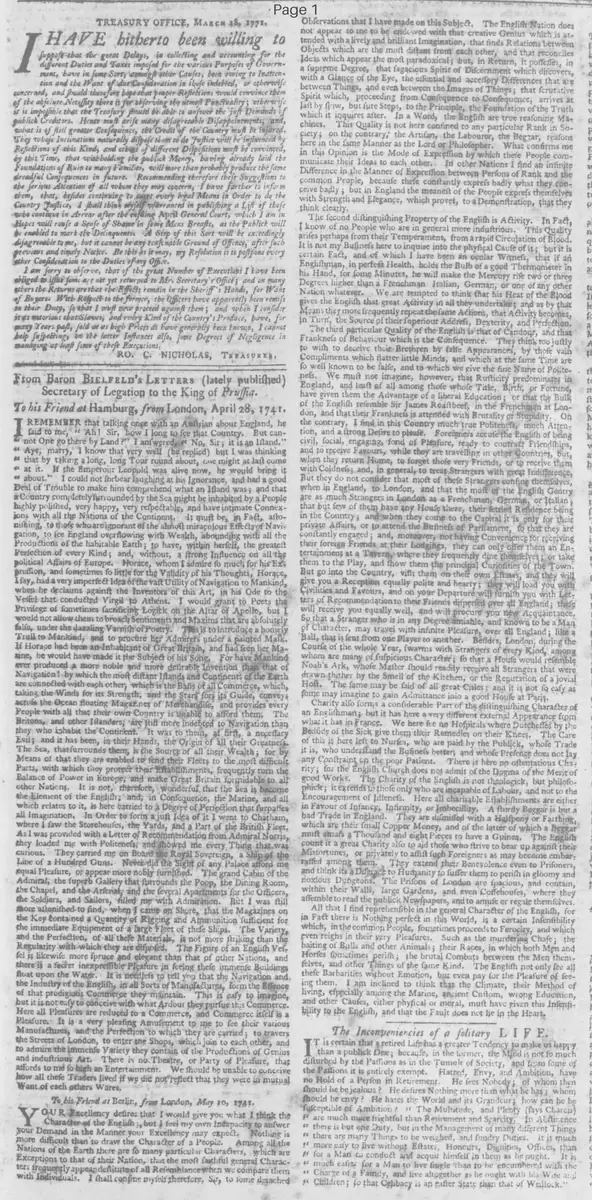
Your Excellency desires that I would give you what I think the Character of the English; but I feel my own Incapacity to answer your Demand in the Manner your Excellency may expect. Nothing is more difficult than to draw the Character of a People. Among all the Nations of the Earth there are so many particular Characters, which are Exceptions to that of their Nation, that the most faithful general Characters frequently appear destitute of all Resemblance when we compare them with Individuals. I Shall confine myself therefore, Sir, to some detached Observations that I have made on this Subject. The English Nation does not appear to me to be endowed with that creative Genius which is attended with a lively and brilliant Imagination, that finds Relations between Objects which are the most distant from each other, and that reconciles Ideas which appear the most paradoxical; but, in Return, it possesses, in a supreme Degree, that sagacious Spirit of Discernment which discovers, with a Glance of the Eye, the essential and accessory Differences that are between Things, and even between the Images of Things; that creative Spirit which, proceeding from Consequence to Consequence, arrives at last by slow, but sure Steps, to the Principle, the Foundation of the Truth which it inquires after. In a Word, the English are true reasoning Machines. This Quality is not here confined to any particular Rank in Society; on the contrary, the Artisan, the Labourer, the Beggar, reasons here in the same Manner as the Lord or Philosopher. What confirms me in this Opinion is the Mode of Expression by which these People communicate their Ideas to each other. In other Nations I find an infinite Difference in the Manner of Expression between Persons of Rank and the common People, because these constantly express badly what they conceive badly; but in England the meanest of the People express themselves with Strength and Elegance, which proves, to a Demonstration, that they think clearly.
The second distinguishing Property of the English is Activity. In Fact, I know of no People who are in general more industrious. This Quality arises perhaps from their Temperament, from a rapid Circulation of Blood. It is not my Business here to inquire into the physical Cause of it; but it is certain Fact, and of which I have been an ocular Witness, that if an Englishman, in perfect Health, holds the Bulb of a good Thermometer in his Hand, for some Minutes, he will make the Mercury rise two or three Degrees higher than a Frenchman, Italian, German, or one of any other Nation whatever. We are tempted to think that his Heat of the Blood gives the English that great Activity in all they undertake; and as by that Means they more frequently repeat the same Actions, that Activity becomes, in Turn, the Source of their superior Address, Dexterity, and Perfection.
The third particular Quality of the English is that of Candour, and that Frankness of Behaviour which is the Consequence. They think too justly to wish to deceive their Brethren by false Appearances, by those vain Compliments which flatter little Minds, and which at the same Time are so well known to be false, and to which we give the fine Name of Politeness. We must not imagine, however, that Rusticity predominates in England, and least of all among those whose Title, Birth, or Fortune, have given them the Advantage of a liberal Education; or that the Bulk of the English resemble Sir James Roastbeef, in the Frenchman at London, and that their Frankness is attended with Brutality or Stupidity. On the contrary, I find in this Country much true Politeness, much Attention, and a strong Desire to please. Foreigners accuse the English of being civil, social, engaging, fond of Pleasure, ready to contract Friendships, and to receive Favours, while they are travelling in other Countries, but, when they return Home, to forget those very Friends, or to receive them with Coldness; and, in general, to treat Strangers with great Indifference. But they do not consider that most of these Strangers coming themselves, when in England, to London, and that the most of the English Gentry are as much Strangers in London as a Frenchman, German, or Italian; that but few of them have any House there, their settled Residence being in the Country; and when they come to the Capital it is only for their private Affairs, or to attend the Business of Parliament, so that they are constantly engaged; and, moreover, not having Convenience for receiving their foreign Friends at their Lodgings, they can only offer them an Entertainment at a Tavern, where they frequently dine themselves; or take them to the Play, and show them the principal Curiosities of the Town. But go into the Country, visit them on their own Estates, and they will give you a Reception equally polite and hearty; they will load you with Civilities and Favours, and on your Departure will furnish you with Letters of Recommendation to their Friends dispersed over all England; these will receive you equally well, and will procure you new Acquaintance. So that a Stranger who is in any Degree amiable, and known to be a Man of Character, may travel with infinite Pleasure, over all England; like a Ball, that is sent from one Player to another. Besides, London, during the Course of the whole Year, swarms with Strangers of every Kind, among whom are many of suspicious Character; so that a House would resemble Noah's Ark, whose Master should readily receive all Strangers that were drawn thither by the Smell of the Kitchen, or the Reputation of a jovial Host. The same may be said of all great Cities; and it is not so easy as some may imagine to gain Admittance into a good House at Paris.
Charity also forms, a considerable Part of the distinguishing Character of an Englishman; but it has here a very different external Appearance from what it has in France. We here see no Hospitals where Duchesses by the Bedside of the Sick give them their Remedies on their Knees. The Care of this is here left to Nurses, who are paid by the Publick, whose Trade it is, who understand the Business better, and whose Presence does not lay any Constraint on the poor Patient. There is here no ostentatious Charity; for the English Church does not admit of the Dogma of the Merit of good Works. The Charity of the English is not the theological, but philosophick; it extends to those only who are incapable of Labour, and not to the Encouragement of Idleness. Here all charitable Establishments are either in Favour of Infancy, Infirmity, or Imbecility. A sturdy Beggar is but a bad Trade in England. They are dismissed with a Halfpenny or Farthing, which are their smallest Copper Money, and of the latter of which a Beggar must amass a Thousand and eight Pieces to have a Guinea. The English count it a great Charity also to aid those who strive to bear up against their Misfortunes, or privately to assist such Foreigners as may become embarrassed among them. They extend their Benevolence even to Prisoners, and think it a Disgrace to Humanity to suffer them to perish in gloomy and noxious Dungeons. The Prisons of London are spacious, and contain, within their Walls, large Gardens, and even Coffeehouses, where they assemble to read the publick Newspapers, and to amuse or regale themselves.
All that I find reprehensible in the general Character of the English, for in Fact there is Nothing perfect in this World, is a certain Insensibility which, in the common People, sometimes proceeds to Ferocity, and which Even reigns in their very Pleasures, Such as the murdering Chase; the baiting of Bulls and other Animals; their Races, in which both Men and Horses sometimes perish; the brutal Combats between the Men themselves, and other Things of the same Kind. The English not only see all these Barbarities without Emotion, but even pay for the Pleasure of seeing them. I am inclined to think that the Climate, their Method of living, especially among the Marine, ancient Custom, wrong Education, and other Causes, either physical or moral, must have given this Insensibility to the English, and that the Fault does not lie in the Heart.
Your Excellency desires that I would give you what I think the Character of the English; but I feel my own Incapacity to answer your Demand in the Manner your Excellency may expect. Nothing is more difficult than to draw the Character of a People. Among all the Nations of the Earth there are so many particular Characters, which are Exceptions to that of their Nation, that the most faithful general Characters frequently appear destitute of all Resemblance when we compare them with Individuals. I Shall confine myself therefore, Sir, to some detached Observations that I have made on this Subject. The English Nation does not appear to me to be endowed with that creative Genius which is attended with a lively and brilliant Imagination, that finds Relations between Objects which are the most distant from each other, and that reconciles Ideas which appear the most paradoxical; but, in Return, it possesses, in a supreme Degree, that sagacious Spirit of Discernment which discovers, with a Glance of the Eye, the essential and accessory Differences that are between Things, and even between the Images of Things; that creative Spirit which, proceeding from Consequence to Consequence, arrives at last by slow, but sure Steps, to the Principle, the Foundation of the Truth which it inquires after. In a Word, the English are true reasoning Machines. This Quality is not here confined to any particular Rank in Society; on the contrary, the Artisan, the Labourer, the Beggar, reasons here in the same Manner as the Lord or Philosopher. What confirms me in this Opinion is the Mode of Expression by which these People communicate their Ideas to each other. In other Nations I find an infinite Difference in the Manner of Expression between Persons of Rank and the common People, because these constantly express badly what they conceive badly; but in England the meanest of the People express themselves with Strength and Elegance, which proves, to a Demonstration, that they think clearly.
The second distinguishing Property of the English is Activity. In Fact, I know of no People who are in general more industrious. This Quality arises perhaps from their Temperament, from a rapid Circulation of Blood. It is not my Business here to inquire into the physical Cause of it; but it is certain Fact, and of which I have been an ocular Witness, that if an Englishman, in perfect Health, holds the Bulb of a good Thermometer in his Hand, for some Minutes, he will make the Mercury rise two or three Degrees higher than a Frenchman, Italian, German, or one of any other Nation whatever. We are tempted to think that his Heat of the Blood gives the English that great Activity in all they undertake; and as by that Means they more frequently repeat the same Actions, that Activity becomes, in Turn, the Source of their superior Address, Dexterity, and Perfection.
The third particular Quality of the English is that of Candour, and that Frankness of Behaviour which is the Consequence. They think too justly to wish to deceive their Brethren by false Appearances, by those vain Compliments which flatter little Minds, and which at the same Time are so well known to be false, and to which we give the fine Name of Politeness. We must not imagine, however, that Rusticity predominates in England, and least of all among those whose Title, Birth, or Fortune, have given them the Advantage of a liberal Education; or that the Bulk of the English resemble Sir James Roastbeef, in the Frenchman at London, and that their Frankness is attended with Brutality or Stupidity. On the contrary, I find in this Country much true Politeness, much Attention, and a strong Desire to please. Foreigners accuse the English of being civil, social, engaging, fond of Pleasure, ready to contract Friendships, and to receive Favours, while they are travelling in other Countries, but, when they return Home, to forget those very Friends, or to receive them with Coldness; and, in general, to treat Strangers with great Indifference. But they do not consider that most of these Strangers coming themselves, when in England, to London, and that the most of the English Gentry are as much Strangers in London as a Frenchman, German, or Italian; that but few of them have any House there, their settled Residence being in the Country; and when they come to the Capital it is only for their private Affairs, or to attend the Business of Parliament, so that they are constantly engaged; and, moreover, not having Convenience for receiving their foreign Friends at their Lodgings, they can only offer them an Entertainment at a Tavern, where they frequently dine themselves; or take them to the Play, and show them the principal Curiosities of the Town. But go into the Country, visit them on their own Estates, and they will give you a Reception equally polite and hearty; they will load you with Civilities and Favours, and on your Departure will furnish you with Letters of Recommendation to their Friends dispersed over all England; these will receive you equally well, and will procure you new Acquaintance. So that a Stranger who is in any Degree amiable, and known to be a Man of Character, may travel with infinite Pleasure, over all England; like a Ball, that is sent from one Player to another. Besides, London, during the Course of the whole Year, swarms with Strangers of every Kind, among whom are many of suspicious Character; so that a House would resemble Noah's Ark, whose Master should readily receive all Strangers that were drawn thither by the Smell of the Kitchen, or the Reputation of a jovial Host. The same may be said of all great Cities; and it is not so easy as some may imagine to gain Admittance into a good House at Paris.
Charity also forms, a considerable Part of the distinguishing Character of an Englishman; but it has here a very different external Appearance from what it has in France. We here see no Hospitals where Duchesses by the Bedside of the Sick give them their Remedies on their Knees. The Care of this is here left to Nurses, who are paid by the Publick, whose Trade it is, who understand the Business better, and whose Presence does not lay any Constraint on the poor Patient. There is here no ostentatious Charity; for the English Church does not admit of the Dogma of the Merit of good Works. The Charity of the English is not the theological, but philosophick; it extends to those only who are incapable of Labour, and not to the Encouragement of Idleness. Here all charitable Establishments are either in Favour of Infancy, Infirmity, or Imbecility. A sturdy Beggar is but a bad Trade in England. They are dismissed with a Halfpenny or Farthing, which are their smallest Copper Money, and of the latter of which a Beggar must amass a Thousand and eight Pieces to have a Guinea. The English count it a great Charity also to aid those who strive to bear up against their Misfortunes, or privately to assist such Foreigners as may become embarrassed among them. They extend their Benevolence even to Prisoners, and think it a Disgrace to Humanity to suffer them to perish in gloomy and noxious Dungeons. The Prisons of London are spacious, and contain, within their Walls, large Gardens, and even Coffeehouses, where they assemble to read the publick Newspapers, and to amuse or regale themselves.
All that I find reprehensible in the general Character of the English, for in Fact there is Nothing perfect in this World, is a certain Insensibility which, in the common People, sometimes proceeds to Ferocity, and which Even reigns in their very Pleasures, Such as the murdering Chase; the baiting of Bulls and other Animals; their Races, in which both Men and Horses sometimes perish; the brutal Combats between the Men themselves, and other Things of the same Kind. The English not only see all these Barbarities without Emotion, but even pay for the Pleasure of seeing them. I am inclined to think that the Climate, their Method of living, especially among the Marine, ancient Custom, wrong Education, and other Causes, either physical or moral, must have given this Insensibility to the English, and that the Fault does not lie in the Heart.
What sub-type of article is it?
Epistolary
Essay
What themes does it cover?
Social Manners
Political
Moral Virtue
What keywords are associated?
English Character
Reasoning
Activity
Candour
Charity
Insensibility
National Traits
Social Customs
Literary Details
Title
To His Friend At Berlin, From London, May 10, 1741.
Subject
Character Of The English
Form / Style
Epistolary Essay On National Traits
Key Lines
In A Word, The English Are True Reasoning Machines.
The Second Distinguishing Property Of The English Is Activity.
The Third Particular Quality Of The English Is That Of Candour, And That Frankness Of Behaviour Which Is The Consequence.
Charity Also Forms, A Considerable Part Of The Distinguishing Character Of An Englishman;
All That I Find Reprehensible In The General Character Of The English... Is A Certain Insensibility Which... Sometimes Proceeds To Ferocity