Thank you for visiting SNEWPapers!
Sign up free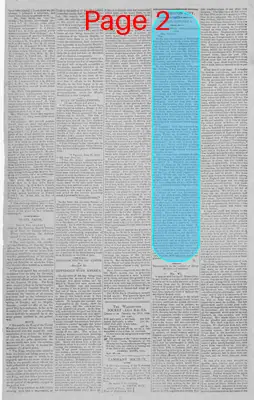
Letter to Editor
October 2, 1807
The National Intelligencer And Washington Advertiser
Washington, District Of Columbia
What is this article about?
A letter to Mr. Smith critiques the absurd and oppressive nature of legal proceedings, using an anecdote from John Wesley's 1761 account of a poor English prisoner's exaggerated indictment for smuggling, questioning justice, mercy, and common sense in the system.
Clipping
OCR Quality
95%
Excellent
Full Text
WASHINGTON CITY,
FRIDAY, OCTOBER 2.
FOR THE NATIONAL INTELLIGENCER.
MR. SMITH,
SIR,
As the late transactions at Richmond have given rise to much serious thought and reflection on the different proceedings of courts of law—technical phrases and terms—I have thought proper to send you for insertion the following statement: It is taken from the life of that great and good man, Mr. Wesley, published by G. Dobbin and Murphy, Baltimore, and certainly merits the serious consideration of every man.
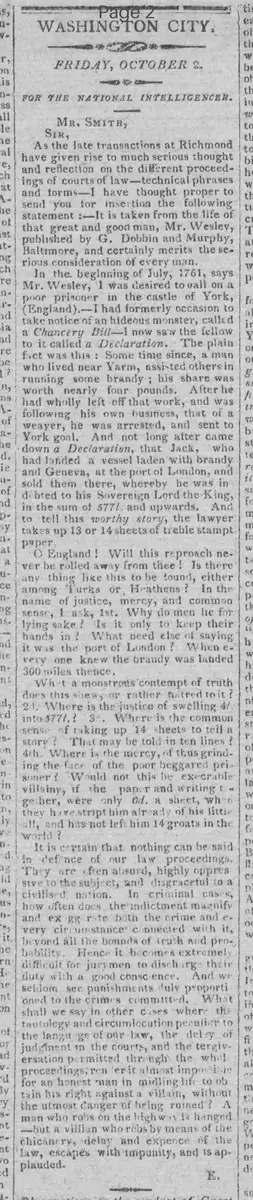
In the beginning of July, 1761, says Mr. Wesley, I was desired to call on a poor prisoner in the castle of York, (England). I had formerly occasion to take notice of an hideous monster, called a Chancery Bill—I now saw the fellow to it called a Declaration. The plain fact was this: Some time since, a man who lived near Yarm, assisted others in running some brandy; his share was worth nearly four pounds. After he had wholly left off that work, and was following his own business, that of a weaver, he was arrested, and sent to York gaol. And not long after came down a Declaration, that Jack, who had landed a vessel laden with brandy and Geneva, at the port of London, and sold them there, whereby he was indebted to his Sovereign Lord the King, in the sum of 577l and upwards. And to tell this worthy story, the lawyer takes up 13 or 14 sheets of treble stamped paper
O England! Will this reproach never be rolled away from thee! Is there any thing like this to be found, either among Turks or Heathens? In the name of justice, mercy, and common sense, I ask, 1st. Why do men lie for lying sake? Is it only to keep their hands in? What need else of saying it was the port of London? When every one knew the brandy was landed 300 miles thence.
What a monstrous contempt of truth does this shew, or rather kindred to it? 2d. Where is the justice of swelling 4l into 577l.? 3d. Where is the common sense of taking up 14 sheets to tell a story? That may be told in ten lines? 4th. Where is the mercy, of thus grinding the face of the poor beggared prisoner? Would not this be execrable villainy, if the paper and writing together, were only 6d. a sheet, when they have stript him already of his little, and has not left him 14 groats in the world?
It is certain that nothing can be said in defence of our law proceedings. They are often absurd, highly oppressive to the subject, and disgraceful to a civilised nation. In criminal cases, how often does the indictment magnify and exaggerate both the crime and every circumstance connected with it, beyond all the bounds of truth and probability. Hence it becomes extremely difficult for jurymen to discharge their duty with a good conscience. And we seldom see punishments duly proportioned to the crimes committed. What shall we say in other cases where the tautology and circumlocution peculiar to the language of our law, the delay of judgment in the courts, and the tergiversation permitted through the whole proceedings, render it almost impossible for an honest man in middling life to obtain his right against a villain, without the utmost danger of being ruined? A man who robs on the highway is hanged—but a villain who robs by means of the chicanery, delay and expense of the law, escapes with impunity, and is applauded.
E.
FRIDAY, OCTOBER 2.
FOR THE NATIONAL INTELLIGENCER.
MR. SMITH,
SIR,
As the late transactions at Richmond have given rise to much serious thought and reflection on the different proceedings of courts of law—technical phrases and terms—I have thought proper to send you for insertion the following statement: It is taken from the life of that great and good man, Mr. Wesley, published by G. Dobbin and Murphy, Baltimore, and certainly merits the serious consideration of every man.
In the beginning of July, 1761, says Mr. Wesley, I was desired to call on a poor prisoner in the castle of York, (England). I had formerly occasion to take notice of an hideous monster, called a Chancery Bill—I now saw the fellow to it called a Declaration. The plain fact was this: Some time since, a man who lived near Yarm, assisted others in running some brandy; his share was worth nearly four pounds. After he had wholly left off that work, and was following his own business, that of a weaver, he was arrested, and sent to York gaol. And not long after came down a Declaration, that Jack, who had landed a vessel laden with brandy and Geneva, at the port of London, and sold them there, whereby he was indebted to his Sovereign Lord the King, in the sum of 577l and upwards. And to tell this worthy story, the lawyer takes up 13 or 14 sheets of treble stamped paper
O England! Will this reproach never be rolled away from thee! Is there any thing like this to be found, either among Turks or Heathens? In the name of justice, mercy, and common sense, I ask, 1st. Why do men lie for lying sake? Is it only to keep their hands in? What need else of saying it was the port of London? When every one knew the brandy was landed 300 miles thence.
What a monstrous contempt of truth does this shew, or rather kindred to it? 2d. Where is the justice of swelling 4l into 577l.? 3d. Where is the common sense of taking up 14 sheets to tell a story? That may be told in ten lines? 4th. Where is the mercy, of thus grinding the face of the poor beggared prisoner? Would not this be execrable villainy, if the paper and writing together, were only 6d. a sheet, when they have stript him already of his little, and has not left him 14 groats in the world?
It is certain that nothing can be said in defence of our law proceedings. They are often absurd, highly oppressive to the subject, and disgraceful to a civilised nation. In criminal cases, how often does the indictment magnify and exaggerate both the crime and every circumstance connected with it, beyond all the bounds of truth and probability. Hence it becomes extremely difficult for jurymen to discharge their duty with a good conscience. And we seldom see punishments duly proportioned to the crimes committed. What shall we say in other cases where the tautology and circumlocution peculiar to the language of our law, the delay of judgment in the courts, and the tergiversation permitted through the whole proceedings, render it almost impossible for an honest man in middling life to obtain his right against a villain, without the utmost danger of being ruined? A man who robs on the highway is hanged—but a villain who robs by means of the chicanery, delay and expense of the law, escapes with impunity, and is applauded.
E.
What sub-type of article is it?
Persuasive
Ethical Moral
Social Critique
What themes does it cover?
Crime Punishment
Morality
Social Issues
What keywords are associated?
Legal Proceedings
Court Critique
Justice System
Wesley Anecdote
Prisoner Oppression
Smuggling Case
Legal Exaggeration
What entities or persons were involved?
E.
Mr. Smith
Letter to Editor Details
Author
E.
Recipient
Mr. Smith
Main Argument
legal proceedings are absurd, oppressive, and unjust, as illustrated by an exaggerated indictment in a smuggling case that inflates a minor offense into a massive debt, highlighting lies, lack of mercy, and disproportionate punishment while allowing legal chicanery to evade justice.
Notable Details
Anecdote From Mr. Wesley's Life In July 1761 About A Poor Weaver Imprisoned In York Gaol For Assisting In Brandy Smuggling
Declaration Exaggerates Debt From 4l To 577l Using 13 14 Sheets Of Stamped Paper
Critiques Lying In Legal Documents, Swelling Penalties, Verbosity, And Grinding The Poor
Contrasts Highway Robbery Punishment With Legal Villainy That Escapes Impunity