Thank you for visiting SNEWPapers!
Sign up free
The Stark County Democrat
Canton, Stark County, Ohio
What is this article about?
Rep. J.H. Ely's investigation exposes fraud in Patent Office stationery procurement: thousands of unaccounted items charged at inflated prices, false deliveries certified during absences, and $21,000 profit on bond paper; bill proposed for lowest-bidder contracts.
Clipping
OCR Quality
Full Text
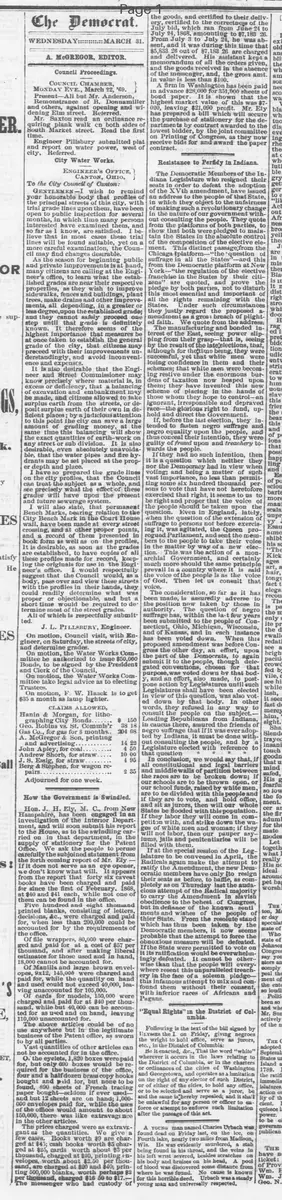
Hon. J. H. Ely, M. C., from New Hampshire, has been engaged in an investigation of the Interior Department, and will soon submit his report to the House, as to the swindling carried on in that department, in the supply of stationery for the Patent Office. We ask the people to peruse carefully the subjoined statement from the forthcoming report of Mr. Ely. If it does not serve as an eye opener, we don't know what will. It appears from the report that forty six caveat books have been charged and paid for since the first of February, 1868, at $40 and $41 each, while not one of them can be found in the office.
Five hundred and eight thousand printed blanks, consisting of letters, decisions, &c., were charged and paid for, when less than 200,000 could be accounted for by the requirements of the office.
Of file wrappers, 80,000 were charged and paid for at a cost of $57 per thousand, and after making liberal estimates for those used and in hand, 18,000 cannot be accounted for.
Of Manilla and large brown envelopes, 9x12, 145,000 were charged and paid for, while the quantity on hand and used could not exceed 40,000, leaving unaccounted for 105,000.
Of cards for models, 150,000 were charged and paid for at $40 per thousand, while but 40,000 can be accounted for as used and on hand, leaving 110,000 unaccounted for.
The above articles could be of no use anywhere but in the legitimate business of the Patent office, as sworn to by all parties.
Vast quantities of other articles cannot be accounted for in the office.
Of the eyelets, 1,820 boxes were paid for, but only 690 boxes would be required for the business of the office, four and a half dozen brass copy hooks bought and paid for, but none to be found, 90 sheets of French tracing paper bought-seldom if ever used and but 12 sheets are on hand; 1,000,000 envelopes paid for, while the uses of the offices would amount to about 150,000, there was like extravagance in the other articles.
The prices charged were as extravagant as the quantities. We give a few cases. Books worth $9 are charged at $45; cash books worth $5 charged at $25, cards worth about $3 per thousand, charged at $20; printing envelopes, worth about $2.50 per thousand, are charged at $20 and $40; printing 500,000 blanks, worth perhaps $2 per thousand, charged $16.50 to $17.
The messenger who had custody of the goods, and certified to their delivery, certified to the correctness of the July bill, which ran from June 24 to July 24, 1868, amounting to $7,183.26. From July 3 to July 24, he was absent, and it was during this time that $5,833.26 out of $7,183.26 are charged and delivered. His assistant kept a memorandum of all the orders given, and the goods received in the absence of the messenger, and, the gross amt. in value is less than $100.
A firm in Washington has been paid in advance $28,000 for 351,000 sheets of bond paper. It is shown that the highest market value of this was $7,020, leaving $21,090 profit. Mr. Ely has prepared a bill which will secure the purchase of stationery for the departments by contract awarded to the lowest bidder, by the joint committee on Printing of Congress, as they now receive bids for and award the paper contract.
What sub-type of article is it?
What themes does it cover?
What keywords are associated?
What entities or persons were involved?
Where did it happen?
Story Details
Key Persons
Location
Interior Department, Patent Office, Washington
Event Date
February 1868 To July 1868
Story Details
Hon. J. H. Ely investigates swindling in the Interior Department's Patent Office stationery supplies, revealing overcharged and unaccounted-for items like caveat books, printed blanks, file wrappers, envelopes, cards, eyelets, and more, with extravagant prices and false certifications leading to substantial government losses; proposes bill for competitive bidding.