Thank you for visiting SNEWPapers!
Sign up free
Alexandria Gazette & Advertiser
Alexandria, Virginia
What is this article about?
A letter from Paris dated Dec. 5, 1823, describes an excursion to the North Holland Canal near Helder and Amsterdam. The canal, nearly complete, is 56 miles long and 24 feet deep, designed for large ships including ships of the line. Details include locks, sluices, innovative cement by Mons. Cazius, construction challenges with sandy soil, and excavation methods using scoops.
Clipping
OCR Quality
Full Text
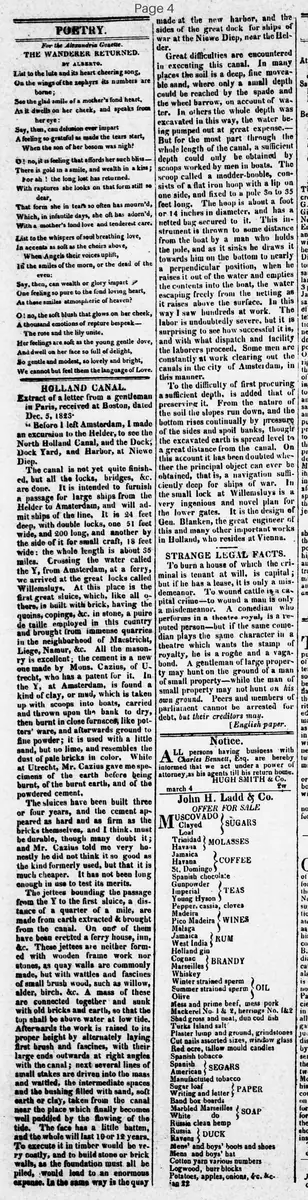
Extract of a letter from a gentleman in Paris, received at Boston, dated Dec. 5, 1823.
Before I left Amsterdam, I made an excursion to the Helder, to see the North Holland Canal, and the Dock; Dock Yard, and Harbor, at Nieuwe Diep.
The canal is not yet quite finished, but all the locks, bridges, &c. are done. It is intended to furnish a passage for large ships from the Helder to Amsterdam, and will admit ships of the line. It is 24 feet deep, with double locks, one 51 feet wide, and 200 long, and another by the side of it for small craft, 18 feet wide: the whole length is about 56 miles. Crossing the water called the Y, from Amsterdam, at a ferry, we arrived at the great locks called Willemsluys. At this place is the first great sluice, which, like all others, is built with brick, having the quoins, copings, &c. in stone, a pierre de taille employed in this country and brought from immense quarries in the neighborhood of Maestricht, Liege, Namur, &c. All the masonry is excellent; the cement is a new one made by Mons. Cazius, of Utrecht, who has a patent for it. In the Y, at Amsterdam, is found a kind of clay, or mud, which is taken up with scoops into boats, carried and thrown upon the bank to dry, then burnt in close furnaces, like potters' ware, and afterwards ground to fine powder; it is used with a little sand, but no lime, and resembles the dust of pale bricks in color. While at Utrecht, Mr. Cazius gave me specimens of the earth before being burnt, of the burnt earth, and of the powdered cement.
The sluices have been built three or four years, and the cement appeared as hard and as firm as the bricks themselves, and I think must be durable, though many doubt it; and Mr. Cazius told me very honestly he did not think it so good as the kind formerly used, but that it is much cheaper. It has not been long enough in use to test its merits.
The jetties bounding the passage from the Y to the first sluice, a distance of a quarter of a mile, are made from earth extracted & brought from the canal. On one of them have been erected a ferryhouse, inn, &c. These jetties are neither formed with wooden frame work nor stones, as quay walls are commonly made, but with wattles and fascines of small brush wood, such as willow, alder, birch. &c. A mass of these are connected together and sunk with old bricks and earth, so that the top shall be above water at low tide. Afterwards the work is raised to its proper height by alternately laying first brush and fascines, with their large ends outwards at right angles with the canal; next several lines of small stakes are driven into the mass and wattled, the intermediate spaces and the bushing filled with sand, soft earth or clay, taken from the canal near the place which finally becomes well puddled by the flowing of the tide. The face has a little batten, and the whole will last 10 or 15 years. To execute it in timber would be very costly, and to build stone or brick walls, as the foundation must all be piled, would lead to an enormous expense. In the same way is the quay made at the new harbor, and the sides of the great dock for ships of war at the Nieuwe Diep, near the Helder.
Great difficulties are encountered in executing this canal. In many places the soil is a deep, fine moveable sand, where only a small depth could be reached by the spade and the wheel barrow, on account of water. In others the whole depth was excavated in this way, the water being pumped out at great expense.— But for the most part through the whole length of the canal, a sufficient depth could only be obtained by scoops worked by men in boats. The scoop called a modder-booble, consists of a flat iron hoop with a lip on one side, and fixed to a pole 30 to 35 feet long. The hoop is about a foot or 14 inches in diameter, and has a netted bag secured to it. This instrument is thrown to some distance from the boat by a man who holds the pole, and as it sinks he draws it towards him on the bottom to nearly a perpendicular position, when he raises it out of the water and empties the contents into the boat, the water escaping freely from the netting as it rises above the surface. In this way I saw hundreds at work. The labor is undoubtedly severe, but it is surprising to see how successful it is, and with what dispatch and facility the laborers proceed. Some men are constantly at work clearing out the canals in the city of Amsterdam, in this manner.
To the difficulty of first procuring a sufficient depth, is added that of preserving it. From the nature of the soil the slopes run down, and the bottom rises continually by pressure of the sides and spoil banks, though the excavated earth is spread level to a great distance from the canal. On this account it has been doubted whether the principal object can ever be obtained, that is, a navigation sufficiently deep for ships of war. In the small lock at Willemsluys is a very ingenious and novel plan for the lower gates. It is the design of Gen. Blanken, the great engineer of this and many other important works in Holland, who resides at Vienna.
What sub-type of article is it?
What keywords are associated?
What entities or persons were involved?
Where did it happen?
Foreign News Details
Primary Location
North Holland, Netherlands
Event Date
Dec. 5, 1823
Key Persons
Outcome
canal nearing completion but faces challenges in maintaining depth for ships of the line; innovative but unproven cement and construction methods employed.
Event Details
Description of the North Holland Canal's construction, including dimensions, locks at Willemsluys, use of new cement by Mons. Cazius, jetty building with fascines, excavation difficulties in sandy soil using modder-booble scoops, and preservation issues; designed by Gen. Blanken for large ship passage from Helder to Amsterdam.