Thank you for visiting SNEWPapers!
Sign up free
Editorial
June 17, 1849
Event 2 of 2
The Daily Union
Washington, District Of Columbia
What is this article about?
This editorial rebukes the Whig 'Republic' for dodging slavery questions amid elections while endorsing internal improvements. It condemns President Taylor's cabinet for northern-biased power distribution, fostering a risky coalition that imbalances sections and threatens the Union, advocating non-intervention in territorial slavery.
Clipping
OCR Quality
98%
Excellent
Full Text
This is Event 2 of 2. The full text below covers all events in this component.
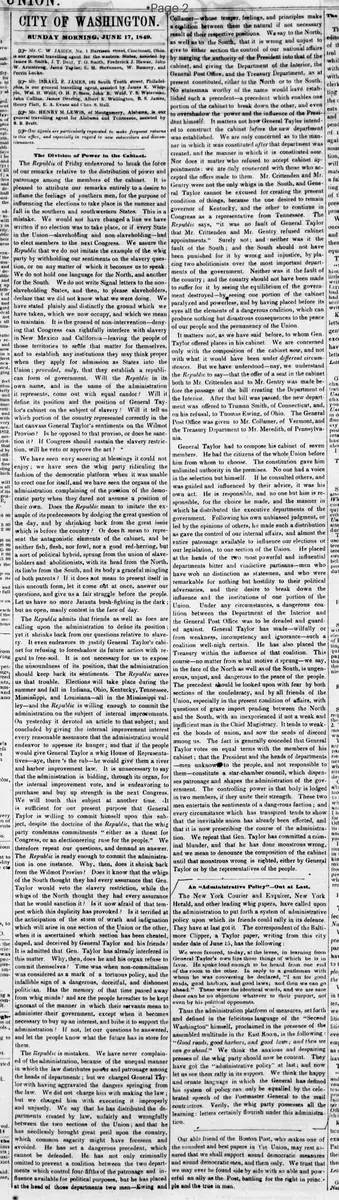
The Division of Power In the Cabinet.
The Republic of Friday endeavored to break the force of our remarks relative to the distribution of power and patronage among the members of the cabinet. It is pleased to attribute our remarks entirely to a desire to inflame the feelings of southern men, for the purpose of influencing the elections to take place in the summer and fall in the southern and southwestern States. This is a mistake. We would not have changed a line we have written if no election was to take place, or if every State in the Union—slaveholding and non-slaveholding—had to elect members to the next Congress. We assure the Republic that we do not imitate the example of the whig party by withholding our sentiments on the slavery question, or on any matter of which it becomes us to speak. We do not hold one language for the North, and another for the South. We do not write Signal letters to the non-slaveholding States, and then, to please slaveholders, declare that we did not know what we were doing. We have stated plainly and distinctly the ground which we have taken, which we now occupy, and which we mean to maintain. It is the ground of non-intervention—denying that Congress can rightfully interfere with slavery in New Mexico and California—leaving the people of those territories to settle that matter for themselves, and to establish any institutions they may think proper when they apply for admission as States into the Union; provided, only, that they establish a republican form of government. Will the Republic in its own name, and in the name of the administration it represents, come out with equal candor? Will it define its position and the position of General Taylor's cabinet on the subject of slavery? Will it tell us which portion of the country represented correctly in the last canvass General Taylor's sentiments on the Wilmot Proviso? Is he opposed to that proviso, or does he sanction it? If Congress should pass the slavery restriction, will he veto or approve the act?
We have seen envy sneering at blessings it could not enjoy; we have seen the whig party ridiculing the fashion of the democratic platform when it was unable to erect one for itself, and we have seen the organs of the administration complaining of the position of the democratic party when they dared not assume a position of their own. Does the Republic mean to imitate the example of its predecessors by dodging the great question of the day, and by shrinking back from the great issue which is before the country? Or does it mean to represent the antagonistic elements of the cabinet, and be neither fish, flesh, nor fowl, nor a good red-herring, but a sort of political hybrid, sprung from the union of slaveholders and abolitionists, with its head from the North its limbs from the South, and its body a graceful mingling of both parents? If it does not mean to present itself in this uncouth form, let it come out at once, answer our questions, and give us a fair struggle before the people. Let us have no more Jarauta bush-fighting in the dark; but an open, manly contest in the face of day
The Republic admits that friends as well as foes are calling upon the administration to define its position; yet it shrinks back from our questions relative to slavery. It even endeavors to justify General Taylor's cabinet for refusing to foreshadow its future action with regard to free-soil. It is not necessary for us to expose the unsoundness of its position, that the administration should keep back its sentiments. The Republic saves us that trouble. Elections will take place during the summer and fall in Indiana, Ohio, Kentucky, Tennessee, Mississippi, and Louisiana—all in the Mississippi valley—and the Republic is willing enough to commit the administration on the subject of internal improvements. On yesterday it devoted an article to that subject; and concluded by giving the internal improvement interest every reasonable assurance that the administration would endeavor to appease its hunger; and that if the people would give General Taylor a whig House of Representatives—aye, there's the rub—he would give them a river and harbor improvement law. It is unnecessary to say that the administration is bidding, through its organ, for the internal improvement vote, and is endeavoring to purchase and buy up strength in the next Congress.
We will touch this subject at another time. It is sufficient for our present purpose that General Taylor is willing to commit himself upon this subject, despite the doctrine of the Republic, that the whig party condemns commitments "either as a threat for Congress, or an electioneering ruse for the people." We therefore repeat our questions, and demand an answer. The Republic is ready enough to commit the administration in one instance. Why, then, does it shrink back from the Wilmot Proviso? Does it know that the whigs of the South thought they had every assurance that Gen. Taylor would veto the slavery restriction, while the whigs of the North thought they had every assurance that he would sanction it? Is it now afraid of that tempest which this duplicity has provoked? Is it terrified at the anticipation of the storm of wrath and indignation which will arise in one section of the Union or the other, when it is ascertained which section has been cheated, duped, and deceived by General Taylor and his friends?
It is admitted that Gen. Taylor has already interfered in this matter. Why, then, does he and his organ refuse to commit themselves? Time was when non-committalism was considered as a mark of a tortuous policy, and the infallible sign of a dangerous, deceitful, and dishonest politician. Has the memory of that time passed away from whig minds? and are the people hereafter to be kept ignorant of the manner in which their servants mean to administer their government, except when it becomes necessary to buy up an interest, and bribe it to support the administration? If not, let our questions be answered, and let the people know what the future has in store for them.
The Republic is mistaken. We have never complained of the administration, because of the unequal manner in which the law distributes power and patronage among the heads of departments; but we charged General Taylor with having aggravated the dangers springing from the law. We did not charge him with making the law; but we charged him with executing it improperly and unjustly. We say that he has distributed the departments created by law, unfairly and wrongfully between the two sections of the Union; and that he has needlessly brought great peril upon the country, which common sagacity might have foreseen and avoided. He has set a dangerous precedent, which cannot be defended. He has not only criminally omitted to prevent a coalition between the two departments which control four-fifths of the patronage and influence available for political purposes, but he has placed at the head of them
Collamer—whose temper, feelings, and principles make a coalition between them the natural if not necessary result of their respective positions. We say to the North, as well as to the South, that it is wrong and unjust to give to either section the control of our national affairs by merging the authority of the President into that of the cabinet, and giving the Department of the Interior, the General Post Office, and the Treasury Department, as at present constituted, either to the North or to the South.
No statesman worthy of the name would have established such a precedent—a precedent which enables one portion of the cabinet to break down the other, and even to overshadow the power and the influence of the President himself. It matters not how General Taylor intended to construct the cabinet before the new department was established. We are only concerned as to the manner in which it was constituted after that department was created, and the manner in which it is constituted now. Nor does it matter who refused to accept cabinet appointments: we are only concerned with those who accepted the offers made to them. Mr. Crittenden and Mr. Gentry were not the only whigs in the South, and General Taylor cannot be excused for creating the present condition of things, because the one desired to remain governor of Kentucky, and the other to continue in Congress as a representative from Tennessee. The Republic says, "it was no fault of General Taylor that Mr. Crittenden and Mr. Gentry refused cabinet appointments." Surely not; and neither was it the fault of the South; and the South should not have been punished for it by wrong and injustice, by placing two abolitionists over the most important departments of the government. Neither was it the fault of the country; and the country should not have been made to suffer for it by seeing the equilibrium of the government destroyed—by seeing one portion of the cabinet paralyzed and powerless, and by having placed before its eyes all the elements of a dangerous coalition, which can produce nothing but disastrous consequences to the peace of our people and the permanency of the Union.
It matters not, as we have said before, to whom Gen. Taylor offered places in his cabinet. We are concerned only with the composition of the cabinet now, and not with what it would have been under different circumstances. But we have understood—nay, we understand the Republic to say—that the offer of a seat in the cabinet both to Mr. Crittenden and to Mr. Gentry was made before the passage of the bill creating the Department of the Interior. After that bill was passed, the new department was offered to Truman Smith, of Connecticut, and, on his refusal, to Thomas Ewing, of Ohio. The General Post Office was given to Mr. Collamer, of Vermont, and the Treasury Department to Mr. Meredith, of Pennsylvania.
General Taylor had to compose his cabinet of seven members. He had the citizens of the whole Union before him from whom to choose. The constitution gave him unlimited authority in the premises. No one had a voice in the selection but himself. If he consulted others, and was guided and influenced by their advice, it was his own act. He is responsible, and no one but him is responsible, for the choice he made, and the manner in which he distributed the executive departments of the government. Following his own unbiassed judgment, or led by the opinions of others, he made such a distribution as gave the control of our internal affairs, and almost the entire patronage available to influence our elections or our legislation, to one section of the Union. He placed at the heads of the two most powerful and influential departments bitter and vindictive partisans—men who have won no distinction as statesmen, and who were remarkable for nothing but hostility to their political adversaries, and their desire to break down the influence and the institutions of one portion of the Union. Under any circumstances, a dangerous coalition between the Department of the Interior and the General Post Office was to be dreaded and guarded against. General Taylor has made—wilfully or from weakness, incompetency and ignorance—such a coalition well-nigh certain. He has also placed the Treasury within the influence of that coalition. This course—no matter from what motive it sprung—we say, in the face of the North as well as of the South, is ungenerous, unjust, and dangerous to the peace of the people The precedent should be looked upon with fear by both sections of the confederacy, and by all friends of the Union, especially in the present condition of affairs, with questions of grave import pending between the North and the South, with an inexperienced if not a weak and inefficient man in the Chief Magistracy. It tends to weaken the bonds of union, and sow the seeds of discord among us. The fact is generally conceded that General Taylor votes on equal terms with the members of his cabinet; that the President and the heads of departments—men unknown to the people, and not responsible to them—constitute a star-chamber council, which dispenses patronage and shapes the administration of the government. The controlling power in that body is lodged in two members, if they unite their strength. These two men entertain the sentiments of a dangerous faction; and every circumstance which has transpired tends to show that the inevitable union has already been effected, and that it is now prescribing the course of the administration. We repeat that Gen. Taylor has committed a criminal blunder, and that he has done monstrous wrong, and we mean to denounce the composition of the cabinet until that monstrous wrong is righted, either by General Taylor or by the representatives of the people.
The Republic of Friday endeavored to break the force of our remarks relative to the distribution of power and patronage among the members of the cabinet. It is pleased to attribute our remarks entirely to a desire to inflame the feelings of southern men, for the purpose of influencing the elections to take place in the summer and fall in the southern and southwestern States. This is a mistake. We would not have changed a line we have written if no election was to take place, or if every State in the Union—slaveholding and non-slaveholding—had to elect members to the next Congress. We assure the Republic that we do not imitate the example of the whig party by withholding our sentiments on the slavery question, or on any matter of which it becomes us to speak. We do not hold one language for the North, and another for the South. We do not write Signal letters to the non-slaveholding States, and then, to please slaveholders, declare that we did not know what we were doing. We have stated plainly and distinctly the ground which we have taken, which we now occupy, and which we mean to maintain. It is the ground of non-intervention—denying that Congress can rightfully interfere with slavery in New Mexico and California—leaving the people of those territories to settle that matter for themselves, and to establish any institutions they may think proper when they apply for admission as States into the Union; provided, only, that they establish a republican form of government. Will the Republic in its own name, and in the name of the administration it represents, come out with equal candor? Will it define its position and the position of General Taylor's cabinet on the subject of slavery? Will it tell us which portion of the country represented correctly in the last canvass General Taylor's sentiments on the Wilmot Proviso? Is he opposed to that proviso, or does he sanction it? If Congress should pass the slavery restriction, will he veto or approve the act?
We have seen envy sneering at blessings it could not enjoy; we have seen the whig party ridiculing the fashion of the democratic platform when it was unable to erect one for itself, and we have seen the organs of the administration complaining of the position of the democratic party when they dared not assume a position of their own. Does the Republic mean to imitate the example of its predecessors by dodging the great question of the day, and by shrinking back from the great issue which is before the country? Or does it mean to represent the antagonistic elements of the cabinet, and be neither fish, flesh, nor fowl, nor a good red-herring, but a sort of political hybrid, sprung from the union of slaveholders and abolitionists, with its head from the North its limbs from the South, and its body a graceful mingling of both parents? If it does not mean to present itself in this uncouth form, let it come out at once, answer our questions, and give us a fair struggle before the people. Let us have no more Jarauta bush-fighting in the dark; but an open, manly contest in the face of day
The Republic admits that friends as well as foes are calling upon the administration to define its position; yet it shrinks back from our questions relative to slavery. It even endeavors to justify General Taylor's cabinet for refusing to foreshadow its future action with regard to free-soil. It is not necessary for us to expose the unsoundness of its position, that the administration should keep back its sentiments. The Republic saves us that trouble. Elections will take place during the summer and fall in Indiana, Ohio, Kentucky, Tennessee, Mississippi, and Louisiana—all in the Mississippi valley—and the Republic is willing enough to commit the administration on the subject of internal improvements. On yesterday it devoted an article to that subject; and concluded by giving the internal improvement interest every reasonable assurance that the administration would endeavor to appease its hunger; and that if the people would give General Taylor a whig House of Representatives—aye, there's the rub—he would give them a river and harbor improvement law. It is unnecessary to say that the administration is bidding, through its organ, for the internal improvement vote, and is endeavoring to purchase and buy up strength in the next Congress.
We will touch this subject at another time. It is sufficient for our present purpose that General Taylor is willing to commit himself upon this subject, despite the doctrine of the Republic, that the whig party condemns commitments "either as a threat for Congress, or an electioneering ruse for the people." We therefore repeat our questions, and demand an answer. The Republic is ready enough to commit the administration in one instance. Why, then, does it shrink back from the Wilmot Proviso? Does it know that the whigs of the South thought they had every assurance that Gen. Taylor would veto the slavery restriction, while the whigs of the North thought they had every assurance that he would sanction it? Is it now afraid of that tempest which this duplicity has provoked? Is it terrified at the anticipation of the storm of wrath and indignation which will arise in one section of the Union or the other, when it is ascertained which section has been cheated, duped, and deceived by General Taylor and his friends?
It is admitted that Gen. Taylor has already interfered in this matter. Why, then, does he and his organ refuse to commit themselves? Time was when non-committalism was considered as a mark of a tortuous policy, and the infallible sign of a dangerous, deceitful, and dishonest politician. Has the memory of that time passed away from whig minds? and are the people hereafter to be kept ignorant of the manner in which their servants mean to administer their government, except when it becomes necessary to buy up an interest, and bribe it to support the administration? If not, let our questions be answered, and let the people know what the future has in store for them.
The Republic is mistaken. We have never complained of the administration, because of the unequal manner in which the law distributes power and patronage among the heads of departments; but we charged General Taylor with having aggravated the dangers springing from the law. We did not charge him with making the law; but we charged him with executing it improperly and unjustly. We say that he has distributed the departments created by law, unfairly and wrongfully between the two sections of the Union; and that he has needlessly brought great peril upon the country, which common sagacity might have foreseen and avoided. He has set a dangerous precedent, which cannot be defended. He has not only criminally omitted to prevent a coalition between the two departments which control four-fifths of the patronage and influence available for political purposes, but he has placed at the head of them
Collamer—whose temper, feelings, and principles make a coalition between them the natural if not necessary result of their respective positions. We say to the North, as well as to the South, that it is wrong and unjust to give to either section the control of our national affairs by merging the authority of the President into that of the cabinet, and giving the Department of the Interior, the General Post Office, and the Treasury Department, as at present constituted, either to the North or to the South.
No statesman worthy of the name would have established such a precedent—a precedent which enables one portion of the cabinet to break down the other, and even to overshadow the power and the influence of the President himself. It matters not how General Taylor intended to construct the cabinet before the new department was established. We are only concerned as to the manner in which it was constituted after that department was created, and the manner in which it is constituted now. Nor does it matter who refused to accept cabinet appointments: we are only concerned with those who accepted the offers made to them. Mr. Crittenden and Mr. Gentry were not the only whigs in the South, and General Taylor cannot be excused for creating the present condition of things, because the one desired to remain governor of Kentucky, and the other to continue in Congress as a representative from Tennessee. The Republic says, "it was no fault of General Taylor that Mr. Crittenden and Mr. Gentry refused cabinet appointments." Surely not; and neither was it the fault of the South; and the South should not have been punished for it by wrong and injustice, by placing two abolitionists over the most important departments of the government. Neither was it the fault of the country; and the country should not have been made to suffer for it by seeing the equilibrium of the government destroyed—by seeing one portion of the cabinet paralyzed and powerless, and by having placed before its eyes all the elements of a dangerous coalition, which can produce nothing but disastrous consequences to the peace of our people and the permanency of the Union.
It matters not, as we have said before, to whom Gen. Taylor offered places in his cabinet. We are concerned only with the composition of the cabinet now, and not with what it would have been under different circumstances. But we have understood—nay, we understand the Republic to say—that the offer of a seat in the cabinet both to Mr. Crittenden and to Mr. Gentry was made before the passage of the bill creating the Department of the Interior. After that bill was passed, the new department was offered to Truman Smith, of Connecticut, and, on his refusal, to Thomas Ewing, of Ohio. The General Post Office was given to Mr. Collamer, of Vermont, and the Treasury Department to Mr. Meredith, of Pennsylvania.
General Taylor had to compose his cabinet of seven members. He had the citizens of the whole Union before him from whom to choose. The constitution gave him unlimited authority in the premises. No one had a voice in the selection but himself. If he consulted others, and was guided and influenced by their advice, it was his own act. He is responsible, and no one but him is responsible, for the choice he made, and the manner in which he distributed the executive departments of the government. Following his own unbiassed judgment, or led by the opinions of others, he made such a distribution as gave the control of our internal affairs, and almost the entire patronage available to influence our elections or our legislation, to one section of the Union. He placed at the heads of the two most powerful and influential departments bitter and vindictive partisans—men who have won no distinction as statesmen, and who were remarkable for nothing but hostility to their political adversaries, and their desire to break down the influence and the institutions of one portion of the Union. Under any circumstances, a dangerous coalition between the Department of the Interior and the General Post Office was to be dreaded and guarded against. General Taylor has made—wilfully or from weakness, incompetency and ignorance—such a coalition well-nigh certain. He has also placed the Treasury within the influence of that coalition. This course—no matter from what motive it sprung—we say, in the face of the North as well as of the South, is ungenerous, unjust, and dangerous to the peace of the people The precedent should be looked upon with fear by both sections of the confederacy, and by all friends of the Union, especially in the present condition of affairs, with questions of grave import pending between the North and the South, with an inexperienced if not a weak and inefficient man in the Chief Magistracy. It tends to weaken the bonds of union, and sow the seeds of discord among us. The fact is generally conceded that General Taylor votes on equal terms with the members of his cabinet; that the President and the heads of departments—men unknown to the people, and not responsible to them—constitute a star-chamber council, which dispenses patronage and shapes the administration of the government. The controlling power in that body is lodged in two members, if they unite their strength. These two men entertain the sentiments of a dangerous faction; and every circumstance which has transpired tends to show that the inevitable union has already been effected, and that it is now prescribing the course of the administration. We repeat that Gen. Taylor has committed a criminal blunder, and that he has done monstrous wrong, and we mean to denounce the composition of the cabinet until that monstrous wrong is righted, either by General Taylor or by the representatives of the people.
What sub-type of article is it?
Partisan Politics
Constitutional
What keywords are associated?
Cabinet Patronage
Northern Coalition
Union Peril
Taylor Precedent
Sectional Imbalance
What entities or persons were involved?
General Taylor
Department Of The Interior
General Post Office
Treasury Department
Collamer
Editorial Details
Primary Topic
Unequal Patronage Distribution In Cabinet
Stance / Tone
Accusatory Of Injustice To South And Union Peril
Key Figures
General Taylor
Department Of The Interior
General Post Office
Treasury Department
Collamer
Key Arguments
Taylor Aggravated Dangers Of Law By Unfair Distribution
Omitted To Prevent Coalition Controlling Patronage
Placed Abolitionists In Key Northern Departments
Set Dangerous Precedent Overshadowing President
Composition Gives North Control Over Internal Affairs