Thank you for visiting SNEWPapers!
Sign up free
Boon's Lick Times
Fayette, Howard County, Missouri
What is this article about?
A military critique from Monterey, Mexico, dated Dec. 9, 1846, analyzes flaws in the U.S. campaign against Mexico, highlighting分散 forces, logistical issues, and the need for concentration on decisive points like San Luis Potosi and Vera Cruz to achieve peace.
Clipping
OCR Quality
Full Text
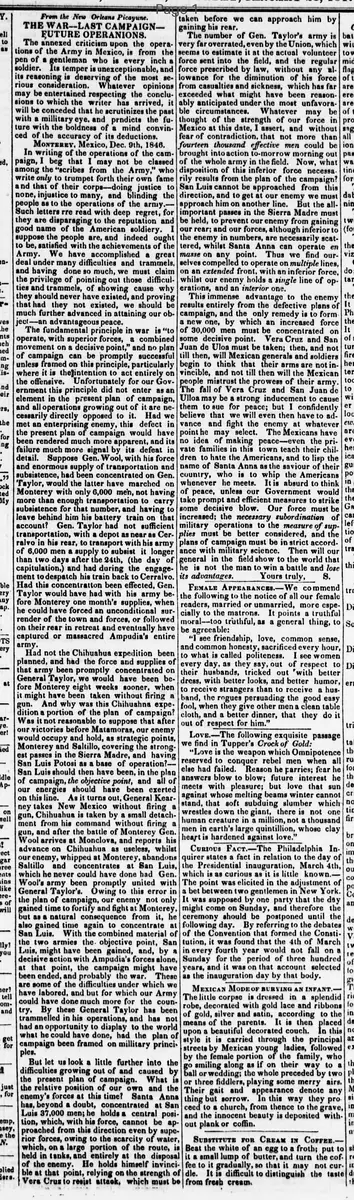
THE WAR—LAST CAMPAIGN—
FUTURE OPERATIONS.
The annexed criticism upon the operations of the Army in Mexico, is from the pen of a gentleman who is every inch a soldier. Its temper is unexceptionable, and its reasoning is deserving of the most serious consideration. Whatever opinions may be entertained respecting the conclusions to which the writer has arrived, it will be conceded that he scrutinizes the past with a military eye, and predicts the future with the boldness of a mind convinced of the accuracy of its deductions.
Monterey, Mexico, Dec. 9th, 1846.
In writing of the operations of the campaign, I beg that I may not be classed among the "scribes from the Army," who write only to trumpet forth their own fame and that of their corps—doing justice to none, injustice to many, and blinding the people as to the operations of the army.— Such letters are read with deep regret, for they are disparaging to the reputation and good name of the American soldiery. I suppose the people are, and indeed ought to be, satisfied with the achievements of the Army. We have accomplished a great deal under many difficulties and trammels. and having done so much, we must claim the privilege of pointing out those difficulties and trammels, of showing cause why they should never have existed, and proving that had they not existed, we should be much further advanced in attaining our object—an advantageous peace.
The fundamental principle in war is "to operate, with superior forces, a combined movement on a decisive point," and no plan of campaign can be promptly successful unless framed on this principle, particularly where it is the intention to act entirely on the offensive. Unfortunately for our Government this principle did not enter as an element in the present plan of campaign, and all operations growing out of it are necessarily directly opposed to it. Had we met an enterprising enemy, this defect in the present plan of campaign would have been rendered much more apparent, and its failure much more signal by its defeat in detail. Suppose Gen. Wool, with his force and enormous supply of transportation and subsistence, had been concentrated on Gen. Taylor, would the latter have marched on Monterey with only 6,000 men, not having more than enough transportation to carry subsistence for that number, and having to leave behind him his battery train on that account? Gen. Taylor had not sufficient transportation, with a depot as near as Cerralvo in his rear, to transport with his army of 6,000 men a supply to subsist it longer than two days after the 24th, (the day of capitulation,) and had during the engagement to despatch his train back to Cerralvo. Had this concentration been effected, Gen. Taylor would have had with his army before Monterey one month's supplies, when he could have forced an unconditional surrender of the town and forces, or followed on their rear in retreat and eventually have captured or massacred Ampudia's entire army.
Had not the Chihuahua expedition been planned, and had the force and supplies of that army been promptly concentrated on General Taylor, we would have been before Monterey eight weeks sooner, when it might have been taken without firing a gun. And why was this Chihuahua expedition a portion of the plan of campaign? Was it not reasonable to suppose that after our victories before Matamoras, our enemy would occupy and hold, as strategic points, Monterey and Saltillo, covering the strongest passes in the Sierra Madre, and having San Luis Potosi as a base of operation?— San Luis should then have been, in the plan of campaign, the objective point, and all of our energies should have been exerted on this line. As it turns out, General Kearney takes New Mexico without firing a gun, Chihuahua is taken by a small detachment from his command without firing a gun, and after the battle of Monterey Gen. Wool arrives at Monclova, and reports his advance on Chihuahua as useless, whilst our enemy, whipped at Monterey, abandons Saltillo and concentrates at San Luis, which he never could have done had Gen. Wool's army been promptly united with General Taylor's. Owing to this error in the plan of campaign, our enemy not only gained time to fortify and fight at Monterey, but as a natural consequence from it, he also gained time again to concentrate at San Luis. With the combined material of the two armies the objective point, San Luis, might have been gained, and, by a decisive action with Ampudia's forces alone, at that point, the campaign might have been ended, and probably the war. These are some of the difficulties under which we have labored, and but for which our Army could have done much more for the country.
By these General Taylor has been trammelled in his operations, and has not had an opportunity to display to the world what he could have done, had the plan of campaign been framed on military principles.
But let us look a little further into the difficulties growing out of and caused by the present plan of campaign. What is the relative position of our own and the enemy's forces at this time? Santa Anna has, beyond a doubt, concentrated at San Luis 37,000 men; he holds a central position, which, with his force, cannot be approached from this direction even by superior forces, owing to the scarcity of water, which, on a large portion of the route, is held in tanks, and entirely at the disposal of the enemy. He holds himself invincible at that point, relying on the strength of Vera Cruz to resist attack, which must be taken before we can approach him by gaining his rear.
The number of Gen. Taylor's army is very far overrated, even by the Union, which seems to estimate it at the actual volunteer force sent into the field, and the regular force prescribed by law, without any allowance for the diminution of his force from casualties and sickness, which has far exceeded what might have been reasonably anticipated under the most unfavorable circumstances.
Whatever may be thought of the strength of our force in Mexico at this date, I assert, and without fear of contradiction, that not more than fourteen thousand effective men could be brought into action to-morrow morning out of the whole army in the field. Now, what disposition of this inferior force necessarily results from the plan of the campaign? San Luis cannot be approached from this direction, and to get at our enemy we must approach him on another line. But the all-important passes in the Sierra Madre must be held, to prevent our enemy from gaining our rear; and our forces, although inferior to the enemy in numbers, are necessarily scattered, whilst Santa Anna can operate en masse on any point. Thus we find ourselves compelled to operate on multiple lines, on an extended front, with an inferior force, whilst our enemy holds a single line of operations, and an interior one.
This immense advantage to the enemy results entirely from the defective plans of campaign, and the only remedy is to form a new one, by which an increased force of 30,000 men must be concentrated on some decisive point. Vera Cruz and San Juan de Ulloa must be taken; then, and not till then, will Mexican generals and soldiers begin to think that their arms are not invincible, and not till then will the Mexican people mistrust the prowess of their army. The fall of Vera Cruz and San Juan de Ulloa may be a strong inducement to cause them to sue for peace; but I confidently believe that we will even then have to advance and fight the enemy at whatever point he may select. The Mexicans have no idea of making peace—even the private families in this town teach their children to hate the Americans, and to lisp the name of Santa Anna as the saviour of their country, who is to whip the Americans whenever he meets. It is absurd to think of peace, unless our Government would take prompt and efficient measures to strike some decisive blow. Our force must be increased; the necessary subordination of military operations to the measure of supplies must be better considered, and the plans of campaign must be in strict accordance with military science. Then will our general in the field show to the world that he is not the man to win a battle and lose its advantages.
Yours truly,
S.
What sub-type of article is it?
What keywords are associated?
What entities or persons were involved?
Where did it happen?
Domestic News Details
Primary Location
Monterey, Mexico
Event Date
Dec. 9th, 1846
Key Persons
Outcome
critique suggests that without strategic errors, the campaign could have ended sooner with capture or defeat of mexican forces; current u.s. forces estimated at 14,000 effective men, scattered and inferior to enemy's 37,000 at san luis.
Event Details
Anonymous military critique analyzes flaws in U.S. campaign plan, including分散 forces to Chihuahua expedition instead of concentrating on Gen. Taylor for advance on Monterey and San Luis Potosi; predicts need for 30,000 more men to take Vera Cruz and force peace.