Thank you for visiting SNEWPapers!
Sign up free
Editorial
October 6, 1887
The Central Nevadan
Battle Mountain, Lander County, Nevada
What is this article about?
A fatherly admonition defending high salaries for Christian preachers like Moody and temperance advocates like F. Murphy and Gough, contrasting their worth with that of atheists, bartenders, and politicians, emphasizing that virtue and good causes are undervalued compared to vices.
Clipping
OCR Quality
98%
Excellent
Full Text
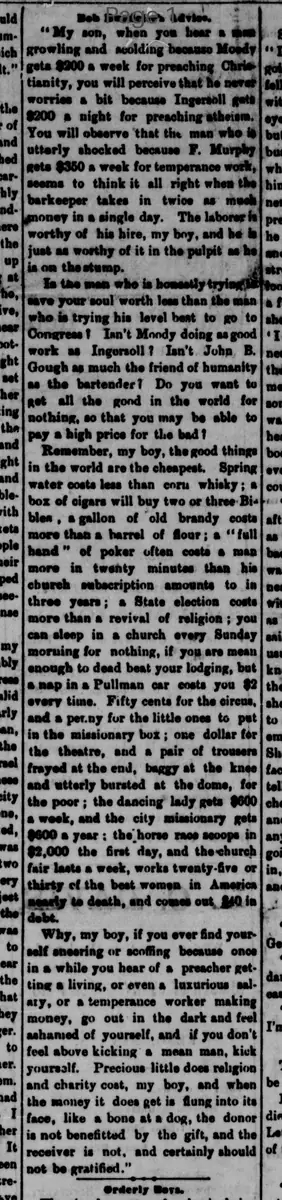
"My son, when you hear a man growling and scolding because Moody gets $200 a week for preaching Christianity, you will perceive that he never worries a bit because Ingersoll gets $200 a night for preaching atheism. You will observe that the man who is utterly shocked because F. Murphy gets $350 a week for temperance work, seems to think it all right when the barkeeper takes in twice as much money in a single day.
The laborer is worthy of his hire, my boy, and he is just as worthy of it in the pulpit as he is on the stump. Is the man who is honestly trying to save your soul worth less than the man who is trying his level best to go to Congress? Isn't Moody doing as good work as Ingersoll? Isn't John B. Gough as much the friend of humanity as the bartender?
Do you want to get all the good in the world for nothing, so that you may be able to pay a high price for the bad? Remember, my boy, the good things in the world are the cheapest. Spring water costs less than corn whisky: a box of cigars will buy two or three Bibles, a gallon of old brandy costs more than a barrel of flour; a "full hand" of poker often costs a man more in twenty minutes than his church subscription amounts to in three years; a State election costs more than a revival of religion; you can sleep in a church every Sunday morning for nothing, if you are mean enough to dead beat your lodging, but a nap in a Pullman car costs you $2 every time.
Fifty cents for the circus, and a penny for the little ones to put in the missionary box; one dollar for the theatre, and a pair of trousers frayed at the end, baggy at the knee and utterly bursted at the dome, for the poor; the dancing lady gets $600 a week, and the city missionary gets $600 a year: the horse race scoops in $2,000 the first day, and the church fair lasts a week, works twenty-five or thirty of the best women in America nearly to death, and comes out $40 in debt.
Why, my boy, if you ever find yourself sneering or scoffing because once in a while you hear of a preacher getting a living, or even a luxurious salary, or a temperance worker making money, go out in the dark and feel ashamed of yourself, and if you don't feel above kicking a mean man, kick yourself. Precious little does religion and charity cost, my boy, and when the money it does get is flung into its face, like a bone at a dog, the donor is not benefitted by the gift, and the receiver is not, and certainly should not be gratified."
The laborer is worthy of his hire, my boy, and he is just as worthy of it in the pulpit as he is on the stump. Is the man who is honestly trying to save your soul worth less than the man who is trying his level best to go to Congress? Isn't Moody doing as good work as Ingersoll? Isn't John B. Gough as much the friend of humanity as the bartender?
Do you want to get all the good in the world for nothing, so that you may be able to pay a high price for the bad? Remember, my boy, the good things in the world are the cheapest. Spring water costs less than corn whisky: a box of cigars will buy two or three Bibles, a gallon of old brandy costs more than a barrel of flour; a "full hand" of poker often costs a man more in twenty minutes than his church subscription amounts to in three years; a State election costs more than a revival of religion; you can sleep in a church every Sunday morning for nothing, if you are mean enough to dead beat your lodging, but a nap in a Pullman car costs you $2 every time.
Fifty cents for the circus, and a penny for the little ones to put in the missionary box; one dollar for the theatre, and a pair of trousers frayed at the end, baggy at the knee and utterly bursted at the dome, for the poor; the dancing lady gets $600 a week, and the city missionary gets $600 a year: the horse race scoops in $2,000 the first day, and the church fair lasts a week, works twenty-five or thirty of the best women in America nearly to death, and comes out $40 in debt.
Why, my boy, if you ever find yourself sneering or scoffing because once in a while you hear of a preacher getting a living, or even a luxurious salary, or a temperance worker making money, go out in the dark and feel ashamed of yourself, and if you don't feel above kicking a mean man, kick yourself. Precious little does religion and charity cost, my boy, and when the money it does get is flung into its face, like a bone at a dog, the donor is not benefitted by the gift, and the receiver is not, and certainly should not be gratified."
What sub-type of article is it?
Moral Or Religious
Temperance
Social Reform
What keywords are associated?
Religion
Temperance
Charity
Salaries
Morality
Vice
Preachers
What entities or persons were involved?
Moody
Ingersoll
F. Murphy
John B. Gough
Editorial Details
Primary Topic
Defense Of Salaries For Preachers And Temperance Workers
Stance / Tone
Defensive And Exhortative
Key Figures
Moody
Ingersoll
F. Murphy
John B. Gough
Key Arguments
The Laborer Is Worthy Of His Hire In The Pulpit As On The Stump
Moody's Preaching Christianity Is As Valuable As Ingersoll's Atheism
Temperance Workers Like F. Murphy Deserve Pay Comparable To Barkeepers
Good Things In The World Are Cheaper Than Bad Ones
Religion And Charity Cost Little Compared To Vices Like Alcohol And Gambling