November 3, 2026 · 6 min read
The 1740s: Louisbourg and the Forty-Five
Contents
Part of Decade by Decade: History as the Newspapers Told It, a series on the big stories of each decade as the newspapers reported them.
All source materials for this post were acquired using SNEWPapers. We are in the process of the most accurate extraction, in terms of correct segmentation and textual accuracy, of the Library of Congress' Chronicling America collection ever conducted. You can track our progress here. This post is a demonstration of what you can find using our tools. Connect your Grok, ChatGPT, Claude and more today to our vast database and research whatever you're interested in (and hopefully share it with the rest of us!). What would've taken you a year yesterday, is possible in a few hours with SNEWPapers today. Estimates put the total count of historical newspaper pages at over a billion for U.S. Newspapers alone, with 25+ million sitting in the Library of Congress. By and large, nobody knows what's in them... until now
You may have heard of these events before, but you're likely one of the first people in generations to read these articles again
This is a short decade. The only American newspaper from the 1740s in Chronicling America is The Virginia Gazette, and the collection has just four of its issues from 1740, then nothing until 1745 and 1746, then nothing again until 1751. So whatever happened in 1741 to 1744 or 1747 to 1749 isn't here. Two years of the paper still tell a lot of story, though. Britain was at war with France again, and in those two years New Englanders took France's greatest fortress in America, and a Stuart prince landed in Scotland to take back his grandfather's throne.
Louisbourg
Britain and France went to war in 1744, a war fought mostly in Europe that the colonists called King George's War. The great French fortress of Louisbourg on Cape Breton Island guarded the entrance to the St. Lawrence and sheltered the privateers that preyed on New England's fishing fleets. In the spring of 1745 Massachusetts raised an expedition of about four thousand militiamen under William Pepperrell, a merchant with no military training to speak of, with a Royal Navy squadron under Commodore Peter Warren. To nearly everyone's surprise it worked. The Virginia Gazette followed the siege issue by issue, including the capture of the French warship Vigilant, which was carrying supplies for the garrison:
a great Number of heavy Cannon, with their Materials, besides Small-Arms, Bomb-Shells, Cohorns, &c. even down to an Indian Hatchet
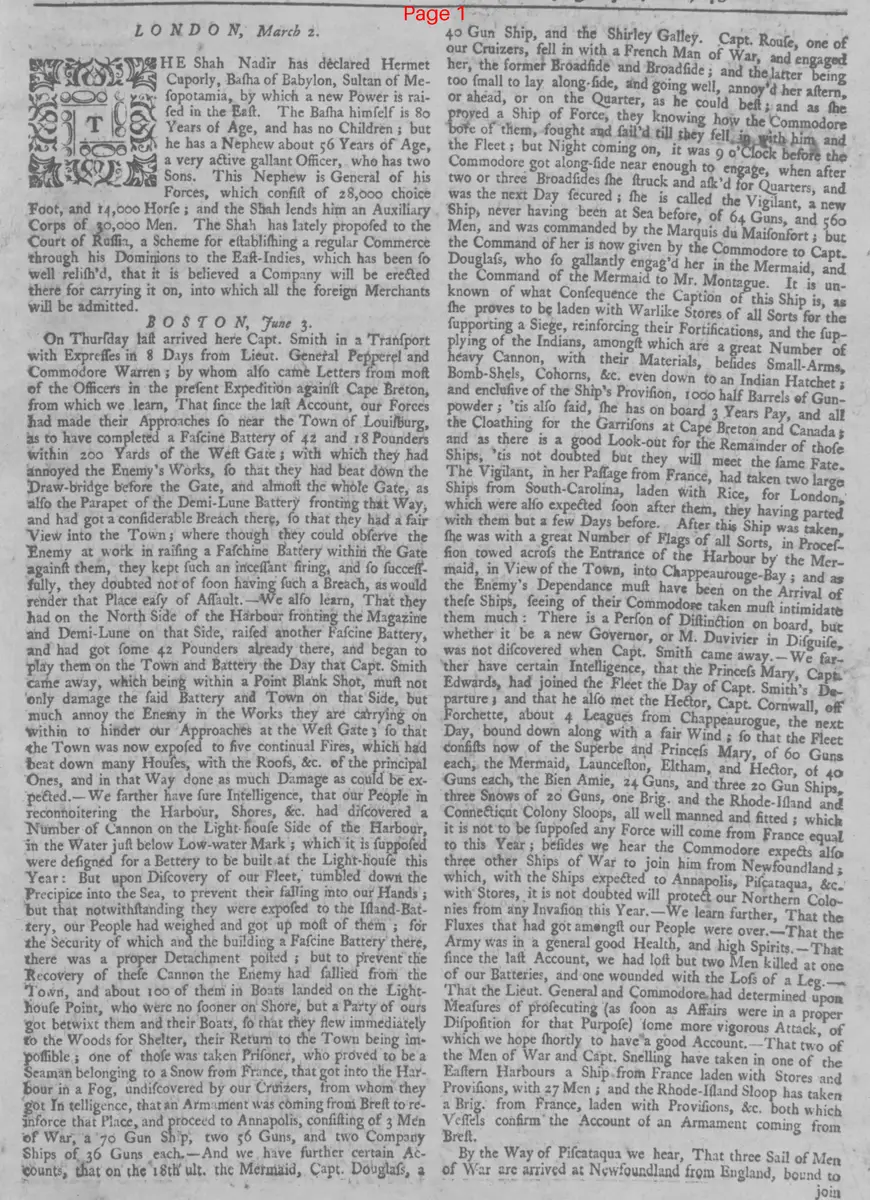
The fortress surrendered at the end of June. Pepperrell was made a baronet, the first American-born man to receive the title, and Warren an admiral. Three years later, at the peace, Britain handed Louisbourg back to France, to New England's lasting fury, and the British had to take it all over again in 1758.
The paper also printed the voyage of a small ship named the Warren, after the commodore, that capsized on the way. Its survivors clung to the wreck for days: "A Dog which they had saved 'til Tuesday Night, and designed to kill the next Day for their Support, was that Night carried away by a Sea, together with a Cag of Beer" (read it).
Fontenoy and Tournay
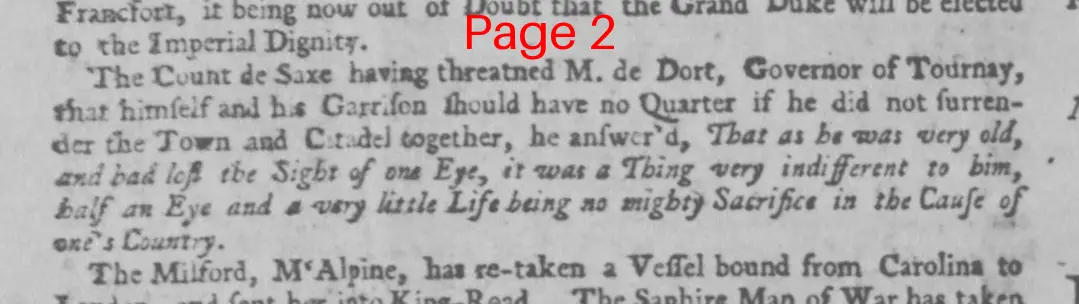
In Europe the war went badly for Britain. In May 1745 the French under Marshal Saxe beat the Duke of Cumberland's allied army at Fontenoy, in what is now Belgium, and took the fortress town of Tournay. The paper printed the battle in letters from Paris, The Hague and the allied camp, three or four months late. As more arrived, the losses grew: a Paris letter admitted "there is not a noble Family in France but have lost Friend or Friends" (read it). A British surgeon taken prisoner described the wounded "stripped of every Thing valuable we had" (read it). And Tournay's old governor, threatened that his garrison would be given no quarter if he held out, is said to have answered:
half an Eye and a very little Life being no mighty Sacrifice in the Cause of one's Country.
The Forty-Five
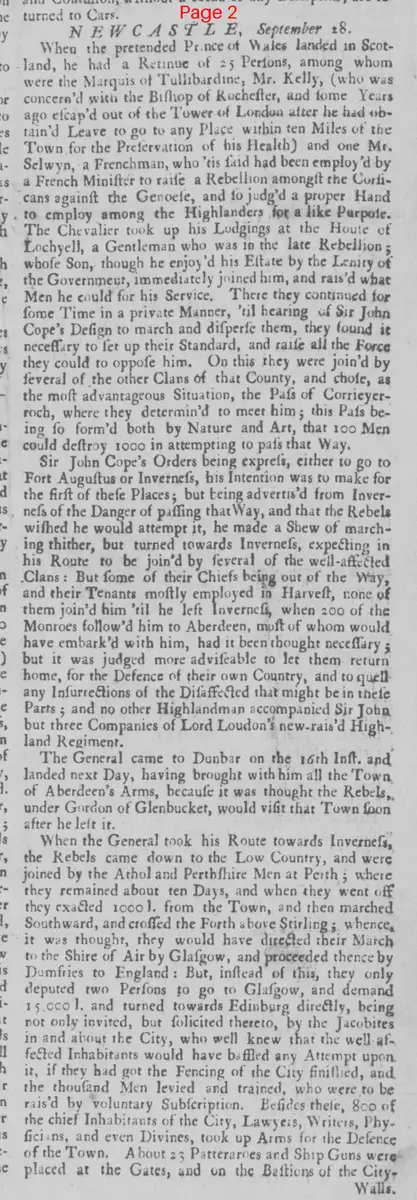
With the British army fighting in Flanders, Charles Edward Stuart, grandson of the King James II who had been driven out in 1688, landed in the western Highlands in July 1745 to win back the throne for his father. The clans that rallied to him took Edinburgh in September, and at Prestonpans they routed the only government army in Scotland in a matter of minutes. The paper's account, from Newcastle, reached Williamsburg that January:
the Highlanders rushed upon them, Sword in Hand, with great Fury, surrounded them, killed about 150 Men, and made about 2000 Prisoners.
The prince's army marched into England and got as far as Derby, 130 miles from London, before his commanders insisted on turning back. The Virginia Gazette was loyal to King George from first to last, and it printed whatever made the rebels look bad. A letter from South Shields said that at one skirmish the prince "ran away to his Horse, and through Fear, mounted with some Difficulty" (read it). A supposedly intercepted letter from his confessor, almost certainly invented, promised that "Our Smithfield Fires shall again blaze" (read it). And a lady in Preston passed on gossip about Jenny Cameron, the Highland woman the London papers had made into the prince's mistress, who "came like the Queen of Sheba, to partake of the Wisdom of Solomon" (read it).
Culloden
The Duke of Cumberland, back from Flanders, caught the retreating Highland army on Culloden Moor near Inverness on April 16, 1746. It was the last pitched battle fought in Britain, and it was over in an hour. The first word reached Virginia in late June, and the fuller letters in July. One, from Edinburgh, has Cumberland urging on his men, and the dragoons who rode down the fleeing Highlanders:
One Brush, my Lads, for the Honour of Old Cobham
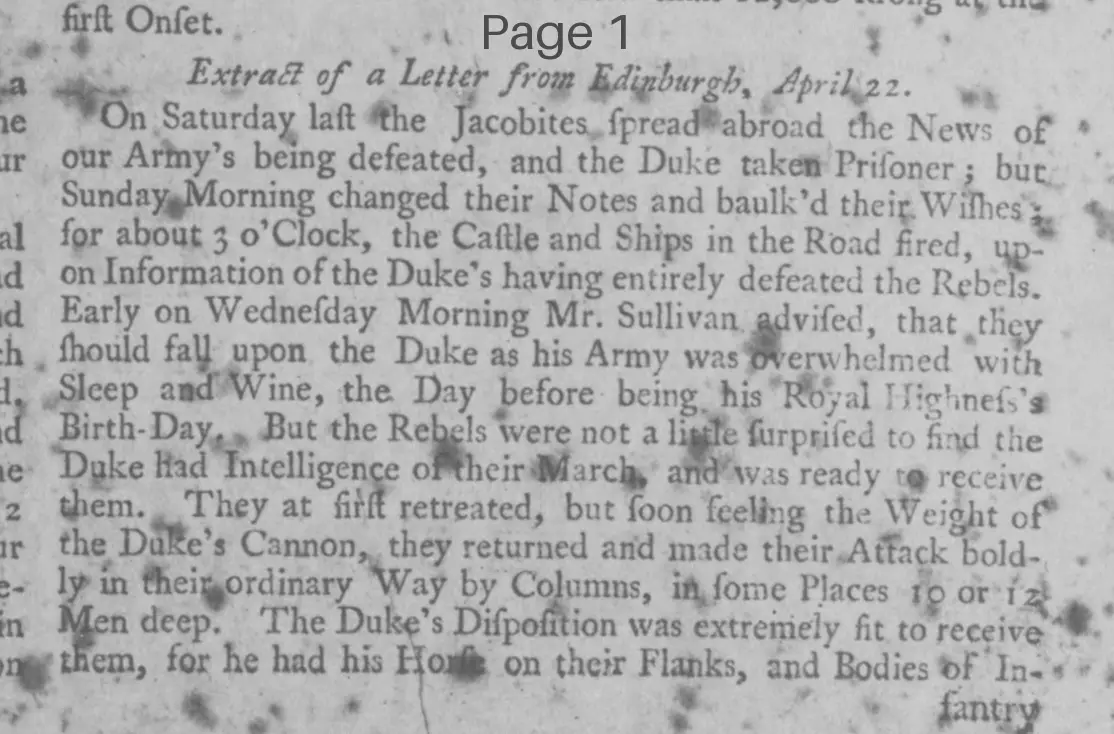
The army gave little quarter that day or in the months of reprisals that followed, which earned the duke the name "Butcher" Cumberland. An eyewitness letter from Inverness is unsparing about the field (read it; graphic). The prince hid in the Highlands and islands for five months, helped at one point by Flora MacDonald, who disguised him as her maid, and escaped to France that September. He never came back.
A plot in Jamaica
In 1745 another plot among enslaved people was uncovered in Jamaica. The letter the paper printed, written from the planters' side, shows how close it came. A planter's wife who learned of it wrote at once to warn her husband in town, but he was "at Cards when he receiv'd the Letter, put it into his Pocket, and thought no more of it 'til the next Day":
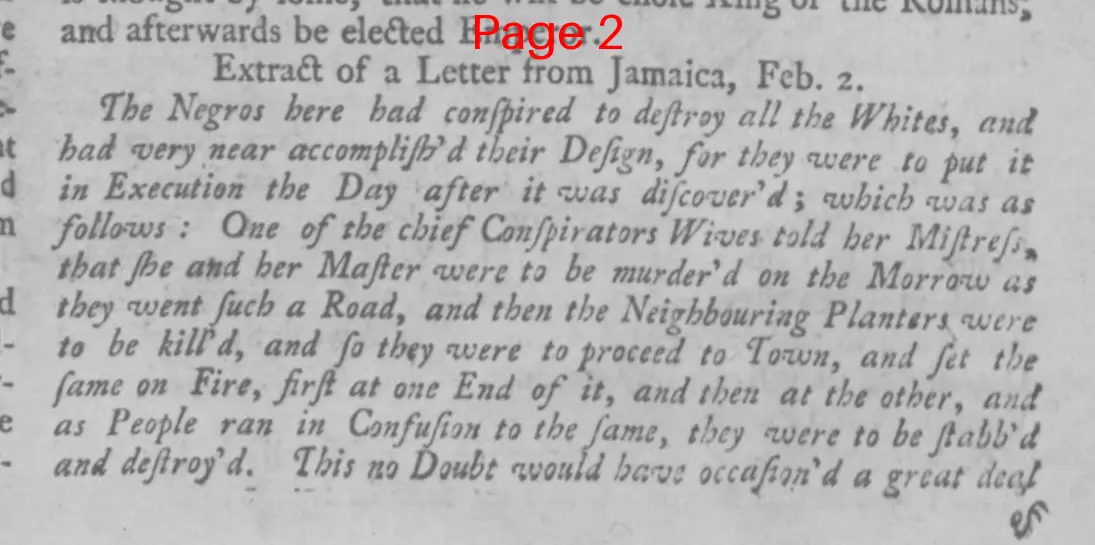
The punishments that followed are told in the same letter, in the planters' terms.
Also in the 1740s
- In August 1745 a whirlwind tore through Mansfield, Connecticut, levelling barns and thousands of trees. An eyewitness reckoned it "moved in its Course forward, as I apprehend, at least 32 Feet a Second," yet "there was no Life lost, nor any Person hurt." (read it)
- Nadir Shah, the shepherd's son of the 1730s, was still winning: in 1745 he routed an Ottoman army near Erivan, whose commander, "endeavouring to rally them in Person, with his Sabre in Hand received a Musket-shot." (read it)
- A troop convoy leaving Torbay wrecked itself before it reached the open sea: "70 Soldiers, six Sailors, and six Women, are drowned." (read it)
Sources
The SNEWPapers links below provide the full transcription and metadata, as well as links to the original source material at the Library of Congress and to PDFs of the original pages:
- The Virginia Gazette, 1745-06-27, Virginia, p. 1
- The Virginia Gazette, 1745-07-04, Virginia, p. 3
- The Virginia Gazette, 1745-09-19, Virginia, p. 2
- The Virginia Gazette, 1745-09-19, Virginia, p. 2
- The Virginia Gazette, 1745-08-22, Virginia, p. 2
- The Virginia Gazette, 1746-01-02, Virginia, pp. 2, 3
- The Virginia Gazette, 1745-12-12, Virginia, p. 3
- The Virginia Gazette, 1746-01-16, Virginia, pp. 1, 2
- The Virginia Gazette, 1746-04-10, Virginia, p. 1
- The Virginia Gazette, 1746-07-11, Virginia, pp. 1, 2
- The Virginia Gazette, 1746-07-11, Virginia, p. 1
- The Virginia Gazette, 1745-05-16, Virginia, pp. 2, 3
- The Virginia Gazette, 1745-11-14, Virginia, p. 2
- The Virginia Gazette, 1746-01-02, Virginia, p. 2
- The Virginia Gazette, 1745-06-06, Virginia, pp. 1, 2