October 31, 2026 · 8 min read
The 1750s: The world war that started in the woods
Contents
Part of Decade by Decade: History as the Newspapers Told It, a series on the big stories of each decade as the newspapers reported them.
All source materials for this post were acquired using SNEWPapers. We are in the process of the most accurate extraction, in terms of correct segmentation and textual accuracy, of the Library of Congress' Chronicling America collection ever conducted. You can track our progress here. This post is a demonstration of what you can find using our tools. Connect your Grok, ChatGPT, Claude and more today to our vast database and research whatever you're interested in (and hopefully share it with the rest of us!). What would've taken you a year yesterday, is possible in a few hours with SNEWPapers today. Estimates put the total count of historical newspaper pages at over a billion for U.S. Newspapers alone, with 25+ million sitting in the Library of Congress. By and large, nobody knows what's in them... until now
You may have heard of these events before, but you're likely one of the first people in generations to read these articles again
The 1750s opened quietly. Britain and France were officially at peace, and the colonial papers filled with European court news weeks or months old. By the end of the decade the two powers had fought a war across four continents, and the newspapers had followed every turn of it, usually a month or two late.
The year Britain lost eleven days
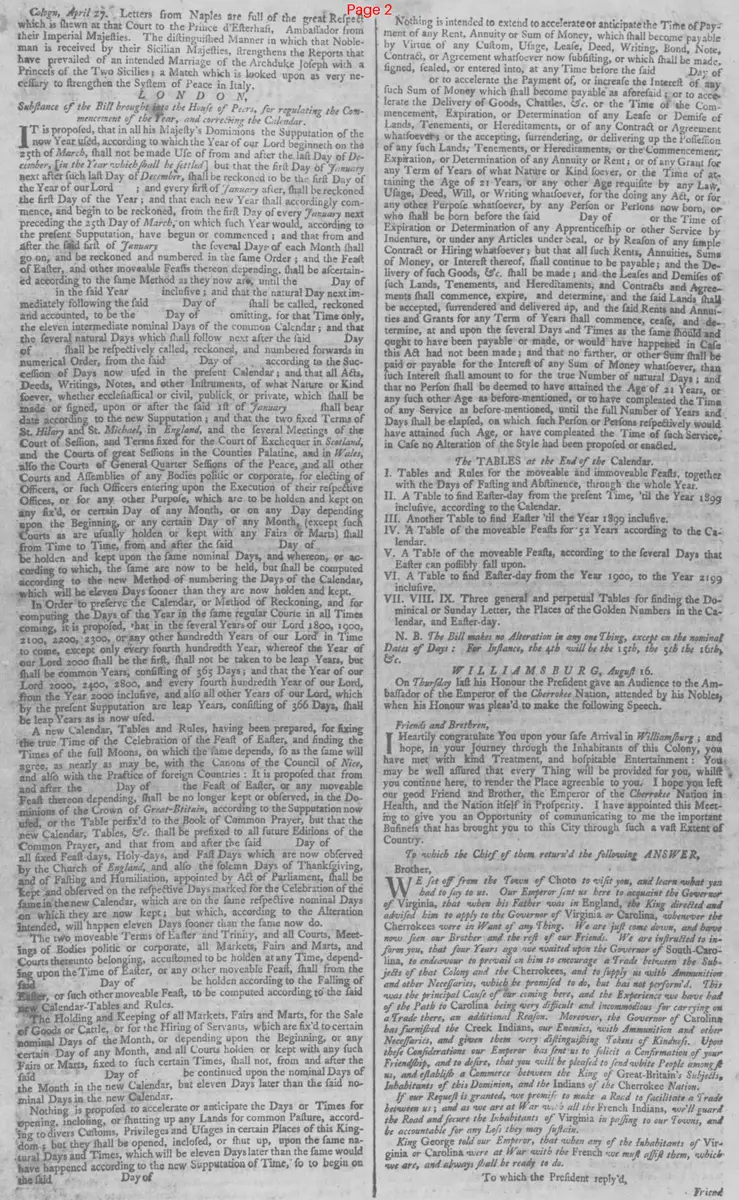
Until 1752, Britain and its colonies still used the old Julian calendar. Most of Europe had switched to the Gregorian calendar since 1582, so London dates ran eleven days behind Paris dates, and the British year began on March 25 rather than January 1. Parliament's Calendar Act fixed both: 1751 became a short year that ended on December 31, and in September 1752 eleven days simply disappeared, so that Wednesday, September 2 was followed by Thursday, September 14.
The Virginia Gazette printed the substance of the bill in August 1751, with the dates still left blank, and a reassurance at the bottom:
N. B. The Bill makes no Alteration in any one Thing, except on the nominal Dates of Days: For Instance, the 4th will be the 15th, the 5th the 16th, &c.
Franklin's lightning
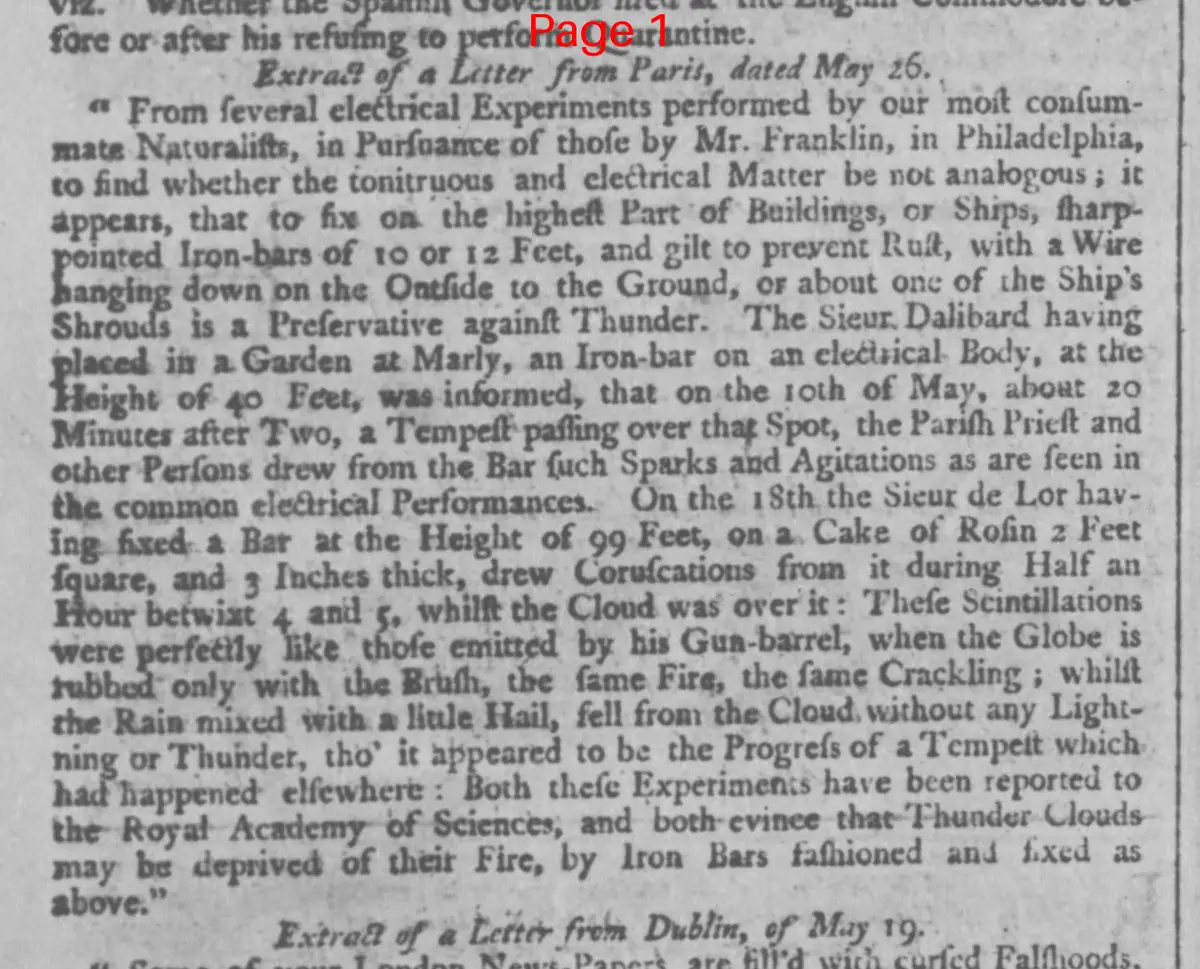
In 1751 a London printer published Benjamin Franklin's letters on electricity, including a proposal: put a tall iron rod on high ground in a storm, and you can draw electricity out of a thundercloud. In May 1752 French experimenters at Marly-la-Ville did exactly that, and the result made Franklin famous across Europe. The news came back to America the long way round, via Paris and London, and The Virginia Gazette printed it that October:
The Sieur de Lor having fixed a Bar at the Height of 99 Feet ... drew Coruscations from it during Half an Hour
Lightning was not an abstraction to readers. A year earlier the same paper printed a ship captain's account of a strike at sea off South Carolina: "I met with a dismal Crack, together with a Shower of Fire, which broke over us, as if the whole Dissolution of the World was come." Read the captain's account.
Admiral Byng: shot for not doing his utmost
When war with France broke out again in 1756, the French opened it by landing on Minorca, the British base in the Mediterranean. Admiral John Byng was sent to relieve it, fought an indecisive battle with the French fleet in May, and sailed back to Gibraltar. The garrison of Fort St. Philip held out until the end of June and then surrendered.
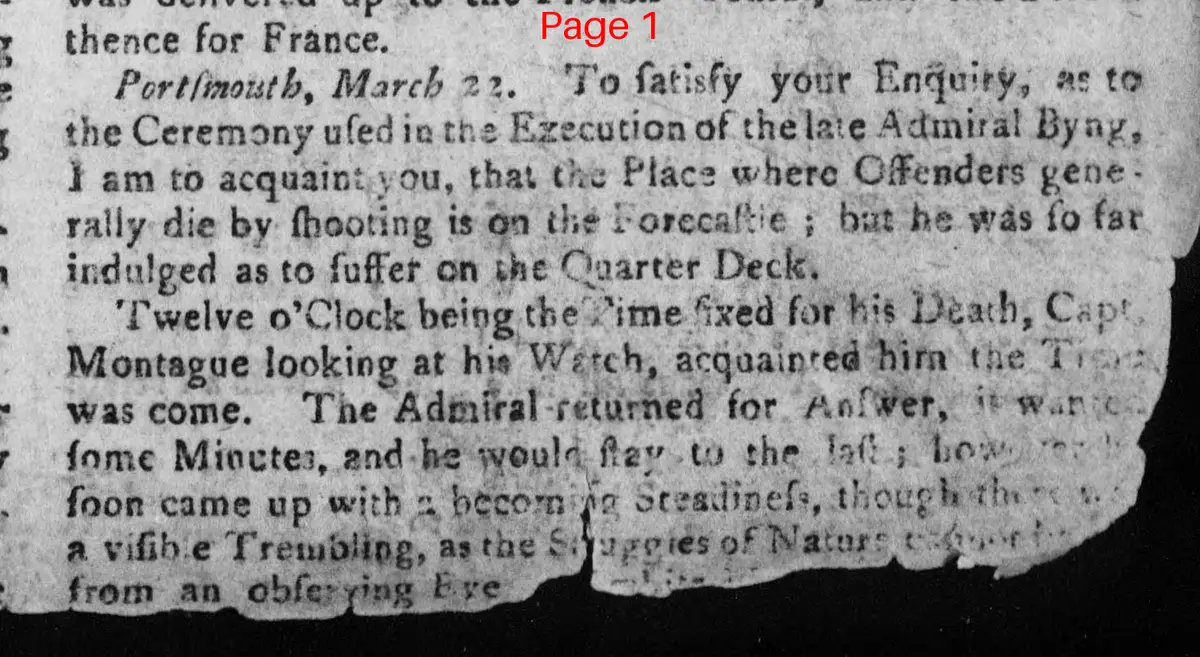
The New Hampshire Gazette followed it all from a distance of months. Its account of the siege that October has the garrison's commander answering the French demand to surrender with artillery: "The gallant General Blakeney dismiss'd the Flag of Truce, and gave them an Answer by Cannon Ball and Bomb Shells" (read it). By December Byng was under arrest and complaining about his room (read it). A court martial found that he had failed to do his utmost against the enemy, a crime that carried a mandatory death sentence, and he was shot by a firing squad on the deck of HMS Monarch in March 1757. Voltaire made the execution famous in Candide: in England, he wrote, it is good to kill an admiral from time to time, to encourage the others. New Hampshire read about it that June:
he fell on his Left Side, and made but one Shudder in the Agonies of Death
The fall of Fort William Henry
In America the war had already been running for two years. In August 1757 the Marquis de Montcalm besieged Fort William Henry at the south end of Lake George with French troops and some 1,800 Native allies. The British commander, Lieutenant Colonel George Monro, surrendered on terms that let his garrison march away. The next morning, Montcalm's allies fell on the column, killing and capturing many of the soldiers and camp followers. James Fenimore Cooper put the story into The Last of the Mohicans seventy years later.
Readers of the New Hampshire Gazette got the news in pieces over six weeks, and then, on September 9, from the men who were there. One officer of the New Hampshire regiment wrote that he had "nothing left but my Shirt, Stockings and Shoes," and that when the killing of the sick and wounded began, he "really thought ... that they would Sacrifice the Well next."
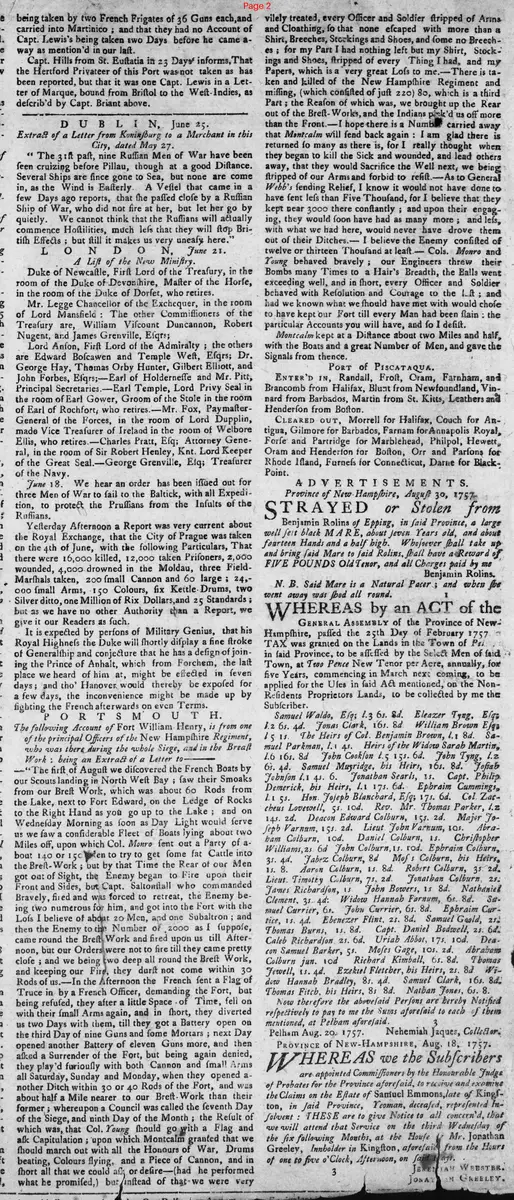
The same issue printed a journal of the siege, which quotes Montcalm's letter demanding surrender and ends with the line "THUS FELL FORT-WILLIAM-HENRY." Read the journal.
1758: Louisbourg and Ticonderoga
The summer of 1758 brought the British one great victory and one disaster. At Louisbourg, the French fortress on Cape Breton Island, General Amherst and Admiral Boscawen landed an army in June and forced its surrender at the end of July. One of the brigadiers was a 31-year-old named James Wolfe. A letter from the siege, printed that August, mixes the brutal with the oddly polite. German soldiers in French service caught trying to desert were hanged on the ramparts, sixteen at a time, and yet:
Last Week Brigadier Wolfe received a Compliment, with a Pyramid of Sweetmeats, from the Governor's Lady
"This is strange Complaisance between inveterate Enemies!" the writer added.
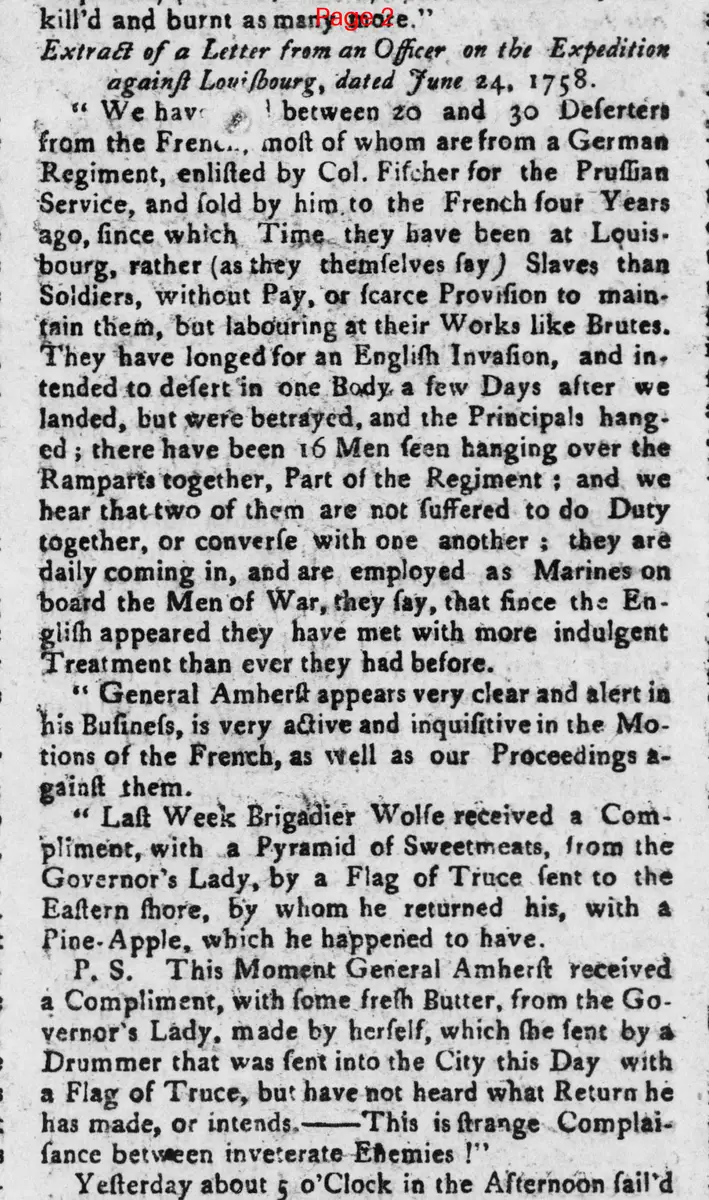
Meanwhile, General Abercromby led the largest army yet seen in North America against Fort Carillon, which the British called Ticonderoga. His second-in-command, the popular Lord Howe, was killed in a skirmish two days before the main assault, and the New Hampshire Gazette reported it while the outcome was still unknown (read it). Earlier that summer the paper had told readers that Howe "has sacrificed a fine Head of Hair of his own, as an Example to the Soldiers," cropping it short for forest fighting (read it). The assault on July 8 against the French breastworks failed, with nearly two thousand British casualties.
1759: Quebec
In 1759, the "year of victories" in Britain, Wolfe was given command of the attack on Quebec. He besieged the city all summer without success, until on the night of September 12 his troops climbed a cliff path above the town and formed up on the Plains of Abraham. The battle the next morning lasted minutes. Wolfe was killed, and so was Montcalm, and Quebec surrendered five days later.
The New Hampshire Gazette had a glimpse inside the city months earlier. In July it printed a captured letter written in Quebec that April, before the British fleet had even arrived:
we have been reduced to a Quarter of a pound of Bread, per Day, and have often had no meat at all
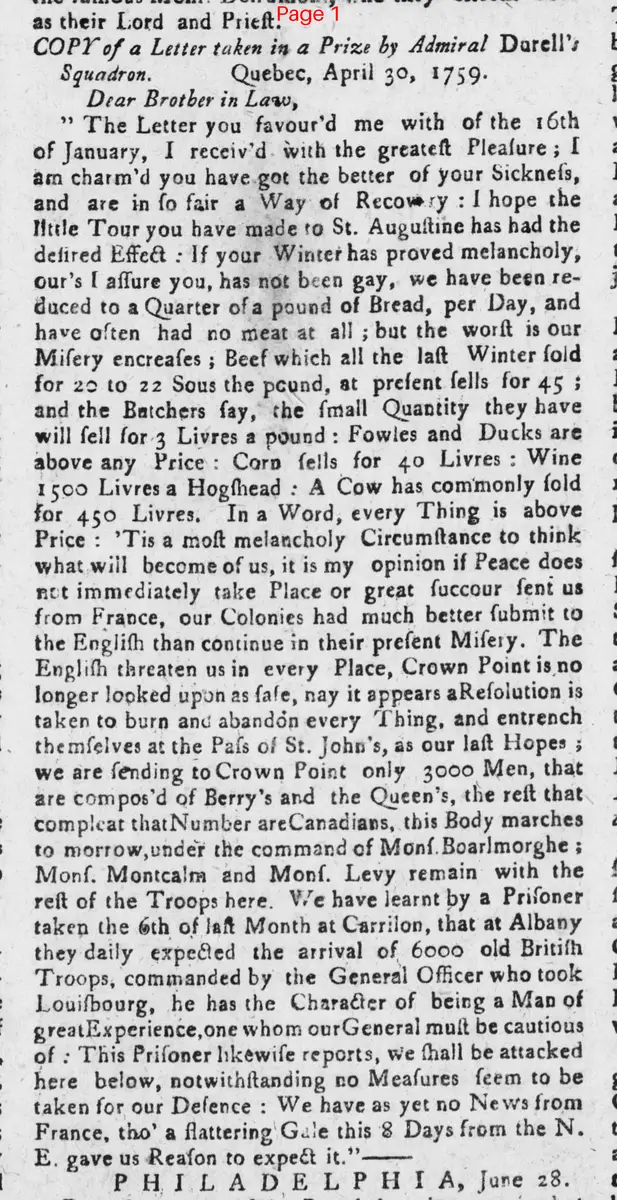
The first issue in our index to carry news of the battle is from November 2, with a list of the killed and wounded headed by "General WOLFE" (read it). French prisoners' accounts of how both generals died followed in The Virginia Gazette on November 30 (read it), and in December the New Hampshire Gazette printed Wolfe's orders to his army on the eve of the battle, weeks after readers knew he was dead: "A vigorous Blow struck by the Army at this Juncture, may determine the Fate of Canada" (read it).
Also in the 1750s
- A man hanged in England in 1751 for drowning a woman he believed was a witch told the crowd at the gallows: "I do not believe there is such a Thing in being as a Witch." (read it)
- Jedediah Buxton, a farm labourer who couldn't write, did enormous sums in his head while a gentleman timed him with a watch. (read it)
- Eighteen months after the Lisbon earthquake, "The King continues in his wooden Palace," and the Queen refused to spend a day anywhere surrounded by walls. (read it)
Sources
The SNEWPapers links below provide the full transcription and metadata, as well as links to the original source material at the Library of Congress and to PDFs of the original pages:
- The Virginia Gazette, 1751-08-16, Virginia, p. 2
- The Virginia Gazette, 1752-10-27, Virginia, p. 1
- The Virginia Gazette, 1751-10-17, Virginia, p. 2
- The New Hampshire Gazette, 1756-10-07, New Hampshire, p. 2
- The New Hampshire Gazette, 1756-12-02, New Hampshire, p. 2
- The New Hampshire Gazette, 1757-06-24, New Hampshire, pp. 1, 2
- The New Hampshire Gazette, 1757-09-09, New Hampshire, p. 2
- The New Hampshire Gazette, 1757-09-09, New Hampshire, p. 1
- The New Hampshire Gazette, 1758-08-18, New Hampshire, p. 2
- The New Hampshire Gazette, 1758-07-21, New Hampshire, p. 3
- The New Hampshire Gazette, 1758-06-16, New Hampshire, p. 3
- The New Hampshire Gazette, 1759-07-13, New Hampshire, p. 1
- The New Hampshire Gazette, 1759-11-02, New Hampshire, pp. 2, 3
- The Virginia Gazette, 1759-11-30, Virginia, p. 2
- The New Hampshire Gazette, 1759-12-07, New Hampshire, p. 1
- The Virginia Gazette, 1751-12-05, Virginia, p. 3
- The Virginia Gazette, 1752-01-02, Virginia, pp. 1, 2
- The New Hampshire Gazette, 1757-07-22, New Hampshire, p. 2