November 2, 2026 · 10 min read
The 1730s: News from everywhere, by way of London
Contents
Part of Decade by Decade: History as the Newspapers Told It, a series on the big stories of each decade as the newspapers reported them.
All source materials for this post were acquired using SNEWPapers. We are in the process of the most accurate extraction, in terms of correct segmentation and textual accuracy, of the Library of Congress' Chronicling America collection ever conducted. You can track our progress here. This post is a demonstration of what you can find using our tools. Connect your Grok, ChatGPT, Claude and more today to our vast database and research whatever you're interested in (and hopefully share it with the rest of us!). What would've taken you a year yesterday, is possible in a few hours with SNEWPapers today. Estimates put the total count of historical newspaper pages at over a billion for U.S. Newspapers alone, with 25+ million sitting in the Library of Congress. By and large, nobody knows what's in them... until now
You may have heard of these events before, but you're likely one of the first people in generations to read these articles again
In the summer of 1736 the printer William Parks started The Virginia Gazette in Williamsburg, the colony's first newspaper. Everything in this decade comes from its pages. Most of what it printed was news from London, weeks or months old by the time a ship brought it up the James River: wars in eastern Europe, the doings of courts, the strange career of a German adventurer who made himself a king. Closer to home there was Georgia's border with Spanish Florida, Spanish coast guards seizing British ships, and by the end of the decade, a war.
The King of Corsica
In 1736 the island of Corsica had been in revolt against its rulers, the Republic of Genoa, for seven years. That spring a German baron and soldier of fortune, Theodor von Neuhoff, landed with a ship full of arms and money he had raised on credit, and the rebels made him their king. The Virginia Gazette reported the coronation that September:
His Crown indeed was only a Wreath of Laurel; but what he wanted in the Richness of his Diadem, was made up in the Shouts of the Spectators
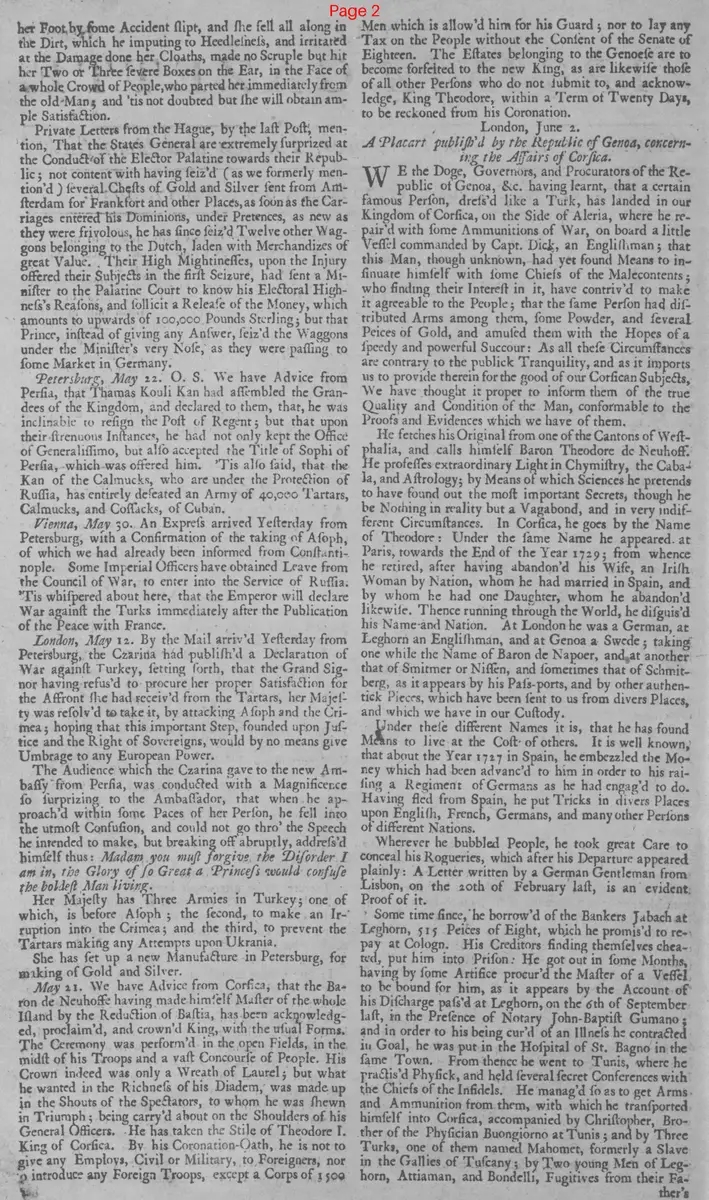
It didn't last. By November the paper was writing his political obituary: "The Reign of King Theodore, in Corsica, has been like a Meteor, unexpected in Appearance ... and vanish'd in a Moment" (read it). Another report summed up his career: "At London he was a German, at Leghorn an Englishman, and at Genoa a Swede" (read it). In 1737 he turned up in Amsterdam hiding from his creditors, until a man hired to find him, posing as someone who wanted a captain's commission in his army, got him to admit who he was. He was arrested for debt (read it). Theodore made more attempts to return to Corsica, spent years in a London debtors' prison, and died poor in 1756. The island's revolt went on, and a generation later it produced Pasquale Paoli, whom you'll meet in the 1760s.
The Porteous riots
In April 1736 a crowd in Edinburgh turned on the City Guard after the hanging of a popular smuggler, and Captain John Porteous's men fired into it, killing several people. Porteous was tried for murder and sentenced to death, and the paper printed the case against him: "the Populace began to fling large Stones at the Guard, whereby several were hurt, and one had his Shoulder-Bone broke" (read it). When the government in London reprieved him, a mob broke into the Tolbooth prison in September and hanged him from a dyer's pole.
Parliament's response was an act that every minister in Scotland had to read from the pulpit, calling on people to give up the killers. Many ministers refused, and many people walked out of church when it was read. The paper couldn't resist a joke about one of them, Edinburgh's hangman:
honest John Dalgiesh, alias Jack Ketch, whose Scruples possibly arose from this, That the Publication warned Offenders of their Danger
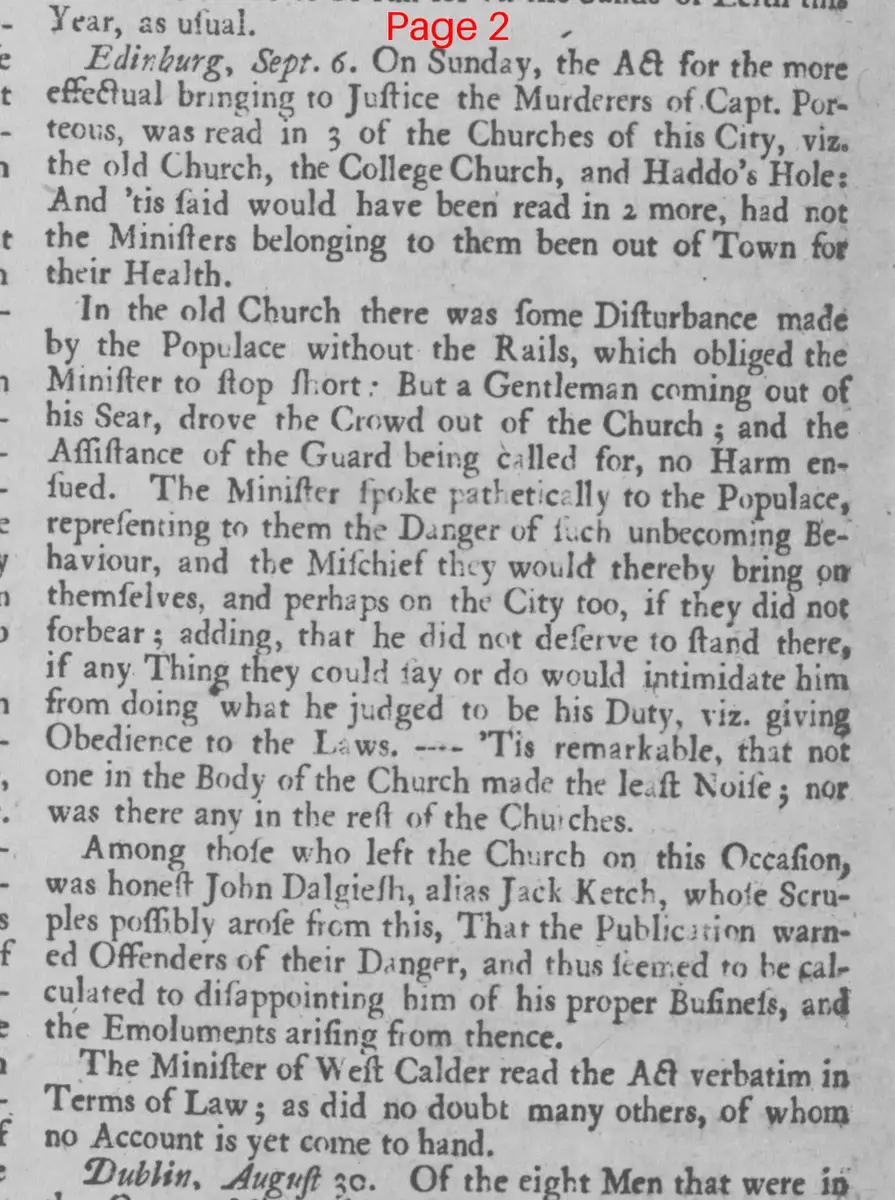
Warning offenders, the paper explained, might disappoint him "of his proper Business, and the Emoluments arising from thence." Nobody was ever convicted of killing Porteous.
Captain Jenkins's ear
Britain and Spain were nominally at peace, but Spanish coast guards in the Caribbean, the guarda costas, stopped and searched British merchant ships for smuggled goods, and often took them. Through the late 1730s The Virginia Gazette printed a run of captains' sworn statements of being seized and plundered. One printer's note on a ship taken not by a coast guard but by a Spanish warship ends: "The Lord open the Eyes of the P-----t" (read it).
The most famous case was years old by then. In 1731 a coast guard captain had cut off the ear of Robert Jenkins, master of the Rebecca. In 1738 Jenkins was called before Parliament, and the story goes that he brought the ear with him in a jar. By February 1739 it was a joke at a London masquerade, where a guest dressed as a Spaniard called himself the "Knight of the Ear":
on his Breast the Form of a Star, whose Points seem'd ting'd with Blood, on which was painted an Ear, and round it, written in Capital Letters, the Word JENKINS
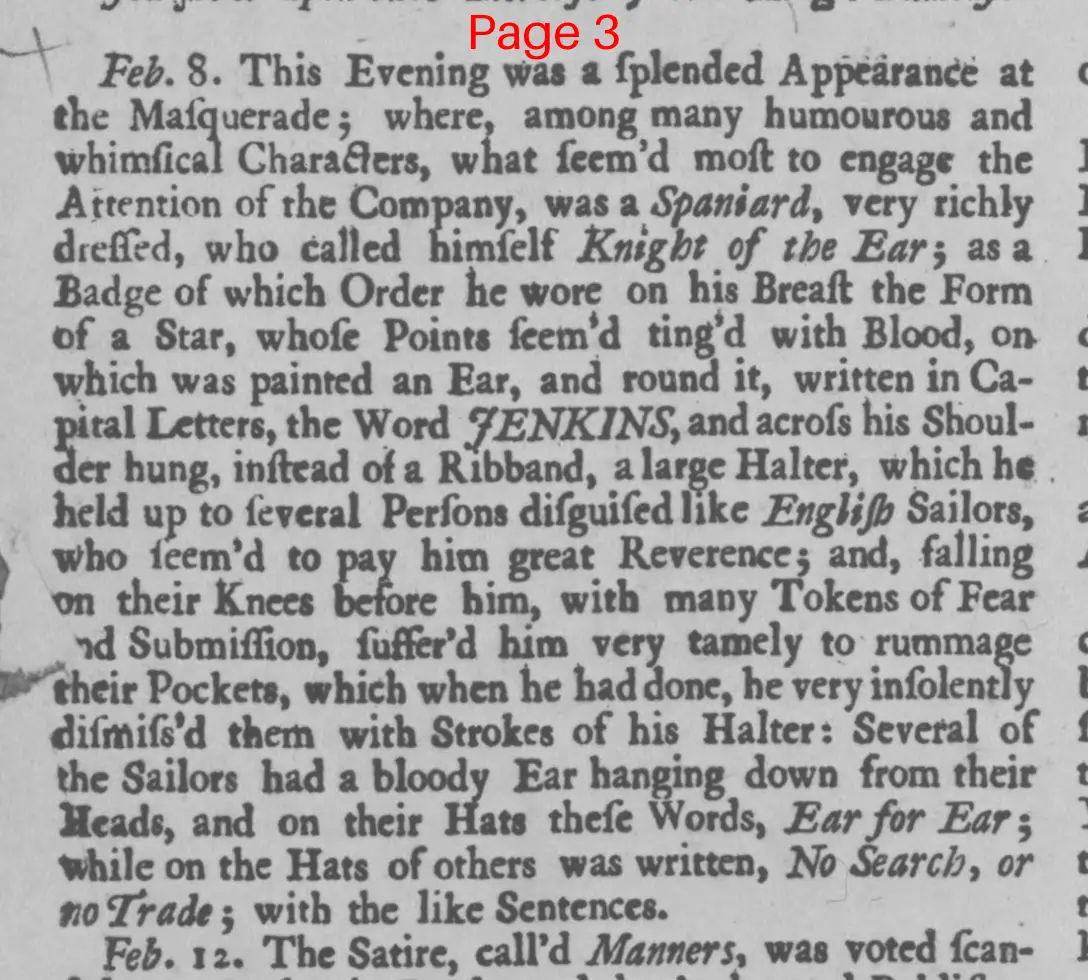
His victims, dressed as English sailors, wore bloody ears and hats reading "Ear for Ear."
War with Spain
By the summer of 1739 war was coming, and Virginia didn't wait for it. In August the governor was empowered to issue letters of marque, licensing private ships to attack Spanish shipping:
to take, sink, burn, destroy, or otherwise annoy, any Ship or other Vessels belonging to the King or Subjects of Spain
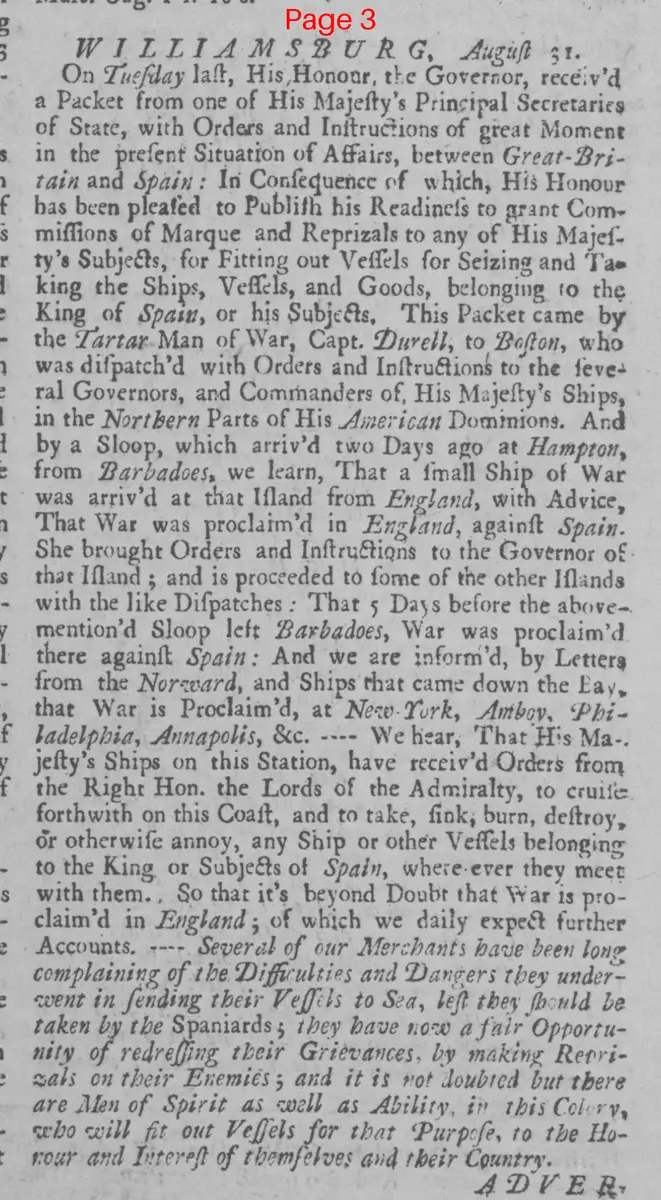
Britain declared war that October, and the paper reported the ceremony in London in January, where "The Spectators expressed their great Satisfaction by loud Acclamations of Joy at each Place" (read it). The war took its name from Jenkins's ear a century later. In November 1739 Admiral Vernon captured Porto Bello, on the Panama coast, and was a national hero; one of the Virginians who later served under him was Lawrence Washington, who named his plantation Mount Vernon after him.
Georgia and the Spanish border
Georgia was founded in 1733 under James Oglethorpe, partly as a refuge for the poor and partly as a buffer between South Carolina and Spanish Florida. Spain claimed the land, and through the decade The Virginia Gazette followed the standoff: Spanish envoys at Oglethorpe's fort at Frederica, rumours of invasion fleets, "4000 Men are already arrived from Old Spain, and that 5000 were daily expected from Mexico" (read it), and a captured guide who "owns that he had undertaken to guide the Spaniards in their invading of Carolina and Georgia" (read it).
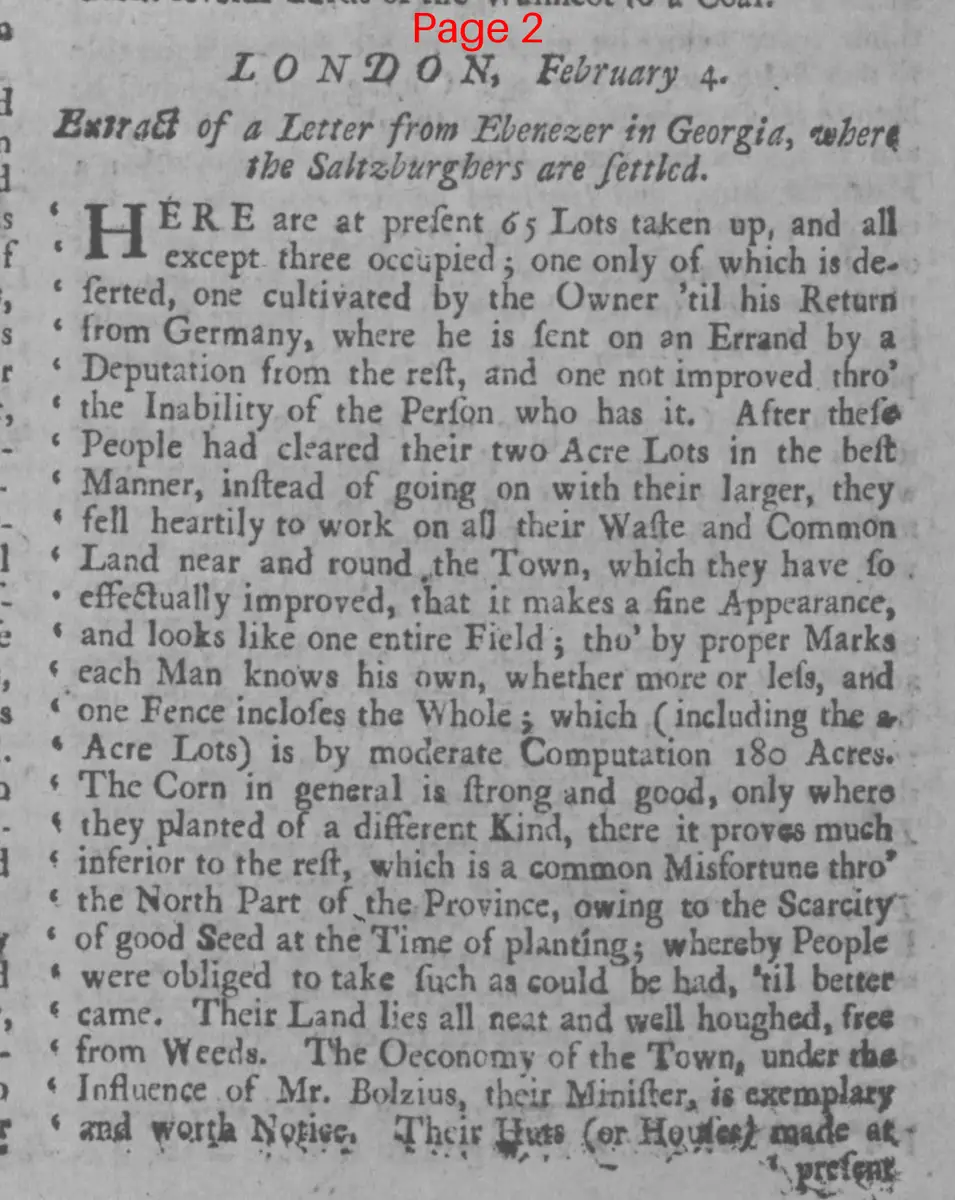
Georgia's founders banned both slavery and rum, and one visitor found the Salzburgers, Protestant refugees from Austria, living just as intended at their town of Ebenezer:
no regular Court of Justice, no Lawyer to plead, or Rum to intoxicate; but Peace seems to prevail.
Resistance in the islands
The Caribbean sugar islands were the wealthiest colonies Britain had, and they ran on the labour of enslaved Africans who far outnumbered the white planters. In October 1736 a plot was uncovered on Antigua: barrels of gunpowder were to be set off under a ball the governor was giving for the King's birthday, as a signal for a rising across the island (read it). The paper reported the punishments over the following months, written entirely from the planters' side. They are among the most brutal things in the archive (read it; very graphic).
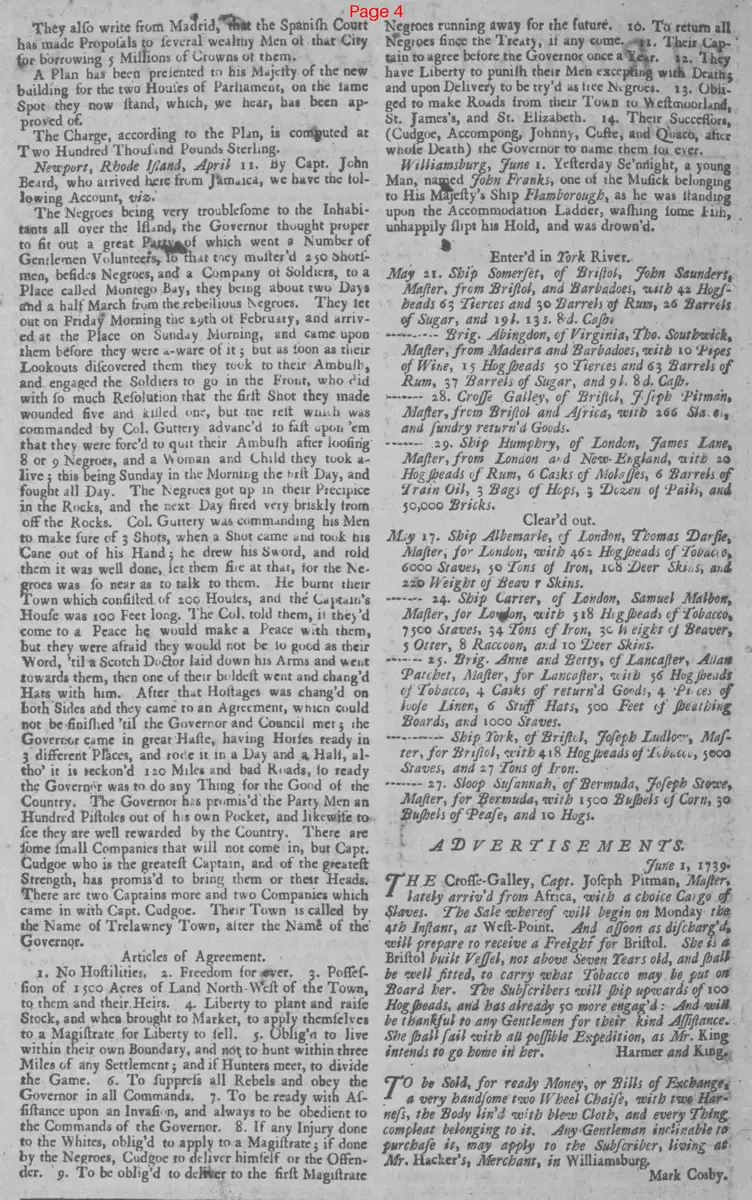
In Jamaica the story ended differently. The Maroons, communities of people who had escaped slavery and lived free in the mountains, had fought the colony to a standstill for years. In 1739 the governor made peace with the Leeward Maroons under their leader Cudjoe, and the paper printed the terms:
- Freedom for ever.
Belgrade and the Turks
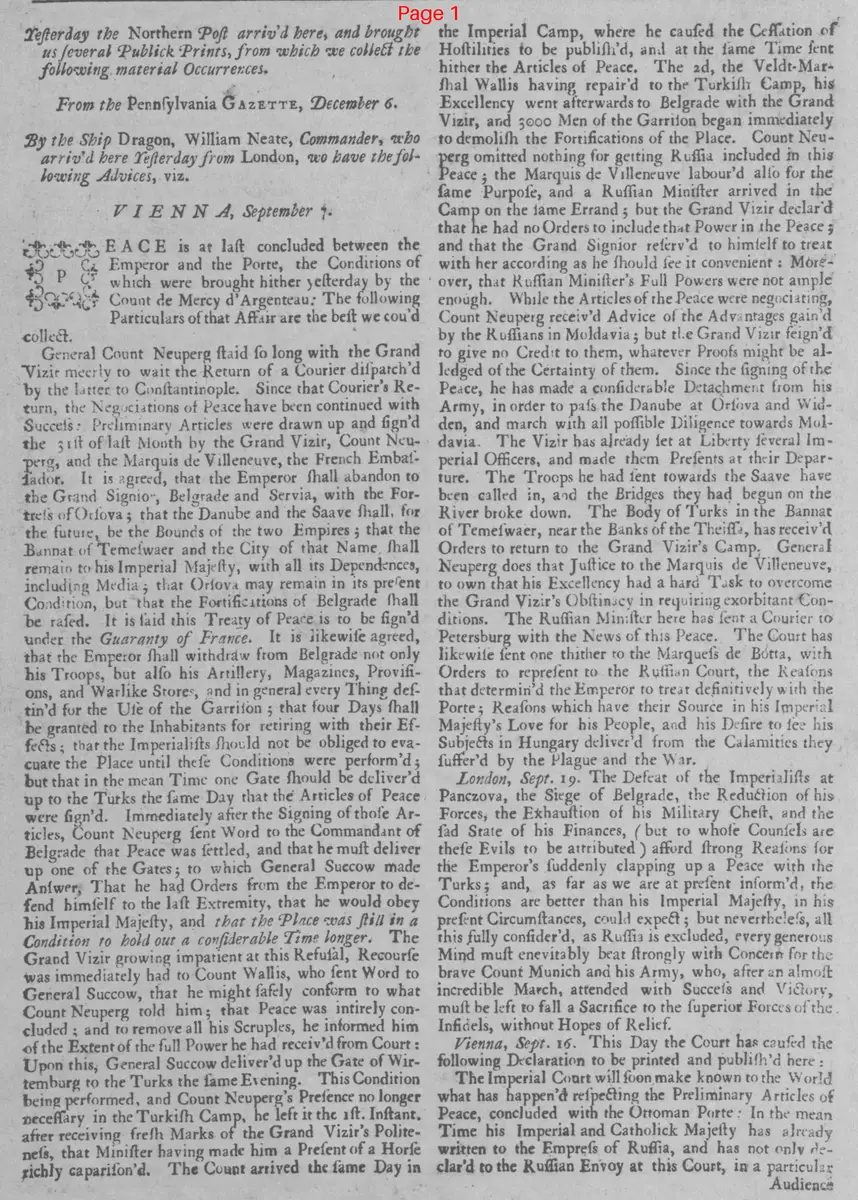
In eastern Europe, Austria and Russia went to war with the Ottoman Empire in 1737. The paper printed letters from Vienna, Venice and Constantinople, usually months old. Russia took the fortress of Oczakow, and in Constantinople the news set off riots (read it; graphic). Austria did badly, and an Austrian general who surrendered a fortress was beheaded at Belgrade; his last words were printed in full (read it; graphic). In 1739 Austria made peace and handed back Belgrade, which it had held for twenty years. When the news reached Williamsburg in January 1740, it came with the Emperor disowning his own negotiator, who had gone to the Turks "without his Knowledge, much less by his Order":
The shepherd who became Shah
The decade's most extraordinary career was in Persia. The man Europeans called "Thamas Kouli Kan" rose from a poor family in Khorasan to command the Persian army, deposed the Safavid shah, and in 1736 was crowned Nadir Shah. The paper's 1737 profile reads like a picaresque novel:
he stole some Sheep from his Father, which he sold, and with the Money listed a Gang of resolute Banditti, of whom he put himself at the Head.
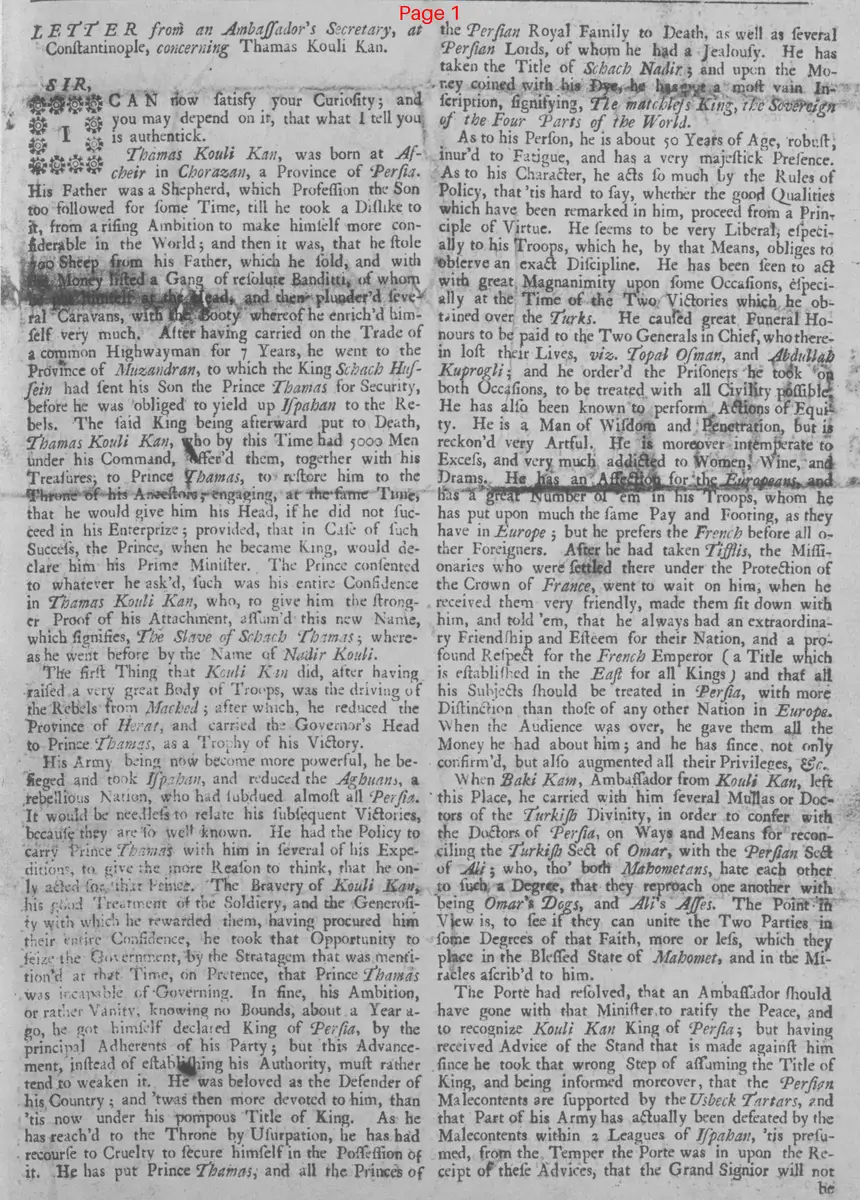
The same profile adds that "he is moreover intemperate to Excess, and very much addicted to Women, Wine, and Drams." In 1739 Nadir invaded Mughal India, sacked Delhi and carried off the Peacock Throne. News from India came by way of Surat, Bombay and London, so as late as December 1739 the paper was printing a manifesto in his name from before the march on Delhi: "In the wide Sea of this perishable World, I seem, as it were, mounted on the Back of an Allegator, from which I am not without Fear of being overset" (read it).
George Whitefield
In 1739 a young Anglican preacher named George Whitefield, barred from many pulpits, began preaching in the open air, to coal miners near Bristol and then to vast crowds in London. The paper reported that at Rose Green "there were upwards of 20,000," and that "many got up in the Trees" to see him:
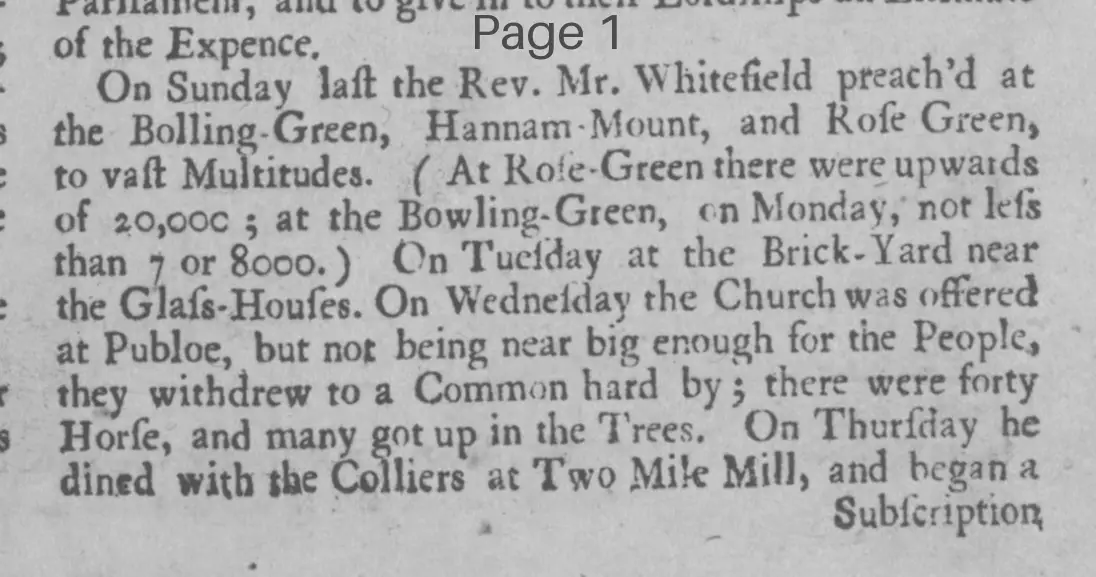
Not everyone was impressed. When he sailed for America that August, a piece the paper reprinted accused him of living off "the Fool's Pence he has talk'd out of the Pockets of his Lunatick Audience" (read it). By December he was in Williamsburg on his way to Georgia, having "preach'd in the open Fields to 8 or 10,000 People at a Time" (read it). His tour of the colonies became the centre of the religious revival later called the Great Awakening.
Also in the 1730s
- In 1736 a Wiltshire man believed to be bewitched had stood for three years with his head and shoulders stuck through a hole in a partition wall. (read it)
- A 110-year-old Irishman "in the 100th Year of his Age ... made a Coffin, which served him 10 Years for a Cupboard, and at last inclosed his Body." (read it)
- In 1738 a ship from Jamaica sank after it "struck on a Whale at Sea, supposed to be asleep on the Water." (read it)
- In 1739 a hare walked calmly through the streets of Edinburgh. "The Old Women are persuaded Puss was a Witch." (read it)
- In Edinburgh, a widower took a woman home the night after his wife's funeral; when a mob besieged the house, the magistrates settled it by declaring them married. (read it)
Sources
The SNEWPapers links below provide the full transcription and metadata, as well as links to the original source material at the Library of Congress and to PDFs of the original pages:
- The Virginia Gazette, 1736-09-10, Virginia, p. 2
- The Virginia Gazette, 1736-11-19, Virginia, p. 3
- The Virginia Gazette, 1736-09-10, Virginia, pp. 2, 3
- The Virginia Gazette, 1737-07-22, Virginia, p. 2
- The Virginia Gazette, 1736-11-12, Virginia, p. 3
- The Virginia Gazette, 1737-11-18, Virginia, p. 2
- The Virginia Gazette, 1739-05-04, Virginia, p. 2
- The Virginia Gazette, 1739-05-04, Virginia, p. 3
- The Virginia Gazette, 1739-08-24, Virginia, p. 3
- The Virginia Gazette, 1740-01-25, Virginia, pp. 3, 4
- The Virginia Gazette, 1738-05-05, Virginia, p. 3
- The Virginia Gazette, 1738-03-01, Virginia, p. 4
- The Virginia Gazette, 1739-06-08, Virginia, pp. 2, 3
- The Virginia Gazette, 1736-12-10, Virginia, p. 4
- The Virginia Gazette, 1737-05-13, Virginia, p. 3
- The Virginia Gazette, 1739-05-25, Virginia, p. 4
- The Virginia Gazette, 1738-01-06, Virginia, p. 2
- The Virginia Gazette, 1738-08-11, Virginia, p. 1
- The Virginia Gazette, 1740-01-04, Virginia, pp. 1, 2
- The Virginia Gazette, 1737-04-29, Virginia, pp. 1, 2
- The Virginia Gazette, 1739-12-28, Virginia, p. 2
- The Virginia Gazette, 1739-06-15, Virginia, pp. 1, 2
- The Virginia Gazette, 1739-09-21, Virginia, p. 3
- The Virginia Gazette, 1739-12-07, Virginia, p. 3
- The Virginia Gazette, 1736-09-17, Virginia, pp. 1, 2
- The Virginia Gazette, 1737-08-12, Virginia, p. 3
- The Virginia Gazette, 1738-08-18, Virginia, p. 3
- The Virginia Gazette, 1739-01-19, Virginia, p. 3
- The Virginia Gazette, 1737-01-21, Virginia, p. 3