October 31, 2026 · 8 min read
The 1760s: From victory to the Stamp Act
Contents
Part of Decade by Decade: History as the Newspapers Told It, a series on the big stories of each decade as the newspapers reported them.
All source materials for this post were acquired using SNEWPapers. We are in the process of the most accurate extraction, in terms of correct segmentation and textual accuracy, of the Library of Congress' Chronicling America collection ever conducted. You can track our progress here. This post is a demonstration of what you can find using our tools. Connect your Grok, ChatGPT, Claude and more today to our vast database and research whatever you're interested in (and hopefully share it with the rest of us!). What would've taken you a year yesterday, is possible in a few hours with SNEWPapers today. Estimates put the total count of historical newspaper pages at over a billion for U.S. Newspapers alone, with 25+ million sitting in the Library of Congress. By and large, nobody knows what's in them... until now
You may have heard of these events before, but you're likely one of the first people in generations to read these articles again
The 1760s began with Britain triumphant and the colonies proud to be British. The war ended in 1763 with France gone from North America. Then Parliament, deep in debt from the war, decided the colonies should help pay for their own defence, and by the end of the decade the colonial papers were full of boycotts, effigies, troops in Boston and toasts to foreign rebels.
The siege of Havana
Spain joined the war on France's side in 1762, and Britain answered by sending a fleet and army against Havana, the richest port in the Spanish Americas. The army landed in June and spent the summer besieging the Moro Castle, the fortress guarding the harbour mouth, while yellow fever and dysentery killed far more men than the Spanish did. Sappers dug a mine under the walls, and the castle was stormed on July 30. The city surrendered in August. At the peace a year later, Britain handed Havana back in exchange for Florida.
Several thousand colonial troops from New York and New England served in the expedition, so the New Hampshire Gazette followed it closely. This letter from on board HMS Briton describes a Spanish sortie made by men who wrote on their hats that they would neither take nor give quarter:
but the Dons soon got such a drubbing as sent 200 of them into the other world
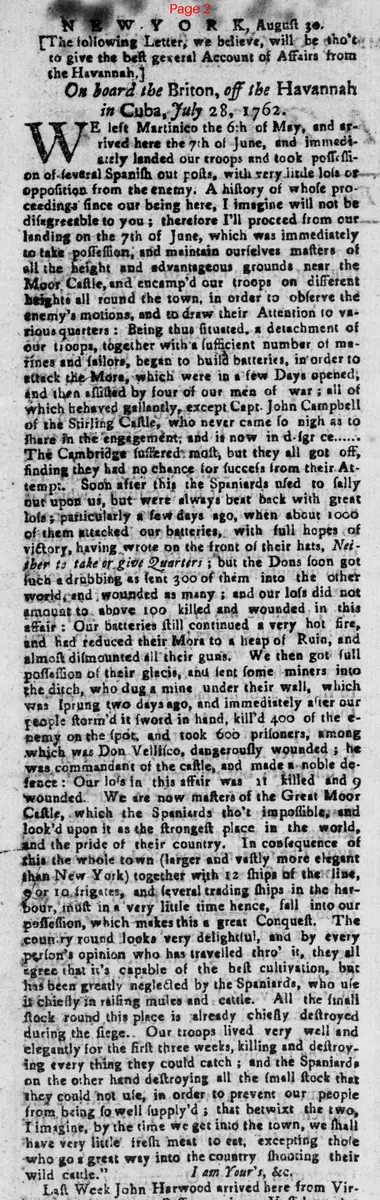
The paper kept the story going after the surrender too, with a report in December of a plot against the British garrison (read it).
Pontiac's War
With the French gone, the British took over their forts around the Great Lakes, cut back the gifts and trade the French had used to keep their Native alliances, and let settlers push west. In the spring of 1763 a coalition of nations, led in part by the Odawa leader Pontiac, struck back. Eight British forts fell within weeks and Detroit was besieged for months.
At Fort Michilimackinac, at the top of Lake Michigan, Ojibwe men played a ball game outside the fort, as they had for several days, then chased the ball through the open gate and took the fort. A survivor's account reached the New-Hampshire Gazette that October:
A party of Chippeway Indians came to the fort and played at ball, as is usual for Indians to do, and as they had done for 3 or 4 days before
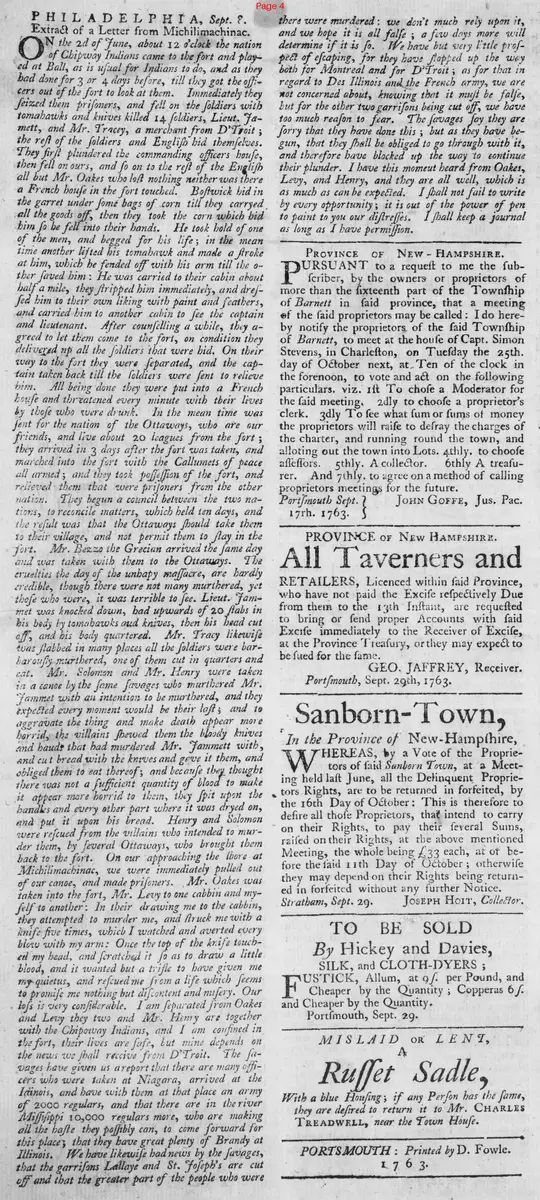
These accounts are graphic, and they use the language of their time. They were also only one side of the story, as the next one shows.
The Paxton Boys
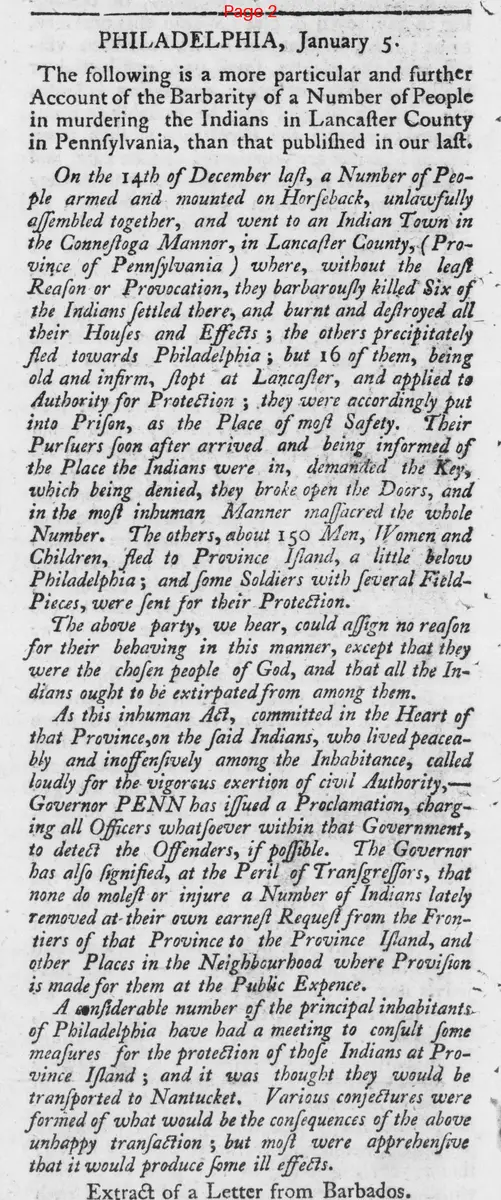
In December 1763, a group of frontiersmen from Paxton township in Pennsylvania, enraged by the war, rode to Conestoga and murdered six of the Susquehannock people living there peacefully under the colony's protection. The fourteen survivors were moved to the Lancaster workhouse for safety. Two weeks later the Paxton men broke in and killed all of them. The New Hampshire paper's account does not spare them:
the above party, we hear, could assign no reason for their behaving in this manner, except that they were the chosen people of God, and that all the Indians ought to be extirpated from among them
In February 1764 several hundred of them marched on Philadelphia, where other Native refugees were sheltering. The city armed itself, and Benjamin Franklin rode out to meet the marchers at Germantown and talked them into going home. A participant's account caught the alarm in the city: "To arms, to arms, was the cry; and in less than half an hour near 1000 of the inhabitants were ready" (read it).
The Stamp Act, from effigies to bonfires
In March 1765 Parliament passed the Stamp Act, a tax on newspapers, legal documents, licences and even playing cards, all of which would have to be printed on stamped paper, from November 1. In August, Bostonians hanged an effigy of Andrew Oliver, the man appointed to distribute the stamps, from a tree in the South End that became known as the Liberty Tree, and then pulled down a building they believed was meant for the stamps. Oliver resigned. Twelve days later a crowd wrecked the houses of several officials, including the lieutenant governor, Thomas Hutchinson. The New-Hampshire Gazette in Portsmouth reported it as news arrived by road:
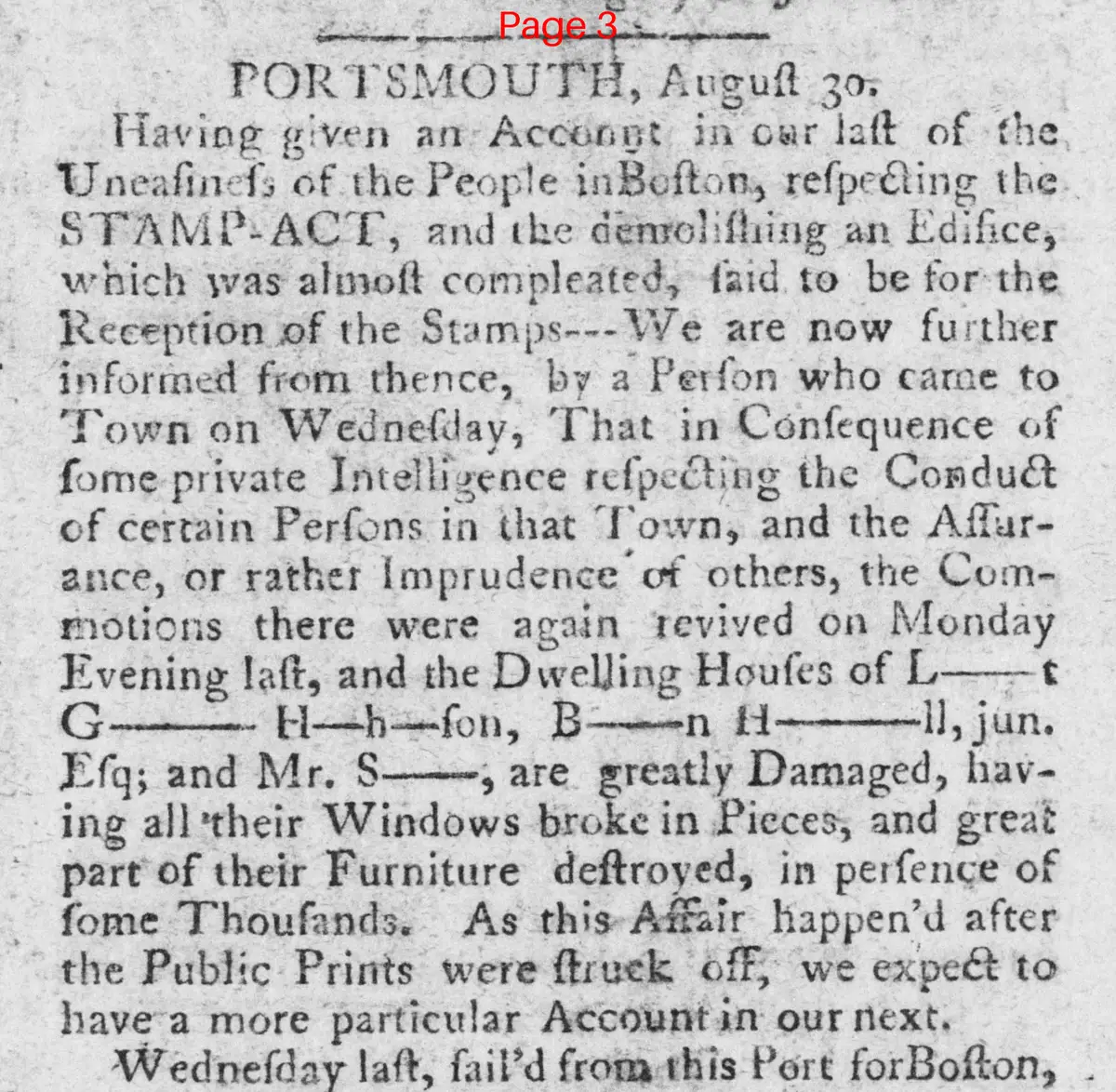
Up and down the coast, stamp distributors resigned or fled. Maryland's, Zachariah Hood, "rode his horse to death, and hardly gave himself time to breathe till he got under the protection of the cannon of Fort George, in New-York, where he remains hid from the resentment of his countrymen, but not from the terrors of his conscience" (read it). It didn't save him: in November, a party of New Yorkers followed him out to Flushing on Long Island and made him sign his resignation (read it).
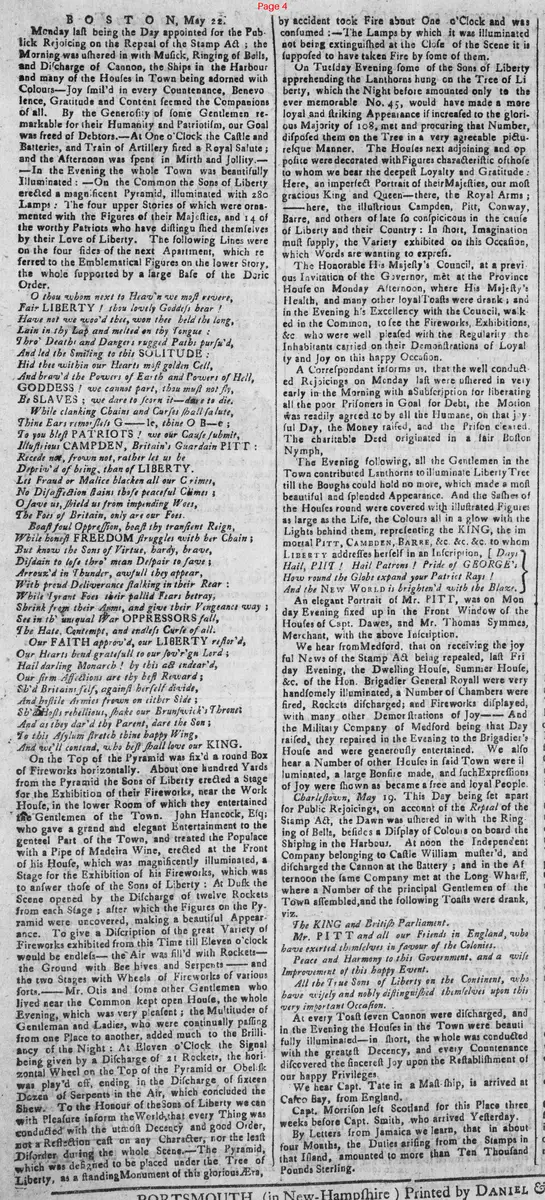
Parliament repealed the act in March 1766. The news took about two months to reach Boston, which held its official celebration on May 19: bells, cannon, the debtors' prison emptied by donation, and on the Common, a pyramid lit with 280 lamps, built by the Sons of Liberty. After everyone went home, the lamps were left burning:
The Pyramid ... by accident took Fire about One o'Clock and was consumed
Troops in Boston
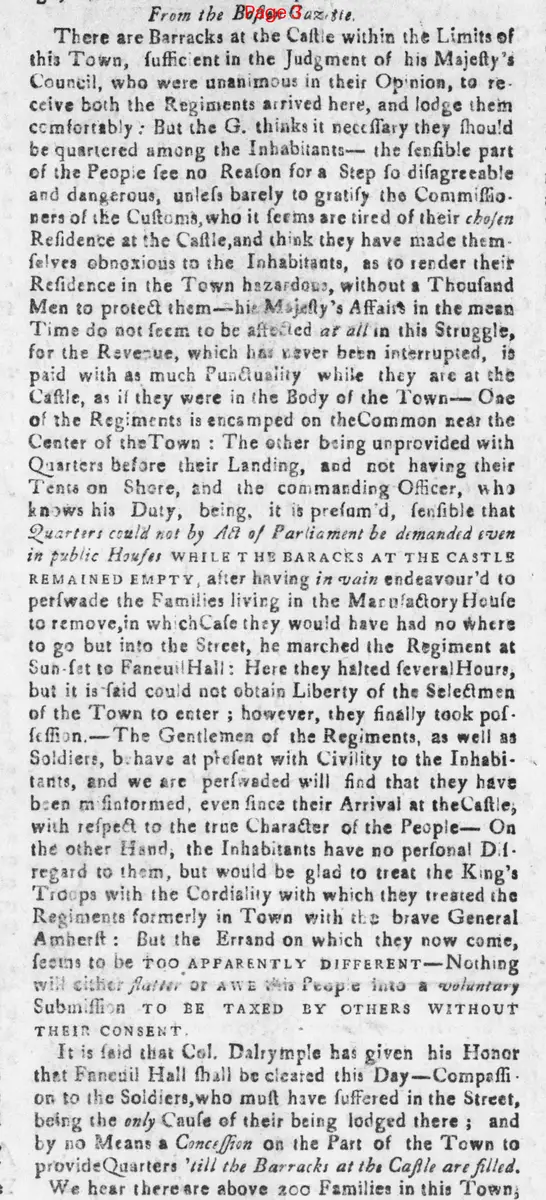
Parliament had kept the right to tax the colonies, and in 1767 it tried again with the Townshend duties on glass, paint, paper and tea. Boston led the resistance, and in June 1768 customs officers seized John Hancock's sloop Liberty, setting off a riot. That autumn two regiments of British soldiers landed in the town. The town refused to quarter them while the barracks at Castle William stood empty. One regiment camped on the Common; the other, with no tents ashore, ended up in Faneuil Hall after its commander "marched the Regiment at Sun-set to Faneuil Hall: Here they halted several Hours, but it is said could not obtain Liberty of the Selectmen of the Town to enter."
A day-by-day journal of the occupation, printed in Virginia that December, records the execution of a deserter on the Common, and an officer telling a group of enslaved men that if they were made free they would be enough to subdue the townspeople (read it). The troops would stay until the Boston Massacre in 1770.
Wilkes, Paoli and the number 45
Colonists in the late 1760s had heroes abroad. One was John Wilkes, a London politician who in 1763 attacked the King's speech in issue No. 45 of his paper The North Briton, was prosecuted and fled to France. He came back in 1768, won a seat in Parliament, and was jailed, expelled and re-elected again and again. "Wilkes and Liberty" became a slogan on both sides of the Atlantic, and the number 45 a badge. In Berwick, at the King's birthday, the ladies' "breastknots, and cockades on their heads, were exactly thrown into the figures 45":
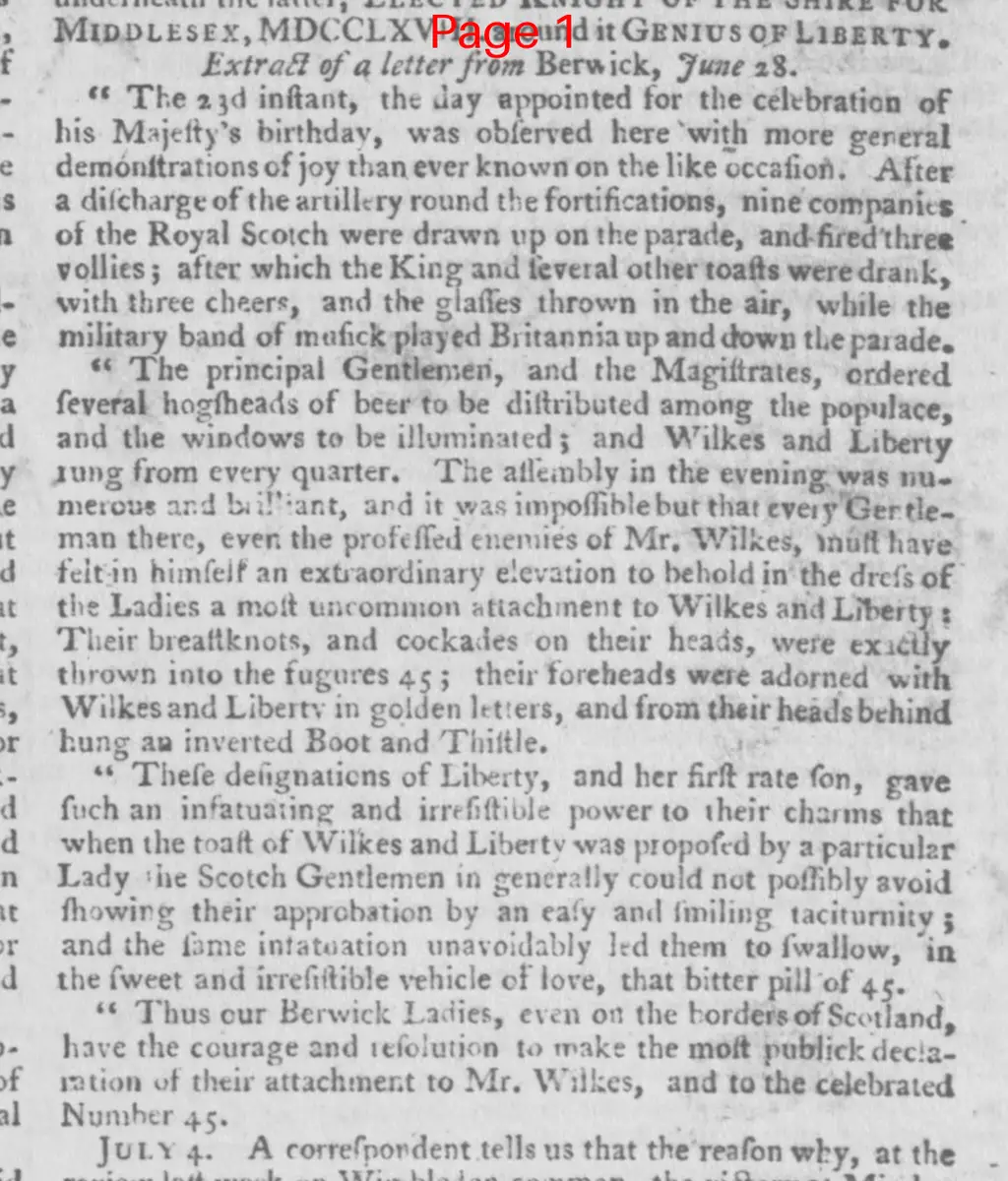
The number turns up again in the Boston repeal celebrations, and in a London shoemaker's window in Cheapside "where were exactly 45 lights" (read it).
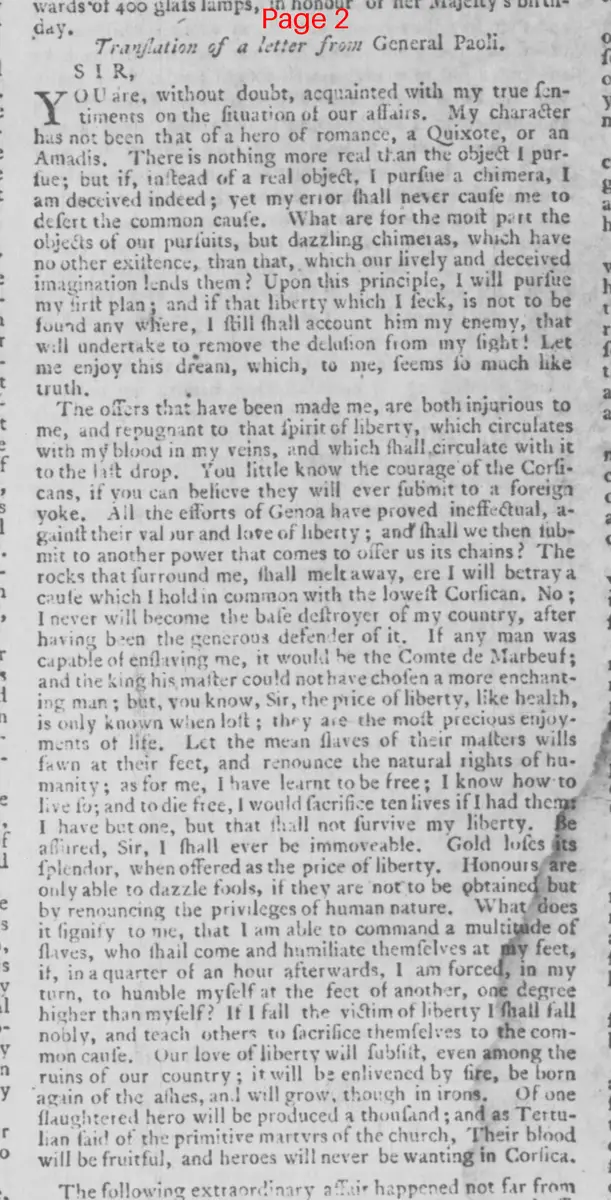
The other hero was Pasquale Paoli, who had led Corsica's fight for independence from Genoa since 1755. In 1768 Genoa sold the island to France, and French troops arrived to take it. American papers followed the war closely ("Paoli stands firm to his tackle," the New Hampshire Gazette told readers in February 1769, read it), and in April The Virginia Gazette printed a letter from Paoli himself:
to die free, I would sacrifice ten lives if I had them: I have but one, but that shall not survive my liberty.
The French crushed the Corsican army at Ponte Novu that May, and Paoli escaped by sea, slipping past French patrols, and made his way to England (read it). A year earlier, at the Boston Sons of Liberty's anniversary dinner in August 1768, the toasts had already included both "Paschal Paoli and his brave Corsicans" and John Wilkes (read it).
Also in the 1760s
- In 1761, a "surprizing MONSTER, with a human Head, the Face like that of a Cow" was reported washed up in Portugal. (read it)
- In 1762, a report of two men killed by lightning came with a note from Franklin on why a wet animal survives a shock that kills a dry one. (read it)
- In 1766, a whale crushed a whaleboat and killed the captain's son: "'Tis said the Whale was seen to take the unhappy Man into his Mouth." (read it)
Sources
The SNEWPapers links below provide the full transcription and metadata, as well as links to the original source material at the Library of Congress and to PDFs of the original pages:
- The New Hampshire Gazette, 1762-09-10, New Hampshire, p. 2
- The New Hampshire Gazette, 1762-12-03, New Hampshire, pp. 2, 3
- The New-Hampshire Gazette and Historical Chronicle, 1763-10-07, New Hampshire, p. 4
- The New-Hampshire Gazette and Historical Chronicle, 1764-01-27, New Hampshire, p. 2
- The New-Hampshire Gazette and Historical Chronicle, 1764-03-09, New Hampshire, p. 2
- The New-Hampshire Gazette and Historical Chronicle, 1765-08-30, New Hampshire, p. 3
- The New-Hampshire Gazette and Historical Chronicle, 1765-10-11, New Hampshire, p. 3
- The New-Hampshire Gazette and Historical Chronicle, 1765-12-27, New Hampshire, p. 2
- The New-Hampshire Gazette and Historical Chronicle, 1766-05-30, New Hampshire, p. 4
- The New-Hampshire Gazette and Historical Chronicle, 1768-10-07, New Hampshire, p. 3
- The Virginia Gazette, 1768-12-01, Virginia, p. 2
- The Virginia Gazette, 1768-09-22, Virginia, p. 1
- The Virginia Gazette, 1766-04-25, Virginia, p. 2
- The New-Hampshire Gazette and Historical Chronicle, 1769-02-17, New Hampshire, p. 3
- The Virginia Gazette, 1769-04-06, Virginia, p. 2
- The Virginia Gazette, 1769-09-14, Virginia, p. 2
- The New-Hampshire Gazette and Historical Chronicle, 1768-08-26, New Hampshire, pp. 2, 3
- The New Hampshire Gazette, 1761-02-06, New Hampshire, p. 1
- The New Hampshire Gazette, 1762-07-09, New Hampshire, p. 2
- The New-Hampshire Gazette and Historical Chronicle, 1766-10-03, New Hampshire, p. 2