November 2, 2026 · 12 min read
The 1770s: Revolution, as it was reported
Contents
Part of Decade by Decade: History as the Newspapers Told It, a series on the big stories of each decade as the newspapers reported them.
All source materials for this post were acquired using SNEWPapers. We are in the process of the most accurate extraction, in terms of correct segmentation and textual accuracy, of the Library of Congress' Chronicling America collection ever conducted. You can track our progress here. This post is a demonstration of what you can find using our tools. Connect your Grok, ChatGPT, Claude and more today to our vast database and research whatever you're interested in (and hopefully share it with the rest of us!). What would've taken you a year yesterday, is possible in a few hours with SNEWPapers today. Estimates put the total count of historical newspaper pages at over a billion for U.S. Newspapers alone, with 25+ million sitting in the Library of Congress. By and large, nobody knows what's in them... until now
You may have heard of these events before, but you're likely one of the first people in generations to read these articles again
The 1770s opened with the Boston Massacre and closed with the colonies six years into a war for independence. It's the decade every American knows the outline of. What the papers add is the view from inside it: the first breathless reports, the rumours that turned out to be wrong, the weeks it took for news to travel from Boston to Williamsburg, and the papers taking sides as openly as any pamphlet.
The Boston Massacre
British regiments had been quartered in Boston since 1768, and relations between soldiers and townspeople were poisonous. On the night of March 5, 1770, a crowd surrounded a sentry outside the Custom House on King Street, throwing snowballs and insults. Captain Thomas Preston brought up a squad of the 29th Regiment, and in the confusion the soldiers fired into the crowd. Five men died, among them Crispus Attucks, a sailor of African and Native descent. The town forced the troops out to Castle William within days.
The New-Hampshire Gazette printed a full account on March 16, naming every dead and wounded man:
the Captain commanded them to fire, and more snow-balls coming, he again said, Damn you, Fire, be the consequence what it will!
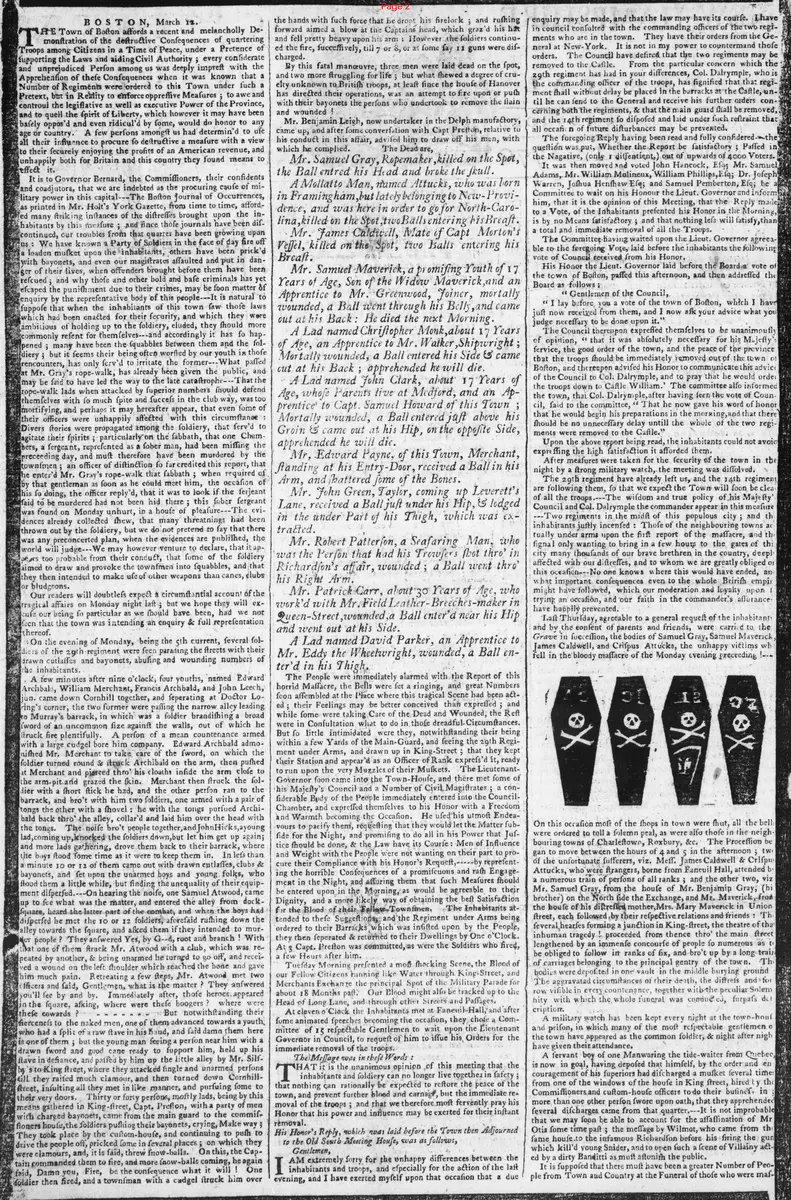
That June the paper reprinted Preston's own account from London, in which he insists he shouted "Don't fire, stop your Firing" and quotes the crowd's taunts: "come on you Rascals, you bloody Backs, you Lobster Scoundrels; fire if you dare" (read it). Another item claimed soldiers had boasted beforehand that "the streets of Boston would flow with blood on the 5th of March" (read it). At trial that autumn, defended by John Adams, Preston and six of his men were acquitted; two were convicted of manslaughter and branded on the thumb.
The Regulators
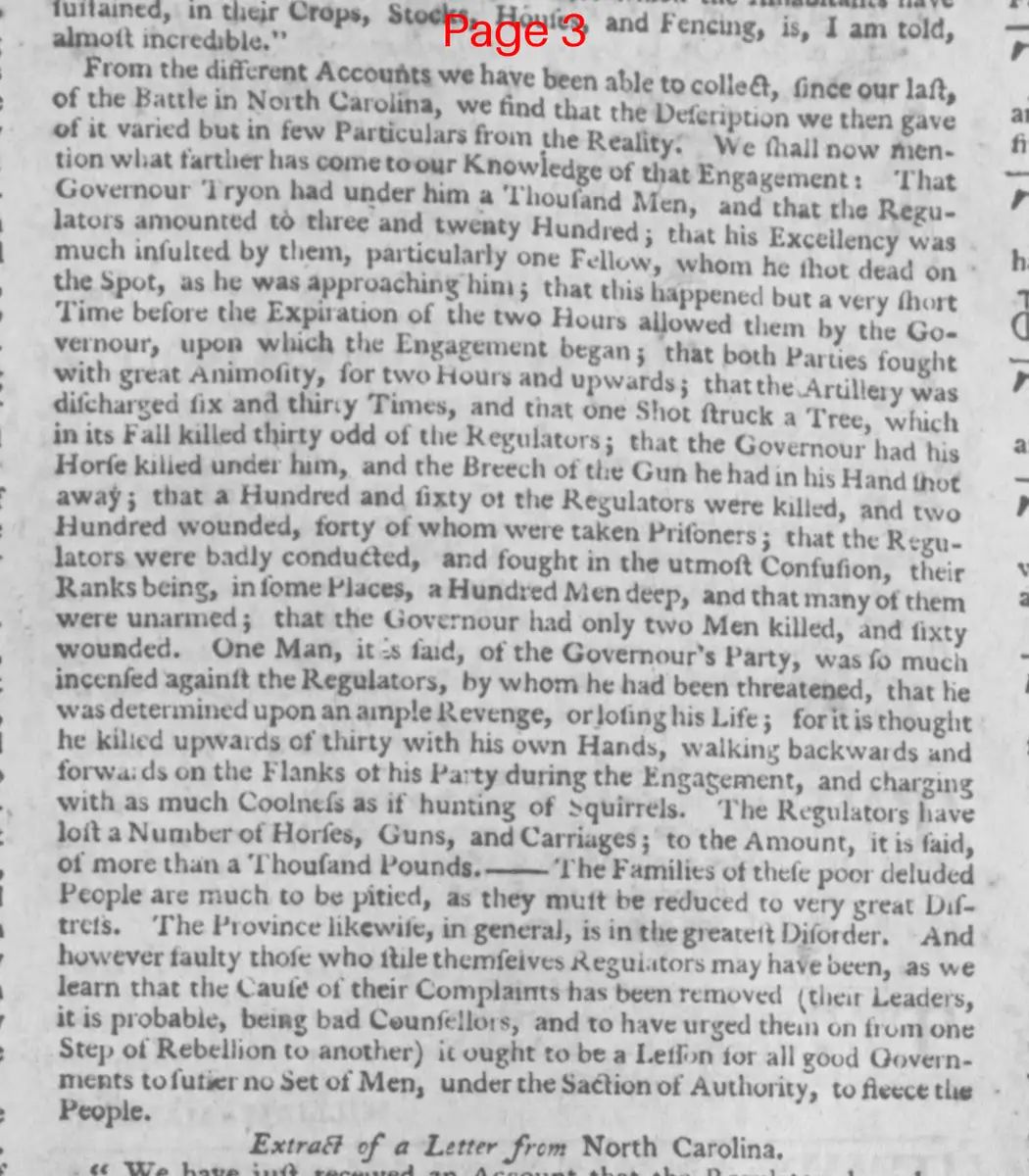
In the North Carolina backcountry, farmers who called themselves Regulators had spent years petitioning against corrupt sheriffs and the fees charged by colonial officials. In September 1770 a crowd broke up the court at Hillsborough and beat the lawyer and official Edmund Fanning (read the report, which is graphic). The next May, Governor William Tryon marched the militia against them, and at Alamance Creek on May 16, 1771, his roughly one thousand men routed a much larger force of Regulators. The Virginia Gazette printed the victors' version, with some dubious details:
one Shot struck a Tree, which in its Fall killed thirty odd of the Regulators.
Six Regulators were hanged. One of them, Benjamin Merrill, spoke from the gallows: "in a few moments I shall leave behind me a wife and ten children to a wicked and censorious world" (read it).
"The very Air he breathed"
James Somerset was an enslaved man brought to London by his owner, Charles Stewart, a customs official from Boston. In 1771 he escaped, was recaptured, and was put aboard a ship bound for Jamaica to be sold. Abolitionists brought a writ of habeas corpus, and the case came before Lord Mansfield, the Lord Chief Justice. The Virginia Gazette, in a colony built on slavery, printed the argument of Somerset's counsel in June 1772:
any Slave, being once in England, the very Air he breathed made him a free Man
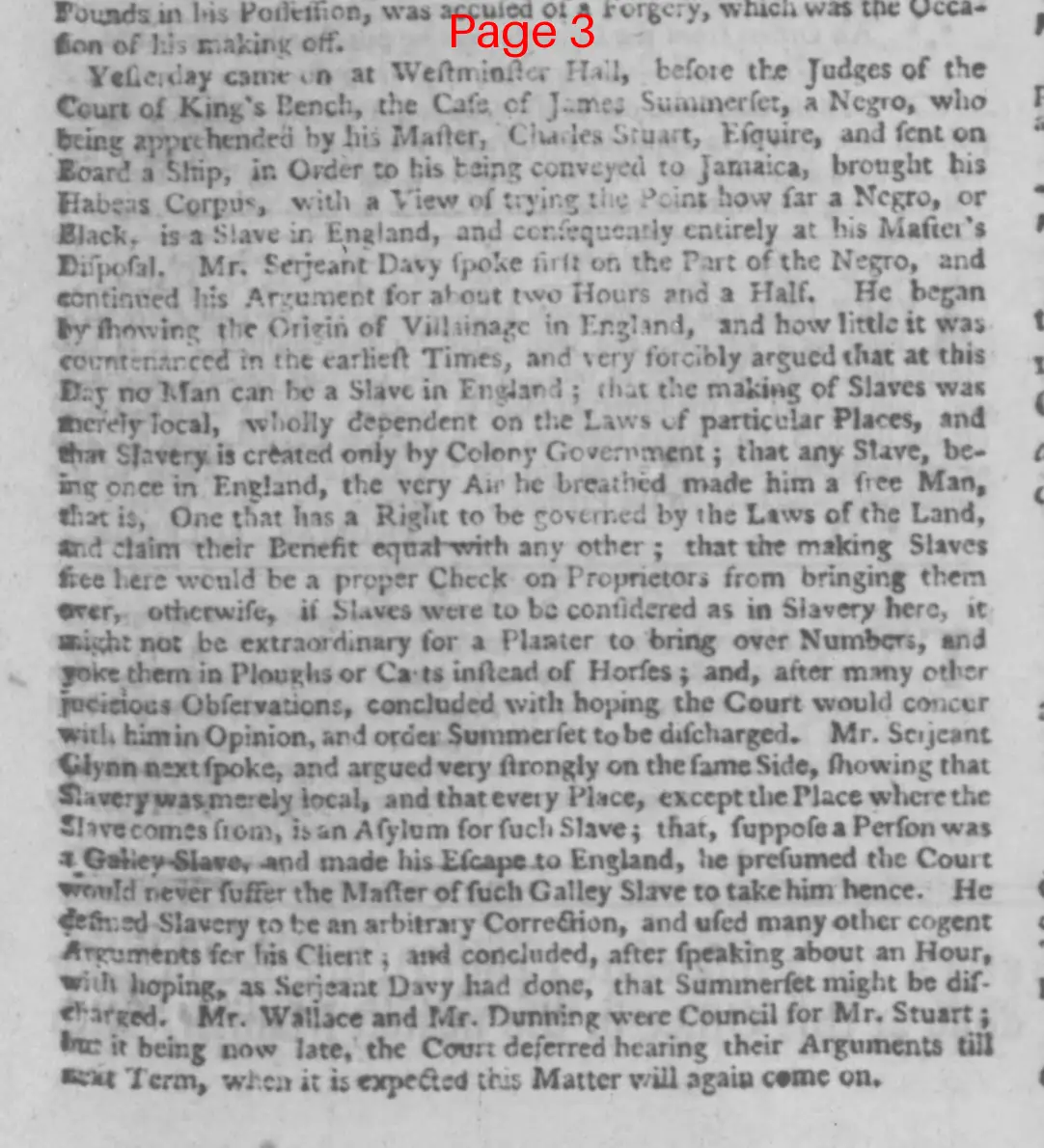
Mansfield ruled that Somerset could not be forced out of England. The judgment was narrower than many took it to be, but it was read on both sides of the Atlantic as the end of slavery in England. In September the same paper reported that "near two Hundred Blacks, with their Ladies, had an Entertainment at a publick House in Westminster, to celebrate the Triumph," where "Lord Mansfield's Health was echoed round the Room, and the Evening was concluded with a Ball" (read it).
A queen, a doctor and a coup in Denmark
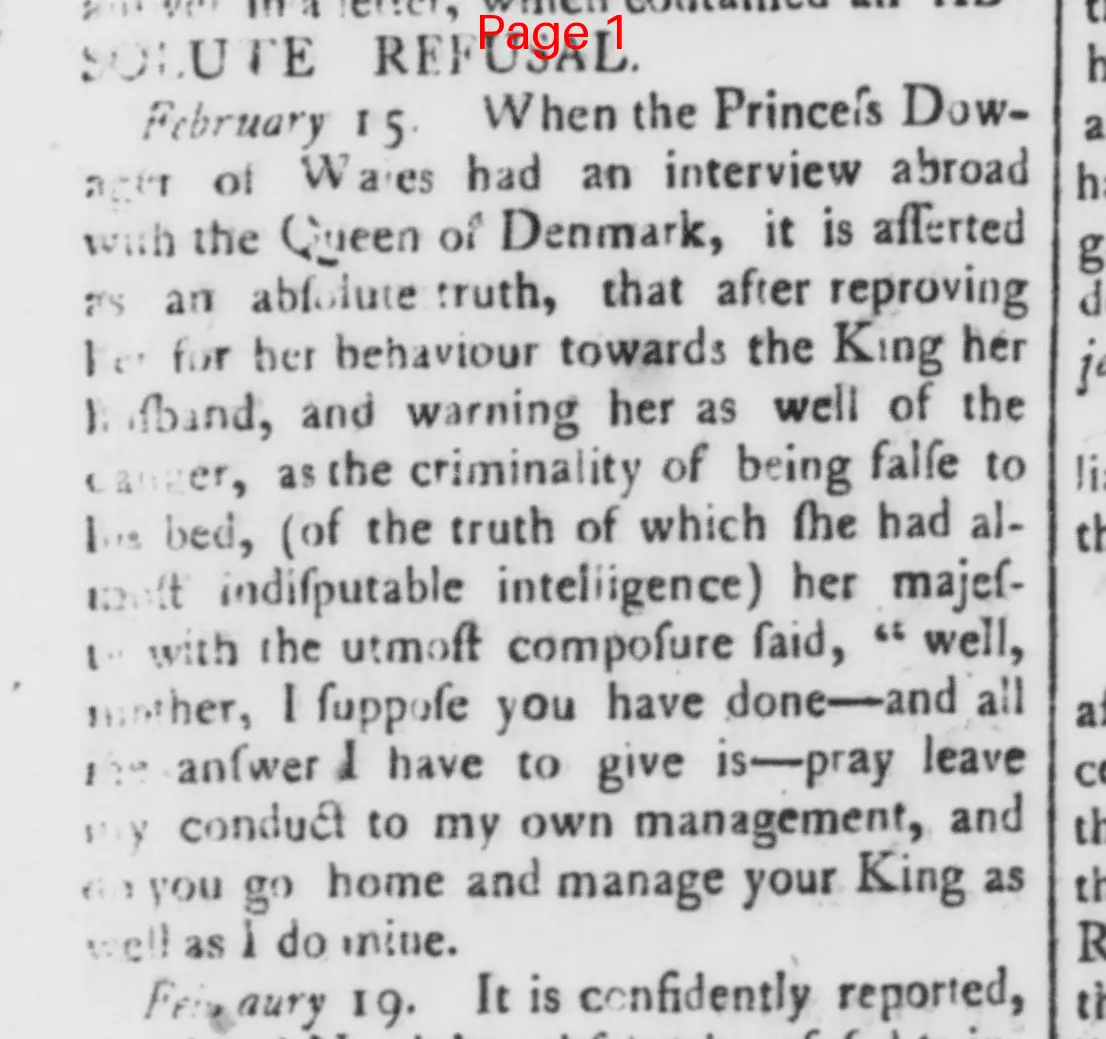
Not every big story was American. King George III's youngest sister, Caroline Matilda, had been married at fifteen to Christian VII of Denmark, who was mentally ill. His German doctor, Johann Friedrich Struensee, became the queen's lover and for over a year ran the kingdom. In January 1772 a palace coup after a masked ball arrested them both. The colonial papers followed it like a serial. The Massachusetts Spy printed an exchange, "asserted as an absolute truth," between the queen and her mother, who had warned her about her conduct:
pray leave my conduct to my own management, and do you go home and manage your King as well as I do mine.
Struensee was executed that April (read it; graphic). The queen was divorced and exiled, and the New-Hampshire Gazette printed a letter attributed to her: "were I in England, my dear country, where the meanest criminal has the privilege of being tried by his Peers !" (read it). She died in exile in 1775, at twenty-three.
The burning of the Gaspee
HMS Gaspee patrolled Narragansett Bay hunting smugglers, and her commander, Lieutenant William Dudingston, was hated for stopping and searching every vessel he could. On June 9, 1772, chasing a packet boat, the Gaspee ran aground near Providence. That night men from the town rowed out, boarded her, shot Dudingston, put the crew ashore and burned the ship. The first report in the New-Hampshire Gazette is precise about the wound:
the Ball went thro' his wrist, as his hand was hanging down his side, and lodged in his groin.
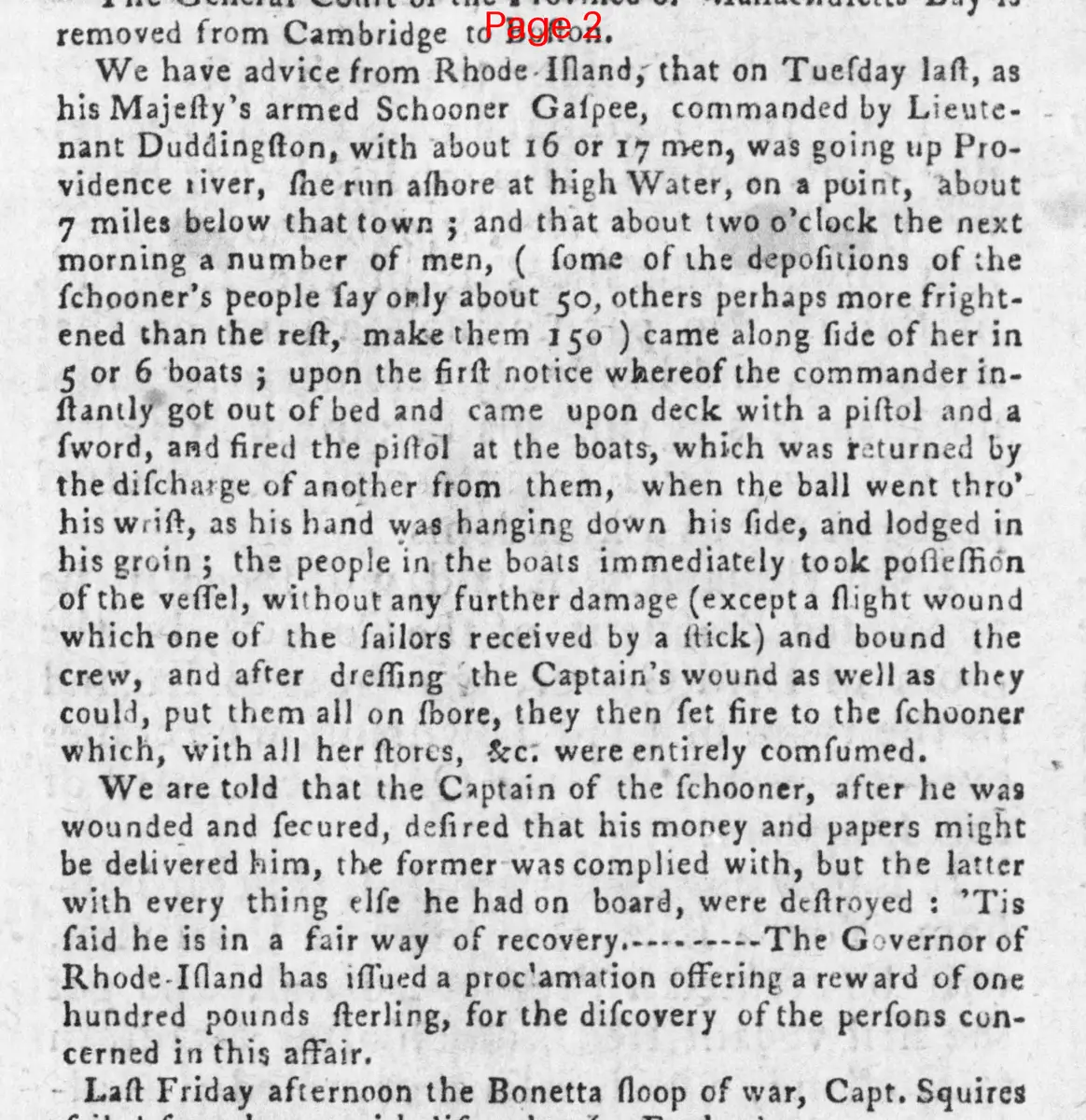
Months later the papers filled in why the town hated him: he "swore the whole Colony could not get on board his vessel," and his crew were accused of "stealing sheep, hogs, poultry, &c. from the farmers round the bay" (read it). A royal commission was sent with power to ship suspects to England for trial. No one was ever named, but the threat alarmed every colony, and committees of correspondence sprang up to coordinate their response.
Tea in the harbour
The Tea Act of 1773 let the East India Company ship tea straight to American ports. It actually made tea cheaper, but it kept the tax Parliament had laid on it, and the colonies saw it as a trap. When the first ships reached Boston, a broadside called the town to meeting: "Friends! Brethren! Countrymen! THAT worst of Plagues the detestable TEA ... is now arrived in this Harbour" (read it). On December 16, when the governor refused to let the ships leave with their cargo, men disguised as Mohawks boarded three of them and dumped 342 chests into the harbour. An express rider carried the news to New York, and The Virginia Gazette printed the letter in January:
every Ounce of the Teas on Board the Captains Hall, Bruce, and Coffin, was immersed in the Bay, without the least Injury to private Property.
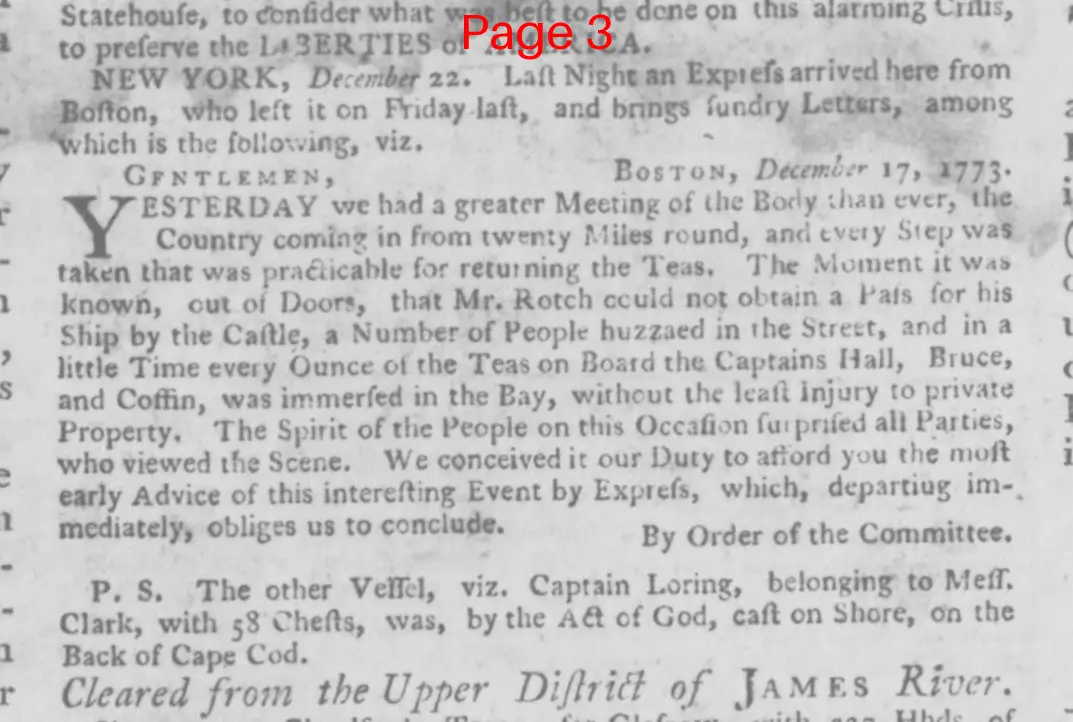
A fourth tea ship, the letter adds, "was, by the Act of God, cast on Shore, on the Back of Cape Cod." Parliament's answer in 1774 was to close the port of Boston until the tea was paid for.
1775: Lexington, Concord and Bunker Hill
Before dawn on April 19, 1775, General Gage sent troops from Boston to seize militia stores at Concord. At Lexington they met a company of militia on the green, and shots were fired. Eight Americans died. The column went on to Concord, then fought its way back to Boston under fire the whole way. The next morning in Portsmouth, the New-Hampshire Gazette had the news by express:
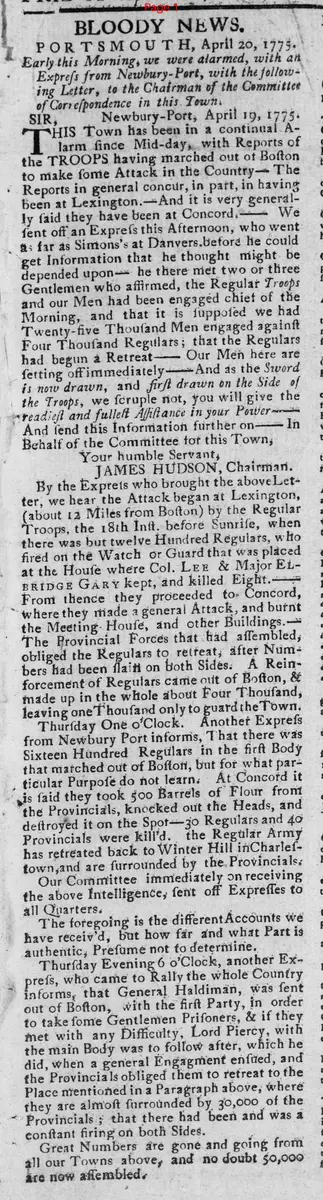
Its first report put "Twenty-five Thousand Men engaged against Four Thousand Regulars," a wild overestimate. A week later, a Salem account had the British officer at Lexington shouting "Disperse you Rebels---Damn you, throw down your Arms and disperse" (read it). In May the paper printed captured letters from British soldiers in the besieged town, one boasting to a friend that he "may have a Wife in every House he comes to, for the Women are left at Home while the Men goes to fight the Soldiers" (read it).
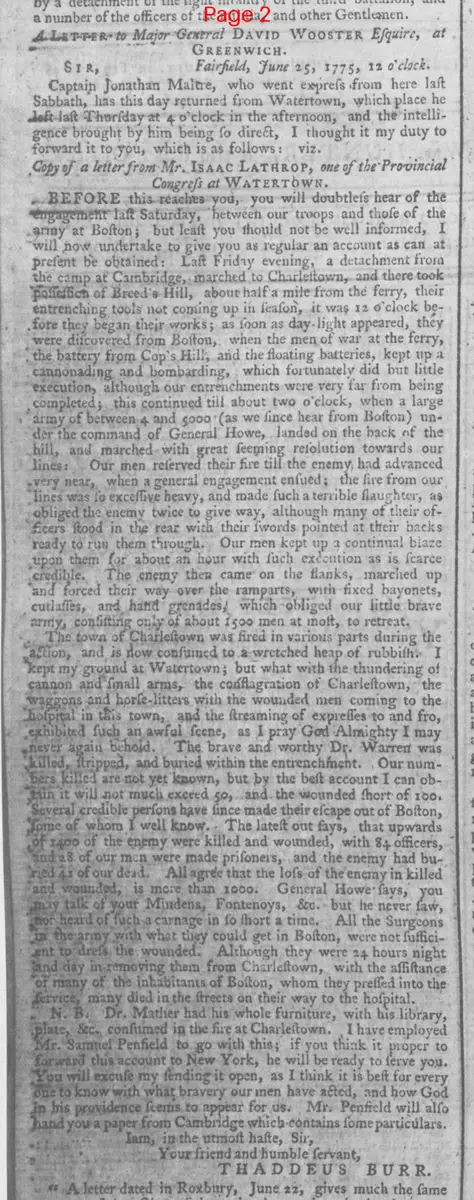
On June 17 the British attacked the American fortifications on the Charlestown peninsula, on Breed's Hill and Bunker Hill. They took the hill on the third assault, at a cost of more than a thousand killed and wounded. The first account in the New-Hampshire Gazette came from a man who had escaped Boston, and already named the most famous American dead: "Major General WARREN, late President of the Provincial Congress, is among the Slain" (read it). Virginia had its fullest account on July 15:
General Howe says, you may talk of your Mindens, Fontenoys, &c. but he never saw, nor heard of such a carnage in so short a time.
Lord Dunmore's Virginia
In Virginia the break came through the governor, Lord Dunmore. The day after Lexington, before anyone in Virginia knew of it, he had marines carry the colony's gunpowder out of the Williamsburg magazine in "his Excellency the Governor's Waggon," promising that "whenever it was wanted, on any Insurrection, it should be delivered in Half an Hour" (read it). By June he had fled to a warship. In November he declared martial law and offered freedom to enslaved people who left rebel masters to fight for the King. Hundreds did. The Virginia Gazette printed the proclamation alongside a reply addressed directly to them:
Be not then, ye Negroes, tempted by this proclamation to ruin yourselves.
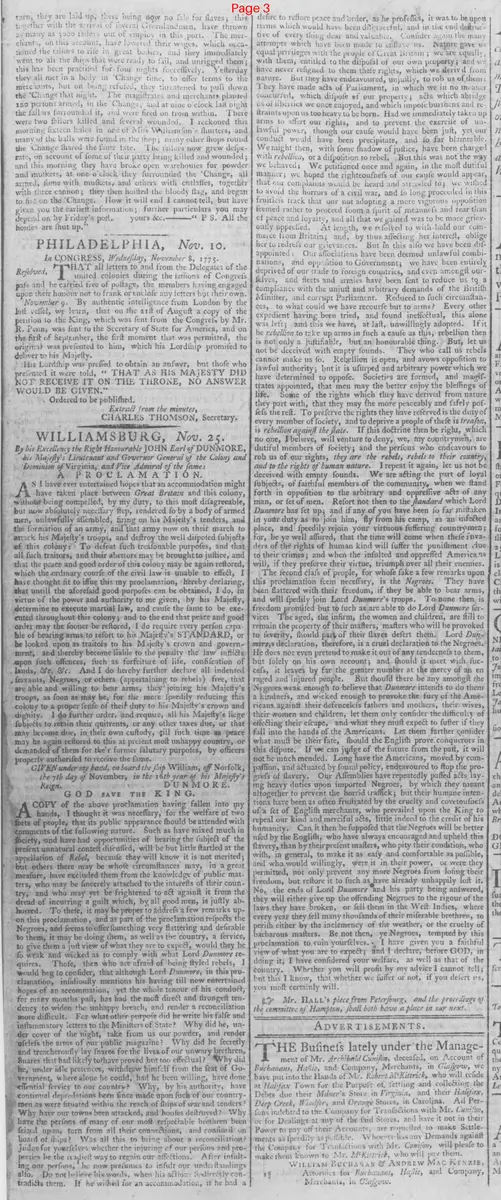
In December Dunmore's troops were beaten at Great Bridge. Colonel Woodford wrote that it was "a second Bunker's Hill affair, in miniature; with this difference, that we kept our post" (read it). On New Year's Day 1776 Dunmore's ships shelled Norfolk, and between them and the patriot troops the town burned.
The Declaration
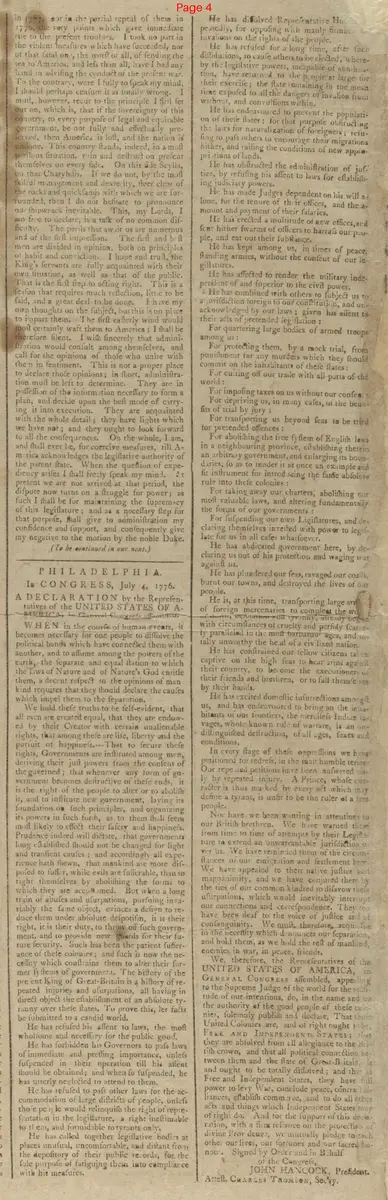
Congress voted for independence on July 2, 1776, and approved the Declaration on July 4. There was no wire to carry it. It spread by rider and by print, and each town read it aloud on its own day. The New York Packet printed the full text on July 11:
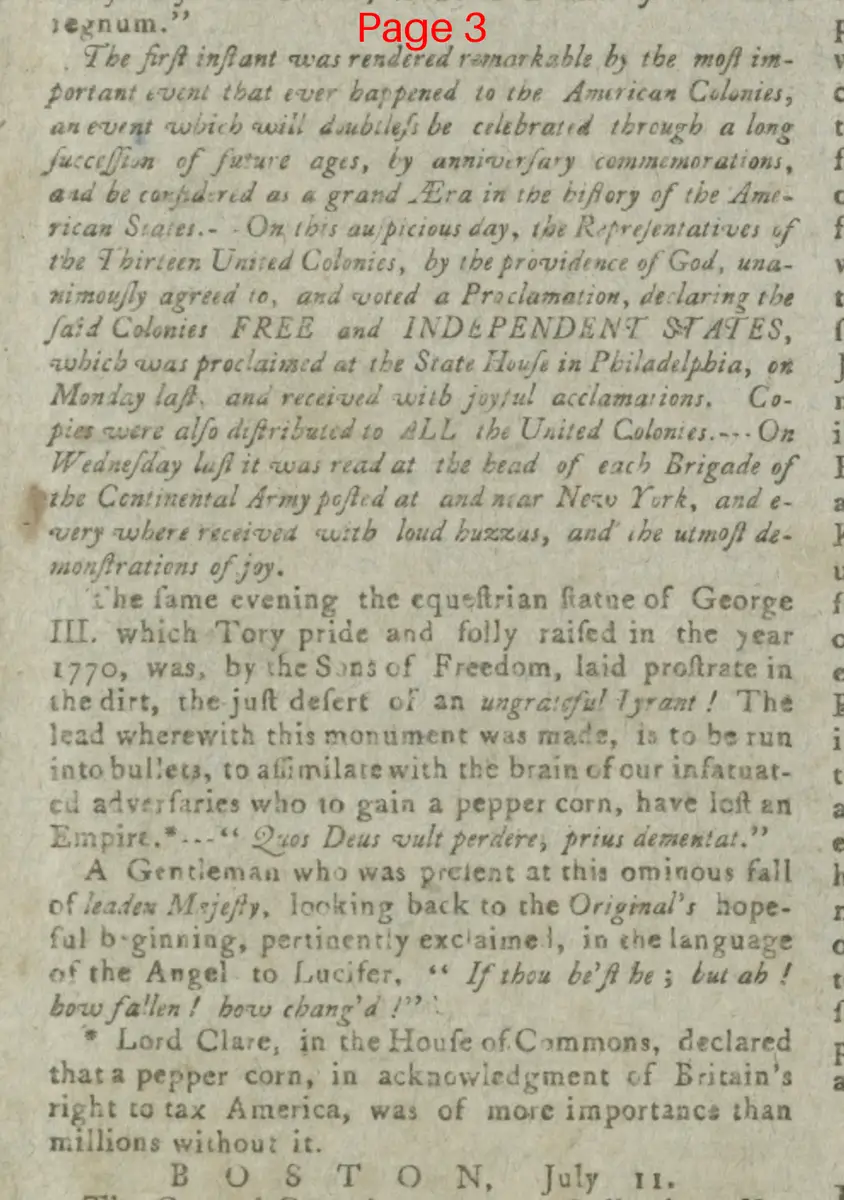
In New York, after the Declaration was read to the army on July 9, a crowd pulled down the gilded lead statue of George III on Bowling Green. The Connecticut Courant reported that "The lead wherewith this monument was made, is to be run into bullets":
Boston heard it read from the State House balcony on July 18, with "three Huzzas from a great Concourse of People" and a toast to "The downfall of Tyrants and Tyranny" (read it).
Trenton
By December 1776 the war was going badly. Washington's army had been driven out of New York and across New Jersey into Pennsylvania, and enlistments were running out. Thomas Paine's The American Crisis ("These are the times that try men's souls") appeared that month, and The Virginia Gazette printed it in January (read it). On the night of December 25, Washington took his army back across the icy Delaware and surprised the Hessian garrison at Trenton the next morning, taking about nine hundred prisoners. A week later he won again at Princeton. His own report to Congress reached The Virginia Gazette by January 10 (read it), but the soldiers' letters are livelier:
luckily they found some Hogheads of Rum at Trenton, large Draughts of which alone preserved the Lives of many.
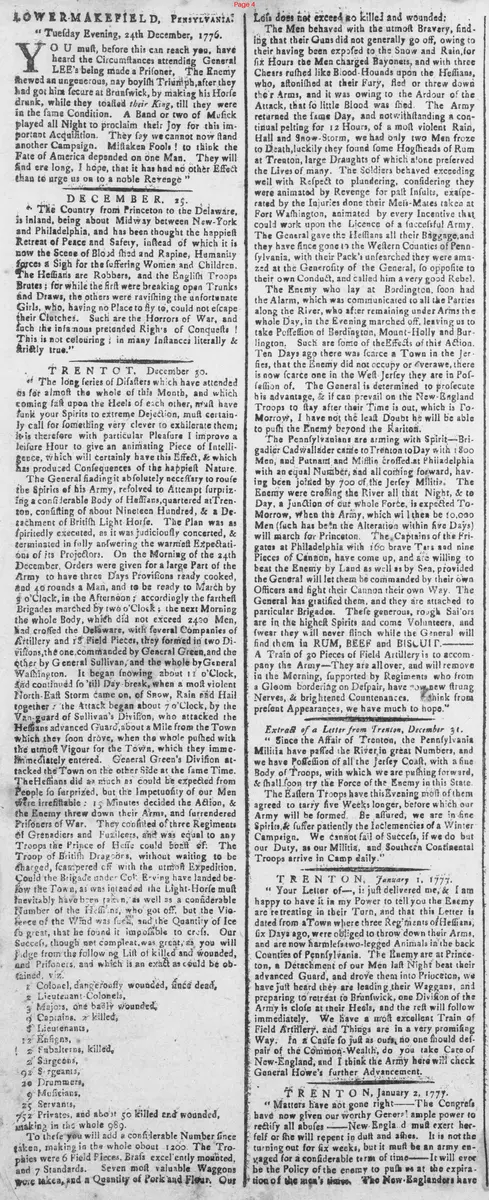
The same letter says the captured Hessians were so surprised by their treatment that they "called him a very good Rebel."
Saratoga
In 1777 General John Burgoyne marched south from Canada to cut New England off from the other colonies. He took Fort Ticonderoga in July, then bogged down in the forests. The killing of a young woman named Jane McCrea by Native warriors attached to his army became the American propaganda story of the campaign (read it; graphic). After two battles near Saratoga, Burgoyne surrendered his whole army on October 17. The victory persuaded France to enter the war on the American side early the next year.
Along the way the papers printed one of the war's small spy stories. A letter from a Loyalist agent, Peter Livius, offering General John Sullivan a reward to change sides, was intercepted at Fort Edward:
This letter was taken out of a canteen with a false bottom
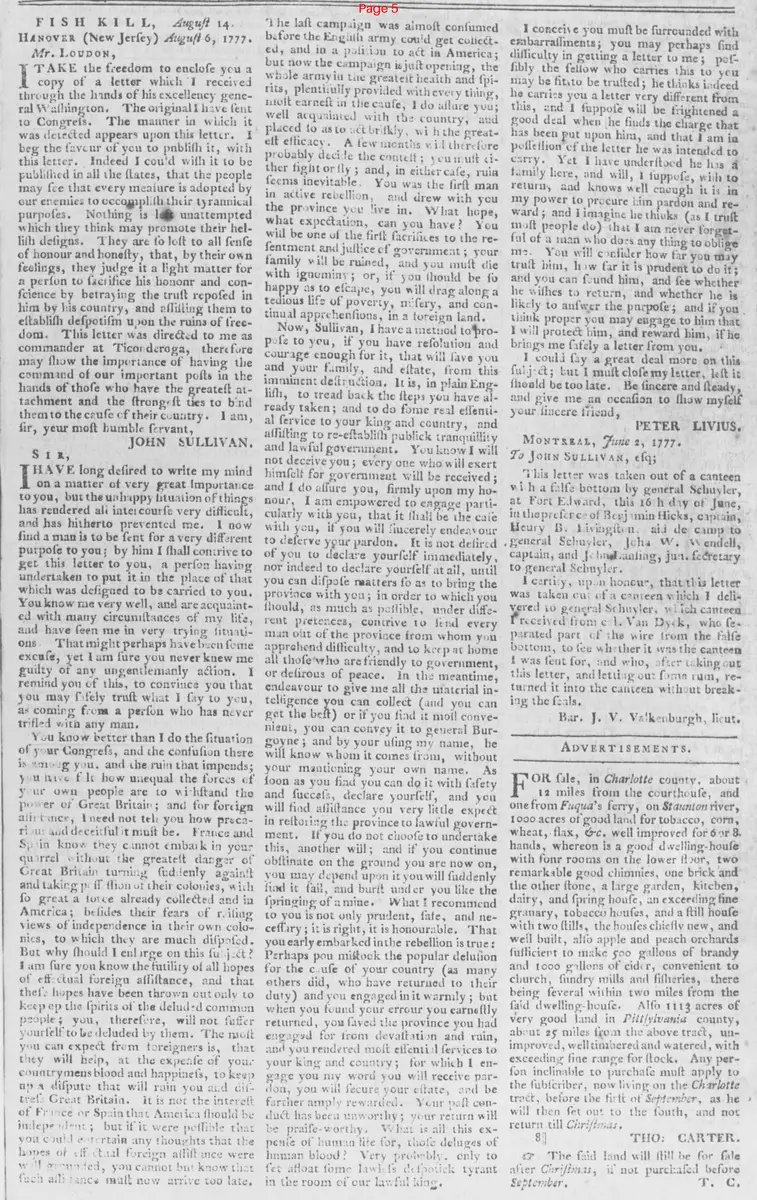
Sullivan sent it to the papers himself, asking that it "be published in all the states."
Also in the 1770s
- In 1771 a whale off Nantucket "bit the boat in two, took said Jenkins in her mouth, and went down with him," then spat him out alive. (read it)
- In 1772 Hingham had a "young Giant" who "has five fingers and a thumb on each hand, and six toes on each foot." (read it)
- In 1773 the New Hampshire paper reported that "the city of Guatemala was sunk by an earthquake, and upwards of 90,000 souls perished." The earthquake was real; the death toll was a wild exaggeration. (read it)
- Five whalemen marooned beside a dead whale survived by "feeding on such parts of the raw flesh, as they could come at with their knives." (read it)
Sources
The SNEWPapers links below provide the full transcription and metadata, as well as links to the original source material at the Library of Congress and to PDFs of the original pages:
- The New-Hampshire Gazette and Historical Chronicle, 1770-03-16, New Hampshire, pp. 2, 3
- The New-Hampshire Gazette and Historical Chronicle, 1770-06-29, New Hampshire, p. 1
- The New-Hampshire Gazette and Historical Chronicle, 1770-06-22, New Hampshire, p. 2
- The Virginia Gazette, 1770-10-25, Virginia, p. 2
- The Virginia Gazette, 1771-06-06, Virginia, p. 3
- The New-Hampshire Gazette and Historical Chronicle, 1771-11-08, New Hampshire, p. 2
- The Virginia Gazette, 1772-06-04, Virginia, p. 3
- The Virginia Gazette, 1772-09-03, Virginia, p. 1
- The Massachusetts Spy, 1772-04-09, Massachusetts, p. 1
- The Virginia Gazette, 1772-07-16, Virginia, p. 3
- The New-Hampshire Gazette and Historical Chronicle, 1772-08-14, New Hampshire, p. 2
- The New-Hampshire Gazette and Historical Chronicle, 1772-06-19, New Hampshire, p. 2
- The New-Hampshire Gazette and Historical Chronicle, 1773-02-05, New Hampshire, p. 2
- The New-Hampshire Gazette and Historical Chronicle, 1773-12-03, New Hampshire, p. 1
- The Virginia Gazette, 1774-01-06, Virginia, p. 3
- The New-Hampshire Gazette and Historical Chronicle, 1775-04-21, New Hampshire, p. 1
- The New-Hampshire Gazette and Historical Chronicle, 1775-04-28, New Hampshire, p. 2
- The New-Hampshire Gazette and Historical Chronicle, 1775-05-19, New Hampshire, p. 3
- The New-Hampshire Gazette and Historical Chronicle, 1775-07-04, New Hampshire, p. 2
- The Virginia Gazette, 1775-07-15, Virginia, p. 2
- The New-Hampshire Gazette and Historical Chronicle, 1775-05-26, New Hampshire, p. 4
- The Virginia Gazette, 1775-11-25, Virginia, p. 3
- The Virginia Gazette, 1775-12-15, Virginia, p. 2
- The New York Packet, and the American Advertiser, 1776-07-11, New York, p. 4
- The Connecticut Courant and Hartford Weekly Intelligencer, 1776-07-15, Connecticut, p. 3
- The Boston Gazette, Or, Country Journal, 1776-07-22, Massachusetts, p. 3
- The Virginia Gazette, 1777-01-10, Virginia, pp. 1, 2
- The Virginia Gazette, 1777-01-10, Virginia, pp. 3, 4
- The Freeman's Journal, Or, New-Hampshire Gazette, 1777-01-21, New Hampshire, p. 4
- The Virginia Gazette, 1777-08-29, Virginia, p. 2
- The Virginia Gazette, 1777-09-05, Virginia, p. 5
- The Massachusetts Spy, 1771-10-10, Massachusetts, p. 2
- The New-Hampshire Gazette and Historical Chronicle, 1772-12-11, New Hampshire, p. 3
- The New-Hampshire Gazette and Historical Chronicle, 1773-11-19, New Hampshire, p. 1
- The New-Hampshire Gazette and Historical Chronicle, 1773-04-09, New Hampshire, pp. 1, 2