October 14, 2026 · 7 min read
Flight, Fear and Thunderbolts: 1793's Yellow Fever Epidemic in Real Time
Contents
All source materials for this post were acquired using SNEWPapers. We are in the process of the most accurate extraction, in terms of correct segmentation and textual accuracy, of the Library of Congress' Chronicling America collection ever conducted. You can track our progress here. This post is a demonstration of what you can find using our tools. Connect your Grok, ChatGPT, Claude and more today to our vast database and research whatever you're interested in (and hopefully share it with the rest of us!). What would've taken you a year yesterday, is possible in a few hours with SNEWPapers today. Estimates put the total count of historical newspaper pages at over a billion for U.S. Newspapers alone, with 25+ million sitting in the Library of Congress. By and large, nobody knows what's in them... until now
You may have heard of these events before, but you're likely one of the first people in generations to read these articles again
Don't Panic!
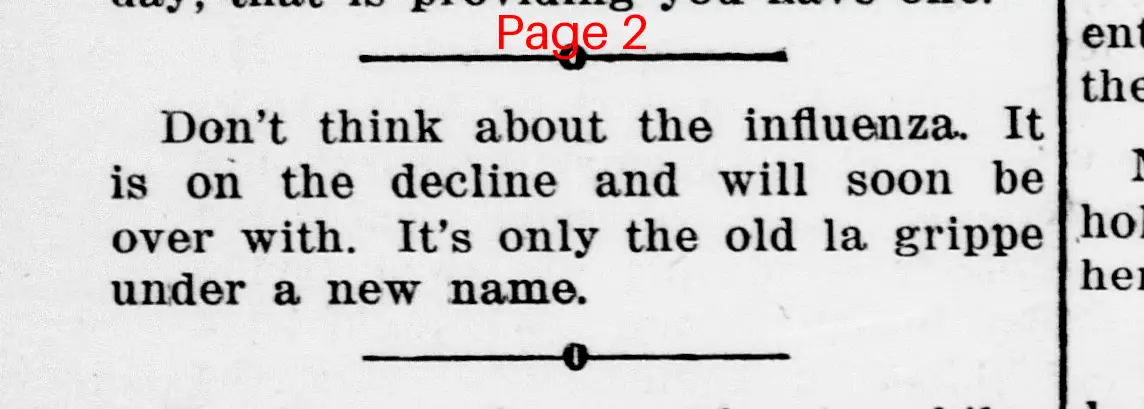
That was the whole item, a filler of three sentences. Just before the peak of the Spanish Flu!
The shape of panic
News and editorials (domestic, local and foreign news, editorials) carry most of the coverage, so measuring against them shows how much of the news an outbreak took up. We do not have all of Chronicling America yet, and Chronicling America does not have all U.S. papers, but the bars are normalized to mentions of the disease per 1,000 components (of the abovementioned variety) that month, so a spike is a genuine signal.
Data is a bit sparse at the moment for 1918 Influenza, but should fill in soon.
Counts are from 2026-10-16 (the dataset is growing daily).
The shape each time echoes eerily: near silence followed by an exponential rise, usually around late summer and a long tail, with follow-up waves.
Mentions of "fever" alongside yellow, malignant or pestilential, per 1,000 news and editorial items in the index that month, 1792–1795; 171 items in all. The epidemic reached Philadelphia in August 1793.
Show data
| Per 1,000 news items | News items | |
|---|---|---|
| Jan 1792 | 0 | 0 |
| Feb 1792 | 2.9 | 1 |
| Mar 1792 | 0 | 0 |
| Apr 1792 | 0 | 0 |
| May 1792 | 6.8 | 3 |
| Jun 1792 | 3.9 | 2 |
| Jul 1792 | 1.5 | 1 |
| Aug 1792 | 5.7 | 3 |
| Sep 1792 | 9.1 | 5 |
| Oct 1792 | 0 | 0 |
| Nov 1792 | 0 | 0 |
| Dec 1792 | 4.3 | 2 |
| Jan 1793 | 2.4 | 1 |
| Feb 1793 | 0 | 0 |
| Mar 1793 | 0 | 0 |
| Apr 1793 | 5.7 | 3 |
| May 1793 | 0 | 0 |
| Jun 1793 | 0 | 0 |
| Jul 1793 | 0 | 0 |
| Aug 1793 | 0 | 0 |
| Sep 1793 | 69.7 | 29 |
| Oct 1793 | 55.7 | 18 |
| Nov 1793 | 35.9 | 7 |
| Dec 1793 | 23.7 | 4 |
| Jan 1794 | 12.5 | 4 |
| Feb 1794 | 0 | 0 |
| Mar 1794 | 5.1 | 2 |
| Apr 1794 | 5.4 | 3 |
| May 1794 | 3.9 | 2 |
| Jun 1794 | 2.7 | 1 |
| Jul 1794 | 13.9 | 7 |
| Aug 1794 | 5.9 | 2 |
| Sep 1794 | 22.4 | 10 |
| Oct 1794 | 21.4 | 13 |
| Nov 1794 | 8.2 | 4 |
| Dec 1794 | 0 | 0 |
| Jan 1795 | 2.4 | 1 |
| Feb 1795 | 0 | 0 |
| Mar 1795 | 0 | 0 |
| Apr 1795 | 18.6 | 8 |
| May 1795 | 8.9 | 4 |
| Jun 1795 | 1.8 | 1 |
| Jul 1795 | 10.5 | 2 |
| Aug 1795 | 36 | 8 |
| Sep 1795 | 42.3 | 8 |
| Oct 1795 | 64.3 | 9 |
| Nov 1795 | 18.8 | 3 |
| Dec 1795 | 0 | 0 |
Mentioning "cholera", per 1,000 news and editorial items in the index that month, 1831–1835; 1,219 items in all. Cholera reached New York in June 1832.
Show data
| Per 1,000 news items | News items | |
|---|---|---|
| Jan 1831 | 4.3 | 2 |
| Feb 1831 | 4.8 | 3 |
| Mar 1831 | 2.5 | 1 |
| Apr 1831 | 4 | 2 |
| May 1831 | 0 | 0 |
| Jun 1831 | 4.4 | 2 |
| Jul 1831 | 14.8 | 8 |
| Aug 1831 | 39.9 | 18 |
| Sep 1831 | 49.6 | 32 |
| Oct 1831 | 17.4 | 8 |
| Nov 1831 | 14.3 | 8 |
| Dec 1831 | 18 | 10 |
| Jan 1832 | 37.3 | 18 |
| Feb 1832 | 34.6 | 12 |
| Mar 1832 | 32.4 | 16 |
| Apr 1832 | 23.9 | 7 |
| May 1832 | 52.8 | 17 |
| Jun 1832 | 109 | 62 |
| Jul 1832 | 327.7 | 116 |
| Aug 1832 | 248.5 | 162 |
| Sep 1832 | 239.5 | 149 |
| Oct 1832 | 123.1 | 66 |
| Nov 1832 | 113.9 | 63 |
| Dec 1832 | 18.6 | 5 |
| Jan 1833 | 16.8 | 5 |
| Feb 1833 | 17 | 5 |
| Mar 1833 | 21.2 | 4 |
| Apr 1833 | 41.2 | 16 |
| May 1833 | 39 | 21 |
| Jun 1833 | 71 | 26 |
| Jul 1833 | 109.3 | 67 |
| Aug 1833 | 62.7 | 40 |
| Sep 1833 | 49.9 | 18 |
| Oct 1833 | 26.6 | 8 |
| Nov 1833 | 22.1 | 4 |
| Dec 1833 | 26.4 | 6 |
| Jan 1834 | 7.9 | 2 |
| Feb 1834 | 0 | 0 |
| Mar 1834 | 4.7 | 1 |
| Apr 1834 | 5 | 1 |
| May 1834 | 29.5 | 17 |
| Jun 1834 | 12.9 | 7 |
| Jul 1834 | 21.7 | 7 |
| Aug 1834 | 63.8 | 24 |
| Sep 1834 | 45.6 | 44 |
| Oct 1834 | 52.7 | 29 |
| Nov 1834 | 29.4 | 17 |
| Dec 1834 | 11.4 | 4 |
| Jan 1835 | 0 | 0 |
| Feb 1835 | 0 | 0 |
| Mar 1835 | 0 | 0 |
| Apr 1835 | 7.8 | 2 |
| May 1835 | 9 | 9 |
| Jun 1835 | 23.5 | 15 |
| Jul 1835 | 25.7 | 14 |
| Aug 1835 | 16 | 9 |
| Sep 1835 | 15.3 | 7 |
| Oct 1835 | 2.3 | 1 |
| Nov 1835 | 1.9 | 1 |
| Dec 1835 | 2.8 | 1 |
Mentioning "cholera", per 1,000 news and editorial items in the index that month, 1848–1851; 621 items in all. Cholera spread through American cities in the spring and summer of 1849.
Show data
| Per 1,000 news items | News items | |
|---|---|---|
| Jan 1848 | 2.4 | 1 |
| Feb 1848 | 2.6 | 1 |
| Mar 1848 | 3.8 | 1 |
| Apr 1848 | 0 | 0 |
| May 1848 | 1.3 | 1 |
| Jun 1848 | 3.8 | 2 |
| Jul 1848 | 4.2 | 2 |
| Aug 1848 | 3.6 | 2 |
| Sep 1848 | 4 | 2 |
| Oct 1848 | 7.4 | 4 |
| Nov 1848 | 18.3 | 11 |
| Dec 1848 | 57.6 | 22 |
| Jan 1849 | 46.8 | 26 |
| Feb 1849 | 22 | 10 |
| Mar 1849 | 12.3 | 9 |
| Apr 1849 | 26.5 | 15 |
| May 1849 | 43.8 | 37 |
| Jun 1849 | 105.6 | 90 |
| Jul 1849 | 130.3 | 92 |
| Aug 1849 | 79.3 | 49 |
| Sep 1849 | 68.5 | 27 |
| Oct 1849 | 38 | 30 |
| Nov 1849 | 8.9 | 6 |
| Dec 1849 | 14.5 | 4 |
| Jan 1850 | 22.2 | 4 |
| Feb 1850 | 12 | 3 |
| Mar 1850 | 16.9 | 10 |
| Apr 1850 | 9.7 | 5 |
| May 1850 | 6.6 | 4 |
| Jun 1850 | 21.3 | 17 |
| Jul 1850 | 52.4 | 36 |
| Aug 1850 | 29.4 | 18 |
| Sep 1850 | 15.3 | 4 |
| Oct 1850 | 8.5 | 5 |
| Nov 1850 | 11.5 | 4 |
| Dec 1850 | 20.4 | 8 |
| Jan 1851 | 16.2 | 3 |
| Feb 1851 | 7.6 | 3 |
| Mar 1851 | 4 | 2 |
| Apr 1851 | 0 | 0 |
| May 1851 | 10.6 | 9 |
| Jun 1851 | 15.9 | 13 |
| Jul 1851 | 18.7 | 12 |
| Aug 1851 | 15.1 | 9 |
| Sep 1851 | 2.9 | 2 |
| Oct 1851 | 3.8 | 2 |
| Nov 1851 | 4.1 | 3 |
| Dec 1851 | 2.2 | 1 |
Mentioning the phrase "yellow fever", per 1,000 news and editorial items in the index that month, 1877–1880; 306 items in all. The Mississippi Valley epidemic began in August 1878.
Show data
| Per 1,000 news items | News items | |
|---|---|---|
| Jan 1877 | 1.6 | 1 |
| Feb 1877 | 0 | 0 |
| Mar 1877 | 0 | 0 |
| Apr 1877 | 0 | 0 |
| May 1877 | 0 | 0 |
| Jun 1877 | 1.7 | 1 |
| Jul 1877 | 0.8 | 1 |
| Aug 1877 | 0.7 | 1 |
| Sep 1877 | 4.1 | 5 |
| Oct 1877 | 8.1 | 6 |
| Nov 1877 | 2.3 | 2 |
| Dec 1877 | 1.6 | 1 |
| Jan 1878 | 0 | 0 |
| Feb 1878 | 0 | 0 |
| Mar 1878 | 1 | 1 |
| Apr 1878 | 0 | 0 |
| May 1878 | 0 | 0 |
| Jun 1878 | 0 | 0 |
| Jul 1878 | 1.9 | 2 |
| Aug 1878 | 25 | 25 |
| Sep 1878 | 85.8 | 72 |
| Oct 1878 | 37.3 | 23 |
| Nov 1878 | 14.1 | 13 |
| Dec 1878 | 12.3 | 11 |
| Jan 1879 | 0.9 | 1 |
| Feb 1879 | 7.9 | 5 |
| Mar 1879 | 5.6 | 8 |
| Apr 1879 | 4.9 | 3 |
| May 1879 | 5 | 3 |
| Jun 1879 | 7.5 | 9 |
| Jul 1879 | 27.5 | 26 |
| Aug 1879 | 34.5 | 42 |
| Sep 1879 | 13.3 | 12 |
| Oct 1879 | 5.4 | 5 |
| Nov 1879 | 4.6 | 3 |
| Dec 1879 | 5.6 | 2 |
| Jan 1880 | 1.9 | 2 |
| Feb 1880 | 2.6 | 2 |
| Mar 1880 | 0 | 0 |
| Apr 1880 | 0 | 0 |
| May 1880 | 4.6 | 5 |
| Jun 1880 | 1.9 | 2 |
| Jul 1880 | 3.1 | 3 |
| Aug 1880 | 1.3 | 1 |
| Sep 1880 | 2.3 | 3 |
| Oct 1880 | 6 | 3 |
| Nov 1880 | 0 | 0 |
| Dec 1880 | 1.3 | 1 |
Mentioning "influenza", per 1,000 news and editorial items in the index that month, 1917–1920; 64 items in all. The deadly autumn wave peaked in October 1918.
Show data
| Per 1,000 news items | News items | |
|---|---|---|
| Jan 1917 | 0 | 0 |
| Feb 1917 | 0 | 0 |
| Mar 1917 | 0 | 0 |
| Apr 1917 | 0 | 0 |
| May 1917 | 0 | 0 |
| Jun 1917 | 0 | 0 |
| Jul 1917 | 0 | 0 |
| Aug 1917 | 0 | 0 |
| Sep 1917 | 0 | 0 |
| Oct 1917 | 0 | 0 |
| Nov 1917 | 0 | 0 |
| Dec 1917 | 0 | 0 |
| Jan 1918 | 0 | 0 |
| Feb 1918 | 0 | 0 |
| Mar 1918 | 0 | 0 |
| Apr 1918 | 0 | 0 |
| May 1918 | 0 | 0 |
| Jun 1918 | 0 | 0 |
| Jul 1918 | 0 | 0 |
| Aug 1918 | 0 | 0 |
| Sep 1918 | 0 | 0 |
| Oct 1918 | 85.6 | 22 |
| Nov 1918 | 37.8 | 9 |
| Dec 1918 | 8.2 | 1 |
| Jan 1919 | 15.9 | 8 |
| Feb 1919 | 0 | 0 |
| Mar 1919 | 10.4 | 8 |
| Apr 1919 | 9.3 | 1 |
| May 1919 | 0 | 0 |
| Jun 1919 | 0 | 0 |
| Jul 1919 | 0 | 0 |
| Aug 1919 | 0 | 0 |
| Sep 1919 | 0 | 0 |
| Oct 1919 | 9.7 | 1 |
| Nov 1919 | 0 | 0 |
| Dec 1919 | 0 | 0 |
| Jan 1920 | 1.9 | 1 |
| Feb 1920 | 39.4 | 8 |
| Mar 1920 | 10.4 | 2 |
| Apr 1920 | 6.3 | 2 |
| May 1920 | 0 | 0 |
| Jun 1920 | 0 | 0 |
| Jul 1920 | 0 | 0 |
| Aug 1920 | 0 | 0 |
| Sep 1920 | 0 | 0 |
| Oct 1920 | 0 | 0 |
| Nov 1920 | 0 | 0 |
| Dec 1920 | 6.9 | 1 |
Philadelphia, 1793: yellow fever
What is yellow fever?
A mosquito-borne viral disease (yellow fever virus YFV). An RNA virus which infects humans primarily through the bite of an infected female.
In the late summer of 1793 Philadelphia (the temporary capital of the United States at the time), it swept through and claimed approximately 5,000 lives, or roughly 10% of the city's population of around 45,000-50,000. It is estimated that half the residents fled, including the Governor, and federal officials like President George Washington evacuating to Mount Vernon.
A timeline of eyewitness Accounts
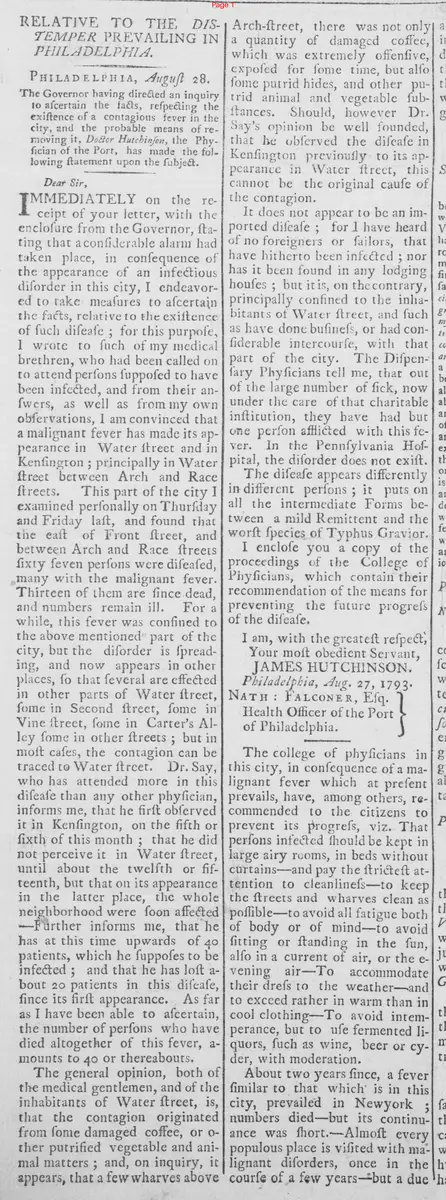
One of the earliest accounts I can find so far, printed in the New Hampshire Gazette, from before they knew what they were dealing with:
a considerable alarm had taken place, in consequence of the appearance of an infectious disorder in this city ... I am convinced that a malignant fever has made its appearance in Water street and in Kensington ... the disorder is spreading, and now appears in other places, so that several are affected in other parts of Water street, some in Second street, some in Vine street, some in Carter's Alley, some in other streets ... The general opinion, both of the medical gentlemen, and of the inhabitants of Water street, is, that the contagion originated from some damaged coffee, or other putrified vegetable and animal matters
Just a few short weeks later, it is being likened to the plague:
"The city is now in a manner depopulated; almost every person who could quit it, is gone—I should judge by appearances, that full one half of the people are gone; business is in a great degree stagnated; and I suppose from this day the public offices will not be opened" ... "“Mr. Hamilton was taken with this terrible disorder last Saturday night" ... "[Dr. Rush] had found, that large doses of Mercury, combined with jalap, had been attended with 'wonderful efficacy.' ... the disease would yield to the power of medicine
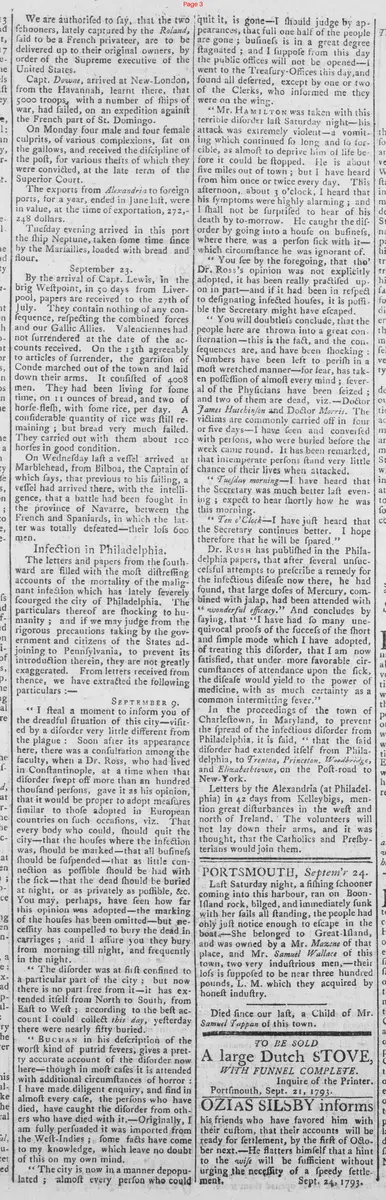
Physician Benjamin Rush was among the first to identify the illness as yellow fever. Another physician Dr. Ross, who had seen the disease take out a hundred thousand persons in Constantinople, gives his opinion as well:
That every body who could, should quit the city—that the houses where the infection was, should be marked—that all business should be suspended—that as little connection as possible should be had with the sick—that the dead should be buried at night, or as privately as possible
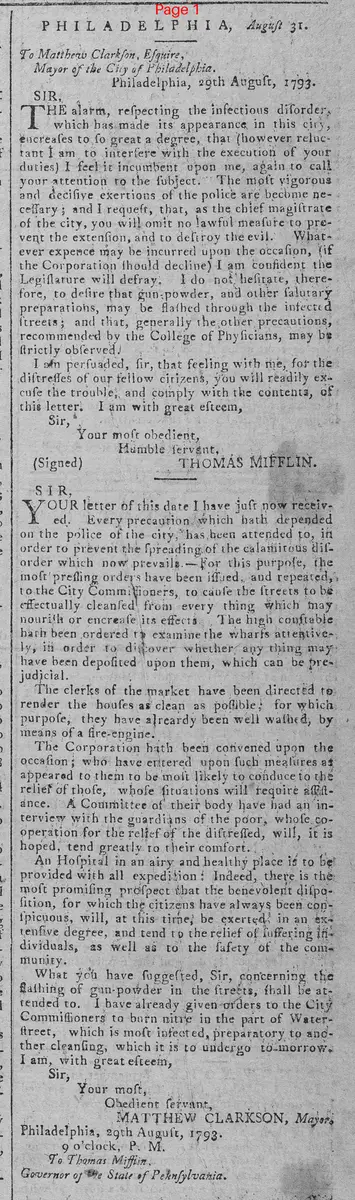
By the end of August the Governor is calling for the most vigorous police measures. In a letter to Matthew Clarkson, Mayor of the City of Philadelphia, Thomas Mifflin writes:
The most vigorous and decisive exertions of the police are become necessary; and I request, that, as the chief magistrate of the city, you will omit no lawful measure to prevent the extension, and to destroy the evil... I do not hesitate, therefore, to desire that gun-powder, and other salutary preparations, may be flashed through the infected streets
The following week we get initial reports of the suspected origin of the disease, initial death toll estimates, numbers of those who have fled...
I believe it will be difficult to determine the origin of the malignant fever, but it is generally admitted to have been imported from Cape Francois, in a vessel which came to a wharf between Arch and Race street, because the infection broke out in a house connected with that vessel, and it was afterwards traced to that vessel ... the disorder was clearly discovered to be the putrid or yellow fever, and each person became afraid of his neighbors ... fear was stamped on every countenance ... I think about 1000 have died since the disorder first made its appearance, but it cannot be ascertained with precision; and we think between 15 and 20,000 removed from their habitations.
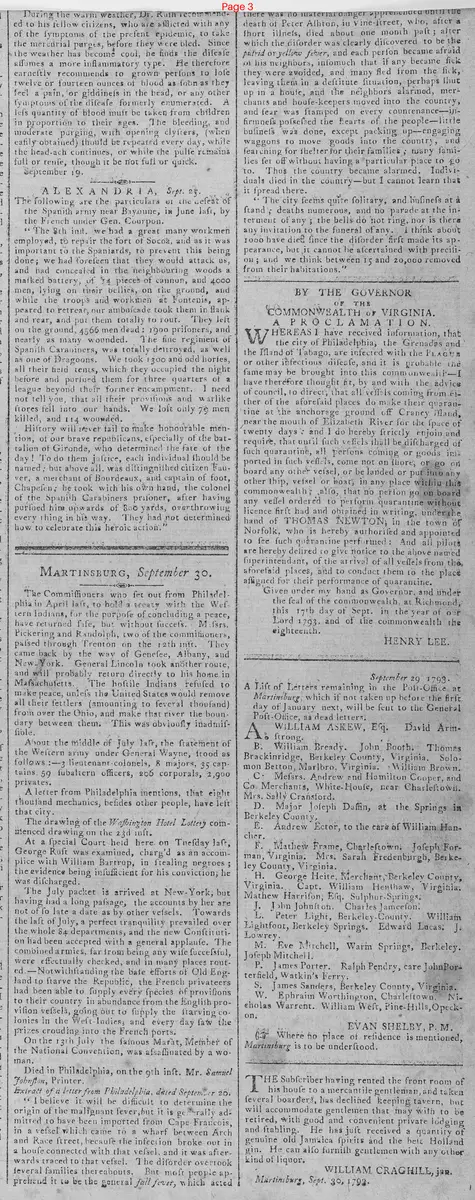
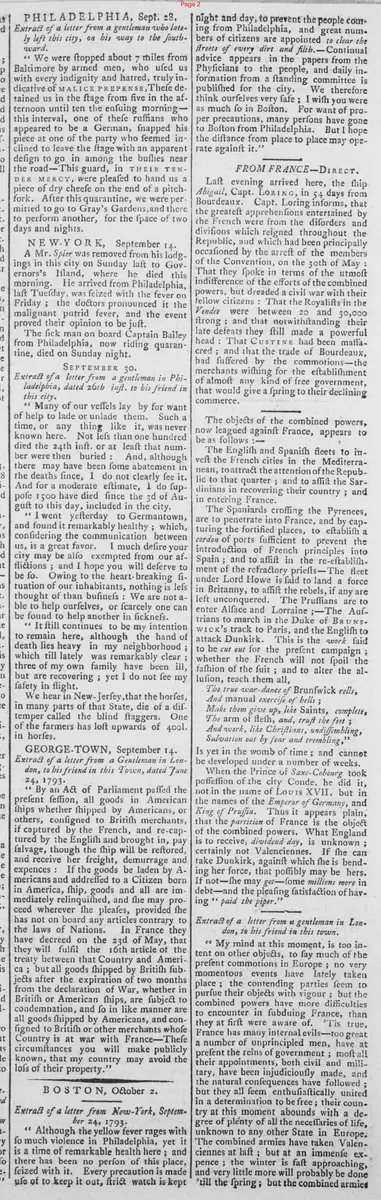
Some initial reports indicated that New York City would enact quarantines on people trying to enter, but eventually they decide to completely bar entry into the city:
Every precaution is made use of to keep it out, strict watch is kept night and day, to prevent the people coming from Philadelphia, and great numbers of citizens are appointed to clear the streets of every dirt and filth
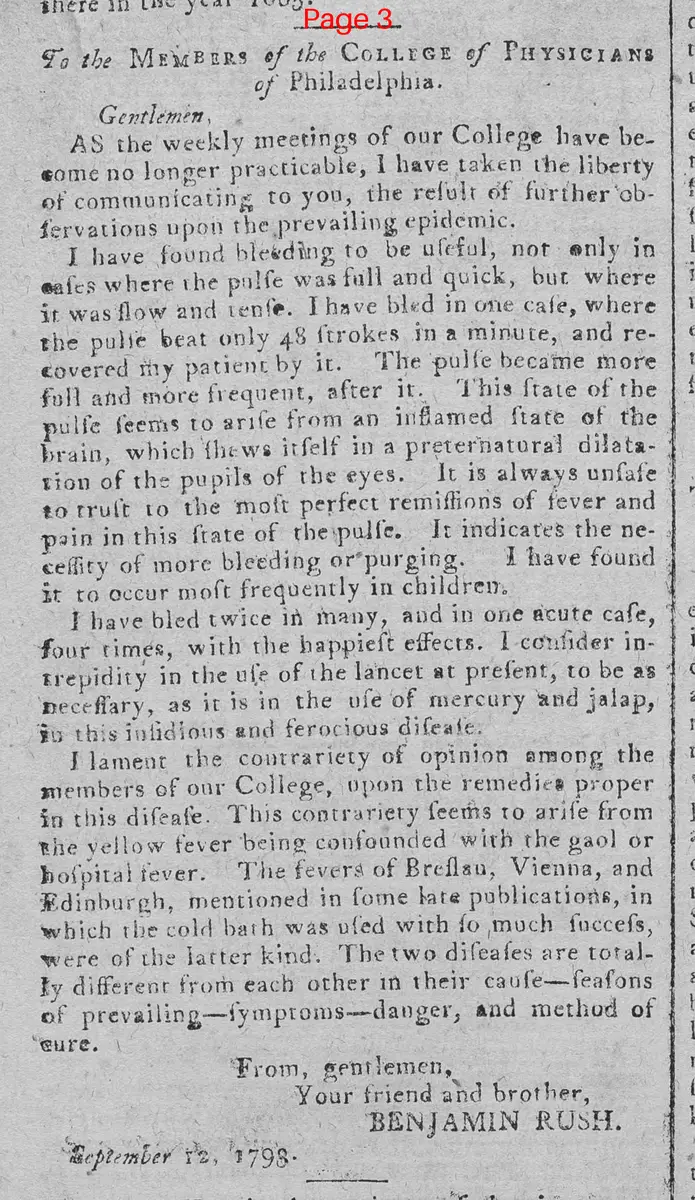
Around the same time, Dr. Rush is expounding to the gentlemen of the College of Physicians of Philadelphia, with great confidence some efficacious treatments for the disease (in addition to the mercury and jalap mentioned before), notably bleeding, even of those with barely a pulse to register, and laments the "contrariety of opinion" among other members. A quick google of "Dr. Rush's Bilious Pills" is worth it... nicknamed "Thunderbolts" or "Thunderclaps", this potent mixture of mercury and jalap were a hallmark of a time where some doctors believed that the best way to cure an illness was to aggressively empty the patient's bowels.
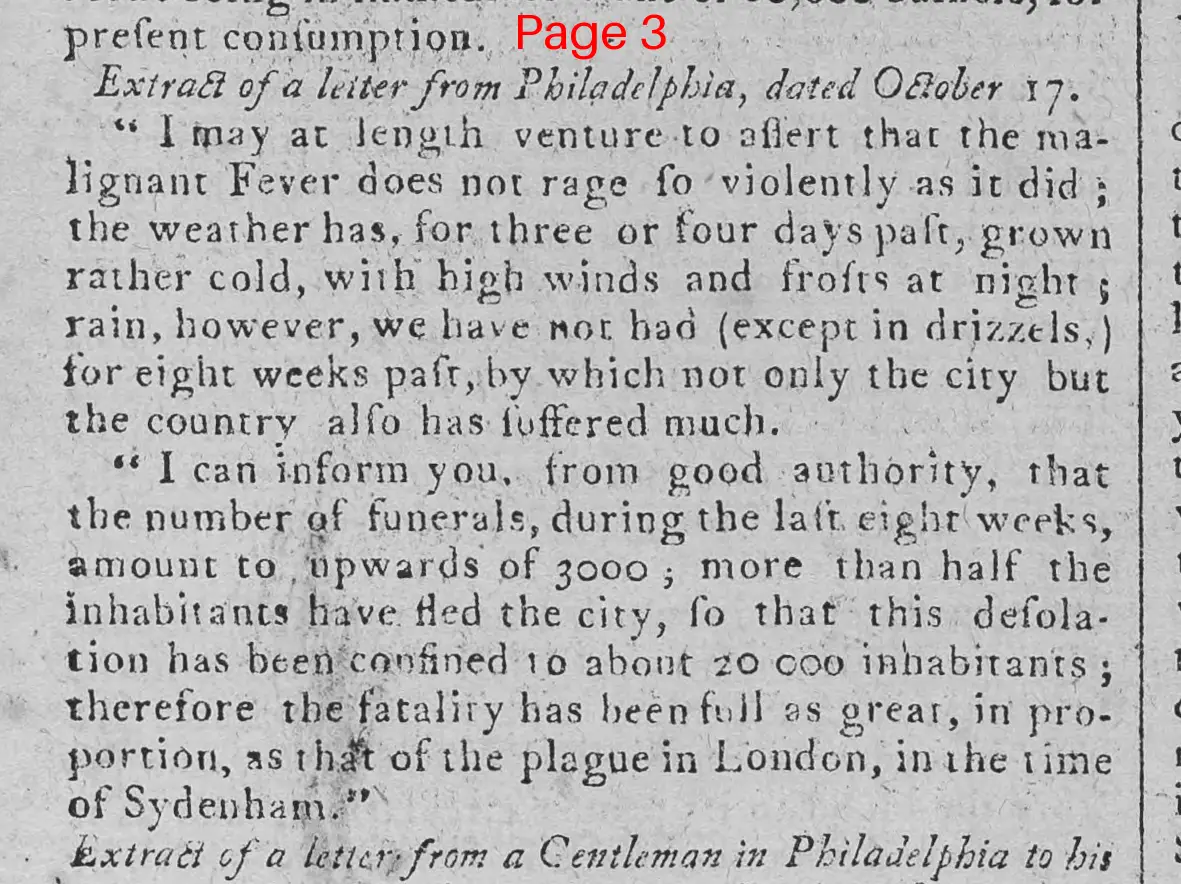
About a month later some hope is seen, and is attributed to the weather getting cooler. We also receive an update on the death tolls, roughly 15% of the people who stayed in the city have perished.
I may at length venture to assert that the malignant Fever does not rage so violently as it did: the weather has, for three or four days past, grown rather cold ... the number of funerals, during the last eight weeks, amount to upwards of 2000 [OCR error, it's 3,000]; more than half the inhabitants have fled the city, so that this desolation has been confined to about 20,000 inhabitants; therefore the fatality has been full as great, in proportion, as that of the plague in London, in the time of Sydenham
Bonus Material:
An interesting, non-medically informed opinion on the origins of the Yellow Fever
A lovely tale of Karma: A man abandons his sick wife, buys her a coffin, and ends up in it himself!
A few short anecdotes on peoples' behaviour during the epidemic
The rest is up to you dear reader!
I've only done my small deep dive of the 1793 Epidemic to whet your appetite. In all cases however, you'll find interesting parallels to the one we all lived through, Covid:
- The first instinct is flight and/or quarantine
- In many cases, under-reporting to protect trade
- The effects of quarantine versus commerce
- Miracle cures
- Defiance of closures
- Denial
How this was made
Every item here came from SNEWPapers and our AI Integration tools. We are in the process of the most accurate extraction, in terms of correct segmentation at the component level as well as accuracy of the text, of all the data from the Library of Congress' Chronicling America collection. You can track the progress on the landing page. It will take a while, but there are already millions of things for you to discover.
Sources
The SNEWPapers links below provide the full-transcription and metadata, as well as the links to the original source material at the Library of Congress and links to the PDFs of the original page(s) the story occurred on:
- The Watertown News, 1918-10-18, Wisconsin, p. 2
- The New Hampshire Gazette, 1793-09-17, New Hampshire, p. 1
- The New Hampshire Gazette, 1793-09-24, New Hampshire, p. 3
- The Patowmac Guardian, and Berkeley Advertiser, 1793-09-23, West Virginia, p. 1
- The Patowmac Guardian, and Berkeley Advertiser, 1793-09-30, West Virginia, p. 3
- The New Hampshire Gazette, 1793-10-08, New Hampshire, p. 2
- The Patowmac Guardian, and Berkeley Advertiser, 1793-09-30, West Virginia, p. 3
- The Patowmac Guardian, and Berkeley Advertiser, 1793-10-28, West Virginia, p. 3
- National Gazette, 1793-10-16, Pennsylvania, p. 1
- The New Hampshire Gazette, 1794-01-25, New Hampshire, p. 3
- The New Hampshire Gazette, 1794-05-27, New Hampshire, p. 1